

Top 10 Cryptocurrencies in 2026: Best Crypto to Buy and Watch This Year
2026/05/08 11:30:02
Introduction
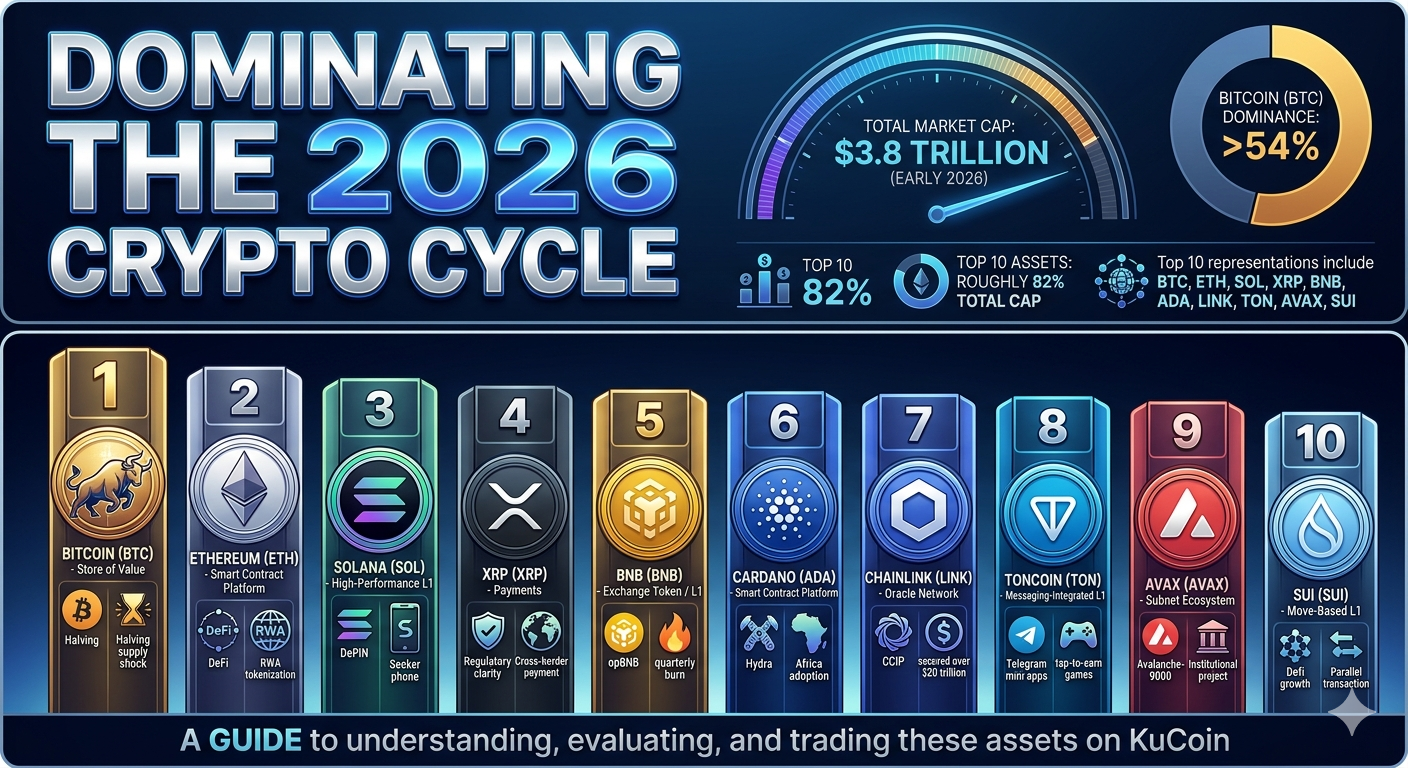
The global cryptocurrency market capitalization crossed $3.8 trillion in early 2026, according to CoinGecko data from April 2026, with Bitcoin alone accounting for over 54% of total market value. For investors asking which digital assets dominate this cycle, the answer is clear: Bitcoin (BTC), Ethereum (ETH), Solana (SOL), XRP, BNB, Cardano (ADA), Chainlink (LINK), Toncoin (TON), Avalanche (AVAX), and Sui (SUI) lead the 2026 rankings by market cap, liquidity, and ecosystem traction.
This guide breaks down each of the top 10 cryptocurrencies in 2026 — what they do, why they matter, and how they have performed entering Q2 2026. Whether you are a long-term holder or an active trader, understanding these assets is essential for building a balanced crypto portfolio in the current cycle.
What Are the Top 10 Cryptocurrencies in 2026?
The top 10 cryptocurrencies in 2026 are ranked primarily by market capitalization, with Bitcoin and Ethereum continuing to lead by wide margins. Together, the top 10 assets represent roughly 82% of the total crypto market cap, based on CoinMarketCap data from April 2026.
The list reflects a mix of established Layer-1 blockchains, payment networks, smart contract platforms, and oracle infrastructure. Notably, the 2026 ranking shows continued strength from Solana and XRP, while newer entrants like Sui have displaced legacy names that dominated in earlier cycles.
|
Rank
|
Asset
|
Symbol
|
Category
|
|
1
|
Bitcoin
|
BTC
|
Store of Value
|
|
2
|
Ethereum
|
ETH
|
Smart Contract Platform
|
|
3
|
Solana
|
SOL
|
High-Performance L1
|
|
4
|
XRP
|
XRP
|
Payments
|
|
5
|
BNB
|
BNB
|
Exchange Token / L1
|
|
6
|
Cardano
|
ADA
|
Smart Contract Platform
|
|
7
|
Chainlink
|
LINK
|
Oracle Network
|
|
8
|
Toncoin
|
TON
|
Messaging-Integrated L1
|
|
9
|
Avalanche
|
AVAX
|
Subnet Ecosystem
|
|
10
|
Sui
|
SUI
|
Move-Based L1
|
Why Is Bitcoin Still the #1 Cryptocurrency in 2026?
Bitcoin remains the #1 cryptocurrency in 2026 because of institutional adoption, fixed supply scarcity, and its role as digital gold. According to a BlackRock institutional report from March 2026, spot Bitcoin ETFs collectively held over 1.3 million BTC — more than 6% of circulating supply.
The April 2024 halving continues to reverberate through 2026 price action, with Bitcoin trading in a structurally tighter supply environment. Sovereign wealth funds and corporate treasuries have expanded BTC allocations following clearer U.S. regulatory guidance issued in late 2025.
Key 2026 Drivers for BTC
-
ETF inflows: Cumulative spot Bitcoin ETF net inflows surpassed $75 billion since January 2024, per Farside Investors data from April 2026.
-
Halving supply shock: Daily new BTC issuance remains at 450 coins post-halving.
-
Macro tailwinds: Persistent fiat debasement concerns continue driving allocation from traditional assets.
What Makes Ethereum the #2 Cryptocurrency in 2026?
Ethereum holds the #2 spot in 2026 because it powers the largest smart contract ecosystem, including the majority of stablecoins, DeFi protocols, and tokenized real-world assets. Based on DefiLlama data from April 2026, Ethereum hosts over $90 billion in total value locked (TVL) — more than all other Layer-1 blockchains combined.
Ethereum's 2025 Pectra upgrade improved validator efficiency and Layer-2 data availability, while ETH staking now secures over 35 million ETH. The asset has also benefited from spot Ethereum ETF approvals, which have attracted billions in inflows since launch.
Why ETH Matters in 2026
Ethereum is the settlement layer for tokenized treasuries, on-chain stablecoins like USDC and USDT, and the bulk of Layer-2 activity from networks like Arbitrum, Base, and Optimism. Real-world asset (RWA) tokenization on Ethereum surpassed $12 billion in early 2026, according to RWA.xyz.
Why Did Solana Stay in the Top 3 in 2026?
Solana retained its top-3 ranking in 2026 due to dominant on-chain activity, low fees, and a thriving consumer app ecosystem. According to Artemis data from April 2026, Solana processed more daily transactions than Ethereum and all major L2s combined for most of Q1 2026.
The network has become the preferred chain for memecoins, DePIN projects, and high-frequency trading applications. Solana's Firedancer validator client rollout has improved network reliability, addressing the outage concerns that plagued earlier years.
Solana Ecosystem Highlights
-
DEX volume: Solana DEXs handled over $1.2 trillion in cumulative volume by Q1 2026.
-
DePIN leadership: Networks like Helium and Render anchor a growing decentralized infrastructure sector.
-
Mobile push: The Solana Seeker phone began shipping in 2025, expanding mobile-native crypto access.
Why Has XRP Surged in the 2026 Rankings?
XRP climbed back into the top 5 in 2026 following the conclusion of its long-running SEC dispute and the launch of XRP-based ETFs. Following regulatory clarity established in late 2025, multiple asset managers filed for and received approval for spot XRP ETFs, driving renewed institutional interest.
Ripple's expansion into stablecoin issuance with RLUSD and tokenized cross-border settlement corridors has reinforced XRP's payments narrative. Banks and remittance providers in Asia, Latin America, and the Middle East continue integrating Ripple's payments infrastructure.
What Role Does BNB Play in 2026?
BNB ranks #5 in 2026 as the native asset of BNB Chain and the utility token for Binance, the world's largest crypto exchange by spot volume. BNB Chain's opBNB Layer-2 and Greenfield decentralized storage layer have expanded its utility beyond simple exchange fee discounts.
The token continues to benefit from quarterly burn mechanisms that reduce circulating supply. While regulatory pressure on Binance has eased following its 2023 settlement, BNB now faces stiffer competition from other L1s in DeFi market share.
Why Is Cardano (ADA) Still in the Top 10?
Cardano remains in the top 10 in 2026 due to its large, loyal community and methodical research-driven development. The Chang hard fork in 2024 transitioned Cardano to full on-chain governance, and the Hydra Layer-2 scaling solution has improved throughput meaningfully.
Cardano's adoption in emerging markets — particularly in Africa for identity and education projects — provides a unique narrative compared to Western-focused chains. However, ADA's DeFi TVL still trails major competitors significantly.
Why Is Chainlink (LINK) Critical Infrastructure in 2026?
Chainlink ranks in the top 10 in 2026 because it provides the dominant oracle and cross-chain infrastructure used by virtually every major DeFi protocol and a growing number of traditional financial institutions. According to Chainlink Labs data from March 2026, the network has secured over $20 trillion in cumulative transaction value.
LINK's Cross-Chain Interoperability Protocol (CCIP) has become the standard for institutional cross-chain transfers, with major banks using it for tokenized asset settlement pilots. SWIFT's continued collaboration with Chainlink on tokenization workflows reinforces LINK's institutional positioning.
Why LINK Matters for the Broader Market
If tokenization of real-world assets continues to grow as forecast — Boston Consulting Group projects $16 trillion by 2030 — Chainlink stands to capture significant value as the oracle and messaging layer connecting traditional finance to public blockchains.
What Is Toncoin (TON) and Why Is It in the Top 10?
Toncoin holds a top-10 position in 2026 thanks to its tight integration with Telegram, which has over 1 billion monthly active users as of early 2026. TON-based mini apps, payments, and games have onboarded tens of millions of new crypto users directly through the messaging app.
The TON ecosystem benefits from a unique distribution advantage no other blockchain can match. Telegram's wallet integration, USDT support on TON, and viral tap-to-earn games have driven sustained user growth, though monetization and retention remain ongoing challenges.
Why Is Avalanche (AVAX) Still Relevant in 2026?
Avalanche maintains a top-10 ranking in 2026 due to its subnet architecture, which has attracted institutional and gaming deployments. The Avalanche9000 upgrade, which went live in late 2024, dramatically reduced subnet launch costs and made AVAX more competitive with newer modular ecosystems.
Major financial institutions including JPMorgan and Citi have used Avalanche subnets for tokenized fund pilots. Gaming projects like Off The Grid have brought meaningful consumer activity to the network, though competition from Solana and emerging L1s remains intense.
Why Did Sui Break Into the Top 10 in 2026?
Sui broke into the top 10 in 2026 driven by strong DeFi growth, gaming traction, and parallel transaction execution that delivers genuinely fast user experiences. According to DefiLlama data from April 2026, Sui's TVL grew over 400% year-over-year, surpassing several legacy Layer-1s.
The Move programming language's object-centric model has attracted developers building consumer-grade applications. Sui's combination of low fees, sub-second finality, and a well-funded ecosystem foundation has made it one of the standout performers of the 2025-2026 cycle.
How Should You Build a Top 10 Crypto Portfolio in 2026?
Building a top 10 crypto portfolio in 2026 requires balancing core holdings with selective exposure to higher-beta assets. A common framework allocates 50-60% to BTC and ETH as the foundation, 20-30% to top L1s like SOL and a payments leader like XRP, and the remainder to infrastructure and emerging plays such as LINK, TON, AVAX, and SUI.
Risk management matters more than picking winners. Position sizing, dollar-cost averaging, and rebalancing quarterly help manage volatility better than chasing momentum. Investors should also consider tax implications, custody preferences, and time horizon.
Common Misconceptions to Avoid
-
"Market cap rank equals best returns": Smaller top-10 assets historically outperform during bull phases but draw down harder.
-
"Diversification means owning 50 coins": Concentration in 5-10 quality assets typically outperforms scattered exposure.
-
"Past leaders always lead": Several top-10 names from 2021 are no longer in the rankings.
How to Buy the Top 10 Cryptocurrencies on KuCoin
KuCoin offers spot and futures trading for all 10 cryptocurrencies discussed in this article, with deep liquidity, competitive fees, and over 30 million users globally. Buying any of the top 10 cryptocurrencies on KuCoin takes only a few minutes.
Steps to Get Started
-
Create an account: Sign up on kucoin.com with your email or phone number and complete identity verification.
-
Fund your account: Deposit crypto from another wallet, or buy crypto directly with credit card, bank transfer, or P2P.
-
Choose your asset: Search for BTC, ETH, SOL, XRP, BNB, ADA, LINK, TON, AVAX, or SUI on the spot or futures market.
-
Place your order: Use market orders for instant execution or limit orders to set your preferred entry price.
-
Secure your assets: Enable two-factor authentication and consider transferring long-term holdings to a hardware wallet.
New users can now register at KuCoin and Get Up to 11,000 USDT in New User Rewards.
Conclusion
The top 10 cryptocurrencies in 2026 — Bitcoin, Ethereum, Solana, XRP, BNB, Cardano, Chainlink, Toncoin, Avalanche, and Sui — represent the most liquid, established, and ecosystem-rich digital assets in the market. Bitcoin's institutional adoption, Ethereum's dominance in tokenization and DeFi, and Solana's high-performance consumer applications anchor the top of the list, while infrastructure plays like Chainlink and emerging L1s like Sui round out a diversified opportunity set.
Each of these assets offers distinct exposure to a different segment of the crypto economy, from store-of-value and payments to smart contracts, oracles, and consumer messaging integration. For investors building exposure in 2026, focusing on the top 10 provides a balance of liquidity, lower idiosyncratic risk, and meaningful upside relative to broader market exposure. Always assess your risk tolerance, investment horizon, and conduct your own research before making allocation decisions.
FAQs
Which cryptocurrency has the highest growth potential in 2026?
Sui and Solana have shown the strongest year-over-year growth among top-10 assets entering 2026, but Bitcoin offers the most asymmetric risk-reward for investors prioritizing capital preservation alongside upside. Higher-beta assets typically outperform in bull phases but carry sharper drawdown risk.
Are stablecoins included in the top 10 cryptocurrencies?
Stablecoins like USDT and USDC frequently appear in the top 10 by raw market cap, but they are typically excluded from "best crypto to buy" lists because they are pegged to fiat and do not appreciate. This article focuses on non-stablecoin assets with price discovery.
How often does the top 10 cryptocurrency list change?
The top 10 list changes meaningfully every 12-24 months, with one to three positions typically rotating each year. Bitcoin and Ethereum have held the top two spots since 2017, but the lower half of the top 10 sees frequent turnover as narratives and ecosystems evolve.
Is it better to buy one top cryptocurrency or diversify across all 10?
Diversifying across 5-10 top cryptocurrencies generally reduces single-asset risk while maintaining meaningful upside. Concentrated bets on Bitcoin or Ethereum offer lower volatility, while broader baskets capture upside from rotating narratives but require more active management.
What is the safest way to store top 10 cryptocurrencies?
Hardware wallets such as Ledger or Trezor offer the highest security for long-term holdings, while reputable centralized exchanges like KuCoin provide convenience for active trading. A common practice is keeping trading capital on exchange and moving long-term holdings to cold storage.