

The 42.5% Dominance: What the US Concentration Means for Bitcoin's Censorship Resistance
2026/06/14 12:00:00
Bitcoin's Authoritarian Perspective
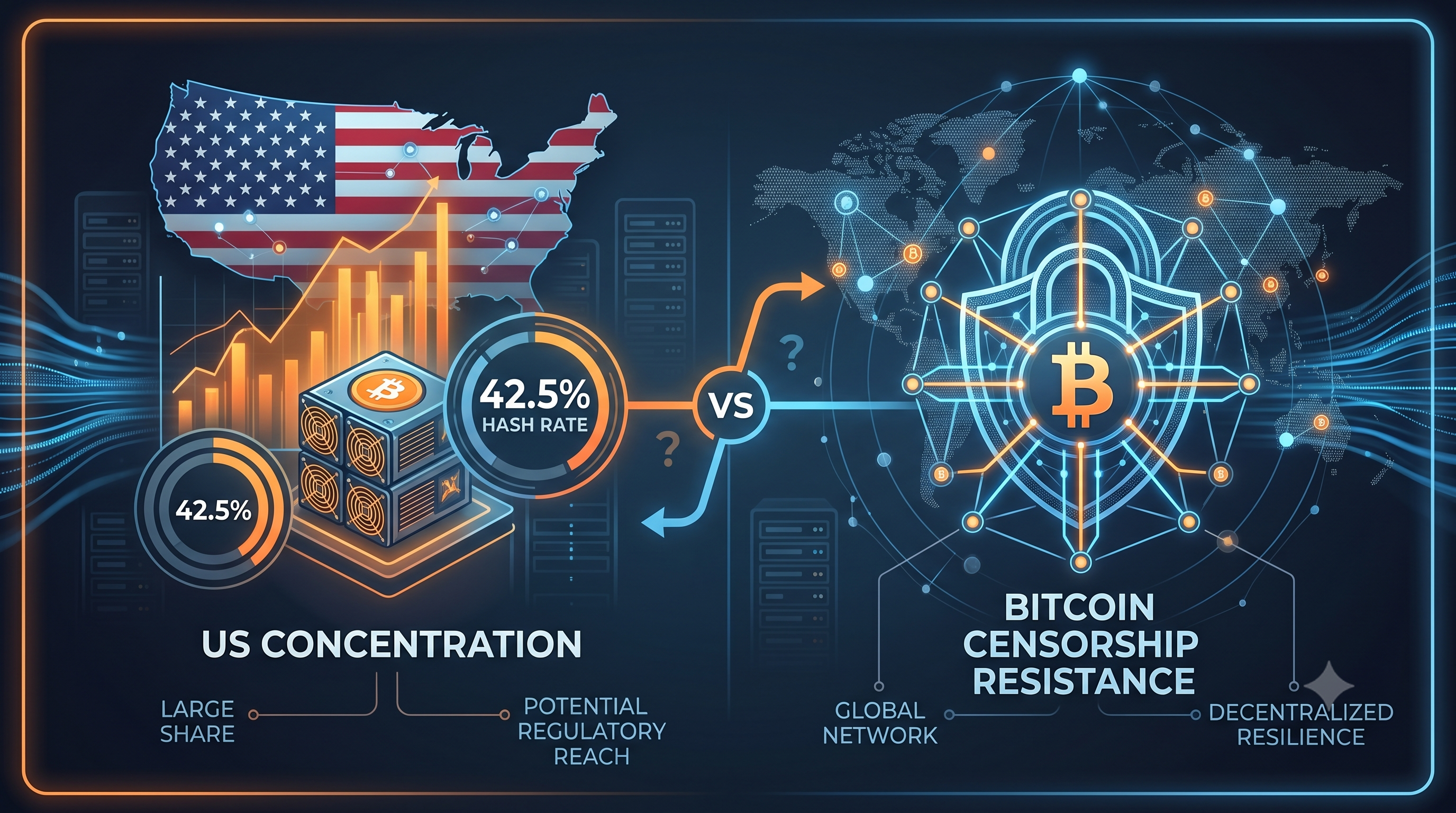
Bitcoin was designed to function without a central authority. Its security model relies on a globally distributed network of miners competing to validate transactions and produce blocks. For more than a decade, the network has demonstrated remarkable resilience against government pressure, infrastructure disruptions, and market shocks. Yet the geographic distribution of mining power remains a recurring concern because the concentration of hashrate in any single jurisdiction can create potential points of influence over transaction processing and network governance. Industry data suggest that the United States remains the dominant force in Bitcoin mining. Publicly listed U.S. miners alone accounted for approximately 31.5% of the global network hashrate in June 2025, according to a JPMorgan analysis, while broader estimates that include private operators place the country's total influence substantially higher. At the pool level, U.S.-based Foundry USA has consistently remained the largest mining pool in the world, frequently controlling roughly one-third of the global Bitcoin hashrate.
This concentration has fueled a renewed debate about Bitcoin's censorship resistance. If a large percentage of miners operate within a single legal jurisdiction, could regulators influence transaction selection? Could mining pools become chokepoints for censorship? Or does Bitcoin's architecture contain enough safeguards to prevent geographic concentration from becoming a systemic threat? The answers are more nuanced than either critics or supporters often acknowledge. Bitcoin's security depends not only on where miners operate but also on who controls block construction, how mining pools function, and whether technological upgrades can reduce the influence of centralized intermediaries. Understanding the implications of U.S. dominance requires examining all of these factors together.
Why Geographic Concentration Matters Less Than Block Production Control
The most common argument surrounding mining concentration focuses on geography. The assumption is straightforward: if a large percentage of Bitcoin's hashrate exists within one country, that country gains disproportionate influence over the network. While geographic concentration deserves attention, it is not necessarily the most important metric when evaluating censorship resistance. Bitcoin's consensus mechanism grants influence to miners only when they successfully produce blocks. The critical question is therefore not simply where mining machines are located but who ultimately decides which transactions enter those blocks. In modern Bitcoin mining, most operators participate through mining pools rather than mining independently. Pools aggregate hashrate from thousands of participants worldwide, smoothing revenue and reducing variance for individual miners. This distinction significantly changes the discussion of censorship. A mining facility located in Texas may contribute hashrate to a pool headquartered elsewhere, while a miner operating in South America could contribute to a U.S.-based pool. Consequently, the location of physical hardware does not automatically determine control over transaction inclusion. What matters more is the entity responsible for constructing block templates and selecting transactions.
Historically, mining pools have exercised substantial authority over transaction selection. This arrangement created concerns that large pools could become censorship points if pressured by regulators or commercial interests. Researchers and industry participants have increasingly focused on pool concentration rather than raw geographic concentration for this reason. Several analyses indicate that a relatively small number of major pools collectively account for the majority of Bitcoin block production, making pool governance a critical factor in network decentralization. As a result, evaluating Bitcoin's censorship resistance requires looking beyond maps and mining facilities. The architecture of mining pools, the incentives governing miner behavior, and the technologies that distribute transaction-selection authority may ultimately matter more than the percentage of hashrate physically located within U.S. borders.
The Pool Layer Has Become Bitcoin’s Most Important Decentralization Battleground
The debate surrounding Bitcoin censorship resistance has increasingly shifted from geography to mining pool concentration. While headlines often focus on the percentage of hashrate located in the United States, the more consequential issue is that a relatively small number of mining pools are responsible for producing most Bitcoin blocks. This distinction matters because mining pools, not individual miners, typically determine which transactions are included in candidate blocks. Foundry USA illustrates this dynamic. The pool has maintained its position as the world's largest Bitcoin mining pool throughout 2025 and 2026, frequently accounting for roughly 30% to 37% of total network hashrate, depending on the measurement period and methodology. Data compiled by Hashrate Index, Spark, and other industry trackers consistently place Foundry well ahead of competitors such as AntPool, F2Pool, and ViaBTC. Concentration becomes more significant when viewed collectively. The top few mining pools regularly control a majority of Bitcoin's block production.
Foundry and AntPool alone often approach or exceed 50% of observed block production during certain periods, while the top five pools collectively account for roughly three-quarters of global hashrate. This reality creates understandable concerns among decentralization advocates because transaction censorship, if it were ever attempted, it would likely emerge through pool-level policies rather than direct government control of individual mining facilities. Yet pool concentration should not automatically be interpreted as centralized ownership. Mining pools aggregate computational power from thousands of independent participants spread across multiple countries and legal jurisdictions. If a pool operator attempted sustained censorship or behavior perceived as harmful to Bitcoin's neutrality, miners could redirect their hashrate elsewhere. This mobility acts as a market-based constraint on pool power. Research into mining economics has repeatedly shown that pools depend on miner participation, meaning their dominance is ultimately conditional rather than permanent. The resulting picture is complex. Pool concentration introduces potential risks, but Bitcoin's competitive mining environment continues to provide mechanisms that can counterbalance excessive influence before it grows into systemic control.
The China Mining Ban Demonstrated Bitcoin’s Ability to Survive Extreme Concentration Shocks
One of the strongest arguments against fears of permanent geographic concentration comes from Bitcoin's own history. In 2021, China effectively eliminated industrial-scale Bitcoin mining within its borders, removing what was then the world's largest mining jurisdiction almost overnight. The event caused one of the most dramatic disruptions in the network's history and offered a real-world test of Bitcoin's censorship resistance under extreme conditions. Before the ban, estimates frequently placed China's share of global Bitcoin mining above 50%, with some analyses suggesting substantially higher figures during certain periods. Critics argued that such concentration represented a long-term threat to Bitcoin's decentralization. When Chinese authorities forced miners offline, global hashrate plunged sharply, block production slowed, and concerns emerged about network security. Yet the anticipated collapse never occurred. Instead, Bitcoin's economic incentives triggered a rapid redistribution of mining activity. Equipment migrated to the United States, Canada, Kazakhstan, Latin America, and several emerging mining hubs. Within months, the network hashrate began to recover. Difficulty adjustments automatically compensated for the temporary reduction in computing power, ensuring that block production eventually returned to normal levels without requiring intervention from any central authority.
The significance of this episode extends beyond simple resilience. It demonstrated that mining infrastructure, while capital-intensive, remains geographically mobile. Jurisdictions can influence where miners operate, but they cannot easily dictate where global mining activity ultimately settles. The migration also accelerated investment in North American mining infrastructure, helping change the United States into the largest single mining jurisdiction today. For the censorship-resistance debate, the lesson is important. Concentration should be monitored because it can create vulnerabilities. However, Bitcoin's history suggests that mining concentration is not necessarily permanent. Economic incentives, regulatory changes, energy-market dynamics, and competitive pressures continuously reshape the distribution of hashrate. The network's survival after the China ban remains one of the strongest pieces of evidence that Bitcoin's decentralization mechanisms can adapt even when a dominant jurisdiction suddenly disappears.
How Transaction Censorship Would Actually Occur on Bitcoin
Concerns about censorship resistance often become abstract, making it difficult to evaluate the actual risks posed by mining concentration. In practice, Bitcoin transaction censorship would require specific actions by block producers. A miner or mining pool attempting censorship would exclude selected transactions from the candidate blocks it creates, preventing those transactions from being confirmed through that particular source of hashrate. The strategy could target addresses associated with sanctioned entities, privacy tools, political organizations, or any category designated by the censoring party. The key limitation is that Bitcoin operates as an open, competitive system rather than a centralized payment network. A censored transaction does not disappear simply because one pool rejects it. The transaction remains in the mempool, waiting for inclusion by another miner. As long as a meaningful portion of the network hashrate remains willing to process the transaction, censorship attempts become delays rather than permanent prohibitions. Researchers have long noted that effective censorship requires sustained coordination among a large share of block producers, significantly raising the economic and operational costs of enforcement.
Data from mining pool distribution trackers show that Bitcoin's hashrate remains spread across numerous major pools despite concentration concerns. This fragmentation creates a practical obstacle for any coordinated censorship campaign because participation from multiple large pools would be required to consistently prevent confirmation. According to industry analyses compiled by Hashrate Index and other monitoring services, even dominant pools face competitive pressure from rival operators and independent miners that can choose alternative policies. Economic incentives further complicate censorship efforts. Miners earn revenue by maximizing transaction fees and block rewards. Excluding high-fee transactions reduces potential earnings, creating a direct financial cost for censorship. During periods of elevated network activity, transaction fees can account for a meaningful share of miner revenue, increasing the opportunity cost of selective filtering. The result is a system where censorship remains theoretically possible but economically expensive unless supported by broad industry coordination. Bitcoin's architecture does not eliminate censorship risk entirely, but it forces would-be censors to overcome powerful competitive incentives that encourage transaction neutrality.
Stratum V2 Could Reduce the Influence of Large Mining Pools
Among the technological developments shaping Bitcoin's decentralization debate, few are as significant as Stratum V2. The protocol was designed to address one of the most important structural issues in modern mining: the concentration of block-construction authority within mining pools. Under the dominant Stratum V1 system, pool operators typically create block templates and distribute work assignments to participating miners. This arrangement gives pools substantial influence over transaction selection, even when the underlying hashrate belongs to thousands of independent operators. Stratum V2 introduces a feature known as Job Negotiation, which allows individual miners to construct their own block templates rather than relying exclusively on pool operators. This seemingly technical change has major implications for censorship resistance. If miners gain greater control over transaction inclusion, the ability of pool operators to enforce network-wide filtering policies becomes substantially weaker. The shift effectively separates hashrate aggregation from transaction-selection authority, reducing one of the most commonly cited centralization concerns within Bitcoin mining. Development efforts led by organizations, including Braiins and contributors from across the Bitcoin ecosystem, have continued advancing Stratum V2 adoption.
Technical documentation published by the project describes improved security, encrypted communications, greater efficiency, and enhanced miner autonomy as key benefits. While adoption remains gradual, many industry observers view the protocol as one of the most promising long-term tools for strengthening decentralization without requiring changes to Bitcoin's core consensus rules. The broader significance extends beyond mining pools themselves. Bitcoin's resilience has historically depended on aligning economic incentives with decentralization goals. Stratum V2 follows that tradition by allowing miners to retain the financial advantages of pooled mining while reclaiming influence over block construction. If adoption accelerates over the coming years, discussions about pool concentration may become less alarming because the entities controlling hashrate would increasingly be the same entities controlling transaction selection. Rather than relying solely on geographic diversification, Bitcoin could strengthen censorship resistance through architectural improvements that distribute decision-making power more effectively across the mining ecosystem. In that sense, Stratum V2 represents not merely a mining upgrade but a strategic evolution in Bitcoin's decentralization model.
Publicly Listed U.S. Miners Are Reshaping the Industry’s Power Structure
The rise of publicly traded Bitcoin mining companies represents one of the most important developments in the post-China mining era. Firms such as MARA Holdings, Riot Platforms, CleanSpark, and Core Scientific have expanded aggressively, investing billions of dollars in infrastructure, energy agreements, and next-generation mining equipment. Their growth has contributed significantly to the increasing concentration of Bitcoin hashrate within the United States. According to a June 2025 JPMorgan analysis, publicly listed U.S. miners collectively accounted for approximately 31.5% of the global Bitcoin network hashrate, representing a record level of influence for the sector. The figure reflects years of capital investment supported by public equity markets, debt financing, and strategic partnerships with energy providers. Public miners possess advantages that many smaller operators lack, including easier access to funding, institutional relationships, and large-scale procurement agreements for mining hardware. These strengths have enabled rapid expansion even during periods of industry volatility.
The growing role of public companies has generated mixed reactions within the Bitcoin community. Supporters argue that transparent reporting requirements, audited financial statements, and corporate governance standards improve accountability compared with opaque private operations. Public miners also contribute to infrastructure development, grid stabilization programs, and renewable energy investments that strengthen the industry's long-term sustainability. Critics focus on a different concern. Public corporations operate within highly regulated environments and maintain visible management teams, legal entities, and physical facilities. These characteristics potentially make them more susceptible to regulatory pressure than smaller or geographically dispersed mining operations. If transaction filtering requirements were ever imposed on large industrial miners, publicly traded companies would likely face stronger incentives to comply than anonymous independent operators. This tension illustrates a broader reality: institutionalization can enhance transparency while simultaneously introducing new forms of concentration risk. The expansion of public miners has unquestionably strengthened Bitcoin's industrial base, but it has also transformed the censorship-resistance discussion from a purely technical debate into one that increasingly intersects with corporate governance and capital markets.
Independent Miners Continue to Play a Critical Defensive Role
Despite the industry's increasing industrialization, independent miners remain an essential component of Bitcoin's censorship resistance. Their influence cannot be measured solely through hashrate percentages because their value lies in preserving diversity within the mining ecosystem. Every independent operator represents a separate decision-maker capable of choosing mining pools, selecting software implementations, and responding to network incentives independently. Historically, Bitcoin mining began as a highly decentralized activity performed by individuals using personal computers. Economic competition gradually favored specialized hardware and industrial-scale operations, leading to the emergence of today's large mining facilities. While this transition improved network security by increasing total computational power, it also reduced the relative share of small-scale participants. Even so, independent miners have not disappeared. Thousands continue to contribute hashrate through pools, home mining setups, small commercial facilities, and niche energy arrangements across multiple jurisdictions.
The significance of these participants becomes particularly clear during periods of controversy or policy change. Mining pools ultimately depend on miners choosing to connect their machines. If a pool adopts policies perceived as harmful to Bitcoin's neutrality, independent operators can redirect their hashrate elsewhere. This ability to switch pools creates a market-based check on centralized decision-making. Industry analysts frequently note that mining pool leadership can change surprisingly quickly when miners perceive better economic or ideological alternatives. Emerging technologies may further strengthen the position of independent miners. Stratum V2, decentralized pool architectures and improvements in home-mining hardware all seek to reduce barriers to participation while increasing miner autonomy. Although these developments are unlikely to reverse the broader trend toward industrial-scale mining, they can help distribute control more widely across the ecosystem. Bitcoin's censorship resistance ultimately depends on more than raw hashrate distribution. It relies on maintaining a sufficiently diverse set of actors capable of making independent decisions. Large mining companies contribute security and investment, but independent miners continue to provide something equally valuable: decentralization through diversity. Their presence ensures that Bitcoin's future is shaped by a broad network of participants rather than a small collection of dominant institutions.
The Nakamoto Coefficient Offers a More Useful Lens Than Geography Alone
Discussions about Bitcoin's decentralization frequently rely on simple geographic statistics, such as the percentage of global hashrate located within a particular country. While these figures are useful, they often fail to capture the more important question: how many independent entities would need to coordinate to significantly influence the network? This is where the concept of the Nakamoto Coefficient becomes particularly valuable. Named after Bitcoin creator Satoshi Nakamoto, the Nakamoto Coefficient measures the minimum number of independent actors required to disrupt or control a system. In Bitcoin's case, researchers often examine mining pools, mining companies, or other infrastructure providers when estimating this figure. A higher coefficient generally indicates stronger decentralization because influence is distributed among a larger number of participants. Applying this framework to Bitcoin reveals why the often-cited 42.5% U.S. mining concentration does not automatically translate into effective control. Even if a significant share of hashrate is physically located within the United States, that hashrate remains distributed across numerous companies, facilities, investors, energy providers, and mining pools.
Coordination among all these entities would be extraordinarily difficult, particularly given their competing commercial interests. Public miners answer to shareholders, private operators pursue independent strategies, and mining pools compete aggressively for market share. The distinction becomes even more important when considering transaction censorship. Geographic concentration alone does not grant a government or institution direct authority over Bitcoin block production. Influence would require cooperation from multiple independent actors that may have little incentive to participate in coordinated filtering efforts. Bitcoin's design intentionally creates economic competition between miners, making large-scale coordination expensive and difficult to sustain over long periods. Researchers studying decentralized systems increasingly argue that control metrics should focus on decision-making power rather than physical location. By that standard, Bitcoin remains significantly more decentralized than many critics suggest. The network certainly faces concentration risks, but assessing those risks requires understanding who controls block production, who controls mining infrastructure, and how easily participants can exit arrangements they no longer support.
Energy Markets Are Becoming a Hidden Driver of Mining Distribution
Bitcoin mining discussions often focus on regulation, technology, and decentralization, yet energy economics may be the most powerful force shaping future hashrate distribution. Mining is fundamentally an energy-intensive business. As block rewards become increasingly competitive, access to affordable electricity frequently determines which operators survive and which are forced to shut down. The United States gained substantial mining market share after China's 2021 ban, partly because of its diverse energy landscape. Regions across Texas, North Dakota, Wyoming, and other states offered access to relatively low-cost power, supportive infrastructure, and favorable business environments. Publicly traded miners invested heavily in these locations, creating large-scale operations capable of competing globally. However, energy markets are constantly evolving. Countries in Latin America, the Middle East, Africa, and parts of Asia are increasingly exploring opportunities to monetize stranded, underutilized, or excess energy resources through Bitcoin mining. Hydroelectric power in South America, natural gas projects in Africa, and renewable energy developments in several emerging markets have begun attracting mining investment. According to industry reports from organizations such as the Cambridge Centre for Alternative Finance, mining activity continues to diversify as operators seek lower costs and improved profitability.
This dynamic has important implications for censorship resistance. Energy competition naturally encourages geographic diversification because miners continuously search for the most efficient operating environments. High energy costs, grid constraints, or regulatory uncertainty can rapidly reduce a region's attractiveness, prompting capital and equipment to relocate elsewhere. The process resembles the post-China migration, albeit on a slower and more gradual scale. As a result, today's concentration figures may not accurately predict tomorrow's mining landscape. Bitcoin mining remains one of the most mobile industries in the digital economy. Facilities require substantial investment, but mining machines themselves can often be transported and redeployed when economic conditions change. This mobility acts as a decentralizing force that continuously pressures the industry to seek new jurisdictions and energy sources. Rather than viewing mining concentration as a fixed condition, it may be more accurate to see it as a constantly evolving outcome of global energy competition. That perspective helps explain why Bitcoin's hashrate distribution has repeatedly changed throughout its history and why further shifts are likely in the years ahead.
Bitcoin’s Censorship Resistance Depends on Incentives More Than Intentions
Many discussions about censorship resistance focus on the intentions of governments, mining companies, or mining pools. While intentions matter, Bitcoin's security model is ultimately built around incentives. The network assumes that participants may act in their own interests and seeks to align those interests with honest behavior. This incentive-driven approach explains why Bitcoin has remained operational despite enormous changes in its mining landscape. Over the years, mining has shifted from hobbyist CPUs to GPUs, from GPUs to ASICs, from home setups to industrial facilities, and from Chinese dominance to North American leadership. Throughout these transitions, the network continued functioning because participants were incentivized to maximize revenue rather than undermine the system supporting that revenue. Transaction censorship presents a useful example. A miner that excludes profitable transactions sacrifices potential fee income. A mining pool that adopts controversial policies risks losing participants to competitors. A jurisdiction that creates an unfavorable environment may encourage miners to relocate elsewhere.
In each case, economic incentives act as a counterweight against behavior that could weaken network utility or profitability. This does not mean incentives eliminate all risks. Coordinated action among sufficiently powerful actors could still create disruptions, particularly if political or regulatory objectives outweigh economic considerations. However, Bitcoin's design ensures that such efforts carry meaningful costs and face resistance from competing market participants. The importance of incentives is often overlooked when analyzing concentration statistics. A figure such as 42.5% U.S. dominance may appear alarming in isolation, but the practical implications depend on whether the actors involved share common objectives and possess mechanisms for sustained coordination. In reality, the Bitcoin mining industry remains highly competitive. Companies compete for capital, energy contracts, hardware procurement, and market share. Mining pools compete for participants. Investors seek returns rather than centralized control. This competitive environment helps preserve Bitcoin's neutrality. The network does not rely on trusting any individual miner, company, or jurisdiction. Instead, it relies on the expectation that diverse participants pursuing their own interests will collectively reinforce the integrity of the system.
The Real Question Is Whether Concentration Continues to Increase
Perhaps the most important takeaway from the current debate is that concentration itself is not a binary condition. Bitcoin has never existed in a state of perfect decentralization, nor has it ever been completely centralized. The network operates along a spectrum, with various forces continuously pushing toward concentration or dispersion. Viewed through this lens, the most relevant question is not whether the United States currently accounts for roughly 42.5% of global mining activity. The more significant issue is whether concentration trends continue moving in that direction or begin reversing over time. If mining, pool control, and block-construction authority become increasingly concentrated within a shrinking number of entities, censorship concerns will naturally grow more serious. If diversification continues across jurisdictions, pools, and technologies, the risks become more manageable. Several developments suggest that the future remains open rather than predetermined. Geographic diversification continues as miners explore new energy markets. Stratum V2 offers a pathway toward distributing block-construction authority. Independent miners retain the ability to change pools when incentives shift. Competition among large mining firms prevents any single company from establishing overwhelming dominance.
At the same time, concentration pressures remain real. Public miners continue expanding. Pool market share remains heavily skewed toward a handful of operators. Institutional capital increasingly shapes industry development. These trends deserve close monitoring because censorship resistance depends on maintaining meaningful competition and diversity across the ecosystem. Bitcoin's history provides reasons for cautious optimism. The network has repeatedly adapted to major structural changes, including dramatic shifts in mining geography, hardware technology, and industry organization. Each challenge has revealed vulnerabilities while also demonstrating the system's capacity for self-correction. For investors, researchers, and policymakers, the lesson is clear: concentration metrics should be viewed as indicators rather than verdicts. They show areas requiring attention, but they do not by themselves determine whether Bitcoin remains censorship-resistant. The answer depends on how technology, incentives, competition, and market dynamics evolve in the years ahead.
Bitcoin’s Resilience Suggests the Network Is Stronger Than a Single Statistic
The headline figure of 42.5% U.S. mining concentration naturally attracts attention because it appears to challenge one of Bitcoin's most important promises: resistance to censorship and centralized control. Yet a closer examination of the network reveals a more complicated reality. Geographic concentration is a meaningful metric, but it is only one component of a much larger decentralization framework that includes mining pools, block-construction authority, economic incentives, hardware ownership, energy markets, and technological innovation. The evidence suggests that Bitcoin's censorship resistance cannot be accurately measured by location data alone. The network has already survived events that many observers once believed would threaten its existence, including the collapse of the dominant Chinese mining sector in 2021. It has adapted to shifts in hardware production, changes in mining economics, regulatory pressure, and repeated cycles of industry consolidation. Each period of concentration has generated legitimate concerns, yet each has also produced countervailing forces that redistributed influence across the ecosystem.
Current risks should not be dismissed. Large mining pools continue to control substantial portions of block production. Publicly traded miners have accumulated unprecedented levels of infrastructure and capital. Regulatory pressure remains a possibility in major jurisdictions. These developments deserve scrutiny because decentralization requires continuous maintenance rather than passive observation. At the same time, Bitcoin possesses structural defenses that remain highly relevant. Miners can change pools. Equipment can move across borders. Competitive incentives discourage coordinated censorship. Emerging technologies such as Stratum V2 seek to return greater transaction-selection authority to individual miners. Global energy markets continue to create new opportunities for geographic diversification. Together, these factors help prevent concentration from automatically becoming control.
FAQs
Why is Bitcoin mining concentration considered a potential threat to censorship resistance?
Bitcoin's censorship resistance depends on no single entity having sufficient influence to consistently prevent transactions from being confirmed. When a large percentage of mining power becomes concentrated within a specific country, company, or mining pool, concerns emerge that external pressure could influence transaction selection. The risk is not necessarily that censorship would occur immediately, but that fewer independent actors would need to coordinate to implement it. The greater the concentration, the more important it becomes to evaluate who controls block production and whether alternative participants can effectively counterbalance that influence.
Does the United States control Bitcoin because it hosts a large share of global mining activity?
No. Hosting a significant share of mining activity is not the same as controlling Bitcoin. Mining operations within the United States are owned by numerous independent companies, investors, and operators with competing interests. Bitcoin's consensus mechanism does not grant authority based solely on geography. Effective control would require sustained coordination among multiple actors that may have little incentive to cooperate. Geographic concentration can increase certain risks, but it does not automatically translate into network control.
Why are mining pools often viewed as more important than mining locations?
Mining pools generally determine which transactions are included in candidate blocks. Because most miners participate through pools, the entity constructing the block template often has more influence over transaction selection than the physical location of mining hardware. This is why many researchers focus on pool concentration when evaluating censorship risks. A geographically distributed network can still face challenges if block-production authority becomes concentrated among a small number of pool operators.
How would Bitcoin respond if a major mining pool attempted transaction censorship?
A mining pool can refuse to include specific transactions in blocks it produces, but those transactions remain visible to the broader network. Competing pools and independent miners can still confirm them. Sustained censorship would generally require participation from a significant share of the total network hashrate. If a pool adopted unpopular censorship policies, miners could redirect their equipment to alternative pools, potentially reducing the censoring pool's influence over time.
What role does Stratum V2 play in strengthening decentralization?
Stratum V2 is a mining protocol designed to give miners greater control over block construction. Under the traditional mining model, pool operators often decide which transactions enter candidate blocks. Stratum V2 allows miners to participate more directly in transaction selection through job negotiation features. Supporters believe this can reduce the influence of large pool operators and improve Bitcoin's censorship resistance without changing the network's consensus rules.
Is the 42.5% U.S. mining share ultimately a serious problem for Bitcoin?
The statistic deserves attention, but it should not be viewed in isolation. A high concentration level can increase certain risks, particularly if mining pools, public companies, or regulators gain greater influence over transaction processing. However, Bitcoin's resilience depends on a broader set of factors that include competition among miners, pool mobility, technological improvements, and global energy dynamics. The more important question is whether concentration continues increasing unchecked or whether decentralizing forces remain strong enough to preserve a diverse and competitive mining ecosystem.
Disclaimer: This content is for informational purposes only and does not constitute investment advice. Cryptocurrency investments carry risk. Please do your own research (DYOR).