

Ripple RLUSD Gains Major Cross-Chain Boost: Squid Integration Enables Seamless Swaps Across XRPL, Ethereum & L2s
2026/06/18 11:49:00
Ripple’s RLUSD Goes Multi-Chain
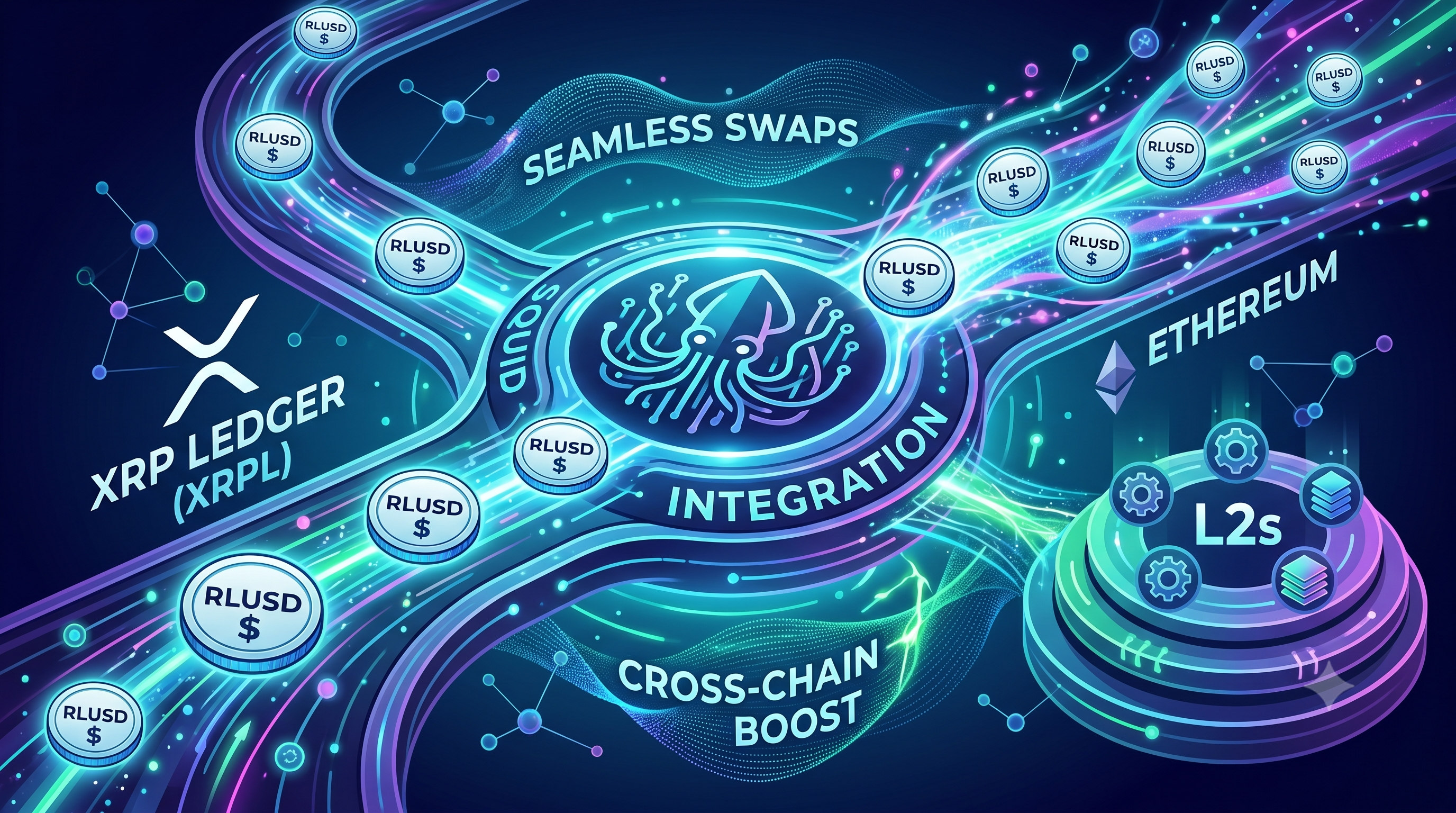
Ripple’s RLUSD stablecoin has achieved a notable advancement in usability and multi-chain accessibility through its integration with Squid, a prominent cross-chain routing platform. Announced around June 16, 2026, this development permits users and developers to execute seamless swaps and transfers of RLUSD between the XRP Ledger (XRPL), Ethereum, and various Ethereum Layer 2 solutions such as Base and Optimism, bypassing traditional bridging complexities. As stablecoins increasingly underpin liquidity and real-world applications across blockchain networks, this enhancement elevates RLUSD’s versatility for payments, decentralized finance, and institutional treasury management.
The move extends RLUSD’s native presence on XRPL and Ethereum, complemented by prior Wormhole-enabled expansions to L2s, fostering greater capital efficiency and ecosystem connectivity. Leveraging Squid’s intent-based routing across more than 100 blockchains, RLUSD significantly improves interoperability, minimizes operational friction in multi-chain environments, and solidifies its position in regulated payments, DeFi protocols, and treasury operations, mirroring the industry’s move toward unified blockchain infrastructure.
Squid’s Routing Layer Transforms RLUSD Accessibility Across Ecosystems
Squid has incorporated RLUSD as a supported asset in its cross-chain framework, facilitating direct swaps from prominent stablecoins, including USDC and USDT, alongside XRP, ETH, and thousands of additional tokens, all within a single transaction. This capability removes the need for manual bridging processes that historically complicated movements between XRPL and Ethereum-based environments. Per Squid’s official announcement on June 16, 2026, the platform now functions as the dedicated cross-chain swap and transfer layer for RLUSD, supporting efficient execution across XRPL, Ethereum, Base, Optimism, and numerous other networks. Participants access these features via Squid’s user interface at app.squidrouter.com or through its comprehensive API and SDK offerings tailored for dApp developers.
The system utilizes Squid Intents to aggregate optimal routes from diverse on-chain and off-chain liquidity pools, achieving competitive fees and dependable performance. Within the XRPL domain, this enables smoother capital inflows to protocols like Strobe for lending activities, Girin for Visa-linked real-world payments, and Risepad for streamlined token launches. As of mid-June 2026, RLUSD’s market capitalization reached approximately $1.64 billion, with circulating supply surpassing 1.63 billion tokens, highlighting its substantial expansion since its late 2024 debut.
This integration aligns precisely with RLUSD’s architecture as a fully reserved, regulated USD stablecoin offering 1:1 redeemability, supported by segregated holdings of cash and cash equivalents under institutional oversight. Ripple’s Stablecoin Product Lead Lauren Berta has underscored the critical need for frictionless movement across vibrant ecosystems to meet rising demand in payments, DeFi, and treasury applications. Squid Co-Founder Fig has noted Ripple’s direction toward establishing one of the most widely adopted regulated stablecoins, with Squid providing the essential multi-chain connectivity. Consequently, XRPL projects experience improved liquidity provisioning, while capital from external chains integrates more readily, cultivating enhanced overall ecosystem synergy.
In operational terms, an Ethereum-based trader can now convert USDC directly to RLUSD on XRPL or Base without intermediate steps, thereby preserving asset value and limiting slippage risks. Developers further capitalize on straightforward SDK implementations that embed RLUSD functionality into wallets such as D’CENT or Ondex. This robust technical base accommodates high-throughput scenarios while upholding compliance standards attractive to institutional players. In an era of fragmented blockchain activity, such solutions effectively resolve persistent user experience and capital efficiency obstacles, driving measurable adoption gains. Additional context from recent market data reveals sustained peg stability near $1.00 and elevated trading volumes post-listings on various platforms, reinforcing RLUSD’s competitive momentum. The combination of native speed on XRPL and broad DeFi compatibility via Ethereum positions the asset advantageously amid broader stablecoin market growth projected toward multi-trillion scales.
How Wormhole’s L2 Expansion Complements Squid’s Cross-Chain Capabilities
Ripple’s collaboration with Wormhole has successfully extended RLUSD to several Ethereum Layer 2 networks, including Base, Optimism, Ink, and Unichain, employing the Native Token Transfer (NTT) standard for native-like functionality. This rollout, finalized in the months preceding the Squid integration, maintains the stablecoin’s fundamental attributes while optimizing for lower transaction costs on high-performance chains. Squid augments this infrastructure by supplying intelligent routing that interconnects these L2 deployments fluidly with XRPL and additional ecosystems. The resulting architecture delivers comprehensive multi-chain coverage: native issuance on XRPL prioritizes rapid, economical settlements, while Ethereum provides extensive DeFi composability, and L2 extensions further minimize gas expenses for routine interactions.
Squid manages the intricate aspects of value transfer between these domains, efficiently sourcing liquidity and completing operations in unified steps. This proves especially advantageous for XRPL’s expanding DeFi landscape, where protocols gain streamlined access to Ethereum-derived liquidity pools. Mid-June 2026 market observations confirm RLUSD’s consistent $1.00 peg alongside notable volume increases following expanded exchange availability. The stablecoin has secured placement among the top 10 by market capitalization in recent assessments, capitalizing on the sector-wide surge in stablecoin utilization for liquidity and settlements. Practical advantages for participants include effortless utilization of RLUSD in cross-border remittances or yield optimization strategies spanning multiple chains, all while remaining within familiar wallet interfaces. Integrators such as AhnLab Blockchain Company incorporate these tools for compliant asset handling across environments.
The layered interplay between Wormhole’s transfer protocol and Squid’s routing establishes a scalable interoperability foundation that evolves alongside RLUSD’s usage patterns. Enterprises investigating treasury solutions obtain refined mechanisms for on-ramps, off-ramps, and efficient settlements, whereas retail users enjoy simplified DeFi engagements. Collectively, this infrastructure equips RLUSD to secure increased transaction share within a competitive arena dominated by established stablecoins. Further enhancements in wallet support and protocol integrations continue to lower participation thresholds, promoting inclusive growth across user segments. Analysis of on-chain metrics indicates rising transfer volumes and protocol interactions, signaling genuine utility expansion beyond speculative trading. As blockchain networks proliferate, the demand for reliable cross-chain mechanisms intensifies, and RLUSD’s enhanced connectivity directly addresses this requirement through proven technical implementations.
Practical Use Cases Unlocked by RLUSD and Squid Integration
The Squid integration unlocks a wide array of practical applications for RLUSD, spanning efficient capital onboarding to automated, programmable payments. Users can obtain RLUSD directly on XRPL and subsequently transfer or exchange it across chains instantaneously, serving as a potent entry point for fresh liquidity into the XRP ecosystem. Cross-chain payment flows simplify considerably, supporting transfers between XRPL, Ethereum, Base, and Optimism for both personal remittances and enterprise settlements. Within DeFi environments, RLUSD integrates smoothly into yield platforms and real-world asset (RWA) tokenization projects, empowering holders to allocate capital across disparate networks without liquidity silos. Cross-currency exchange capabilities enable direct conversions involving ETH, XRP, or other assets, optimizing trading execution and arbitrage prospects.
Institutional users particularly value enterprise-grade on/off-ramp solutions that facilitate substantial volume movements while integrating with existing fintech and neobanking systems, embedding regulated dollar rails. Ripple’s advancements in agentic payments further synergize, permitting AI-driven agents to conduct transactions utilizing RLUSD on XRPL infrastructure. Specific protocols exemplify these benefits: Strobe employs Squid routing for capital relocation between XRPL and its EVM sidechain to boost lending and borrowing efficiency; Girin facilitates bridging for real-world spending scenarios, and launch platforms like Risepad draw liquidity from diverse origins for new token issuances. These implementations yield concrete enhancements in user experience and capital velocity metrics. For instance, builders on the XRPL EVM Sidechain can embed Squid’s SDK to permit direct funding from Ethereum wallets, streamlining user acquisition.
Treasury operations managing diversified reserves achieve superior tools for position balancing and reliable execution. The setup additionally bolsters RWA flows where stable valuation remains paramount for connecting traditional finance to blockchain rails. In aggregate, it mitigates longstanding frictions that constrained stablecoin applications in heterogeneous chain settings, thereby catalyzing adoption among retail participants, developer communities, and institutional entities alike. Recent data on XRPL activity underscores increased protocol engagements and liquidity depth attributable to such interoperability improvements. Broader industry trends toward connected infrastructures amplify these effects, as more projects recognize the value of seamless asset movement for sustained growth and user retention.
Impact on XRPL Ecosystem Liquidity and Developer Adoption
The XRPL ecosystem derives substantial gains from the augmented liquidity channels opened by Squid and RLUSD integration. The ledger’s inherent advantages in swift settlements and minimal fees now combine effectively with cross-chain accessibility to draw capital formerly confined to Ethereum or L2 networks. Protocols incorporating Squid have documented accelerated user onboarding, as participants execute swaps from over 100 chains straight into XRPL-native environments. Developers profit immensely from a unified SDK that conceals the intricacies of bridge management, hastening the creation of applications focused on payments, decentralized exchanges, and advanced identity solutions such as Ondex.
The XRPL EVM Sidechain magnifies these opportunities by introducing Ethereum-compatible smart contract capabilities, with Squid acting as the conduit for XRP and RLUSD transfers. This hybrid configuration merges XRPL’s operational efficiency with EVM developer familiarity, significantly reducing onboarding hurdles for teams transitioning from alternative ecosystems. Recent metrics position XRPL prominently in real-world asset inflows, with RLUSD’s expansion playing a supportive role in this trajectory. Boasting a market cap near $1.64 billion and robust transaction activity, the stablecoin furnishes dependable liquidity foundations for DeFi building blocks on XRPL. Wallets, including D’CENT, have activated native multichain swap support, elevating custody options and connectivity standards for end users.
Ripple’s strategic investment in Squid’s development round further cements alignment, nurturing profounder ties throughout the ecosystem. As additional protocols embrace these capabilities, positive network effects intensify, pulling in greater numbers of users and elevating on-chain engagement levels. This dynamic enhances XRPL’s standing relative to other Layer 1 platforms, emphasizing interoperability, increasing its attractiveness for both yield-seeking and utility-oriented activities. Observable results encompass quicker capital allocation within lending markets and lowered expenses associated with cross-ecosystem trading pairs. Continued platform maturation, including potential expansions in supported assets and features, promises to sustain this upward momentum. Community and developer feedback highlights improved tooling accessibility as a key driver for innovation cycles.
Comparative Advantages of RLUSD in the Regulated Stablecoin Market
RLUSD sets itself apart via stringent regulatory compliance, native multi-chain issuance, and now superior interoperability powered by Squid. Fully backed by transparent reserves and offering 1:1 redemption, it attracts institutions pursuing bank-grade stability in a sector where aggregate stablecoin capitalization has surpassed hundreds of billions of dollars. Its recent top 10 positioning by mid-2026 reflects effective delivery on these pillars. The design supports fluid operations across XRPL for superior speed and Ethereum/L2s for deep DeFi integration, distinguishing it from chain-limited alternatives or those encountering periodic peg pressures. Squid’s contribution eradicates earlier interoperability constraints, allowing RLUSD to rival leaders like USDC in cross-chain performance benchmarks.
Regional partnerships, notably in Türkiye, broaden its institutional footprint for global access. In payment contexts, RLUSD enables near real-time settlements with diminished friction when paired with Ripple’s overarching network. DeFi applications benefit from multi-chain availability that accommodates diversified yield approaches and RWA compositions. Transfer velocity and monthly volume figures demonstrate substantial real utility extending past mere speculation, with reports of multi-billion dollar flows in active periods. This regulated base, augmented by ongoing technical refinements, crafts a persuasive proposition for diverse market participants.
Enterprises secure compliance assurances alongside operational dependability, permitting confident deployment in production environments. Developers, meanwhile, utilize mature toolkits for constructing compliant, scalable applications. As the stablecoin category advances toward deeper integration with traditional finance, attributes like these assist RLUSD in claiming meaningful market territory. Competitive analyses reveal advantages in transaction finality and cost efficiency on XRPL, complementing Ethereum’s composability strengths. Market observers anticipate continued growth as interoperability features mature and regulatory clarity expands.
Technical Mechanics Behind Seamless RLUSD Swaps
Squid applies intent-based execution models to determine optimal paths for RLUSD transactions, consolidating liquidity from varied sources to secure superior pricing and rapid completion. Users define origin and target assets along with chains, after which the platform autonomously manages approvals and routing within a cohesive workflow. Dedicated support for XRPL-specific parameters guarantees smooth compatibility with its distinct consensus and account structures, operating alongside standard EVM chains. Consider a typical flow: converting Ethereum's USDC to XRPL's RLUSD entails Squid is identifying the most efficient route, performing necessary swaps, and delivering the destination asset with minimal intermediary exposure.
Gas optimizations on L2 networks combined with XRPL’s inherently low fees maintain economical execution even for frequent interactions. Developer integration occurs through well-documented SDKs that enable customized implementations, such as embedding swap functionality within payment gateways or corporate treasury interfaces. Security underpinnings draw from battle-tested bridge systems like Axelar, reinforced by Squid’s solver network that promotes consistent, verifiable outcomes. Historical volume processing in the billions has cultivated confidence for scaling RLUSD operations.
Real-world protocol integrations on XRPL validate operational maturity, powering capabilities ranging from multi-chain lending pools to identity-verified transfer mechanisms. Ongoing roadmap items, including additional chain onboarding, ensure RLUSD retains adaptability amid evolving network landscapes. End users typically encounter near-instant finality across supported routes, rendering the stablecoin appropriate for time-critical functions like remittances or high-frequency trading. This technical solidity forms the bedrock for expanding adoption scenarios and sustained ecosystem contributions. Further refinements in user interface design and analytics tools enhance transparency and control for all participant levels.
Market Effects for Stablecoin Competition and Liquidity
The bolstered cross-chain features fortify RLUSD’s positioning within a marketplace anchored by USDT and USDC dominance. Holding roughly $1.64 billion in market capitalization with recent volume upticks, the asset exhibits clear potential for expansion concurrent with sector maturation. Liquidity gains on XRPL and interconnected chains are poised to stimulate additional trading pair creation and elevated DeFi total value locked (TVL), delivering advantages to XRP ecosystem stakeholders. Platforms featuring RLUSD trading pairs, particularly those paired with XRP, stand to experience heightened activity and user retention. Institutional appetite for compliant stablecoin options intensifies as interoperability barriers diminish.
Across the crypto domain, improved stablecoin connectivity alleviates fragmentation effects, potentially elevating aggregate capital efficiency and on-chain economic throughput. Industry analysts consistently identify stablecoins as vital on-ramps to DeFi and broader institutional participation, with RLUSD advantageously configured through its reserve structure and technological ensemble. Strategic alliances and listing expansions fuel ongoing momentum, evident in recent developments. These forces shape liquidity dynamics across networks, privileging infrastructures that accommodate versatile multi-chain assets. Comparative volume data suggests RLUSD is capturing incremental share through enhanced accessibility. Long-term implications include greater price stability support and diversified use case proliferation.
Integration with XRPL EVM Sidechain and Future Scalability
Squid streamlines bridging and swapping operations between core XRPL and its EVM Sidechain, unlocking sophisticated EVM-based dApps while capitalizing on XRPL’s core performance strengths. This combined model delivers high transaction throughput alongside cost efficiencies, creating ideal conditions for scaling RLUSD deployment in areas such as gaming, NFT marketplaces, and advanced DeFi primitives. Developers construct applications that fluidly operate across both environments, utilizing RLUSD as a stable collateral, payment medium, or settlement asset. Prospective core protocol upgrades and sidechain enhancements are expected to magnify these advantages considerably. The paradigm establishes a template for other ledger systems pursuing similar hybrid interoperability strategies.
Enterprises secure advantages from RLUSD’s compliance pedigree and Squid-facilitated transfers for optimized treasury oversight, international payment corridors, and fintech platform embeddings. Collaborations in markets like Türkiye alongside anticipated Japan initiatives demonstrate expansive global aspirations. Squid’s infrastructure accommodates high-volume requirements with the dependability necessary for institutional workflows. Neobanking providers and payment facilitators can incorporate these elements to deliver superior service levels to clients. Squid’s suite of API, SDK, and widget resources substantially decreases technical barriers, supporting accelerated development of RLUSD-enabled functionalities.
Industry Context for Interoperability Solutions
Squid’s contributions exemplify the progressing movement toward consolidated liquidity across diverse blockchain networks. RLUSD both benefits from and advances this evolution by supplying a compliant, multifunctional, stable instrument. Parallel integrations observable industry-wide indicate meaningful strides toward a more cohesive on-chain economic environment. XRPL-oriented creators obtain direct multichain liquidity access minus bespoke bridge engineering. This dynamic propels advancements in payment rails, RWA platforms, and autonomous agent systems.
Community resources and documentation further empower builders to experiment and deploy confidently. Anticipated expansions, intensified protocol embeddings, and supportive regulatory developments collectively bode well for RLUSD’s prolonged advancement. Squid’s iterative improvements will likely introduce further chain support and enhanced features, amplifying practical value. The stablecoin’s progression illustrates the potency of merging regulatory adherence, native multi-chain design, and cutting-edge interoperability solutions.
Conclusion
The Squid integration represents a key milestone for Ripple’s RLUSD, furnishing actionable cross-chain tools that elevate functionality throughout XRPL, Ethereum, and L2 landscapes. Addressing core interoperability demands via proficient routing and extensive ecosystem coverage, RLUSD reinforces its relevance in payments, DeFi, and additional domains. This progress advances blockchain connectivity standards and stablecoin evolution, equipping users and developers with more potent instruments for multi-chain financial activities. Sustained adoption trends and infrastructure enhancements point toward expanded opportunities as the sector continues maturing.
FAQs
What does the Squid integration specifically enable for RLUSD users on XRPL and Ethereum?
The integration permits immediate swaps and transfers of RLUSD among XRPL, Ethereum, Base, Optimism, and over 100 additional chains, starting from holdings like USDC or XRP, all executed in one transaction. It eliminates cumbersome manual bridging, augments liquidity availability for XRPL protocols encompassing lending, payments, and wallets, and facilitates diverse applications from everyday transfers to complex treasury strategies. Developers integrate via SDKs for custom dApp features, while regular users leverage the optimized Squid interface for superior capital efficiency and reduced fees.
How does this affect liquidity and activity on the XRP Ledger?
Improved cross-chain pathways through the Squid channel, additional liquidity from Ethereum and L2 sources into XRPL, fostering deeper DEX markets, elevated trading volumes, and expanded capital pools for DeFi initiatives. Projects such as Strobe and Girin illustrate enhanced real-world utility in lending, borrowing, and payment scenarios. RLUSD’s attainment of around a $1.64 billion market cap supplies stable reserves that encourage further on-chain participation and attract builders to the XRPL EVM Sidechain.
What are the main benefits for developers integrating RLUSD with Squid?
Developers receive streamlined multichain liquidity through a consolidated SDK and API set, enabling features like cross-chain payments, instant asset exchanges, and user onboarding flows without custom bridge development. This shortens development timelines for XRPL and EVM-compatible projects, supports agentic automation, and integrates readily with existing wallets and protocols for wider distribution.
How does RLUSD compare to other stablecoins in terms of interoperability?
RLUSD excels with native deployments on XRPL and Ethereum, plus L2 extensions, now greatly enhanced by Squid connectivity reaching over 100 chains. This delivers speed advantages on XRPL and rich DeFi composability on Ethereum networks relative to more restricted competitors. Regulatory backing further appeals to institutional users, positioning RLUSD competitively for cross-chain volume and settlement tasks.
Are there specific wallets or protocols recommended for using RLUSD with Squid?
Recommended options feature D’CENT for secure multichain management, Ondex for combined payments and identity services, and Strobe for DeFi yield opportunities. Squid’s application interface accommodates a broad selection of XRPL and EVM wallets, supplemented by detailed bridging guides to the XRPL EVM Sidechain. Users are advised to confirm compatibility with their chosen tools and follow official documentation for optimal security.
What risks or considerations should users keep in mind with cross-chain RLUSD transactions?
Key considerations include variable transaction fees across networks, potential liquidity differences by route, wallet security protocols, and a thorough review of any smart contract interactions. Although Squid prioritizes reliability, all blockchain activities involve risks such as congestion periods or short-term liquidity constraints. Engaging only through verified interfaces and maintaining awareness of updates supports safer participation.
How might this integration influence RLUSD’s future growth and market position?
Enhanced accessibility and utility are expected to drive higher transaction counts, wider acceptance in payments and DeFi verticals, and entry into new geographic and functional areas. Synergies with compliance strengths and strategic partnerships bolster its standing among leading stablecoins, supporting sustained expansion in a maturing market.
What role does Wormhole play alongside Squid in RLUSD’s multichain strategy?
Wormhole supplies native transfer mechanisms to L2 networks, including Base and Optimism, whereas Squid layers on advanced routing and swap execution, connecting all instances. This complementary arrangement yields comprehensive interoperability that benefits both end users and application builders across varied blockchain ecosystems.
Disclaimer: This content is for informational purposes only and does not constitute investment advice. Cryptocurrency investments carry risk. Please do your own research (DYOR).