

XRP After the Lawsuit: 5 Price Scenarios Traders Are Watching in 2026
2026/05/14 17:33:02
Did you know that XRP whale wallets just hit a record high in May 2026, even as the token trades 48% below its 2025 peak? The irony is impossible to ignore: while retail traders debate whether XRP is "dead," institutional investors are quietly accumulating at a pace not seen since 2023.
The answer to where XRP is headed after its historic SEC settlement is neither simple nor guaranteed. XRP is currently trading near $1.46, trapped in a tight range between $1.36 support and $1.50 resistance. But beneath the surface, the post-lawsuit landscape has fundamentally changed. Seven spot XRP ETFs are in final SEC review, the CLARITY Act could formally classify XRP as a digital commodity by summer, and Ripple's On-Demand Liquidity corridors are expanding into the Middle East and Africa.
This article breaks down five distinct price scenarios for XRP in 2026—ranging from a conservative $1.62 to an optimistic $5.00+—based on regulatory outcomes, ETF approvals, institutional adoption, and technical patterns. Each scenario is grounded in data from the last 60 days, not speculation from years past.
Key Takeaways
-
XRP trades near $1.46 in May 2026, consolidating after the SEC lawsuit resolution in March 2026
-
Seven spot XRP ETFs are in final SEC review with Q2 2026 decision deadlines
-
The CLARITY Act Senate Banking Committee markup on May 14 could unlock $4–$8 billion in institutional inflows
-
Whale wallets holding 1M+ XRP hit record highs, accumulating 1.2 billion tokens in Q1 2026 alone
-
Price scenarios range from conservative ($1.62) to optimistic ($5.00+) depending on regulatory and adoption catalysts
-
Ripple's ODL expansion into Middle East and Africa creates structural demand, though not immediate price impact
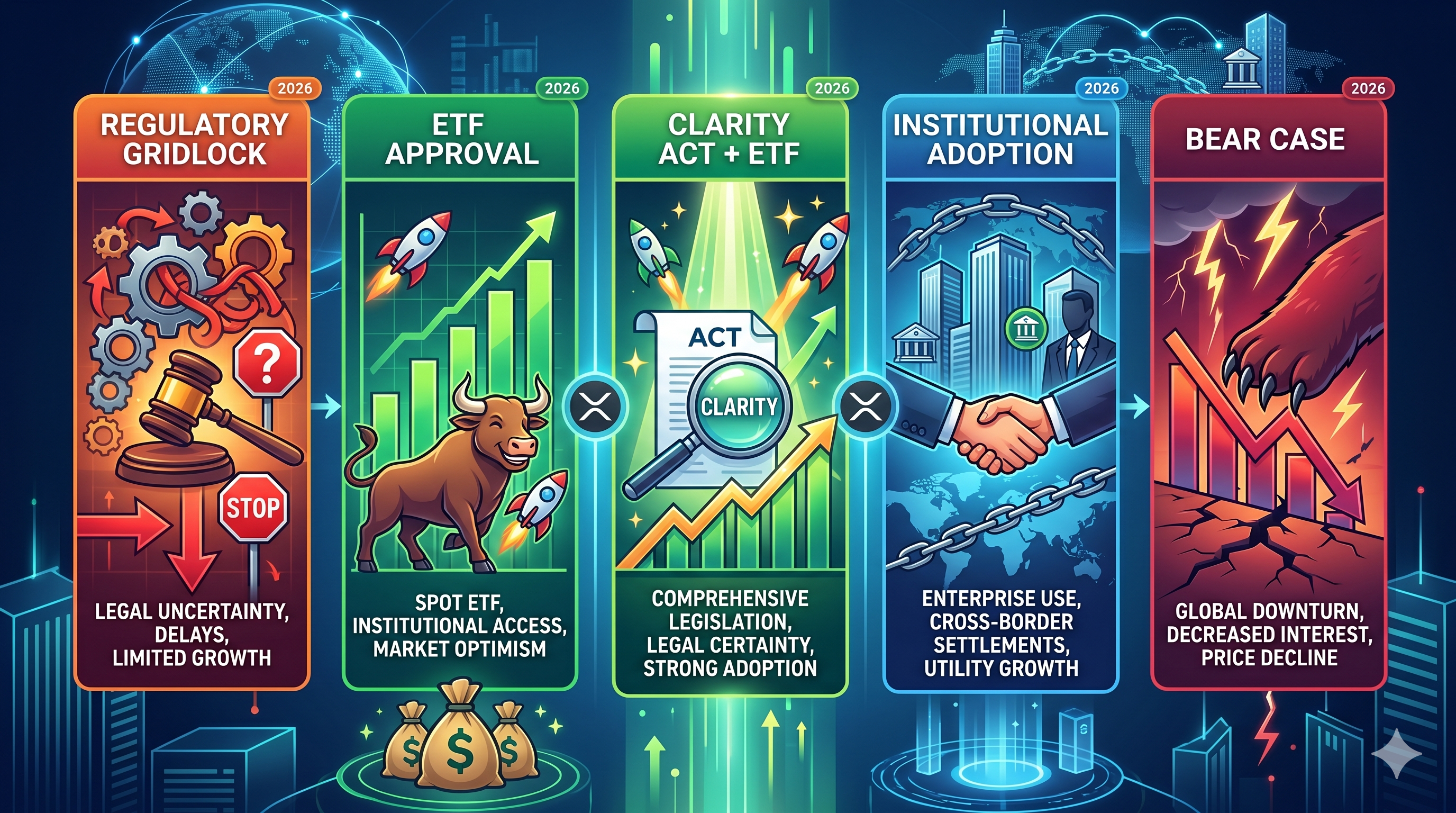
Scenario 1: The "Regulatory Gridlock" Case — XRP Stalls at $1.30–$1.60
The verdict first: If the CLARITY Act stalls in Congress and SEC ETF approvals drag into 2027, XRP likely remains range-bound between $1.30 and $1.60 for the remainder of 2026.
This is the base case that assumes no major regulatory breakthrough. The SEC lawsuit is resolved—Ripple paid $125 million, a fraction of the $2 billion originally demanded—but the programmatic sales ruling that saved XRP from securities classification only applies to this specific case. Without the CLARITY Act codifying XRP's commodity status into federal law, institutional fiduciaries remain hesitant to allocate significant capital.
Technical indicators support this cautious view. XRP has been trapped in a symmetrical triangle since February 2026, with the 20-day and 50-day EMAs both sitting near $1.41. The RSI at 57 leaves room for upside but doesn't scream momentum. AI prediction models from Finbold's composite agent (averaging Gemini 3 Flash, ChatGPT 5.2, Grok 4.1, and DeepSeek) project XRP at $1.55 by May 31, 2026—a modest 6.6% gain from current levels.
On-chain data presents a mixed picture. While whale accumulation is at record levels, exchange reserves have actually increased since mid-February 2025, suggesting retail holders are still distributing into every rally. The divergence between institutional buying (whales) and retail selling (exchange inflows) creates a tug-of-war that keeps price action choppy.
For traders, this scenario implies a continuation of the current environment: scalp opportunities between $1.36 support and $1.50 resistance, but no sustained trend until a catalyst breaks the deadlock.
Scenario 2: The "ETF Approval" Case — XRP Breaks Toward $2.80–$3.65
The verdict first: If one or more spot XRP ETFs receive SEC approval in Q2 2026, XRP could rally to $2.80–$3.65 by year-end, representing 90% to 150% upside from current prices.
This is the scenario the market is currently pricing in as the most probable "bull case." Seven issuers—Grayscale, Bitwise, 21Shares, Canary, WisdomTree, Franklin Templeton, and one additional filer—have spot XRP ETFs in final SEC review. Combined, these products already hold $1 billion in assets under management (AUM) for spot products and $1.4 billion for futures, totaling $2.4 billion in regulated XRP exposure.
Standard Chartered analyst Geoff Kendrick maintains a $2.80 year-end target specifically contingent on ETF approval, citing the precedent of Bitcoin and Ethereum ETF launches which drove sustained inflows for months after approval. The bank's model suggests that XRP ETF inflows could scale from the current $2 million weekly pace back toward the $200 million launch-week range seen with prior crypto ETF approvals.
The technical setup supports this target. A confirmed daily close above $1.45—which XRP briefly achieved on May 11—opens the door to $1.80 according to analyst Ali Martinez. From there, the 200-day EMA at $1.72 acts as the next major resistance before the psychological $2.00 level. Historical data shows XRP has performed positively in Q3 across the last five years, with compounded gains of approximately 249%.
However, traders should note the "sell the news" risk. Ethereum's ETF approval in 2024 saw an initial 20% rally followed by a three-month consolidation. XRP could follow a similar pattern: a sharp spike toward $2.00 on approval, then a period of digestion as inflows build gradually rather than explosively.
Scenario 3: The "CLARITY Act + ETF" Case — XRP Targets $4.00–$5.00
The verdict first: If the CLARITY Act passes Congress and spot ETFs launch simultaneously, XRP could reach $4.00–$5.00 in 2026—a 175% to 240% gain that would place its market cap near $240–$280 billion.
This is the "perfect storm" scenario that combines regulatory clarity with institutional access. The CLARITY Act, which passed the House with a 294-to-134 bipartisan vote, would formally classify XRP as a digital commodity under federal law. The Senate Banking Committee markup scheduled for May 14, 2026 represents the critical next step, with Polymarket odds of 2026 passage at 72% and Ripple CEO Brad Garlinghouse assigning 80% odds to year-end passage.
Why does commodity status matter so much? Right now, pension funds, endowments, and bank asset managers avoid direct XRP exposure because its legal classification creates compliance risk. Federal commodity status removes that barrier entirely. Standard Chartered estimates this unlock could drive $4–$8 billion in new ETF inflows—enough to push XRP's regulated AUM from $2.4 billion to $6–$10 billion.
The price math works as follows: at $4.00, XRP's market cap approaches $240 billion, larger than Binance Coin's current valuation. At $5.00, it nears $280 billion, within striking distance of Ethereum by total value. These aren't fantasy numbers—they're based on institutional AUM models that have proven accurate for Bitcoin and Ethereum.
Ripple's business fundamentals support this valuation. The company's $2.7 billion investment in acquisitions (including Hidden Road, Rail, and GTreasury) expands its payment infrastructure across treasury management and settlement. Over 300 financial institutions use RippleNet, with ODL live in 40+ corridors. SBI Holdings in Japan is now issuing prepaid payment tokens on the XRP Ledger for a $200 billion annual market.
The risk? This scenario requires two independent events to align perfectly. If the CLARITY Act passes but ETFs are delayed—or vice versa—XRP likely lands in Scenario 2 territory ($2.80–$3.65) rather than reaching the $4+ range.
Scenario 4: The "Institutional Adoption" Case — XRP Reaches $6.00–$6.80
The verdict first: If Ripple's ODL expansion into the Middle East and Africa translates into live XRP settlement at scale, XRP could reach $6.00–$6.80 by late 2026 or early 2027.
This scenario is less about speculative trading and more about structural demand. Ripple's new Middle East and Africa headquarters represents a strategic bet on regions with the highest remittance costs and volumes. The UAE alone sends $43 billion in outbound remittances annually, with Saudi Arabia adding $36 billion. Sub-Saharan Africa has the world's highest average remittance cost at 8.78%, with six of the eight global corridors where fees exceed 20% originating from the region.
Here's the critical distinction: most current Ripple partnerships in these regions settle in fiat or RLUSD (Ripple's stablecoin), not XRP. ODL—the product that actually uses XRP for settlement—is live in a growing but still selective set of corridors. For XRP price to benefit, these corridors must switch from fiat/RLUSD settlement to XRP-based ODL.
Trident Digital's $500 million XRP treasury, with phased rollouts targeting African corridors starting mid-2026, is one trigger worth watching. If Trident's rollout aligns with new ODL announcements from Ripple's expanded team, the structural demand could finally translate into price action.
On-chain analysts tracking ODL volume have noted a sharp rise in XRP settlement activity that closely tracks the pace of corridor launches. This is the "utility premium" that separates XRP from pure speculative tokens: when price rises are driven by genuine payment volume rather than narrative, the growth tends to be more stable and sustainable.
The timeline for this scenario is longer than the ETF/CLARITY cases. ODL adoption happens in quarters and years, not weeks and months. Traders looking for this outcome should monitor Ripple's partnership announcements in Q3 and Q4 2026, particularly any live ODL activations in the Middle East and Africa.
Scenario 5: The "Bear Case" — XRP Retests $0.93–$1.11
The verdict first: If macro conditions deteriorate, the CLARITY Act fails, and ETF approvals are denied, XRP could retest the $0.93–$1.11 range seen during the 2026 lows.
This scenario isn't about FUD—it's about risk management. Analyst EGRAG Crypto notes that over XRP's market history, each major bottom has been shallower than the last: first 60% below the 200 SMA, then 40%, and the next possible dip may only be around 20% below, which projects near $0.93. This doesn't predict a crash; it actually shows XRP is maturing with smaller dips and stronger structure.
However, several catalysts could trigger this downside:
-
CLARITY Act failure: If the Senate rejects the bill or delays it past the July 4 White House deadline, the regulatory clarity premium evaporates. XRP returns to the gray zone that suppressed its price from 2020–2024.
-
ETF denial: If the SEC denies all seven spot ETF applications in Q2 2026, the $2.4 billion in regulated exposure could face outflows. Bitcoin ETF denials in prior years caused 30–50% drawdowns.
-
Macro shock: A recession, credit crisis, or geopolitical escalation could trigger a broad crypto selloff. XRP fell 62% from its July 2025 high to its 2026 low of $1.11—a move that could repeat under extreme conditions.
-
Supply overhang: With 61.80 billion XRP in circulating supply against a total supply of 99.99 billion, future price appreciation depends on the pace of escrow releases. If Ripple accelerates institutional sales under its settlement guidelines, the additional supply could weigh on price.
The technical support levels to watch are $1.36 (immediate), $1.29 (strong), and $1.18–$1.22 (the accumulation zone ChatGPT identified for conservative investors). A sustained break below $1.18 would likely trigger a cascade toward the $0.93–$1.11 range.
For traders, this scenario isn't a prediction—it's a contingency. Position sizing should account for the possibility of a 30–50% drawdown, even if the probability is lower than the bullish cases.
XRP Price Scenarios at a Glance
| Scenario | Trigger | Price Target | Probability | Timeline |
| Regulatory Gridlock | No CLARITY Act, delayed ETFs | $1.30–$1.60 | 25% | H2 2026 |
| ETF Approval | SEC approves spot ETFs | $2.80–$3.65 | 35% | Q3–Q4 2026 |
| CLARITY Act + ETF | Commodity status + ETF launch | $4.00–$5.00 | 20% | Q3 2026–Q1 2027 |
| Institutional Adoption | ODL scale in MEA | $6.00–$6.80 | 12% | Late 2026–2027 |
| Bear Case | Macro shock + regulatory failure | $0.93–$1.11 | 8% | Anytime |
⚠️Note: Probabilities are illustrative estimates based on current market conditions and catalyst timelines as of May 2026.
What This Means for Your Trading Strategy
The post-lawsuit XRP landscape offers something rare in crypto: a defined catalyst calendar. The May 14 CLARITY Act markup, Q2 ETF decisions, and Q3 ODL expansion updates create discrete events where volatility will spike. Traders can structure positions around these dates rather than guessing.
For momentum traders, the $1.45–$1.50 resistance band is the line in the sand. A confirmed breakout on volume opens the path to $1.80 and beyond. For value accumulators, the $1.18–$1.36 zone offers favorable risk/reward if you believe the regulatory and adoption trends are irreversible.
The whale data is perhaps the most telling signal. When wallets holding 1M+ XRP accumulate 1.2 billion tokens in a single quarter while price stagnates, it suggests smart money is positioning for a move that hasn't happened yet. The question isn't whether XRP will move—it's which scenario triggers first.
Why Savvy Traders Are Watching KuCoin Right Now
While the XRP narrative unfolds across SEC filings and Senate hearings, the platform you trade on matters just as much as the token you trade. KuCoin has positioned itself as the go-to exchange for altcoin traders who need depth, speed, and early access to emerging narratives.
Here's what makes KuCoin particularly relevant for XRP traders in 2026: the exchange lists XRP across multiple trading pairs including USDT, BTC, and ETH, with competitive maker/taker fees that don't erode profits during tight-range scalping. More importantly, KuCoin's futures and margin products allow traders to hedge spot positions or amplify exposure—critical tools when XRP is coiling for a breakout.
For traders positioning across multiple scenarios, KuCoin's trading bots and grid strategies automate entries and exits around the key levels we've discussed—$1.36 support, $1.45 resistance, $1.80 target. When XRP finally breaks its multi-month consolidation, you'll want to be on a platform that doesn't freeze or throttle orders.
The XRP story is entering its most consequential phase since the 2020 lawsuit. Whether you're accumulating for the $5.00 optimistic case or hedging against the $0.93 bear scenario, having the right tools and information edge isn't optional—it's essential.
Conclusion
XRP in 2026 is a tale of two markets: the visible price action trapped between $1.36 and $1.50, and the invisible institutional accumulation happening at record levels beneath the surface. The SEC lawsuit resolution removed the existential threat, but it didn't guarantee moonshots. What happens next depends on a catalyst stack that includes the CLARITY Act, spot ETF approvals, and ODL adoption in high-volume corridors.
The 5 scenarios outlined here—ranging from $0.93 to $6.80—aren't predictions. They're frameworks for thinking about probability, risk, and position sizing. For traders, the actionable insight is simple: watch $1.45. A sustained break above this level, especially on strong volume around the May 14 CLARITY Act vote or Q2 ETF decisions, likely triggers the $2.80–$3.65 scenario. Failure to hold $1.36 puts the $1.18–$1.22 accumulation zone back in play. The whale wallets accumulating 1.2 billion XRP in Q1 2026 aren't doing so because they enjoy underwater positions—they're positioning for the catalyst calendar they see unfolding. The question isn't whether to be involved, but how to size your involvement for the scenario that actually materializes.
FAQs
Can XRP reach $10 in 2026?
No. At $10, XRP's market cap would exceed $500 billion—larger than Ethereum's historical peak. Most institutional models place $10 as a 2028–2030 target, contingent on ETF inflows above $10 billion and Tier-1 banks settling live transactions through XRP. For 2026, the realistic ceiling is $4–$5 under the most optimistic conditions.
Will XRP holders receive compensation from the SEC settlement?
No. The $125 million settlement went to the federal government as a civil penalty, not to retail investors. The only potential compensation path is through separate class action lawsuits like Zakinov v. Ripple Labs, which remain ongoing in 2026.
Is XRP still a security after the lawsuit?
XRP sold on public exchanges is definitively not a security per Judge Torres's July 2023 ruling. Only direct institutional sales with contractual promises were ruled as securities offerings. The March 2026 SEC and CFTC joint framework further classified XRP as a digital commodity alongside Bitcoin and Ethereum.
What's the biggest risk to XRP in 2026?
Regulatory delay. If the CLARITY Act stalls and ETF approvals are pushed to 2027, XRP likely remains range-bound between $1.30–$1.60. While the lawsuit resolution removed existential risk, it didn't create guaranteed upside. The catalyst calendar is bullish, but execution risk remains the primary threat.
Disclaimer: This article is for informational purposes only and does not constitute financial or investment advice. Cryptocurrency investments carry significant risk. Always conduct your own research before trading.