








Many of my friends have already left or are considering leaving the crypto industry, so I want to share some broader thoughts about the market and discuss what still remains to be done in cryptocurrency.
The core issue is that cryptocurrencies are struggling in three key areas: (i) lack of innovation, with no new developments in the past 2–3 years; (ii) advancements in quantum technology threatening Bitcoin’s survival by 2029; and (iii) large language models like Claude Mythos increasing attack volumes, making DeFi’s risk-reward profile unattractive.
This raises the question: What else is left to do in cryptocurrency?
VC and liquidity token investors
Due to this innovation drought, the VC industry has been fairly quiet, especially in token trading. Every crypto VC will tell you how boring it is unless they’re doing larger Series B+ rounds or funding stablecoin payment startups.
The few exceptional VCs I’ve encountered are investing in counter-cyclical verticals, such as quantum startups (e.g., Project Eleven, Oratomic) or novel ideas (e.g., Shift Foundation, PostFiat, Ambient).
I think this is normal, as we’ve largely figured out what works and what infrastructure is needed, so there are fewer exciting new developments. We’re now in the adoption phase for payments and remittances. The endgame and institutional adoption have arrived.
Similarly, for those working in the crypto space, it only makes sense to work at stablecoin fintech companies (such as Circle, OpenFX, Tempo, Arc, Plasma), trading platforms (such as Polymarket, Kalshi, Hyperliquid), or innovative reverse startups (as mentioned above). Working at an L1 foundation is a well-paying dead end that offers no long-term benefit to you.
A lack of "cool new things" in venture capital means fewer high-quality tokens will be launched, and less VC capital will flow into liquidity markets.
Therefore, long-term liquidity token investors who evaluate tokens based on growth, fundamentals, and value accumulation may now have fewer than ten high-quality options, and this number does not appear likely to increase in the short term.
Only 12 token projects have annual revenues exceeding $50 million. Among them, only three have a cumulative value score of >=7 (HYPE, PUMP, JUP). Even if you evaluate based on teams driving growth and improving token value accumulation, you might add another 5–10 tokens to this list (e.g., MORPHO, SYRUP).
The market capitalization of OTHERS also declined from approximately $450 billion to around $180 billion, while the stock market is experiencing a speculative frenzy in areas such as high-bandwidth memory, photonics, quantum technologies, and peptides.
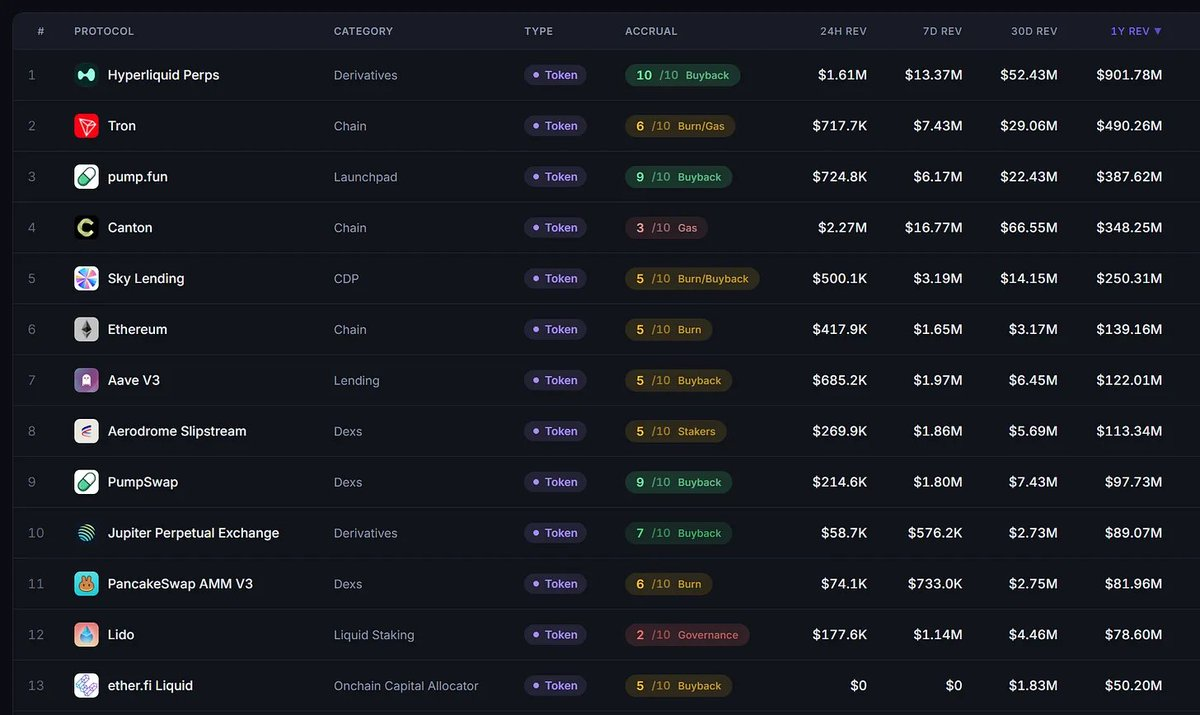
Subjective and systematic traders
You might say that cryptocurrency is primarily driven by narrative and momentum trading, making it well-suited for subjective traders who go long or short based on narratives, catalysts, or news. This is my area of expertise and what I’m most familiar with.
In the depths of a bear market, trading catalysts have remained more profitable, though many require you to stay alert and respond quickly. There are plenty of advantages and solid trading opportunities here.
Nevertheless, there has still been a considerable amount of event-driven trading over the past three months, such as...
Shorted TAO as the Templar subnet departed, dropping from $330 to $260 within 5 hours (April 9)... Longed TAO during Chamath and Jason Cal’s calls, with varying success.
There was no trading here, but interestingly, WLD didn’t even rise on the announcement of the Tinder and Zoom partnership—it fell 8% over two days.
Shorted AAVE during the KelpDAO hack; the attack occurred at approximately 1730 UTC, but was first reported on Twitter about an hour later at around 1830 UTC (April 19).
Short AAVE when Marc Zeller left ACI (March 3).
Shorting TRUMP pullback following Trump's dinner announcement (March 12)
After the surge following the token-to-equity conversion announcement, short ACX to the "conversion price" (March 11).
Short DRIFT during the exploit; it dropped 40% within one hour (April 1).
Shorted RESOLV during the exploit, resulting in a ~10% decline (March 22).
Go long on ALGO during Google's quantum breakthrough (March 31).
Go long on LDO ahead of the buyback announcement, rising approximately 17% within 5 days (March 27).
Long/short positions on pump-and-dump schemes like RAVE, SIREN, STO, PIPPIN, POWER (I prefer to avoid these altogether).
Nevertheless, open interest has dropped by approximately 60% since October 10, and reactions to news are often minimal. You need to be selective about which news to trade and whether others care about it, as retail trading interest is low (typically the slowest to react to headlines), so you're primarily trading against other news traders in a PVP environment.
I’m seeing more and more discretionary traders spending more time predicting markets and trading stocks/commodities—Hyperliquid makes this transition much easier.
As for systematic traders and basis traders, with declining trading volumes and funding rates, traditional strategies have become increasingly less profitable. To stay engaged, they engage in HIP-3 markets, arbitrage prediction markets, trade Pendle PT/Boros, or arbitrage new decentralized perpetual exchanges with limited liquidity.
Yield farmer
An increasing number of hacks in DeFi have caused yield farmers (or institutional TVL traders) to go dormant or exit entirely this year, as the last few profitable opportunities were Plasma and USDai. FlyingTulip may work during a bull cycle, but it attracted little attention upon launch.
The reason "yield trading" typically makes sense is that you can sell the governance tokens rewarded to you (as I’ve emphasized here), but this assumes someone is there to buy them—without liquidity providers or speculative traders adding fuel, it’s hard to make the risk/reward worthwhile.
This applies to the past (OHM), the present (XPL, ENA), and potential future scenarios (USDai’s CHIP). The threshold for on-chain DeFi yields was previously 15–25% APY, accounting for treasury yields near 0% and a roughly 10–15% probability of hacks.
OHM was worth it at the time not because it was lower risk, but because it offered much higher returns.
The current barrier may be approaching a 50–60% annualized yield, due to the increasing number of hacks (DeFi suffered $795 million in hacks in the first four months of 2026), combined with potential risks from Claude Mythos and rising quantum threats. With no buyers for the released tokens, achieving a reasonable risk/reward ratio is difficult.
Most rational farmers have nearly fully shifted off-chain, as even the traditional finance fixed-income yield of 11.5% on STRC offers better risk-adjusted returns (15–20%).
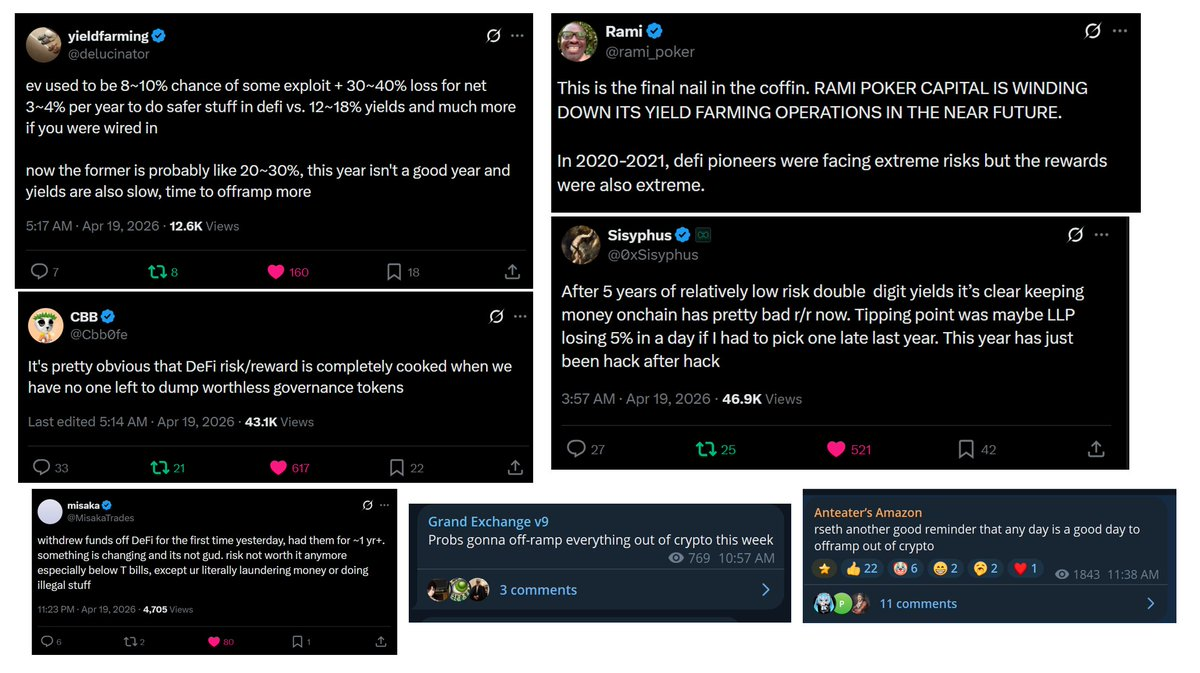
See also: Rami poker, CBB, Sisyphus, delucinator, misaka
On-chain gold miners
Last but not least... the infamous on-chain gold miners: those who buy at a $1 million market cap and sell at a $100 million market cap. I believe these people will continue to exist, because the trenches remain the only place where 100x gains are still possible.
On-chain prospectors also feel like World War II soldiers trapped in a cave, unaware that the gold rush era has essentially ended.

Needless to say, meme coins have already peaked since our beloved president and first lady launched their coin. We’re nearing the end of the euthanasia rollercoaster—things no longer rise like they used to, and there are too many value extractors everywhere (“FNF group,” “LA vape club,” continuous rug pulls, and extractive transaction fees).
Nevertheless, I still believe this niche market will not disappear entirely—a glimmer of hope keeps people in the trenches. Over the past few months, we have seen...
$GAS: GasTown rose from a $100,000 market cap to $60 million over three days, then dropped back to $1 million over the next three days, and is now at a $50,000 market cap. (January 15)
$RALPH: RalphWiggum surged from $500,000 to $55 million in two weeks, then plummeted to $3 million within 12 hours after developers abandoned it (-93%), and is now trading at a $50,000 market cap. (January 21)
$PENGUIN: The Nietzschean Penguin surged to $170 million on January 24, but is now trading at $3 million.
$MOLT reached $120 million in one day (January 31), but is now trading at $1 million.
$WHITEWHALE reached $200 million (January 10), but is now trading at $7 million.
$ASTEROID reached $200 million yesterday (April 19) after Musk tweeted that it could become SpaceX's mascot. It could soon trend toward zero.
Although these do occasionally surge, your chances of hitting them are likely under 10%, and the absolute maximum potential is a net 10x (from $10 million to $100 million), since things rarely rise above $100 million. After reaching the peak, you only have a few hours to sell, as prices typically drop more than 90% within hours.
So... what am I doing?
I’m maintaining an arbitrage strategy on Polymarket that generates approximately a 15% annualized return with a maximum capacity of around $250,000. Fully deployed, it yields about $3,500 per month. Since Polymarket introduced trading fees, arbitrage opportunities have diminished, and following the recent npm package poisoning incident, I increasingly feel the risk/reward profile is no longer favorable—especially after the airdrop. My current plan is to shut it down after the airdrop.
I continue trading cryptocurrencies, but not as actively as before. I had the idea of starting an AI hedge fund, but my exploration led me to conclude that AI is not yet creative enough for subjective trading—such as generating ideas—but it’s excellent when given a task or methodology you’ve used before and require a bit of logical reasoning.
Therefore, I’m spending time automating certain “hedge fund analyst” tasks, such as automating the on-chain investigations I previously conducted on Polymarket for internal wallets—this is fairly process-based but requires a bit of logical thinking. This is a perfect task for Claude.
I’ve also been increasingly exploring the fine-tuning of AI models, particularly from the perspective of crypto and financial data. I’ve been reading beyond crypto and find topics like the AI stack (social impact and equity across the entire stack), physical AI (world action models, vision-language models, and data challenges), and the concept of “AI integration” (PE integration but with AI) intellectually stimulating—but I haven’t yet found a compelling enough problem to dedicate my life to solving.