



Improving macro sentiment drives rebound in risk assets; crypto recovery still shows caution signals
Summary
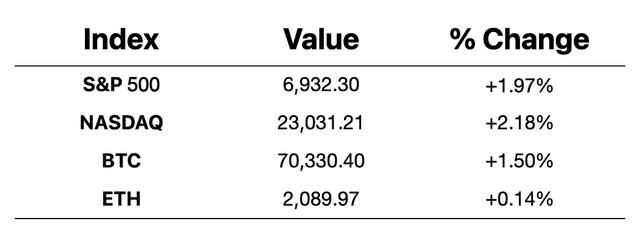
Macro: U.S. consumer sentiment unexpectedly rebounded, while inflation expectations dropped to a 13-month low, indicating stronger optimism about the economic outlook. Bargain-hunting sentiment fueled a sharp equity rebound: the S&P 500 rose nearly 2%, its largest single-day gain since May last year, while the Dow Jones Industrial Average surpassed 50,000 for the first time.Precious metals recovered amid volatility. Early Monday trading saw gold reclaim the $5,000 level and silver move back above $80.
Crypto market: After briefly falling below $60K, Bitcoin staged a technical rebound to $72.3K, recovering most of last Thursday’s sharp decline.Total crypto market capitalization has risen for three consecutive days, reclaiming the $2.4 trillion level. Altcoin market-cap share declined, but trading-volume share increased, suggesting improved liquidity conditions.However, the crypto fear index dropped on Sunday to its lowest level since June 2022, indicating that although overall risk appetite is recovering, market nervousness has not meaningfully eased.
Project developments
Trending tokens: XAU/XAG, HYPE, BNKR
-
XAU/XAG: Precious metals experienced wide volatility over the past week; gold returned above $5,000 and silver above $80.
-
HYPE: Arthur Hayes initiated a bet with Kyle Samani on HYPE’s upside. Hyperliquid platform revenue has grown for three consecutive weeks, with HYPE rising more than 80% from its lows.
-
AI Agents narrative: Boosted activity across the BASE ecosystem; tokens such as BNKR, CLANKER, and AWE posted gains.
-
PUMP: Pump.fun announced the acquisition of Vyper to expand cross-chain trading terminal operations. Since July 15, it has repurchased approximately $282 million in tokens, reducing circulating supply by 22.979%.
-
ONDO: 21Shares is applying to launch an Ondo ETF.
Major asset changes
Crypto Fear & Greed Index: 14 (24h prior: 7) — Extreme Fear
Today’s outlook
-
CME to launch ADA, LINK, and XLM futures
-
CME planning 100-oz silver futures contract
-
MegaETH mainnet launch
-
ZKsync to launch ZKnomics staking pilot
-
Movement (MOVE) unlock: ~164M tokens (~$3.8M)
Macro economy
-
U.S. Treasury Secretary Bessent: No expectation for the Fed to act quickly on balance-sheet issues
-
Trump reiterated expectation that the Dow could reach 100,000 before the end of his term
-
Preliminary U.S. February consumer sentiment: 57.3 vs. January final 56.4, six-month high
-
Fed Vice Chair Jefferson hinted no near-term policy adjustment needed
-
Fed’s Daly: Must balance dual-mandate risks; current situation “unstable”
-
Fed’s Bostic: Restoring scarce reserves is feasible; tariff effects may fade mid-year but inflation risks remain
Policy direction
-
CFTC allows national trust banks to issue USD stablecoins under GENIUS Act framework
-
Bessent: U.S. government has no authority to “bail out” Bitcoin; taxpayer funds will not be invested in crypto. Banking and crypto sectors may eventually offer similar products
-
Illinois proposes state-level “Bitcoin Strategic Reserve” bill
-
Vietnam to tax individual crypto trading at 0.1%, same as equities
-
Hong Kong SFC holds third digital asset consultative panel meeting to strengthen ecosystem
-
Russia’s largest bank plans crypto-collateralized loans
Industry highlights
-
Michael Saylor said on earnings call that “selling Bitcoin is also an option,” no longer strictly buy-only; later posted BTC tracker again, hinting at possible renewed accumulation
-
Tether assisted Turkish authorities in seizing $544M in crypto tied to gambling and money laundering
-
ETH queued for Ethereum PoS continues at elevated levels, now exceeding 4M ETH
-
Trend Research (under Yi Lihua) fully exited ETH, realizing ~ $688M loss
-
Bitcoin mining difficulty saw largest single drop since 2021; 7-day avg hashrate fell to 990.08 EH/s
-
Polymarket parent company filed “POLY” trademark, potentially preparing for token issuance
Deep Dive: Industry Highlights (Feb 09, 2026)
-
Michael Saylor’s Strategy Shift: From "HODL" to "Flexible Defense"
Saylor’s comments during the earnings call mark a pivotal turning point for MicroStrategy (MSTR). For years, his aggressive strategy of leveraging the balance sheet to buy Bitcoin—vowing never to sell—positioned MSTR as the ultimate "Bitcoin shadow fund." However, with BTC prices dipping below the company’s average cost basis (roughly $76,000) in early 2026, MSTR is facing significant fiscal pressure. Mentioning that "selling is an option" is likely a strategic move to appease creditors, demonstrating liquidity flexibility rather than an intent to exit. His subsequent BTC tracker post acts as a psychological hedge to reassure the market that the "long-term bull" thesis remains intact.
-
Tether’s Asset Seizure: Stablecoins as "Centralized Enforcers"
Tether’s cooperation with Turkish authorities to seize $544M reinforces its role as a centralized gatekeeper operating under regulatory pressure. For global authorities, this proves that crypto is no longer a "safe haven" for illicit cross-border flows; for the industry, it highlights the immense power of stablecoin issuers to blacklist wallets at will. While this enhances mainstream institutional trust, it simultaneously drives "decentralization purists" toward over-collateralized, non-custodial stablecoin alternatives that are resistant to censorship.
-
Surge in ETH Staking Queue: A Shift from Selling to "Long-Term Locking"
The staking entry queue exceeding 4 million ETH is a strong signal of returning market confidence. Following the massive unstaking and profit-taking wave seen at the 2025 peak, the current surge suggests that institutional players (like BitMine and others) are once again prioritizing yield over immediate liquidity. This is likely driven by the efficiency gains from the recent Pectra upgrade. This "supply lock-up" effect often serves as a leading indicator for mid-term price recovery, as it significantly reduces the circulating supply on exchanges.
-
Trend Research’s Exit: A Case Study in "Institutional capitulation"
The total exit of ETH by Yi Lihua’s Trend Research, realizing a staggering $688M loss in just eight days, is a classic example of forced deleveraging. Using recursive borrowing on protocols like Aave during a price crash (below $2,000) likely triggered a liquidation cascade. This level of loss underscores how even veteran "O.G." firms are vulnerable to liquidity crunches. While this capitulation caused the recent ETH price weakness, it also means a major source of sell-side pressure has been completely "flushed out," clearing the path for a cleaner recovery.
-
Mining Difficulty Drop: The Great "Industry Shakeout"
The 11% drop in mining difficulty—the largest since 2021—points to a perfect storm of high energy costs, harsh weather, and price suppression. With the production cost of 1 BTC (approx. $87,000) currently exceeding its market price (approx. $69,000), inefficient miners are shutting down or pivoting to AI compute. Historically, such massive difficulty adjustments coincide with market bottoms. As weak miners exit, the "hashrate floor" stabilizes, and the profit margins for surviving miners begin to recover mechanically.
-
Polymarket’s "POLY" Trademark: Evolution into a Financial Ecosystem
The trademark filing for "POLY" confirms long-standing rumors of a token issuance (Airdrop). As the standout dApp of the 2024–2025 cycle, Polymarket needs to convert its massive traffic into a self-sustaining ecosystem. A token would allow them to incentivize liquidity, decentralize governance, and—crucially—build a legal and financial war chest to handle ongoing regulatory scrutiny in the U.S. This marks the transition of prediction markets from niche gambling tools to a cornerstone of "Predictive Finance" (PreFi).
