

Truth in the Age of AI: How ZK-Proofs are Ensuring Trust in the Symbiotic Web
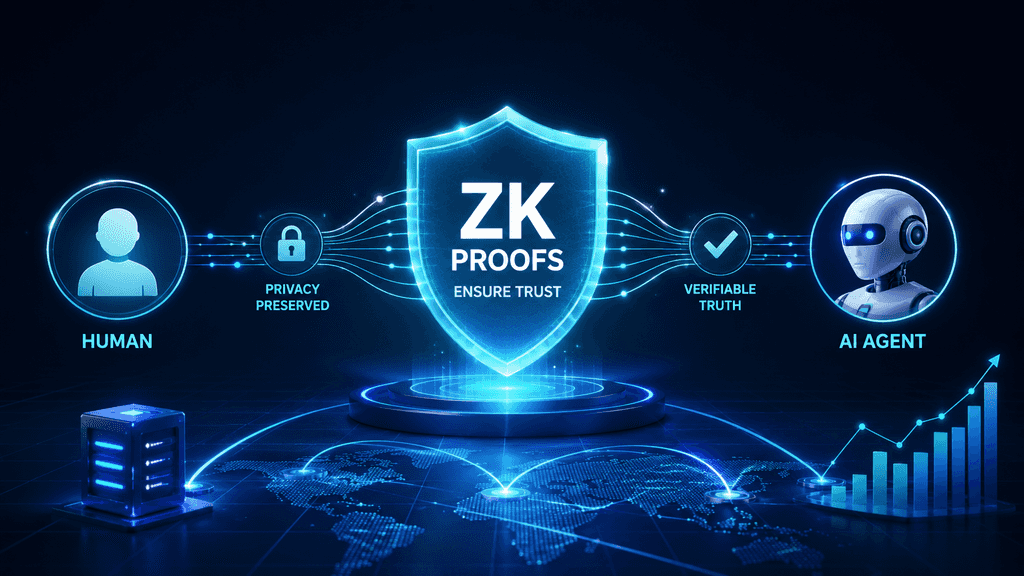
The rapid convergence of Artificial Intelligence and blockchain technology has birthed the "Symbiotic Web," an ecosystem where autonomous AI agents and human users interact seamlessly. However, this new digital frontier faces a significant crisis: the erosion of objective truth due to synthetic media and opaque algorithmic decision-making. As deepfakes and biased AI models proliferate, the need for verifiable certainty has never been more urgent.
In this deep dive, we explore how ZK-Proofs are Ensure Trust across decentralized networks. By leveraging the cryptographic power of ZK-Proofs, we can finally bridge the gap between AI efficiency and blockchain transparency.
Key Takeaways
-
Mathematical Truth: ZK-Proofs allow for the verification of data or computations without revealing the underlying sensitive information.
-
AI Accountability: ZKML (Zero-Knowledge Machine Learning) ensures that AI models operate exactly as claimed, preventing "model swapping" or tampering.
-
Cross-Chain Security: ZK-Proofs are Ensure Trust in interoperability by replacing centralized bridge committees with succinct mathematical proofs.
-
Privacy-First Identity: Users can prove their personhood or specific attributes (like age or citizenship) to AI systems without exposing their full legal identity.
-
Data Integrity: Technologies like Chainlink DECO allow private real-world data to be integrated into smart contracts securely and privately.
Understanding the Foundation: What are Zero-Knowledge Proofs (ZK-Proofs)?
To understand why ZK-Proofs are Ensure Trust in our modern era, we must first define the core technology. A Zero-Knowledge Proof is a cryptographic method by which one party (the prover) can prove to another party (the verifier) that a given statement is true, without conveying any information apart from the fact that the statement is indeed true.() Leading platforms like KuCoin emphasize the importance of ZKPs in maintaining this balance between privacy and transparency. In the context of a crypto exchange, this means you can prove you have sufficient funds for a trade without showing your entire wallet balance.
The Three Pillars: Completeness, Soundness, and Zero-Knowledge
For a protocol to be considered a true ZK-Proof, it must satisfy three fundamental mathematical properties:
-
Completeness: If the statement is true, an honest prover will be able to convince an honest verifier of this fact.
-
Soundness: If the statement is false, no cheating prover can convince an honest verifier that it is true (except with a mathematically negligible probability).
-
Zero-Knowledge: If the statement is true, the verifier learns nothing other than the fact that the statement is true. This pillar is what protects user privacy in the Symbiotic Web.
Interactive vs. Non-Interactive Proofs (zk-SNARKs & zk-STARKs)
Early iterations of ZK-Proofs were interactive, requiring multiple rounds of communication. For blockchain scalability, non-interactive proofs like those highlighted in KuCoin's guide to ZK-VM and ZK-EVM are essential.
-
zk-SNARKs (Succinct Non-Interactive Argument of Knowledge): These are small in size and can be verified in milliseconds.They are widely used in Layer 2 scaling solutions, though they often require an initial "trusted setup."
-
zk-STARKs (Scalable Transparent Argument of Knowledge): These do not require a trusted setup and are resistant to quantum computing attacks, offering a more future-proof security model.
The Symbiotic Web: Where AI Agents and Humans Co-exist
The Symbiotic Web represents a paradigm shift where AI is no longer just a tool, but an active participant in the economy. AI agents now have their own crypto wallets, execute smart contracts, and curate social media feeds. This coexistence introduces a "Black Box" problem where humans cannot easily verify the intentions or the data sources of their AI counterparts.
The Trust Deficit in a Synthetic Reality
In a world where an AI can generate a fake video of a political event, trust becomes a commodity. This "synthetic reality" threatens the stability of financial markets. When an AI agent executes a trade on a crypto exchange, how do we know it isn't acting on manipulated data? Without a verification layer, the Symbiotic Web risks collapsing under the weight of misinformation.
Why Cryptography is the Only Solution for AI Transparency
Regulations are often too slow to keep up with code. Cryptography provides an automated, objective, and immutable solution. ZK-Proofs are Ensure Trust because they don't rely on human integrity; they rely on the laws of mathematics, which cannot be altered.
The Tech Pillar: How ZK-Proofs are Ensuring Trust in AI Outputs
The integration of AI and ZK-Proofs is most evident in the emerging field of Zero-Knowledge Machine Learning (ZKML). As AI models handle more sensitive tasks—from medical diagnosis to credit scoring—the ability to verify the "how" and "why" behind an output becomes paramount.
ZKML: Verifying the Integrity of the AI "Black Box"
ZKML allows a model provider to prove that a specific output was generated by a specific model without revealing proprietary weights. KuCoin identifies top ZK projects that are currently pioneering these verifiable computation methods.
-
Model Authenticity: Ensures the AI you paid for is the one actually running.
-
Computation Integrity: Proves that no steps in the neural network were skipped.
-
Auditability: Allows regulators to verify that a model meets safety standards without accessing intellectual property.
Data Privacy: Training AI on Sensitive Records Without Exposure
ZK-Proofs allow AI models to be trained on encrypted data. The model can "learn" and provide a proof that the training was conducted correctly without ever "seeing" the raw, private information of the individuals involved, satisfying both research needs and privacy laws.
Verifiable Media: Establishing Content Provenance in the Deepfake Era
To combat deepfakes, ZK-Proofs can be used to create a "digital birth certificate" for content. When a photo is taken by a verified camera sensor, a ZK-Proof of its metadata is generated. If the photo is later edited by an AI, a new proof can be generated to show exactly which parts were altered.
Seamless Connectivity: The Role of ZK-Bridges in the Symbiotic Web
In the current blockchain landscape, liquidity is fragmented. Cross-chain bridges are the lifelines that connect these ecosystems, but they are also the most vulnerable points of failure due to the reliance on centralized validator sets.
Replacing Third-Party Committees with Mathematical Certainty
ZK-Proofs are Ensure Trust by enabling "trustless" bridges. In a ZK-bridge, the state of the source chain is proven mathematically on the destination chain. There is no need for a committee to vote; the proof itself provides the absolute certainty required to unlock funds.
Reducing On-Chain Overhead via Succinct Verification
One of the primary benefits of using ZK-Proofs for bridging is their succinctness. A zk-SNARK can compress thousands of transactions into a single proof that is only a few hundred bytes, which KuCoin notes is essential for Layer-2 scaling. This drastically reduces gas costs and ensures the Symbiotic Web remains economically viable.
Decentralized Identity: Proving Personhood to AI Systems
As AI agents become more sophisticated, they can easily bypass traditional tests. Decentralized Identity (DID) systems powered by ZK-Proofs offer a solution that balances security with extreme privacy.
Privacy-Preserving Oracles: Integrating Real-World Data via DECO
Chainlink’s DECO is a prime example of how ZK-Proofs integrate with the real world. DECO allows users to prove data from a web server without the server needing to support blockchain technology directly.
-
Undercollateralized Loans: A user can prove their credit score is above 700 without revealing the actual score.
-
Age Verification: A user can prove they are over 18 without sharing their birth date or address.
-
Sybil Resistance: Proving that a blockchain account is linked to a unique human without revealing who that human is.
Empowering Your Journey in the ZK Era with KuCoin
Understanding the theoretical framework of the Symbiotic Web is only the first step; participating in this decentralized future requires a secure and reliable entry point. As a global leader in the crypto industry, KuCoin provides a robust ecosystem for users to engage with cutting-edge ZK projects like ZKsync and Starknet. To start your journey, simply visit the KuCoin Sign-Up page and create an account using your email or phone number.
To unlock the full potential of the platform—including higher withdrawal limits and exclusive access to new ZK token launches—completing the Identity Verification (KYC) process is essential. By navigating to the ‘Identification’ section in your profile, uploading a valid ID, and completing a quick facial recognition scan, you not only comply with global regulations but also add a critical layer of protection to your assets. In an era where ZK-Proofs are Ensure Trust, taking these proactive steps on a platform like KuCoin ensures that your transition into the Symbiotic Web is both secure and seamless.
Conclusion
The emergence of the Symbiotic Web brings unparalleled opportunities for innovation, yet it also highlights the critical need for a robust verification framework. As we have explored, ZK-Proofs are Ensure Trust by providing a mathematical foundation that validates AI outputs and cross-chain transactions without compromising user privacy.() By implementing ZK-Proofs, decentralized platforms can mitigate the risks of deepfakes, biased algorithms, and centralized bridge failures. This technology is not merely a privacy feature; it is the essential "truth layer" that will define the next generation of the internet, ensuring a secure and transparent future for both humans and AI agents alike.
FAQ
What is the main advantage of ZK-Proofs in the crypto industry?
The primary benefit is privacy. ZK-Proofs allow users to prove they have the right to execute a transaction on a crypto exchange without revealing their private data, such as wallet balances or identity details.
How do ZK-Proofs are Ensure Trust in AI-generated content?
They provide a "cryptographic provenance." By using ZK-Proofs, creators can prove that a video or image is authentic and originated from a specific source, effectively identifying and neutralizing deepfakes.
Is it expensive to use ZK-Proofs on a blockchain?
While generating a proof is computationally intensive, verifying it is extremely cheap and fast. This makes ZK-Proofs ideal for scaling networks, as seen in the ZK-rollup solutions listed on KuCoin.
Can ZK-Proofs prevent AI models from being biased?
They can't stop a programmer from writing a biased model, but ZK-Proofs are Ensure Trust by proving that the model was executed exactly as written, allowing for public audits without exposing proprietary code.
What is the difference between ZK-Proofs and standard encryption?
Standard encryption hides data from unauthorized parties. ZK-Proofs, however, allow you to prove something about that hidden data to a third party without ever decrypting it or showing them the underlying information.
How do ZK-Bridges improve upon older cross-chain technology?
Older bridges rely on trusted third parties. ZK-Bridges use ZK-Proofs to mathematically prove the state of one chain on another, removing the need for intermediaries and significantly reducing the risk of security breaches.