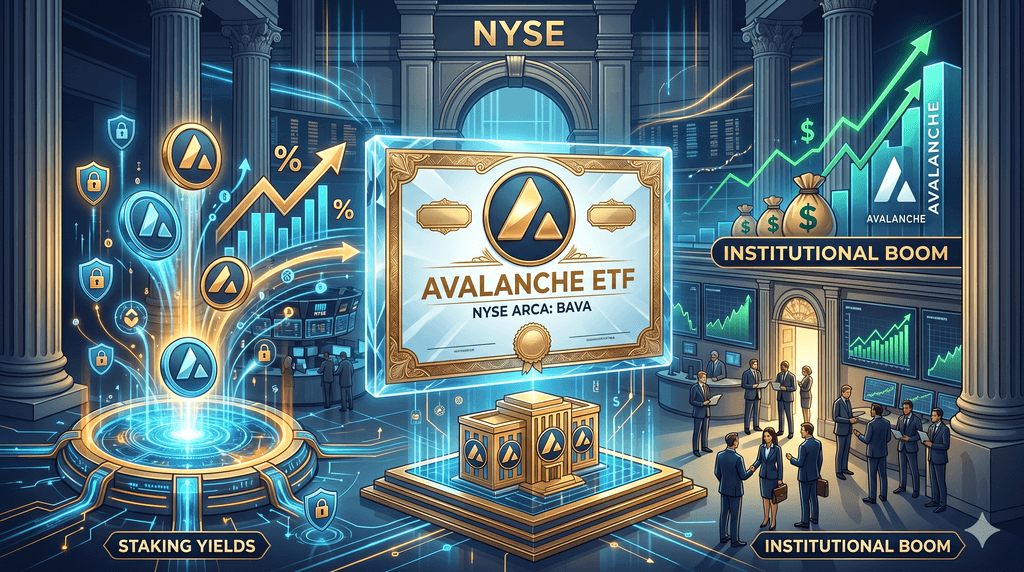
Bitwise Avalanche ETF BAVA Hits NYSE: Staking Yields Open Door to Institutional Avalanche Boom
Bitwise Avalanche ETF BAVA Hits NYSE: Staking Yields Open Door to Institutional Avalanche Boom
Thesis Statement
Bitwise Asset Management rolled out its spot Avalanche ETF on the New York Stock Exchange yesterday, giving everyday investors and institutions a straightforward way to own AVAX while earning staking rewards through the fund itself. The product, ticker BAVA, started trading on April 15, 2026, and quickly drew attention for its fresh approach to handling the token. Early trading hit $400,000 in volume within the first 90 minutes, a solid start that Bloomberg ETF analyst James Seyffart called quite good.
Bitwise's launch of the BAVA ETF signals the start of a new phase where Avalanche moves from blockchain to a core holding in professional portfolios, thanks to its real-world applications and the added layer of yield that makes it stand out in a crowded market.
Bitwise Avalanche ETF Launches on NYSE With Game-Changing Staking Twist
Bitwise Asset Management, which oversees $11 billion in client assets, introduced the Bitwise Avalanche ETF under ticker BAVA on April 15, 2026. The fund holds actual AVAX tokens and stakes roughly 70 percent of them through its own Bitwise Onchain Solutions division. This setup targets Avalanche's current average staking reward rate of 5.4 percent as of April 13, 2026, while keeping 30 percent in a liquidity reserve to handle redemptions smoothly. Net rewards, after expenses, flow back to shareholders on a regular schedule. The sponsor fee sits at 0.34 percent, but Bitwise waived it entirely for the first month on the first $500 million in assets to encourage early participation.
Investors can now access the token through regular brokerage accounts without worrying about wallets, private keys, or direct staking mechanics. The launch positions BAVA as the first U.S.-listed AVAX product to manage staking internally for better oversight and efficiency. With Avalanche's market capitalization sitting at $4.1 billion around the announcement, the ETF taps into a network built for speed and scale. Daily staking details appear on the fund's site at bavaetf.com, giving full transparency. This structure turns a technical blockchain feature into a simple income stream for traditional accounts.
How Bitwise Plans to Stake 70 Percent of BAVA Holdings While Keeping Liquidity High
The staking strategy at the heart of BAVA relies on Bitwise's in-house team at Onchain Solutions. They handle the proof-of-stake validation process directly on Avalanche, aiming to lock in the network's 5.4 percent reward rate without exposing the fund to unnecessary risks. By reserving exactly 30 percent of the AVAX for immediate liquidity needs, the fund stays ready for daily trading flows while still putting the majority to work. This balance matters because staking typically ties up assets, yet BAVA's design keeps shares liquid on the NYSE. Rewards come as additional AVAX tokens and are distributed periodically after costs, boosting total returns beyond pure price appreciation.
The precise amount staked updates every day online, so shareholders track participation in real time. Bitwise built its own infrastructure to maximize rewards and maintain control, avoiding third-party services that could add fees or delays. For investors used to bond yields or dividend stocks, this creates a crypto-native income play inside a familiar ETF wrapper. The approach reflects years of experience Bitwise gained managing crypto products, turning complex on-chain mechanics into reliable performance for portfolios. Early data from the debut trading session suggests the market likes the yield-plus-exposure combo.
Avalanche's Subnet Revolution: Why Enterprises Like Toyota Choose Custom Blockchains
Avalanche stands out because it lets organizations spin up their own custom blockchains called subnets. These run independently yet connect back to the main Avalanche network for security and speed. Toyota uses this setup for mobility and supply chain projects, tracking parts and vehicles with near-instant finality and tiny fees. Subnets give companies full control over rules, validators, and privacy while still benefiting from Avalanche's high throughput. Developers and enterprises gain flexibility that older blockchains cannot match, making the platform ideal for large-scale operations.
The architecture supports thousands of transactions per second without clogging the main chain. This design appeals to businesses that need tailored solutions rather than one-size-fits-all public networks. As more firms explore on-chain operations, subnets lower the barrier for real production use. Avalanche's focus on interoperability means these private lanes still communicate seamlessly when needed. The result is a blockchain layer that feels more like enterprise software than typical crypto infrastructure.
FIFA's Avalanche Blockchain Powers 2026 World Cup Digital Collectibles and Tickets
FIFA built its own blockchain on Avalanche to handle digital collectibles and ticket options for the upcoming 2026 World Cup. Fans buy, sell, and trade official NFTs tied to matches and memorabilia through a fast, low-cost environment. The setup delivers instant settlement, so purchases clear in seconds instead of minutes or hours. Avalanche's subnets let FIFA customize governance and access rules to fit global sports regulations. This project brings millions of soccer supporters into blockchain for the first time through something familiar, like team memorabilia.
The scale of the World Cup amplifies Avalanche's reach, showing how the network handles high-volume consumer applications without slowdowns. Fans gain true ownership of digital items, while FIFA gains transparent transaction data. The partnership highlights Avalanche's ability to support mainstream entertainment at global levels. It also demonstrates practical use beyond finance, drawing new audiences to the ecosystem.
Wyoming's First State-Issued Stablecoin Runs on Avalanche's Fast Network
Wyoming launched its Frontier stable token, the first state-backed stablecoin in the United States, directly on Avalanche. The token provides a regulated digital dollar for state operations and local businesses. Avalanche's near-instant finality and minimal fees make it practical for government payments and daily transfers. The subnet model allows Wyoming to set specific compliance rules while keeping the asset secure on the broader network.
This project marks a concrete step for public sector adoption of blockchain technology. Residents and businesses benefit from faster, cheaper transactions compared to traditional banking rails. The stablecoin also serves as a test bed for other states considering similar digital currency programs. Avalanche's performance ensures the token stays stable and usable even during peak activity. Wyoming's move adds legitimacy and real-world volume to the chain.
BlackRock and KKR Lead Tokenization Boom Using Avalanche Infrastructure
Major asset managers, including BlackRock, KKR, Apollo, and SkyBridge, run tokenization pilots on Avalanche. They turn real estate, credit funds, and private shares into digital tokens that trade with full transparency and instant settlement. Avalanche's subnets give each firm a dedicated environment that meets strict compliance standards while staying connected to the main chain. BlackRock's initiatives show how traditional finance can move billions in value on-chain without disrupting existing systems.
KKR and Apollo use the network for private credit products that settle faster and cost less than paper-based alternatives. These projects bring institutional capital into Avalanche and increase demand for AVAX to secure the subnets. The tokenization trend turns illiquid assets into tradable ones, opening new opportunities for investors. Avalanche's low fees and high speed make the economics work at scale.
Matt Hougan on Avalanche: The Blockchain Powering Next Wave of Global Finance
Bitwise CIO Matt Hougan describes Avalanche as one of the top platforms for businesses, governments, and practical applications. He points to its unique structure that combines the security of a large network with the flexibility of custom chains. Hougan believes BAVA gives investors direct access to an asset driving the next stage of blockchain growth in finance and enterprise settings. His view comes from years of analyzing crypto markets and managing large portfolios.
Hougan sees subnets as the key feature that lets institutions build exactly what they need without compromising performance. The CIO's perspective carries weight because Bitwise serves thousands of wealth teams and family offices. His comments frame the Avalanche not as speculative technology but as infrastructure ready for serious money. The launch of BAVA puts Hougan's conviction into a product that thousands of advisors can now recommend.
SkyBridge's Anthony Scaramucci Reveals Why Avalanche Transformed Fund Tokenization
SkyBridge founder Anthony Scaramucci chose Avalanche when his firm tokenized funds because the network delivered speed, low costs, and full transparency. He compares the shift to moving from paper mail to instant secure messaging. Subnets allowed SkyBridge to create a private, compliant lane for investor transactions while keeping everything auditable on-chain. The experience cut settlement times dramatically and reduced operational friction.
Scaramucci's team found Avalanche's architecture perfect for handling real investor money at scale. This endorsement from a well-known Wall Street figure adds credibility to the network's enterprise credentials. His story shows how tokenization feels practical rather than experimental on Avalanche. The success encourages other funds to explore similar moves. Scaramucci's quote captures the human side of blockchain adoption: faster processes mean happier clients and lower overhead.
BAVA generated $400,000 in trading volume during its opening 90 minutes on the NYSE. Market watchers noted the activity as encouraging for a new altcoin ETF. Shares closed the first session around $25.50 after starting near that level, reflecting steady interest. The volume came despite a quiet period for other AVAX products that saw no net inflows for weeks. Traders and institutions tested the new fund's liquidity right away, drawn by the staking feature and low initial fees. The debut performance suggests demand exists for yield-enhanced exposure.
Bitwise's established distribution network through banks and broker-dealers likely helped spread the word quickly. Early flows indicate that advisors who already work with Bitwise products moved fast to add BAVA. The ticker's activity sets a positive tone for future trading days.
Bitwise's $11 Billion Empire Expands With AVAX Exposure for Wealth Advisors
Bitwise serves more than 5,000 private wealth teams, registered investment advisors, family offices, and institutional clients across its suite of over 70 products. The firm operates offices in San Francisco, New York, and London with a team of over 200 professionals focused on crypto. Adding BAVA expands the lineup and gives these clients easy access to Avalanche without direct token handling. Advisors appreciate the ETF format because it fits neatly into existing portfolios and reporting systems.
Bitwise's track record in managing crypto funds builds confidence that BAVA will run efficiently. The $11 billion in assets under management shows the scale of capital that can now rotate toward AVAX through this vehicle. Wealth teams gain a new tool for diversification into high-performance blockchains with built-in yield. The product aligns with growing client interest in real-world blockchain applications rather than pure speculation.
AVAX Eyes $10 Breakthrough as Institutional Products Heat Up the Market
AVAX traded near $9.40 to $9.50 in the days around the BAVA launch, with the market capitalization holding steady around $4.1 billion. The ETF debut coincided with fresh attention on the token, and some observers noted price action testing resistance near the $10 level. Staking rewards add an extra incentive for holders, potentially supporting prices during sideways periods. Institutional products like BAVA bring new buying pressure from traditional accounts that previously stayed away from direct crypto.
The network's active use cases in stablecoins, tokenization, and government pilots provide fundamental support beyond trading hype. As more capital flows into AVAX-linked vehicles, the token benefits from increased visibility and liquidity. The combination of price appreciation potential and 5.4 percent staking yield creates an attractive total return profile. Market participants watch closely to see whether the ETF sparks sustained momentum.
Real-World Use Cases Driving Avalanche Adoption in Governments and Supply Chains
Governments and companies turn to Avalanche for projects that need speed, security, and customization. New Jersey pilots on-chain business certifications and licenses through Balcony, cutting paperwork and speeding approvals. Toyota integrates the network into supply chain tracking for vehicles and parts. Stablecoins from Japan and Korea run on Avalanche, enabling regulated digital payments in local currencies. These deployments prove the platform handles regulated environments at scale. Subnets let each project maintain independence while sharing Avalanche's robust consensus.
Low fees keep costs down for high-volume operations, and instant finality eliminates settlement delays common in traditional systems. The growing list of live applications builds a flywheel effect where more users attract more developers and partners. Avalanche's focus on practical utility separates it from networks that rely mainly on speculation. Real adoption metrics, such as active subnets and transaction volumes, continue to rise as these projects mature.
Bitwise Onchain Solutions Delivers Oversight and Rewards for BAVA Investors
Bitwise Onchain Solutions forms the operational backbone for BAVA's staking program. The internal team manages validators, monitors network health, and adjusts participation to protect liquidity. This direct control reduces reliance on external providers and lets Bitwise optimize rewards while following strict internal policies. Shareholders benefit from professional oversight that retail stakers rarely achieve on their own. The division draws on Bitwise's broader experience running staking across multiple networks.
Daily transparency reports on bavaetf.com let investors see exactly how much AVAX works to generate yield at any moment. The setup turns a technical process into a set-it-and-forget-it feature inside the ETF. For institutions wary of direct blockchain interaction, this layer of professional management removes key barriers. Rewards flow automatically, creating passive income that compounds the fund's appeal. Bitwise's approach highlights how specialized crypto managers bridge the gap between decentralized networks and traditional finance.
Frequently Asked Questions
What exactly is the Bitwise Avalanche ETF, and how does it work for regular investors?
The Bitwise Avalanche ETF, ticker BAVA, holds AVAX tokens directly and trades on the NYSE like any stock. Investors buy shares through standard brokerage accounts and gain exposure to the token's price plus staking rewards managed internally by Bitwise. The fund stakes about 70 percent of its holdings to earn roughly 5.4 percent annually while keeping enough liquid for smooth trading. Net rewards are distributed periodically after fees, so shareholders receive extra value without handling crypto themselves. The 0.34 percent sponsor fee drops to zero for the first month on the first $500 million in assets.
How does the 5.4 percent staking yield in BAVA compare to holding AVAX directly?
BAVA investors get the same staking rewards as direct holders but without the hassle of running nodes or managing wallets. Bitwise handles everything through its Onchain Solutions team and passes net rewards to shareholders. The fund's liquidity reserve ensures shares are easy to buy and sell on the exchange. Direct holders face security risks and tax complexities that the ETF structure simplifies for most accounts. The yield adds a steady income component on top of any price gains in AVAX.
Why did Bitwise choose Avalanche for this new ETF product?
Bitwise sees Avalanche as a leader in real-world blockchain applications for businesses and governments. Its subnet technology supports custom chains for projects like FIFA collectibles, state stablecoins, and major tokenization efforts by firms such as BlackRock. The network delivers fast settlement and low fees, making it practical for enterprise use. Bitwise believes these strengths position Avalanche for broader adoption, and BAVA lets clients participate through a familiar ETF format with the added benefit of staking.
What real-world projects run on Avalanche right now?
Avalanche powers FIFA's digital collectibles and potential 2026 World Cup ticket sales, Wyoming's first state-issued stablecoin, New Jersey's on-chain business licensing pilot, and Toyota's supply chain initiatives. Major players, including KKR, Apollo, SkyBridge, and BlackRock, run tokenization programs on the network. Japan and Korea use it for regulated stablecoins. These live deployments span sports, government, finance, and logistics, showing the chain's versatility beyond pure trading.
Who is likely to buy shares of the new BAVA ETF?
Wealth advisors, family offices, registered investment advisors, and institutional investors already working with Bitwise form the core audience. These groups seek diversified crypto exposure inside traditional portfolios. The staking yield appeals to income-focused accounts, while the enterprise focus of Avalanche attracts those interested in long-term blockchain infrastructure. Brokerage clients who want simple AVAX access without technical steps also benefit from the product.
What should investors watch after the BAVA launch?
Investors should track daily staking participation on bavaetf.com, overall trading volume, and any net inflows into the fund. AVAX price movements near the $10 level will influence fund performance, as will continued adoption of subnets by new partners. Reward distributions and fee waivers in the early months will shape total returns. Broader market interest in tokenization and government blockchain projects could drive additional momentum for both the token and the ETF.
Disclaimer: This content is for informational purposes only and does not constitute investment advice. Cryptocurrency investments carry risk. Please do your own research (DYOR).