

Tether Freezes $131M in USDT Linked to Iran’s Central Bank: What Crypto Users Need to Know
2026/07/17 16:52:00
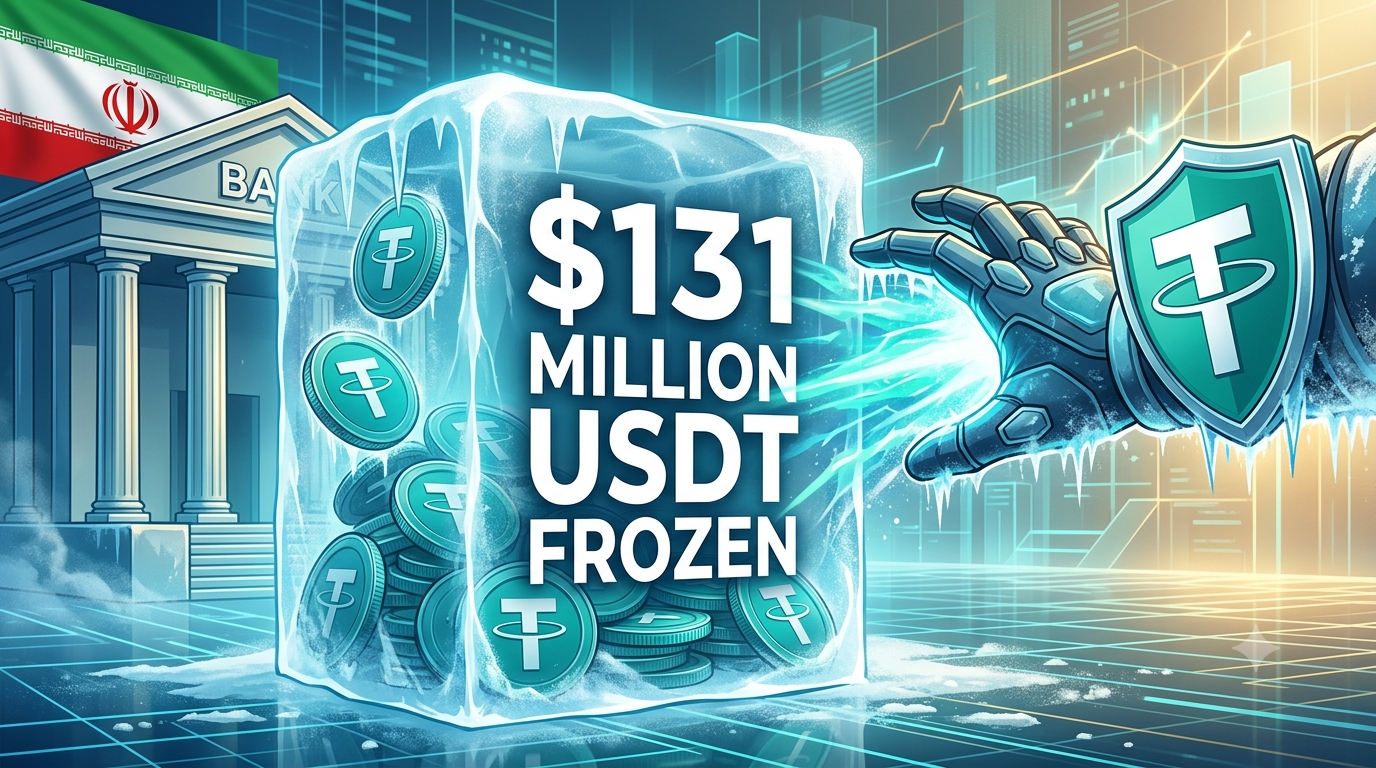
Tether’s freeze of roughly $131 million in USDT across four TRON wallets linked by U.S. authorities to the Central Bank of Iran is one of July 2026’s most important stablecoin stories. On July 14, the U.S. Treasury’s Office of Foreign Assets Control, or OFAC, added the addresses to the Iranian central bank’s sanctions entry. Chainalysis reported that the wallets had received more than $165 million in stablecoins and that about $131 million was subsequently frozen by Tether. The distinction matters: OFAC designated the addresses; Tether used issuer-level controls to stop the tokens from moving.
The incident does not prove that public blockchains have failed. It proves that a dollar-backed token can settle on a decentralized network while remaining subject to centralized governance, legal orders, compliance screening, and issuer intervention. Crypto users now need to separate blockchain decentralization from token-level control.
Key Takeaways
-
Tether, not TRON, froze the USDT after OFAC added four Central Bank of Iran-linked addresses to sanctions records.
-
The funds were frozen, not automatically confiscated or transferred to the U.S. government.
-
The wallets received over $165 million, but about $131 million remained to freeze.
-
The action follows the June 2 sanctions against four major Iranian crypto exchanges.
-
Stablecoins are not finished, but the idea that all on-chain money is censorship-resistant is.
-
Users should evaluate issuer-freeze risk separately from depeg, reserve, exchange, bridge, and private-key risks.
What Happened in the $131 Million USDT Freeze?
OFAC Designated Four TRON Addresses, and Tether Enforced the Restriction
This was a sanctions-enforcement sequence, not a hack or network failure. OFAC’s July 14 update added four TRON addresses to the sanctions entry for the Central Bank of Iran. The official listing associates the entry with Iran-related, counterterrorism, Islamic Revolutionary Guard Corps, and other sanctions tags. Chainalysis then reported that Tether froze approximately $131 million held by the newly identified wallets.
| Stage | Actor | What Changed |
| Identification | Authorities and analytics providers | Four TRON wallets were attributed to the Central Bank of Iran |
| Legal designation | OFAC | The addresses were added to sanctions records |
| Token restriction | Tether | USDT held by the addresses became non-transferable through issuer controls |
Headlines saying the “U.S. froze” $131 million compress separate legal and technical actions. OFAC publishes designations and imposes legal obligations. Tether controls the USDT contract functions capable of restricting addresses. TRON records the outcome but does not independently choose whom to block.
The $165 Million and $131 Million Figures Measure Different Things
The four wallets received more than $165 million in stablecoins over time, while approximately $131 million remained when the freeze was executed. Chainalysis separates cumulative inflows from the amount frozen. The roughly $34 million difference may include earlier transfers, conversions, or payments and should not be labeled “missing” without additional evidence.
“Total received” is a historical flow. “Balance at designation” is a point-in-time stock. “Amount frozen” is an enforcement result. Keeping those metrics separate prevents exaggerated seizure claims.
Was the USDT Seized, Frozen, or Destroyed?
The Assets Were Restricted, Not Automatically Transferred to the Government
The most accurate term is frozen. Chainalysis reported that Tether restricted approximately $131 million held by the newly designated wallets. Public information does not show the full balance being automatically transferred to a government-controlled address at designation.
A token freeze generally means the contract rejects normal transfers involving a blacklisted address. The wallet and private keys may still exist, the balance may remain visible, and unrelated assets at the address may not face the same token-specific restriction. However, the private key alone can no longer move the affected USDT because the issuer’s contract rules intervene.
This is why “not your keys, not your coins” is incomplete for centrally issued stablecoins. Self-custody reduces exchange custody risk, but it does not remove the issuer’s authority over the token.
Frozen USDT Is Not the Same as Burned USDT
A burn permanently removes tokens from circulation; a freeze restricts their use. The $131 million action therefore does not automatically mean USDT supply fell by the same amount, nor does it indicate a reserve shortfall. The immediate impact falls on the designated wallets and counterparties whose compliance systems identify exposure to them.
Further steps—such as continued immobilization, a legally authorized transfer, or a later release—should not be assumed until confirmed.
Why Can Tether Freeze USDT on a Public Blockchain?
USDT Combines Decentralized Settlement With Centralized Issuance
TRON can be decentralized at the network level while USDT remains centrally administered at the asset level. Validators process blocks, users hold keys, and transactions are public. Yet Tether controls issuance, redemption, and address restrictions. That structure follows from the product itself. A fiat-backed stablecoin is issued against reserves and redeemed through an identifiable company. The administrative system that supports minting and redemption can also support sanctions compliance.
Recent June 2026 compliance analysis noted that OFAC was moving toward formal sanctions-program requirements for permitted stablecoin issuers, while OFAC’s Iran guidance warned that intermediaries dealing with designated Iranian exchanges can face sanctions consequences.
USDT therefore offers open-network distribution, not Bitcoin-style monetary neutrality. It can function like a digital dollar without becoming a permissionless bearer asset.
TRON’s Scale Makes the Action Globally Relevant
TRON is one of the largest stablecoin settlement networks. A July 2026 market summary citing DefiLlama data estimated that TRON hosted about $90 billion in stablecoins in June, while another July report said the network settled roughly $681 billion in stablecoin transfers over 30 days.
Low costs, wide exchange support, and deep USDT liquidity make TRON useful for remittances, commerce, and trading. The same characteristics can attract entities trying to move value around banking restrictions.
The network does not assign legal intent to a transaction. Analytics firms, regulated platforms, authorities, and token issuers perform attribution and enforcement.
Why Iran-Linked Crypto Activity Is Under Greater Pressure
The Freeze Follows a Broader June Crackdown on Iranian Exchanges
The July action is part of a wider campaign. On June 2, the U.S. Treasury sanctioned Nobitex, Wallex, Bitpin, and Ramzinex. Treasury said Nobitex processed more than half of Iranian digital-asset inflows in 2025 and accused the exchange of supporting sanctions evasion and regime-linked activity. Chainalysis said the targeted exchanges helped the Central Bank of Iran access stablecoins and facilitated activity connected to sanctioned actors.
Reuters reported that the Nobitex action also covered senior figures and alleged connections to the Iranian government and the Islamic Revolutionary Guard Corps. Nobitex denied direct government ties and said misuse could occur without management knowledge.
The strategy now targets both gateways and wallets. Institutions can be sanctioned, addresses can be listed, stablecoin issuers can freeze tokens, and compliant exchanges can screen connected deposits.
Stablecoins Are Now Part of Geopolitical Finance
Stablecoins are no longer only exchange collateral. They support remittances, payroll, commerce, treasury operations, and cross-border settlement. A state-linked entity may obtain dollar-denominated liquidity without completing a conventional international bank transfer. Yet the digital-dollar issuer can restrict that liquidity once authorities identify the wallets and impose sanctions.
Stablecoins can bypass one layer of traditional financial intermediation while creating another at the token level. Their practical value therefore depends on the user’s legal status, counterparties, address history, issuer, and access to exchanges or redemption channels.
Is the Stablecoin Decentralization Narrative Over?
The Simplistic Narrative Is Over; the Use Case Is Not
Stablecoins are not finished, but the claim that all blockchain-based money is automatically decentralized should be retired. Decentralization varies across the network, token contract, issuer, reserve custodian, bridge, exchange, wallet interface, and redemption system.
Bitcoin minimizes issuer risk because no company promises dollar redemption and no administrator can blacklist BTC at the protocol level. USDT serves a different purpose: maintaining dollar value and transactional liquidity through an issuer and reserve structure. The trade-off is centralized monetary control.
A more accurate description is open-network distribution with permissioned asset governance. That model appeals to institutions and regulators because intervention is possible. Users prioritizing censorship resistance may view the same feature as a weakness.
The relevant question is not whether USDT is decentralized in every respect. It is which parts of its infrastructure are decentralized and which remain under corporate or legal control.
The Market Treated the Freeze as Targeted, Not Systemic
There was no immediate sign of a broad USDT confidence collapse. At approximately noon Singapore time on July 17, USDT traded near $0.9987, Bitcoin around $63,529, and TRX near $0.3155. This time-sensitive snapshot suggests the market viewed the action as address-specific enforcement rather than a system-wide stablecoin failure.
Recent estimates continued to place USDT first among stablecoins, with roughly $184.7 billion in supply in June, while the wider stablecoin market was estimated near $307 billion in mid-July. Liquidity and exchange integration remain strong despite concerns about issuer control.
The likely outcome is market segmentation rather than abandonment. Traders may keep using USDT for liquidity, institutions may prefer different compliance structures, and censorship-resistant users may hold more BTC or decentralized alternatives.
What the Freeze Means for Crypto Traders and Investors
Add Issuer-Freeze Risk to the Stablecoin Framework
“Stable” refers to a price target, not unrestricted transferability. Users should separate the following risks:
| Risk | Practical Question |
| Peg risk | Can the token continue trading close to one dollar? |
| Reserve risk | Are sufficient assets available for redemptions? |
| Issuer and legal risk | Can the issuer restrict transfers or redemptions? |
| Counterparty risk | Could an exchange, broker, or custodian fail? |
| Chain and bridge risk | Could a network, contract, or bridge malfunction? |
| Address-exposure risk | Has the wallet interacted with sanctioned entities? |
The Iran case is primarily an issuer-and-legal-risk event with secondary address-exposure implications. It is not primarily a peg event.
Treating all USDT as impaired exaggerates the action. Ignoring the freeze because the peg held understates it.
A complete risk assessment should also consider how the stablecoin is held. USDT stored in a self-custody wallet carries different risks from USDT placed on a centralized exchange, deposited into a lending protocol, transferred through a bridge, or used as derivatives collateral.
Exchange and OTC Screening Will Matter More
Compliance systems will likely scrutinize the listed wallets and their counterparties. Chainalysis maintains an OFAC sanctions tracker, while compliance specialists warned after the June Iranian exchange designations that virtual-asset service providers should examine direct and indirect exposure, especially in TRON-based stablecoin flows.
A random incoming transaction does not automatically make a user sanctioned. However, exchanges may delay deposits, request source-of-funds evidence, or reject transactions when analytics identify meaningful exposure.
Users handling large stablecoin payments should retain records, avoid unknown OTC counterparties, verify wallet addresses, and use reputable explorers or screening services. Transaction documentation may be particularly important when funds have passed through several intermediary wallets.
Diversify Across Infrastructure, Not Only Ticker Symbols
Several stablecoins held on one exchange still share platform risk. Multiple bridged tokens on one blockchain still share bridge risk. USDT divided among many wallets still shares issuer-freeze risk.
Real diversification considers the issuer, reserve pool, blockchain, custodian, smart contract, exchange, and legal jurisdiction behind each balance.
A trader may use USDT for market liquidity, another stablecoin for access to specific platforms, Bitcoin for issuer-free self-custody, and fiat for near-term operating expenses. The appropriate combination depends on jurisdiction, time horizon, and intended use.
The goal is not to identify one universally superior asset. It is to prevent one hidden dependency from controlling the entire portfolio.
What the Event Means for DeFi and On-Chain Markets
Composability Does Not Erase Base-Token Controls
Depositing USDT into lending markets, liquidity pools, bridges, or vaults does not necessarily remove Tether’s contract authority. An issuer freeze could trap assets, create accounting mismatches, or impair a protocol’s collateral.
DeFi interfaces should therefore disclose blacklist controls, bridge dependencies, and redemption limitations rather than labeling every dollar token simply as “stable.” Protocol governance should also establish procedures for responding when a treasury asset, collateral address, or liquidity position becomes restricted.
The incident may encourage interest in crypto-backed stablecoins, tokenized bank deposits, and synthetic dollar products. However, each design relocates risk rather than eliminating it.
Crypto-backed assets can carry liquidation and oracle risks. Tokenized bank deposits may be even more permissioned. Synthetic dollars can depend on derivatives markets, custodians, funding rates, and counterparties.
Users should choose failure modes that match their intended purpose instead of searching for a completely risk-free stablecoin.
What Crypto Users Should Watch Next
The Next Signal Is Enforcement Expansion, Not Headline Volume
Three developments will show whether this case remains isolated or becomes a broader market event.
First, watch OFAC’s recent-action feed and issuer announcements for additional wallet designations, related address clusters, or changes to the frozen balances. OFAC’s July 14 update demonstrates that existing sanctions entries can be expanded with new blockchain identifiers, while Chainalysis’ sanctions tracker shows that crypto-related designations are increasingly treated as an ongoing monitoring process rather than one-off events.
Second, monitor exchange deposit rules, OTC screening, TRON stablecoin flows, and spreads between USDT and competing dollar tokens. Compliance friction may appear before price stress.
Third, distinguish targeted enforcement from systemic warning signs. A lasting USDT depeg, disrupted redemptions, rapidly shrinking liquidity, or broad exchange restrictions would matter more than repeated headlines about the same wallets. As of July 17, the price data did not show that kind of system-wide break.
How to Approach USDT Trading on KuCoin After the Freeze
The $131 million freeze is a reason to trade with better context, not a reason to make an emotional market move. On KuCoin, eligible users can follow USDT-denominated spot and derivatives markets, compare liquidity across crypto assets, and react to changing conditions without treating targeted sanctions enforcement as a system-wide depeg.
KuCoin’s July product updates show continued expansion of USDT-settled markets, including 24/7 derivatives in supported regions, while its June regulatory coverage emphasized that access and product rules vary by jurisdiction.
The more interesting opportunity is analytical: monitor whether USDT holds its peg, whether TRX liquidity changes, whether exchange deposit policies tighten, and whether competing stablecoins gain volume. Before trading, confirm the network, check wallet history, complete required identity verification, and remember that leverage can magnify losses even when the news appears clear.
KuCoin can be a venue for observing and expressing a market view, but it cannot remove issuer, sanctions, custody, or volatility risk. Curiosity can shape the thesis; disciplined position sizing should govern the trade.
Conclusion
Tether’s freeze of roughly $131 million in USDT linked to four Central Bank of Iran-associated TRON wallets is targeted, issuer-level sanctions enforcement. OFAC identified and designated the addresses; Tether used control over the USDT token to prevent the funds from moving. The assets were not automatically converted into government property, TRON did not fail, and the action did not by itself indicate impaired USDT reserves.
The larger lesson is that stablecoins combine openness and control. Public blockchains provide global settlement, transparent balances, and self-custody, while centralized issuers retain authority over minting, redemption, and blacklisting. That does not end the stablecoin use case; it ends the assumption that dollar tokens offer Bitcoin-like censorship resistance.
Crypto users should separate peg risk from freeze risk, monitor address exposure, diversify across issuers and infrastructure, and retain records for significant transactions. The narrative is not over. It is becoming more accurate—and more useful for anyone managing real capital on-chain.
FAQs
Can Tether Reverse a USDT Freeze?
Yes. Tether can technically remove an address from its blacklist or take another authorized action, but users should not assume a reversal will occur. Any change depends on the issuer’s legal, compliance, and operational process.
Does an OFAC-Listed Address Automatically Freeze Every Cryptocurrency It Holds?
No. OFAC designation creates legal restrictions, but token-level freezing depends on the asset’s design and actions taken by issuers, custodians, exchanges, or other intermediaries. Native assets without issuer-controlled blacklists may remain technically transferable even when dealing in them would violate applicable law.
Can Someone Receive Frozen USDT Without Realizing It?
Normally, blacklisted USDT cannot leave the restricted address. However, users may receive funds with problematic transaction histories from non-blacklisted counterparties, which can trigger review when deposited at an exchange.
Are Decentralized Stablecoins Immune to Sanctions?
No. A protocol may lack a single issuer blacklist, but its front ends, oracles, collateral assets, bridges, governance participants, and exchange access can still be affected by sanctions or other legal controls.
Will the $131 Million Freeze Permanently Change the USDT Price?
There is no evidence that this targeted action alone will permanently alter the peg. USDT traded close to one dollar on July 17, but future stability depends on liquidity, reserves, redemptions, market confidence, and regulation.
Disclaimer: This article is for informational purposes only and does not constitute financial or investment advice. Cryptocurrency investments carry significant risk. Always conduct your own research before trading.