

Cathie Wood: From $59 Billion Peak to $1.2 Million Bitcoin Prediction
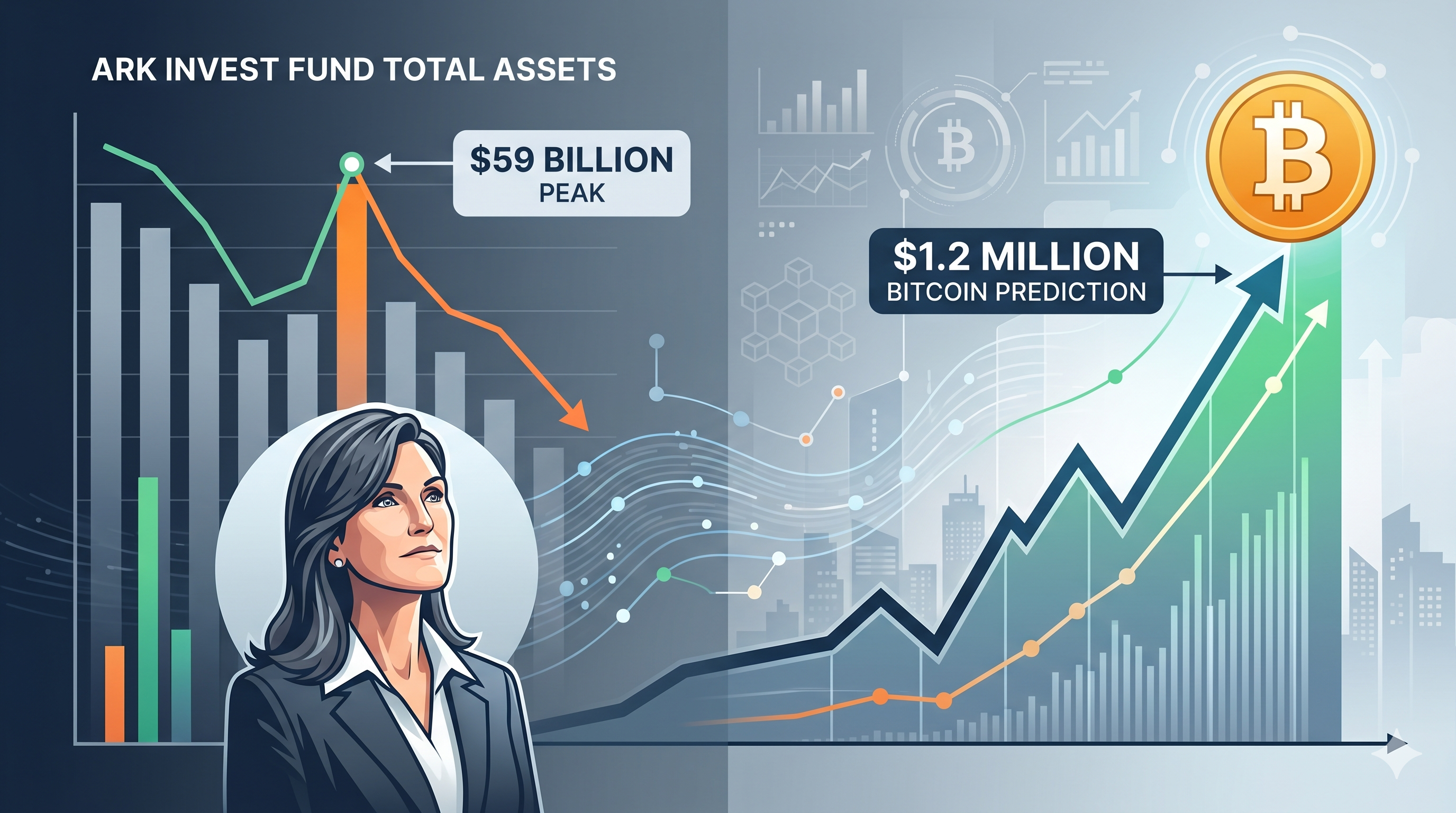
Cathie Wood, the founder and CEO of ARK Invest, stands at a pivotal crossroads in the spring of 2026. Her flagship ARK Innovation ETF (ARKK) famously commanded a staggering $59 billion at its pandemic-era zenith. Today, operating in a dramatically shifted macroeconomic environment, Wood has refined her thesis, focusing heavily on foundational infrastructure over consumer software. Her most headline-grabbing move in the last two months has been a firm restatement of her Bitcoin prediction, placing the premier digital asset at a $1.2 million valuation by 2030. This comprehensive 2026 analysis dissects ARK Invest’s latest strategic portfolio reallocations, synthesizes recent institutional adoption data from March to May, and explains why Wood believes the convergence of artificial intelligence and blockchain is the ultimate wealth-generating event of this decade.
Key Takeaways
-
The Adjusted $1.2 Million Target: In recent Q1 2026 investor updates, ARK Invest officially revised its 2030 Bitcoin price prediction to $1.2 million, recognizing unprecedented institutional stabilization.
-
Evolution from the Peak: Wood’s firm has successfully pivoted away from the pure consumer SaaS applications that drove her 2021 success, heavily reallocating capital into foundational AI hardware and layer-one blockchain infrastructure.
-
The "Great Acceleration" Thesis: ARK's Spring 2026 strategy relies entirely on the synergistic convergence of five technologies: artificial intelligence, multi-omics, robotics, space infrastructure, and decentralized blockchain networks.
-
Institutional Absorption: Between March and May 2026, spot ETF inflows and corporate treasury adoptions have permanently altered Bitcoin's supply dynamics, absorbing liquid supply at historic rates.
The $59 Billion Zenith: Revisiting Cathie Wood’s Historic Peak
The Pandemic Tech Boom and the Rise of ARKK
The astronomical rise of ARK Invest to $59 billion in assets under management was a direct result of aggressive, concentrated bets on digital-first companies uniquely positioned to thrive during global lockdowns. Wood’s core thesis during this period assumed that the pandemic was not a temporary disruption, but a permanent accelerant for remote infrastructure, telemedicine, and digital entertainment. Consequently, her flagship ARKK fund saw triple-digit percentage gains as retail and institutional capital flooded into "stay-at-home" stocks. This era validated Wood's aggressive growth-investing model, proving that exponential technologies can capture massive market share rapidly when physical alternatives are forcibly restricted. Looking back from 2026, this peak represents a unique historical anomaly—a perfect storm of maximum technological necessity combined with zero-interest-rate monetary policy.
The Inevitable Correction and Reality Check
The subsequent collapse from the $59 billion peak was a harsh valuation reality check, driven primarily by the global central banking shift toward aggressive quantitative tightening. When interest rates began their steep ascent to combat inflation in 2022 and 2023, the discounted cash flow models that justified the astronomical valuations of ARK’s unprofitable tech darlings broke down. Capital immediately fled speculative growth assets in favor of yield-bearing, cash-flow-positive legacy businesses. This severe macroeconomic rotation forced a brutal drawdown in ARKK’s net asset value and a massive exodus of retail capital. However, this correction was a necessary crucible that stripped away speculative excess, revealing which technological frameworks possessed genuine long-term economic viability.
Lessons Learned: Shaping the 2026 Strategy
The severe volatility experienced between 2021 and 2024 fundamentally altered ARK's risk management and capital allocation strategies heading into 2026. Wood and her analysts learned that while software can scale infinitely, it is highly susceptible to rapid commoditization and lower barriers to entry. Therefore, the firm’s strategy shifted heavily toward deep tech and physical infrastructure—sectors with massive capital moats that cannot be easily replicated. This includes aggressive positioning in advanced semiconductor foundries, robotic manufacturing automation, and base-layer blockchain protocols.
From Pandemic Darlings to Infrastructure Giants
In the spring of 2026, ARK Invest’s portfolio reflects a deep pivot toward foundational infrastructure companies that provide the computing power and energy necessary for the AI era. Wood recognizes that the easy gains of the consumer digitalization wave have been fully realized. The firm is now hunting for enterprises building the physical and digital rails that power the global economy. This transition acknowledges that true disruption in 2026 requires massive capital expenditure. Consequently, ARK is aggressively allocating capital to advanced-process semiconductor manufacturers, next-generation energy storage companies, and decentralized ledgers.
Unwavering Conviction Amidst Q2 Volatility
Despite the ongoing market volatility characterizing Q2 2026, Cathie Wood’s fundamental conviction in the deflationary power of disruptive innovation remains absolute. She continues to assert that global equity markets are severely mispricing the long-term impacts of exponential technologies. In multiple media appearances throughout April and May 2026, Wood emphasized that legacy corporations face an existential threat from technological obsolescence. Her thesis dictates that innovation is the only true hedge against macroeconomic instability and fiat currency debasement.
Reallocating Capital: March-April 2026 Adjustments
Recent SEC filings from March and April 2026 reveal that ARK Invest has executed aggressive portfolio rebalancing, systematically trimming positions in mature tech stocks to fund acquisitions in emerging blockchain and AI infrastructure. This reallocation strategy demonstrates a proactive approach to capturing the next massive growth wave. Specifically, ARK has been offloading shares of established, mega-cap tech companies that have reached market saturation, redeploying that capital into mid-cap layer-one blockchain protocols and specialized AI hardware startups.
ARK Invest's 2026 Capital Reallocation Strategy
| Sector | 2021 Peak Allocation Focus | Spring 2026 Allocation Focus | Strategic Rationale |
| Technology | Consumer SaaS, remote work. | AI hardware, data infrastructure. | Shifting to capital-intensive "picks and shovels" of AI. |
| Digital Assets | Bitcoin proxies, exchanges. | Layer-1 protocols, RWA platforms. | Prioritizing decentralized settlement layers. |
| Healthcare | Telemedicine, remote diagnostics. | Multi-omics, AI drug discovery. | Moving to fundamental biological breakthroughs. |
| Manufacturing | EV consumer brands. | Autonomous robotics, space tech. | Focusing on automation of global supply chains. |
Decoding the $1.2 Million Bitcoin Prediction for 2030
Why the Target Shifted to $1.2 Million
The slight downward revision of Bitcoin’s 2030 price target to $1.2 million reflects ARK’s updated quantitative models, which now account for a less violent, more stabilized market cycle. Announced in recent investor updates, this adjustment acknowledges the mathematical reality of larger market capitalizations. As Bitcoin's liquidity and size grow due to institutional inflows, massive, erratic percentage gains naturally compress. Wood noted in her late-April 2026 market commentary that the asset simply does not need to achieve hyper-volatile blow-off tops to deliver tremendous portfolio value.
The "Shallowest Four-Year Decline"
Wood categorizes the most recent crypto market phase as the "shallowest four-year cycle decline" in Bitcoin’s history, directly signaling that the asset has achieved permanent structural resilience. Speaking in May 2026, she emphasized that the days of Bitcoin losing 80% of its value during "crypto winters" are effectively over. This increased resilience is driven by the transition of the underlying holder base from short-term retail speculators to long-term institutional holders with multi-decade investment horizons.
The Mathematics of the Projection
For Bitcoin to reach Cathie Wood’s $1.2 million target, its total market capitalization must fundamentally eclipse that of physical gold, cementing its status as the definitive global reserve asset. At $1.2 million per coin, Bitcoin’s market cap would exceed $25 trillion. Wood’s models justify this valuation by projecting that Bitcoin will capture a significant percentage of the global M2 money supply, acting as a mandatory hedge against endless fiat currency debasement. The mathematics rely heavily on the asset's absolute scarcity and continuously halving inflation rate.
The Institutionalization of Bitcoin
Spot ETFs and Corporate Treasury Adoption
Spot Bitcoin ETFs and corporate treasury acquisitions have fundamentally altered the underlying supply-demand dynamics of the cryptocurrency, absorbing liquid supply at unprecedented rates throughout the spring of 2026. Institutional asset managers are now executing daily, programmatic purchases on behalf of millions of retirement accounts and pension funds. Furthermore, the trend of public corporations placing Bitcoin on their balance sheets has accelerated significantly in the last two months. This twin engine of demand creates a permanent floor price for the asset, structurally preventing deep bear markets.
Real World Asset (RWA) Tokenization
Beyond Bitcoin itself, ARK Invest highlights Real World Asset (RWA) tokenization as a complementary catalyst driving massive institutional utility to blockchain networks in 2026. The tokenization of traditional financial instruments, such as U.S. treasury bills and commercial real estate, bridges the gap between decentralized finance protocols and legacy Wall Street institutions. According to ARK's May 2026 projections, the RWA market is expected to exceed $11 trillion by the end of the decade.
Sovereign Wealth Funds Entering the Fray
The most significant development validating Wood’s thesis in recent months has been the accelerating entry of sovereign wealth funds into the digital asset ecosystem. Recent data from April 2026 suggests that several forward-thinking nation-states are accumulating digital assets directly, bypassing traditional dollar-denominated reserves. Wood points to this trend as the ultimate proof of concept for Bitcoin’s utility as a politically neutral, censorship-resistant reserve asset.
Bitcoin Institutional Adoption Metrics (May 2026 Estimates)
| Entity Type | Estimated Global Holdings | Strategic Purpose |
| Spot ETFs | > 1.5 Million BTC | Passive retail and institutional exposure. |
| Public Corporations | > 450,000 BTC | Corporate treasury inflation hedging. |
| Private Companies | > 350,000 BTC | Strategic reserves and operational capital. |
| Sovereign Entities | > 250,000 BTC | Geopolitical diversification; escaping fiat. |
ARK’s "Grand Vision for 2026"
Blockchain as Financial Infrastructure
Within ARK's "Grand Vision," blockchain operates as the critical, non-negotiable financial settlement layer necessary for managing the immense economic output generated by artificial intelligence. Without a decentralized ledger, the economic gains of exponential technologies would be severely bottlenecked by the slow traditional banking system. Wood envisions a near future where autonomous AI agents use cryptocurrency to pay robotic systems for manufacturing time, bypassing human intervention. In this paradigm, digital assets are the required fuel for the machine-to-machine economy.
Artificial Intelligence: The Growth Engine
Artificial Intelligence serves as the primary catalyst and core power source for ARK's entire 2026 vision, acting as a profound growth engine that rapidly accelerates developments in all other sectors. Wood’s team states that AI is a fundamental driver of net-new revenue, demanding massive infrastructure expenditure. This creates a powerful trickle-down effect for companies manufacturing GPUs, designing data centers, and providing energy solutions. As AI models achieve generalized capabilities, they will inherently demand the fast, programmatic payment settlement that only blockchain technology can provide.
Robotics, Space Infrastructure, and Multi-omics
The physical manifestations of ARK's thesis—robotics, space exploration, and multi-omics—represent multi-trillion-dollar industries currently reaching broad commercial viability. In 2026, autonomous robotics is slated to eliminate massive inefficiencies in physical supply chains through robot-taxis and autonomous logistics. Concurrently, space commercialization has unlocked the new economic paradigm of space-based data centers. In healthcare, multi-omics is leveraging AI to aggressively target longevity and personalized medicine.
Regulatory Tailwinds in Early 2026
The regulatory landscape has shifted dramatically in favor of ARK's portfolio companies during the spring of 2026, primarily due to the SEC's implementation of clear, pro-innovation digital asset taxonomies. By decisively moving away from the era of "regulation by enforcement," federal agencies have provided the legal clarity necessary for institutions to deploy capital safely. The recent establishment of safe harbors for decentralized protocols directly benefits the layer-one blockchain networks heavily weighted in ARK's funds.
During the highly publicized congressional hearings on digital asset market structure in April 2026, Cathie Wood emerged as a vocal advocate for maintaining the momentum of financial deregulation. She publicly argued that restrictive securities laws actively harm American competitiveness by driving technological innovation offshore. Her public stance aligns perfectly with her investment thesis: she supports legislation that treats digital assets as a distinct, novel asset class requiring bespoke regulatory frameworks.
What This Means for Everyday Crypto Investors
Transitioning to Long-Term Allocation
For the everyday investor operating in 2026, Cathie Wood’s expansive projections underscore the absolute necessity of viewing cryptocurrency as a long-term, structural portfolio allocation. Retail investors must aggressively transition their mindset from chasing speculative altcoin pumps to steadily accumulating foundational assets. Wood’s $1.2 million target highlights the importance of treating digital assets as a core savings technology. By dollar-cost averaging into blue-chip digital assets, everyday investors can insulate themselves from inevitable fiat inflation.
Navigating Cycle Volatility
Even within a maturing market experiencing shallower drawdowns, the cryptocurrency sector remains inherently volatile, requiring investors to adopt a strict multi-year time horizon. Wood's philosophy teaches that volatility is not risk; it is the natural byproduct of a disruptive asset class undergoing global price discovery. Investors aligned with ARK’s vision must learn to zoom out. Short-term macroeconomic tremors are merely buying opportunities for those with the conviction to hold through the noise.
Identifying Asymmetric Opportunities
While Bitcoin remains the anchor of ARK's digital asset strategy, Wood’s thesis also highlights the massive asymmetric opportunities available in the broader decentralized ecosystem in 2026. Investors are encouraged to look beyond the premier digital currency to identify the specific layer-one protocols, oracle networks, and decentralized physical infrastructure networks (DePIN) actively facilitating the AI and RWA revolutions.
💡 Tips: New to crypto? KuCoin's Knowledge Base has everything you need to get started.
Conclusion
Cathie Wood’s journey from the $59 billion peak of her pandemic-era success to her highly convicted $1.2 million Bitcoin prediction perfectly encapsulates the rapid evolution of the modern financial landscape. Her firm, ARK Invest, has successfully navigated brutal market corrections by transitioning away from pure consumer software to focus relentlessly on deep infrastructure: artificial intelligence, multi-omics, robotics, space commercialization, and foundational blockchain technology. In the spring of 2026, Wood’s thesis is being validated in real-time by the aggressive, irreversible institutionalization of digital assets. With spot ETFs and corporate treasuries absorbing massive amounts of Bitcoin liquid supply, the market has matured, resulting in shallower drawdowns and institutional price stability. For investors willing to look past short-term volatility, Wood’s "Grand Vision" provides a compelling roadmap, dictating that true wealth generation will come from boldly allocating capital to the decentralized, automated technologies building the future global economy.
FAQs
Does Cathie Wood personally own Bitcoin?
Yes, Cathie Wood has publicly confirmed in numerous interviews that she personally owns a significant amount of Bitcoin as a long-term hedge against inflation.
What are the primary risks to ARK's $1.2 million prediction?
The main risks include severe, globally coordinated regulatory bans on digital assets, catastrophic flaws discovered in Bitcoin's core code, or a prolonged global economic depression stalling institutional capital inflows.
How does the 2024 Bitcoin halving impact the 2026 market targets?
The 2024 halving reduced the block reward paid to miners by 50%. By the spring of 2026, the market is fully experiencing this supply shock, driving upward price pressure as institutional demand remains high.
What exactly is "multi-omics" in ARK's investment portfolio?
Multi-omics is a biological analysis approach combining data from different "omes" (like genomes and proteins). ARK backs companies using AI to analyze this data to cure genetic diseases and personalize medicine.
Why did ARK Invest sell some of its ARKB ETF shares recently?
When ARK sells shares of its own Bitcoin ETF, it is an act of active portfolio rebalancing. If a crypto asset surges and becomes too large a percentage of the fund, ARK is structurally obligated to sell portions to maintain diversification.
Disclaimer: This article is for informational purposes only and does not constitute financial or investment advice. Cryptocurrency investments carry significant risk. Always conduct your own research before trading.