



Stablecoin Supply Hits New ATH: Is the 2026 Crypto Bull Market Finally Here?
2026/03/31 02:03:10
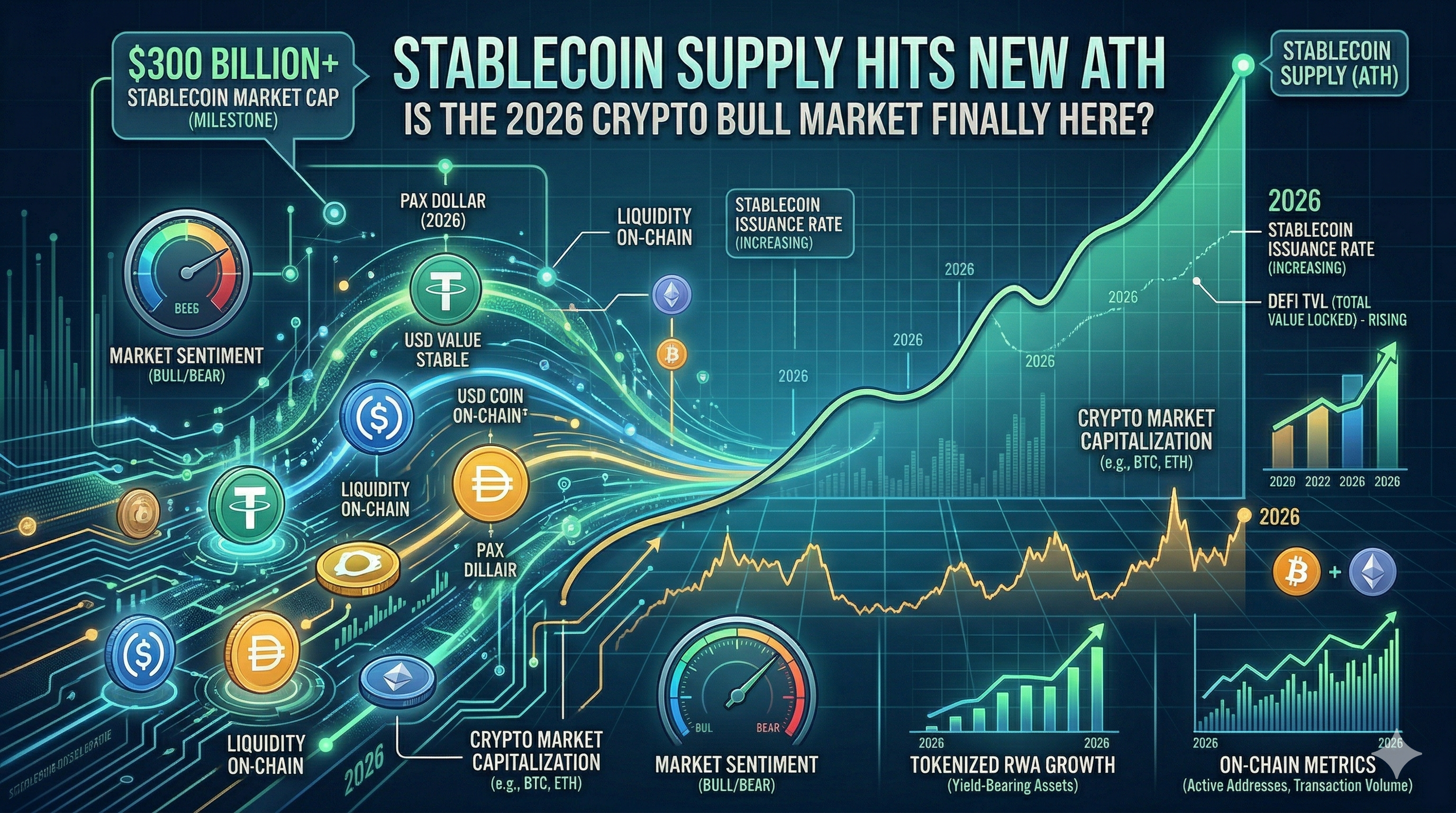
The digital asset landscape in 2026 has reached a definitive crossroads. As of the first quarter, the aggregate market capitalization of stablecoins has surged past previous records, hitting a monumental All-Time High (ATH) that suggests a massive accumulation of sidelined capital. In the world of decentralized finance and centralized exchanges, stablecoins represent the "dry powder" of the ecosystem—liquidity waiting for a signal to ignite.
This surge comes at a time when the global macroeconomic environment is shifting and the technical cycles of major assets like Bitcoin and Ethereum are reaching a point of historical maturity. The central question for investors, institutions, and retail participants remains: Is this record-breaking liquidity the final missing piece for the 2026 bull market, or has the nature of stablecoins evolved into something that no longer guarantees a vertical price rally?
Key Takeaways
-
Liquidity at a Historical Peak: As of March 2026, the aggregate stablecoin market capitalization has shattered previous records, surpassing $315 billion. This unprecedented level of "dry powder" represents a massive buildup of sidelined capital ready to move into volatile assets.
-
The "SSR" Buying Power Signal: The Stablecoin Supply Ratio (SSR) has dropped to a critical range below 10.0. This technical divergence indicates that the current stablecoin supply has the highest relative purchasing power for Bitcoin in over two years, acting as a structural "coiled spring" for the next leg of the bull run.
-
Regulatory De-risking via the GENIUS Act: The 2025 passage of the GENIUS Act has fundamentally changed the market's plumbing. By providing a clear federal framework for "Permitted Payment Stablecoin Issuers," the US has opened the gates for major banks and institutional treasuries to hold and deploy digital dollars legally.
-
Shift from Speculation to Utility: Unlike the 2021 cycle, over 30% of stablecoin volume is now driven by non-speculative use cases, including RWA (Real World Asset) settlements, AI-agent micro-payments, and cross-border B2B transactions, creating a more stable and "sticky" liquidity floor.
-
Institutional "Smart Money" Accumulation: On-chain data confirms that while retail sentiment remains cautious, "Whale" addresses are aggressively absorbing stablecoin inflows. The recent surge in USDC supply on Solana and Ethereum suggests that sophisticated players are positioning for a Q2 2026 breakout.
-
The End of the Four-Year Cycle: The massive influx of regulated stablecoins is effectively "dampening" traditional crypto volatility. Analysts predict that 2026 will mark the end of the traditional four-year boom-bust cycle, replaced by a more sustained, liquidity-driven "Institutional Era."
What Does a Rising Stablecoin Supply Really Mean?
In the early eras of cryptocurrency, a spike in stablecoin issuance was a simple, binary indicator: more USDT or USDC meant more people were preparing to buy Bitcoin. In 2026, the interpretation of this data requires a more nuanced lens. At its core, a rising supply represents an increase in the "monetary base" of the crypto-economy. When the total value of stablecoins grows, it essentially expands the potential energy of the market. Because these assets are pegged to the US Dollar, they provide a stable unit of account that reduces the friction of moving value from legacy bank accounts into blockchain-based protocols.
However, the location of this supply is just as critical as the total volume. On-chain analytics currently show a strategic split. A significant portion of the new supply is residing on Centralized Exchanges (CEXs), which is traditionally a precursor to high-volatility upward movements. Meanwhile, a growing percentage is locked within yield-generating DeFi protocols. This suggests that while some capital is waiting for a 'buy' signal, other segments of this liquidity are content to sit as a digital-native version of a high-yield savings account. For traders looking to track these liquidity shifts in real-time, platforms like KuCoin provide comprehensive market depth tools and stablecoin pair analytics, allowing users to see exactly when this 'dry powder' begins moving into major assets like Bitcoin and Ethereum.
Furthermore, we must consider the Stablecoin Supply Ratio (SSR). This metric compares the market cap of Bitcoin against the total supply of stablecoins. When the SSR is low, it indicates that the current stablecoin supply can purchase a larger portion of the circulating Bitcoin supply. In early 2026, we are seeing a "Low SSR" environment despite Bitcoin's relatively high price floor. This divergence is a classic bullish signal, suggesting that even if Bitcoin were to face a sudden sell-off, there is more than enough "dry powder" to absorb the shock and drive prices toward new heights.
The Macroeconomic Shift: Why 2026 is Different
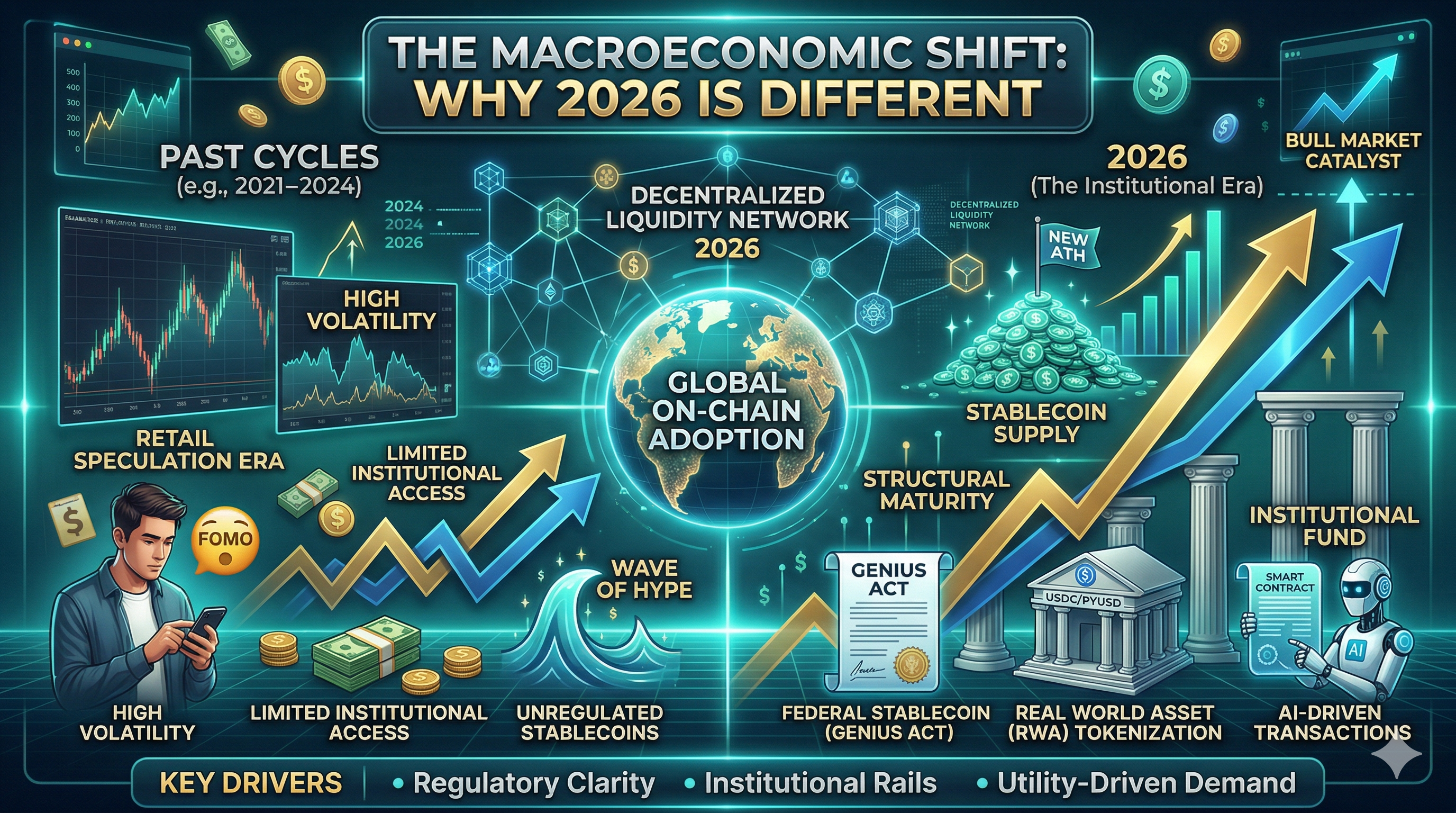
The 2026 market is not a carbon copy of 2021 or even 2024. The most significant differentiator is the level of institutional "normalization." In years past, stablecoins were often viewed with skepticism by regulators and traditional financiers. Today, following the implementation of comprehensive frameworks like MiCA in Europe and the Stablecoin Transparency Act in the United States, these assets have become a legitimate extension of the global financial system. Large-scale asset managers and commercial banks are now utilizing stablecoins—particularly USDC and various bank-issued "flatcoins"—as a settlement layer for cross-border transactions.
This institutional adoption creates a "floor" for stablecoin supply that didn't exist in previous cycles. Much of the current ATH supply is not speculative; it is operational. This means that while there is more money in the system, its movement is governed by corporate treasury cycles and institutional risk-management protocols rather than the whims of retail "day traders." This leads to a more stable but perhaps less explosive growth trajectory. The "Macroeconomic Shift" also involves the interest rate environment. In 2026, as the Federal Reserve and other central banks stabilize rates after the volatility of the mid-2020s, stablecoins have emerged as the primary vehicle for "On-chain T-Bills." This convergence of TradFi yields and DeFi efficiency is attracting a class of capital that previously avoided the crypto space entirely.
Another factor making 2026 unique is the "Global South" adoption curve. In many emerging economies, stablecoins have moved beyond a trading tool to become a primary means of preserving wealth against local currency devaluation. This "utility-driven" demand contributes to the ATH supply but doesn't necessarily translate into immediate Bitcoin buying pressure. Instead, it creates a massive, global network of users who are already "on-chain," making the eventual transition into other crypto assets much easier when the bull market sentiment finally takes hold.
Catalysts for a 2026 Bull Run: Beyond Stablecoins
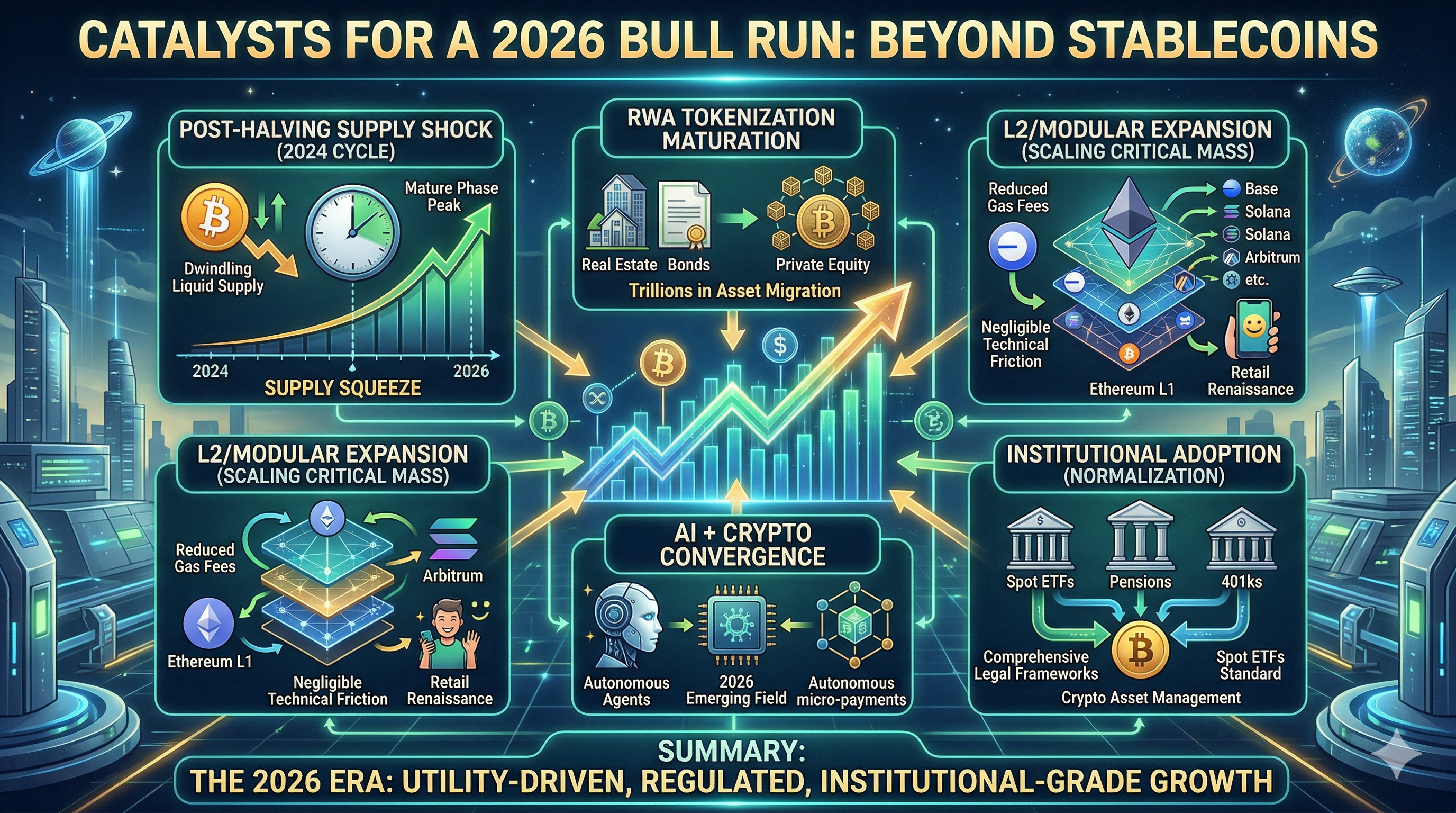
While liquidity is the fuel, a bull market requires a spark. In 2026, those sparks are coming from several high-conviction sectors. The most prominent is the maturation of Real World Asset (RWA) tokenization. We are seeing trillions of dollars in private equity, real estate, and government bonds being moved onto the blockchain. Stablecoins serve as the medium of exchange for these assets. As the RWA sector grows, it creates a virtuous cycle: more assets on-chain require more stablecoins, which increases the total liquidity of the ecosystem, which in turn makes the environment more attractive for speculative ventures.
The technical infrastructure has also reached a point of "Invisibility." In 2026, Layer 2 (L2) and Layer 3 (L3) solutions have made transaction fees negligible. The user experience has improved to the point where a retail user can interact with a DeFi protocol without even knowing they are using a blockchain. This removal of technical friction is a massive catalyst for the "Retail Renaissance." When the psychological trigger of a bull market occurs, the barrier to entry will be lower than it has ever been in history.
Additionally, we must look at the "Post-Halving Dynamics." Historically, the year following a Bitcoin halving (which occurred in 2024) is characterized by supply shock and price discovery. 2026 represents the mature phase of this cycle. With the institutional "Spot ETFs" now a standard part of pension funds and 401k plans, the demand side of the equation is more robust and less prone to the "panic selling" seen in earlier cycles. The combination of record stablecoin liquidity and the dwindling supply of liquid Bitcoin on exchanges creates a "supply squeeze" scenario that could define the 2026 rally.
Lastly, the emergence of AI-driven finance is a wildcard catalyst. In 2026, autonomous AI agents are increasingly using stablecoins to pay for API access, decentralized compute power (DePIN), and data sets. This introduces a new, non-human participant in the market that operates 24/7. These agents require constant liquidity, further bolstering the demand for stablecoins and creating a constant "bid" under the market that didn't exist in previous years.
The Bear Case: If Not Now, When?
Despite the bullish data, a responsible market participant must consider the "Bear Case" or the "Delayed Bull Case." The primary risk in 2026 is liquidity fragmentation. While the total supply of stablecoins is at an ATH, that supply is spread across dozens of different blockchains and L2 scaling solutions. This "siloing" of capital can prevent a unified market move. If the $350 billion in stablecoins is split too thinly across Ethereum, Solana, Base, Monad, and others, the impact on any single asset—including Bitcoin—might be diluted.
The risk of "Regulatory Overreach"
While 2026 has brought much-needed clarity, it has also brought increased costs. Compliance with "Travel Rule" requirements and KYC/AML protocols for stablecoin issuers means that the "permissionless" nature of this liquidity is being challenged. If regulators impose strict caps on how institutions can move stablecoins into volatile assets, the record supply might become "trapped" in authorized, low-risk pools, unable to trigger a broader market rally.
The Market's "Saturation Point"
Is it possible that the market has already "priced in" the record stablecoin supply? If the growth in supply is merely keeping pace with the growth of the digital economy's needs (for payments and RWA), then it may not represent "excess" liquidity available for a pump. In this scenario, the market might remain in a prolonged "sideways" accumulation phase through 2026, frustrating those who expect a repeat of the parabolic runs of the past. If the bull market doesn't materialize by the end of 2026, the market may face a crisis of confidence, as the "four-year cycle" theory would be effectively debunked.
Conclusion
The record-breaking stablecoin supply of 2026 is a dual-edged sword of unprecedented potential and structural complexity. On one hand, the sheer volume of "dry powder" suggests that the crypto-economy has never been better capitalized. The presence of these funds, combined with institutional-grade infrastructure and new technological catalysts like RWA and AI, points toward a bull market that is not just speculative, but fundamentally grounded in utility. On the other hand, the evolution of stablecoins into a mainstream financial tool means that they no longer serve solely as a gateway to Bitcoin; they are now an end-destination for many users.
Whether 2026 becomes the year of the "Greatest Bull Run" or a year of "Institutional Consolidation" will depend on how this record liquidity is deployed. As an investor, the key is to monitor the movement of stablecoins from passive yield protocols back into active trading pairs. The "fire" is ready; the "fuel" is at an all-time high. The coming months will determine if the spark of market sentiment is strong enough to set the 2026 bull market ablaze.
FAQs
Why does ATH in stablecoin supply matter if Bitcoin's price isn't moving yet?
Stablecoin supply is a leading indicator, not a lagging one. It represents the accumulation of capital. Historically, there is often a multi-month lag between a surge in stablecoin issuance and a major price breakout in Bitcoin and Altcoins, as investors wait for the right macroeconomic conditions or technical setups to deploy their "dry powder."
Which stablecoins should I watch in 2026 to gauge market health?
While USDT (Tether) remains the liquidity leader for global trading, USDC and bank-issued stablecoins are better indicators of institutional sentiment. A rise in USDC supply often correlates with "smart money" entering the space, whereas USDT growth often reflects retail and emerging market demand.
How does the 2026 "Stablecoin Supply Ratio" (SSR) differ from previous years?
In 2026, the SSR is influenced by the fact that many stablecoins are used for non-speculative purposes like RWA and B2B payments. Therefore, a "low" SSR is an even more powerful bullish signal today than it was in 2021, because it means that despite billions being used for "utility," there is still massive excess liquidity available for asset purchases.
Could a sudden regulatory crackdown on stablecoins end the bull market?
Regulatory risk is always present, but in 2026, the risk has shifted from "banning" to "heavy oversight." A crackdown on a major issuer would cause short-term volatility, but the decentralized nature of newer, over-collateralized stablecoins and the existence of multiple regulated issuers provide the market with much higher resilience than it had during the Terra/Luna collapse of 2022.
Does more stablecoins mean more inflation in the crypto market?
Not necessarily. Unlike fiat money printing, stablecoins are (ideally) backed 1:1 by reserves. An increase in supply usually means an equivalent amount of fiat has been deposited into the ecosystem. This isn't "inflation" in the traditional sense; it is "expansion" of the market's total value and liquidity.
How can I track stablecoin inflows myself?
While on-chain aggregators like Glassnode are excellent for macro trends, individual traders often find more immediate insights on high-liquidity exchanges. Monitoring the 'Stablecoin-to-Crypto' volume on KuCoin is a practical way to gauge retail sentiment, as it offers a clear view of which specific altcoins are being targeted by fresh liquidity as soon as it enters the market."