

BIS Warns AI Spending Boom Could Trigger Prolonged Investment Recession: What It Means for Your Crypto Portfolio
2026/07/01 10:00:00
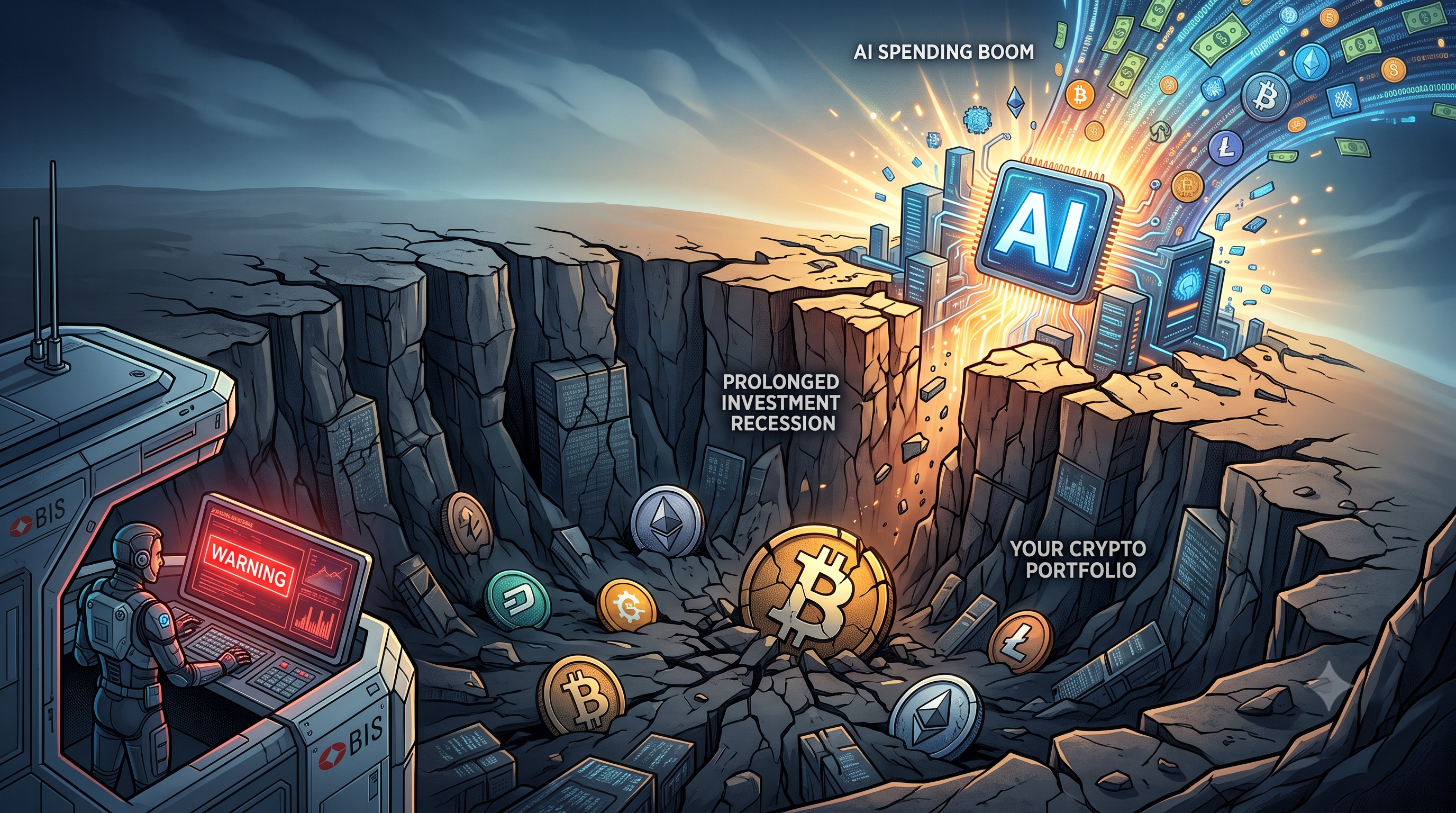
In late June 2026, the Bank for International Settlements (BIS)—often referred to as the "central bank for central banks"—dropped a bombshell on global financial markets. In their annual economic report, the BIS issued a stark warning: the staggering $1 trillion projected to be spent by Big Tech on artificial intelligence infrastructure over the next few years is creating a dangerous bubble. If this "AI exuberance" fails to deliver proportional economic returns, we could be staring down the barrel of a prolonged, global investment recession.
But why should crypto investors care about a warning aimed at Wall Street and Silicon Valley?
The answer lies in macro liquidity. Historically, when the Nasdaq and traditional tech stocks catch a cold, the crypto market gets pneumonia. A burst in the traditional AI bubble would trigger a massive liquidity drain, fundamentally altering the trajectory of the current crypto cycle. More importantly, it puts a massive target on the back of the hottest narrative in Web3: AI crypto tokens.
This article breaks down exactly what the BIS is warning about, how an AI investment recession will ripple through the crypto markets, and why decentralized AI (DePIN) might actually be the lifeboat that saves your portfolio.
The Trillion-Dollar Bubble: What is the BIS Actually Saying?
To understand the threat to your crypto bags, we first need to understand the mechanics of the crisis brewing in traditional finance (TradFi).
Right now, companies like Microsoft, Google, Meta, and Amazon are locked in an existential arms race. To train the next generation of Large Language Models (LLMs), they are buying up GPUs, building massive data centers, and consuming gigawatts of power. The BIS highlights that this capital expenditure is on track to easily surpass $1 trillion. This is a classic "build it and they will come" strategy, driven by FOMO (Fear Of Missing Out) on the enterprise level.
The core issue the BIS identifies isn't just the sheer amount of money being spent; it’s how it's being funded and the lack of immediate return. In a chilling echo of past financial crises, the BIS report notes the rise of complex "shadow borrowing" structures used to finance these massive data centers. Private equity, hedge funds, and obscure credit markets are heavily leveraged to fund AI hardware.
The trap is Return on Investment (ROI). As a recent major research note from Goldman Sachs Global Investment Research pointed out, AI technology, despite its impressive capabilities, is currently too expensive to build and run compared to the actual revenue it generates for end-users. If the AI applications being built on top of this trillion-dollar infrastructure cannot generate enough profit to pay back the colossal debt used to build it, the financial dominoes will start to fall.
The BIS explicitly compared the current AI boom to historical manias, such as the 1840s railway boom and the 2000 Dot-Com crash. In both historical cases, the underlying technology was real and eventually changed the world, but the initial wave of speculative capital was entirely wiped out when reality failed to meet astronomical short-term expectations.
The Ripple Effect: Why a TradFi Crisis Spells Danger for Crypto
Crypto does not exist in a vacuum. If the BIS's nightmare scenario plays out, the contagion will reach Web3 rapidly.
The Macro Liquidity Crunch
When bubbles pop, the immediate reaction of traditional finance is to de-risk. Banks tighten lending standards, venture capital firms close their checkbooks, and asset managers sell off highly volatile assets to cover margin calls and secure cash. This is known as a macro liquidity crunch.
Because crypto is still widely viewed by institutional investors as a "risk-on" asset class, it is often one of the first things sold during a panic. If a tech-led recession hits, the liquidity that has historically driven crypto bull runs will be aggressively pulled from the market.
Bitcoin: Safe Haven or Risk Asset?
What happens to Bitcoin (BTC) in this scenario? In the short term, Bitcoin will likely suffer a sharp drawdown, moving in tandem with a crashing Nasdaq. We have seen this correlation play out during every major macro shock since 2020. However, in a prolonged investment recession where central banks might be forced to eventually print money to stimulate the economy again, Bitcoin's long-term thesis as a decentralized, hard-cap store of value could aggressively decouple it from struggling tech stocks.
AI Tokens in the Crosshairs: Bloodbath or Buying Opportunity?
If you are holding a portfolio heavy in AI narrative coins, the BIS warning should be your ultimate wake-up call.
The 2023-2025 crypto cycle was largely fueled by the "AI narrative." Hundreds of tokens launched with "AI" in their name, raising millions despite having no working product, no user base, and no revenue. If the broader world loses faith in the immediate profitability of AI, the speculative premium on these Web3 "vaporware" projects will vanish overnight. Expect to see purely hype-driven AI coins drop 90% to 99% in value.
Valuation Reset for Top-Tier AI Coins
Even the legitimate heavyweights of the Web3 AI sector will face a brutal reality check. Let's look at a few examples:
-
Bittensor (TAO): A brilliant decentralized machine learning network, but often priced at an astronomical fully diluted valuation (FDV) based on the assumption of endless AI growth.
-
Render (RNDR) & IO.NET (IO): Providers of decentralized GPU computing.
-
Artificial Superintelligence Alliance (FET): Focused on autonomous AI agents.
During an AI investment recession, these top-tier projects won't die, but they will undergo a severe valuation reset. Investors will stop paying for potential and demand real yield. If a project cannot prove that users are actively paying for its compute or AI services, its token price will bleed out.
The coming recession will be a massive cleansing event. The crypto projects that survive will be those that transition from "AI narratives" to actual utility. The survivors will emerge stronger, scooping up market share from dead competitors, presenting a generational buying opportunity for those who can spot the difference between a hype coin and a real business.
The Web3 Advantage: How Decentralized AI Could Win the War
Here is the silver lining: The exact problems the BIS is warning about regarding Big Tech—unsustainable costs, massive centralized debt, and infrastructure monopolies—are the exact problems Web3 AI is built to solve.
DePIN: The Antidote to Big Tech Monopoly
Decentralized Physical Infrastructure Networks (DePIN) offer a fundamentally different economic model. Instead of borrowing billions from shadow banks to build massive data centers, DePIN projects crowd-source hardware. They incentivize individuals and smaller data centers worldwide to provide their idle computing power in exchange for crypto tokens.
Democratizing Compute Power
As noted by leading Web3 research firm Messari, the DePIN sector has the potential to undercut traditional cloud providers like AWS or Google Cloud by a significant margin. If the traditional tech sector enters a recession because AI compute is too expensive, developers will desperately seek cheaper alternatives. Networks like Render (RNDR), Akash Network (AKT), and IO.NET could see massive spikes in actual user adoption because they offer a cost-effective, decentralized lifeline to AI developers who can no longer afford Big Tech's premium prices.
Data Ownership and Transparent Revenue
Traditional AI models are currently facing a crisis of copyright and data ownership, scraping the internet for free to build trillion-dollar products. Web3 AI fixes this by using blockchain rails to track data provenance and micropayments. If an AI uses your data, a smart contract instantly compensates you. In a world where the traditional AI business model is failing, Web3 offers a transparent, financially sustainable alternative.
The Investor’s Playbook: How to Protect Your Crypto Bags
The BIS has sounded the alarm. The rain hasn't started yet, but the dark clouds are visible. Here is how you should position your portfolio to survive the storm and thrive in the aftermath.
-
De-Risking from Hype
Audit your portfolio immediately. Look at every AI token you own and ask one question: "Does this protocol generate real revenue today?" If the answer is no, and the project only exists as a whitepaper with buzzwords, cut your losses or take your profits. The narrative phase is ending; the fundamentals phase is beginning.
-
Accumulating Dry Powder
Do not try to catch falling knives if the Nasdaq begins to slide. Start increasing your allocation to stablecoins (USDC/USDT). Having a healthy reserve of "dry powder" will allow you to buy high-quality assets at distressed prices when the panic inevitably sets in.
-
Dollar-Cost Averaging into Infrastructure
When the dust settles, the foundational layer of Web3 will be what rebuilds the industry. Instead of betting on niche AI consumer apps, shift your focus to the infrastructure. Dollar-cost average (DCA) into high-conviction Layer 1 blockchains, decentralized storage networks (like Arweave or Filecoin, which AI desperately needs), and battle-tested DePIN projects that have proven their ability to attract real-world demand.
Conclusion: A Needed Reality Check
The warning from the Bank for International Settlements should not be viewed as the death of Artificial Intelligence, nor the end of crypto. Rather, it is a necessary reality check. The current trajectory of centralized AI spending is financially unsustainable.
When the bubble pops, the crypto market will face short-term pain as liquidity evaporates. However, this crisis could be the ultimate catalyst for Web3. By breaking the monopoly of Big Tech and offering decentralized, cost-effective, and transparent AI infrastructure, the crypto projects that survive this impending investment recession will become the undisputed giants of the next decade. Prepare now, stay rational, and protect your capital.
FAQs
What does an "investment recession" mean for the crypto market?
An investment recession occurs when capital dries up because businesses and investors stop spending and lending due to poor returns. For crypto, this means a severe drop in macro liquidity. Traditional money will flee high-risk assets (like altcoins) for safe havens, leading to significant downward price pressure across the crypto market.
Will the AI bubble bursting cause a Bitcoin crash?
In the short term, highly likely. Bitcoin still trades largely as a risk-on tech asset in the eyes of institutional investors. If tech stocks crash, algorithmic trading and panic selling will drag BTC down. However, over a longer timeframe, Bitcoin's scarcity and lack of counterparty risk may help it recover faster than traditional tech equities.
Are all AI crypto tokens doomed to fail?
No, but the majority of them are. Tokens that rely purely on the "AI narrative" without a working product or real revenue will likely go to zero. Conversely, projects solving real infrastructure problems (like decentralized compute or data storage) will survive and potentially capture market share from traditional tech companies during a recession.
How is Web3 AI fundamentally different from Big Tech AI?
Big Tech AI (OpenAI, Google) relies on massive, centralized data centers funded by billions in corporate debt, creating walled gardens. Web3 AI (often categorized under DePIN) is decentralized. It crowdsources computing power and data from global participants, rewarding them with tokens. This model drastically lowers the cost of entry and distributes ownership to the community rather than a single corporation.
How should I adjust my crypto portfolio based on the BIS warning?
You should adopt a defensive posture. Take profits on purely speculative AI memecoins or narrative tokens. Build a larger position in stablecoins to wait for better entry points. When re-entering the market, focus strictly on "Real Yield" infrastructure projects, Layer 1s, and DePIN networks that have verifiable user activity and sustainable tokenomics.
Disclaimer: This article is for informational purposes only and does not constitute financial or investment advice. Cryptocurrency investments carry significant risk. Always conduct your own research before trading.