

The Quantum Threat: Can Quantum Computers Break Bitcoin?
2026/04/14 16:39:02
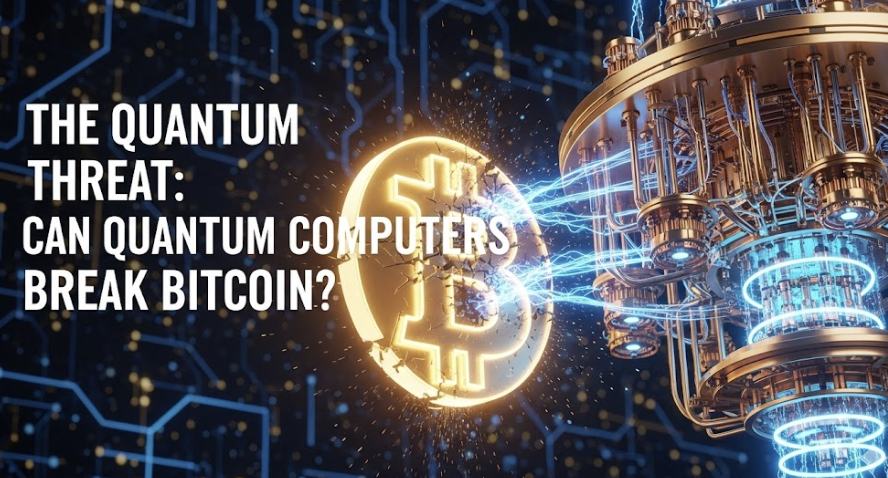
If you are holding digital assets for the long term, you might come across discussions about advanced technology and wonder: can quantum computers break bitcoin? The short answer is no. As a sufficiently powerful quantum machine is still decades away from being built, your crypto portfolio remains highly secure against this specific threat today.
At its core, Bitcoin relies on advanced cryptography that would take traditional supercomputers millennia to crack. However, quantum computers use entirely different physics, theoretically allowing them to unravel these mathematical puzzles much faster.
In this article, we will dissect the real timelines of the quantum threat, explain exactly which parts of the Bitcoin network are vulnerable, and explore the post-quantum defenses being built today.
Key Takeaways
-
While quantum computing theoretically threatens cryptographic security, a machine powerful enough to execute such an attack (Q-Day) is realistically decades away.
-
Bitcoin's mining algorithm (SHA-256) is highly resistant to quantum attacks, but its digital signature scheme (ECDSA) is theoretically vulnerable to Shor’s Algorithm.
-
The most immediate quantum threat targets wallets with exposed public keys, meaning reused Bitcoin addresses are at the highest risk of being compromised.
-
The Bitcoin network is not static. Developers are proactively researching Post-Quantum Cryptography (PQC), which can be implemented via soft or hard forks before the threat materializes.
-
The quantum threat extends far beyond crypto. Traditional banking systems and global stablecoin ecosystems face identical risks, driving a unified push for upgraded cybersecurity.
Understanding the Basics: Quantum Computing vs. Traditional Computing
Before evaluating the threat to the broader crypto market, we must first establish how quantum hardware differs from the devices we use daily. The fundamental difference lies in how they process and store data.
Traditional Computers: The Sequential Approach
The laptop, smartphone, or server you are using right now operates on bits. A bit is strictly binary; it must exist as either a
0 or a 1. Traditional computers solve problems linearly, calculating one possibility after another. While this sequential processing is highly efficient for everyday tasks, like streaming media or executing standard trades, it hits a hard physical limit when faced with the massive mathematical vaults used in blockchain cryptography.Quantum Computers: The Power of Superposition
Quantum computers, on the other hand, operate using qubits (quantum bits). Thanks to a principle of quantum physics known as superposition, a qubit can represent a
0, a 1, or both states simultaneously. Furthermore, through a property called entanglement, qubits can interact with one another in a way that allows the machine's processing power to scale exponentially, rather than linearly.To easily visualize this difference, imagine trying to find the exit to a massive, complex maze:
A traditional computer acts like a person walking through the maze. It hits a dead end, turns back, and tries the next route. It checks every single path one at a time until it finds the exit.
A quantum computer acts like a flood of water. It pours into the maze and flows through every single path simultaneously, instantly identifying the correct route to the exit.
This multidimensional processing power is exactly why traditional encryption methods are at risk. But does this mean Bitcoin's underlying code is already obsolete? To answer that, we have to look at the specific algorithms Bitcoin uses.
The Cryptography Behind Bitcoin
Bitcoin’s security is not a single, monolithic barrier. It is supported by two distinct cryptographic pillars, and quantum computers interact with them in completely different ways.
SHA-256
Bitcoin relies on the SHA-256 hash function for its Proof-of-Work (PoW) consensus mechanism. This is the mathematical process miners use to validate blocks and secure the network's history.
The Threat: The theoretical quantum attack against this layer is called Grover’s Algorithm.
The Reality: SHA-256 is highly resistant to quantum computing. Even a massive quantum machine running Grover's Algorithm would merely act as an incredibly fast ASIC miner; it would not "break" the network. If this ever becomes a practical issue, Bitcoin developers can easily neutralize the threat by upgrading the network to a larger hash size (such as SHA-512).
ECDSA
The Elliptic Curve Digital Signature Algorithm (ECDSA) is the math used to generate your public and private keys. This is the mechanism that proves you actually own your Bitcoin and authorizes your transactions.
The Threat: This is the network's true Achilles' heel. A powerful quantum computer running Shor’s Algorithm could theoretically reverse-engineer this specific math, deducing your private key directly from your public key.
The Reality: If an attacker calculates your private key, they effectively own your funds. (To better understand how these keys are generated and protected today, reviewing the mechanics of a standard crypto wallet is essential).
Because of this stark contrast, quantum computers cannot rewrite the entire blockchain or destroy the Bitcoin network itself. Instead, genuine danger is a precision strike against individual user funds, specifically, targeting wallets that suffer from address reuse.
Can Quantum Computers Break Bitcoin?
When people ask if quantum computers can break Bitcoin, they are usually envisioning a catastrophic event where the entire blockchain shuts down. In reality, the core threat is a targeted, mathematical attack on individual wallets using Shor’s Algorithm.
How the Attack Works
To understand the danger, you must understand how transactions are broadcasted. When you send Bitcoin, you must reveal your public key to the network to prove the funds are yours. A sufficiently powerful quantum computer running Shor’s Algorithm could theoretically take that exposed public key and reverse-engineer your private key. If an attacker possesses your private key, they have full control over your funds.
The Real Danger: Address Reuse
Because of how this attack functions, the quantum threat is not distributed equally across the network. The absolute highest risk lies with reused Bitcoin addresses.
In the early days of crypto, it was common practice to use the same wallet address to receive multiple payments. If you have ever sent funds out of an address and continued to use it, your public key is permanently exposed on the public ledger. Millions of legacy wallets, including those holding early mined coins, currently sit in this vulnerable state.
Why Modern Wallets are Safer
If you follow modern security practices, your risk drops significantly. Today, standard crypto wallets automatically generate a new address for every transaction.
When you use an address only once, your public key remains hidden behind a secure cryptographic hash until the exact moment you spend the funds. By the time a quantum computer could intercept the transaction and calculate your private key, the network has already confirmed the block, and your remaining funds have moved safely to a brand-new, unexposed address.
When Will "Q-Day" Actually Happen?
For years, the crypto industry viewed Q-Day (the theoretical moment when quantum computers can break public-key cryptography) as a distant threat reserved for the late 2030s. However, recent developments have drastically accelerated this timeline.
The 2026 Quantum Breakthroughs
In March 2026, landmark research from Google Quantum AI and Oratomic fundamentally shifted the landscape. These papers demonstrated that breaking Bitcoin's ECDSA encryption requires far fewer resources than previously estimated.
Instead of needing millions of physical qubits, researchers found that advanced architectures could theoretically execute Shor's Algorithm with under 500,000 qubits.
With these optimized systems, recovering a private key from an exposed public key could take mere minutes rather than days.
The Revised Estimates
These breakthroughs moved Q-Day from a theoretical physics problem to a near-term engineering challenge.
Major tech firms are now setting post-quantum migration targets for as early as 2029. Leading industry researchers estimate there is now a tangible probability of a cryptographically relevant quantum computer emerging by 2032.
While Bitcoin will not be broken tomorrow, the threat is active today. Attackers are currently executing Harvest Now, Decrypt Later strategies, scraping and storing encrypted ledger data with the intention of cracking it once quantum hardware matures. Because the timeline is shrinking, the race to upgrade the network has officially begun.
How Will the Bitcoin Network Defend Against Quantum Attacks?
The most important thing to remember is that Bitcoin is not a static protocol. It is a living network actively maintained by top cryptographers worldwide. Just as quantum computing evolves, so does defensive technology designed to defeat it.
Post-Quantum Cryptography (PQC)
The blockchain industry’s primary defense mechanism is Post-Quantum Cryptography (PQC). These are next-generation mathematical algorithms specifically engineered to be completely immune to quantum calculations, including Shor’s Algorithm. Global institutions, such as the National Institute of Standards and Technology (NIST), are already finalizing standard PQC algorithms for worldwide use.
How the Network Will Upgrade
To integrate these quantum-resistant algorithms, the Bitcoin ecosystem will undergo a consensus-driven technical upgrade:
Network Forks: Core developers will propose either a soft fork or a hard fork to update Bitcoin’s underlying code. This upgrade will phase out the vulnerable ECDSA signatures and replace them with a quantum-proof alternative.
The Migration Phase: Once the upgraded network is live, the action required from everyday users will be remarkably simple. You will just need to generate a new, quantum-secure wallet address and transfer your funds into it. As long as you move your assets before a fully functional quantum computer is deployed, your holdings will be completely safe.
Because the crypto community is aggressively preparing for this transition years in advance, the long-term outlook for flagship digital assets remains incredibly strong. If you believe in the network's ongoing resilience, you can easily buy Bitcoin and build your portfolio through a secure platform like KuCoin.
Will Quantum Tech Affect Stablecoins and the Broader Crypto Market?
It is a common misconception that quantum computing is strictly a "Bitcoin problem." In reality, cryptography protecting Bitcoin is the same fundamental math securing the entire Web3 ecosystem, traditional banking, and the global internet.
The Impact on Stablecoins and CBDCs
The broader crypto market, including smart contract platforms like Ethereum and global stablecoin networks, relies heavily on elliptic curve cryptography. As major institutions pivot towards blockchain, quantum vulnerability transforms from a niche crypto issue into a matter of national financial security.
A Unified Global Defense
Because stablecoins, altcoins, and traditional banks face the exact same threat, the push for quantum resistance is not an isolated effort by Bitcoin developers. It is a highly funded, collaborative race driven by global tech giants, governments, and the broader financial sector. By the time quantum computers are capable of threatening a Bitcoin wallet, the unified financial system will have already standardized and deployed Post-Quantum Cryptography across all major asset classes.
Conclusion
So, can quantum computers break bitcoin? In strict mathematical theory, a future quantum machine running Shor’s Algorithm could compromise vulnerable wallets. In practical reality, however, that threat is still years away, and the blockchain industry is already building the shield. The Bitcoin network is capable of upgrading its cryptographic foundations through a consensus-driven fork long before Q-Day arrives. For today's investors, the most effective defense requires zero advanced technology: simply practice basic wallet hygiene, avoid address reuse, and store your wealth on forward-thinking, secure platforms.
FAQs
Can quantum computers mine all remaining Bitcoin?
No. Bitcoin mining relies on SHA-256, which is highly resistant to quantum algorithms. A quantum computer would merely act as a faster miner, not a threat to network consensus.
Is my crypto wallet safe from quantum attacks right now?
Yes. The necessary quantum hardware is still years away. You are completely safe today, especially if you use modern wallets that generate a new address for every transaction.
What is "Q-Day" in crypto space?
Q-Day refers to the theoretical future date when quantum computers become powerful enough to crack traditional public-key encryption, including Bitcoin's ECDSA signatures.
What is a post-quantum blockchain?
It is a blockchain upgraded with Post-Quantum Cryptography (PQC). These next-generation mathematical algorithms are specifically designed to be completely immune to quantum attacks.
Will a Bitcoin network upgrade automatically protect old wallets?
Not automatically. When the network upgrades, users with heavily reused or dormant addresses will likely need to generate a new quantum-secure wallet and manually transfer their funds to stay protected.
Disclaimer
This content is for informational purposes only and does not constitute investment advice. Cryptocurrency investments carry risk. Please do your own research (DYOR).