

The Central Bank Debates a National Stablecoin: Why Russia Needs a Ruble-Denominated Coin Alongside the Digital Ruble
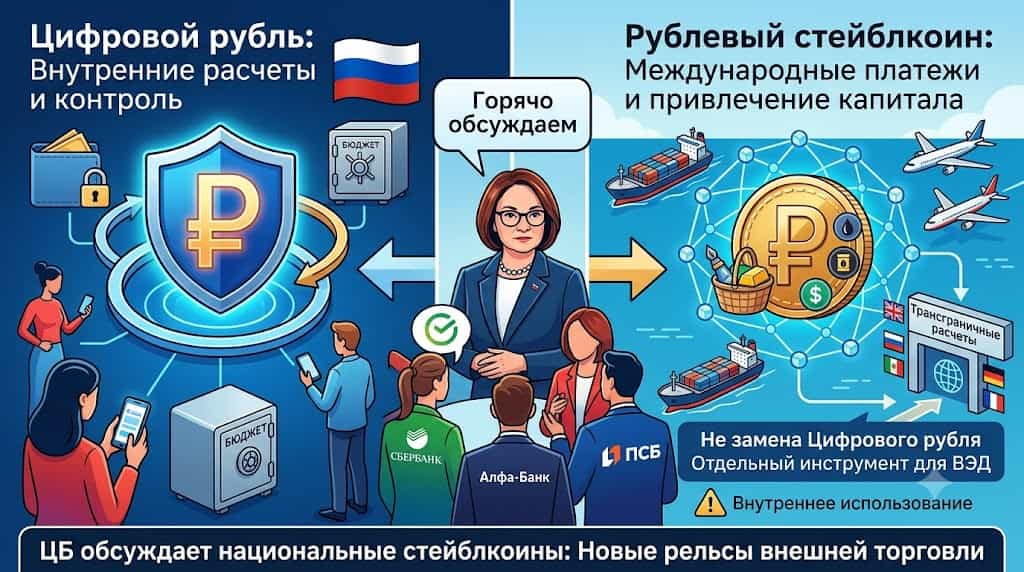
Bank of Russia Governor Elvira Nabiullina said at the Financial Congress that the regulator is "hotly debating" internally whether national stablecoins could complement central bank digital currencies in international settlements. This isn't about replacing the digital ruble — it's about a separate instrument for foreign trade, an area the digital ruble currently has no access to.
The distinction is simple: the digital ruble handles domestic retail payments and controls budget flows, while a ruble stablecoin is conceived as a flexible instrument for cross-border settlements and attracting foreign capital. Major banks — Sberbank, Alfa-Bank, and the PSB group's Tokeon platform — have already publicly backed the idea, and even sparred over the details at one forum session. Let's break down why a separate coin is needed, who would issue it, and whether it would affect ordinary Russians.
Why Is the Central Bank Discussing a National Stablecoin If the Digital Ruble Already Exists?
The digital ruble and a ruble stablecoin solve different problems, which is precisely why the regulator views them as complementary rather than competing instruments. Nabiullina put it directly: "We are also very hotly debating within Russia whether such national stablecoins could complement central bank digital currencies in international settlements."
The digital ruble was designed from the start for the domestic loop — retail payments, government procurement, transparency of budget spending. It's issued directly by the Bank of Russia on a single platform and suits settlements within the country, but isn't meant to circulate freely outside Russian jurisdiction.
A stablecoin works differently: it's a token backed by a reserve asset that can be issued on a public blockchain and handed to a foreign counterparty without going through the traditional correspondent banking network. That flexibility is exactly what makes it a candidate for bridging foreign-trade payments — an area where the digital ruble's current architecture simply doesn't work.
It's important to understand that this isn't about the two instruments competing for the same niche. The digital ruble remains a tool of sovereign control over domestic money flows — it's issued by the central bank, circulates on its platform, and is subject to the same oversight rules as other forms of the national currency. A stablecoin, by contrast, is inherently designed to circulate outside a single jurisdiction and requires compatibility with external blockchain networks, exchanges, and wallets used by foreign counterparties.
What Market Participants Already Discussed at the Forum
At the session "Ruble Stablecoins — An Architecture of Maximum Possibilities," three of the largest banks unexpectedly converged on one point: there are no technical barriers to issuing a coin. Dmitry Vitman, chief operating officer of Alfa-Bank's corporate and investment banking division, noted that participants seemed to have "read the same playbook" — writing a smart contract to issue a token today is no problem for any major player.
Alexander Zozulya, head of Sberbank's global markets department, highlighted a very different challenge: the coin needs to be usable "anywhere in the world," convertible on the spot into whatever is needed at that moment. Igor Egorkin, CEO of the Tokeon platform (part of the PSB group), agreed, adding that everyone has already learned to write smart contracts — the real unsolved problem is two-way liquidity and trust.
Could a Ruble Stablecoin Replace USDT and USDC in Foreign Trade?
Yes, that is precisely the project's stated main goal, but it's an extremely difficult task given the global dominance of dollar-pegged stablecoins. Alfa-Bank stated outright that Russia needs to reduce its dependence on coins pegged to the dollar and euro, such as USDT and USDC, which today handle the bulk of Russian businesses' cross-border settlements.
Sberbank's Alexander Zozulya identified the core problem with the ordinary ruble in international settlements: it "doesn't travel well" outside the country and generates no yield on its own while sitting in an account awaiting conversion. The idea is to create an instrument that would let a company's treasury earn a return while funds "wait" for their next operation — something an ordinary non-cash ruble cannot offer.
The problem is one of scale: USDT's global dominance rests on the fact that the coin can be exchanged for almost any asset in almost any corner of the world. For a ruble stablecoin to become a genuine alternative rather than a niche instrument for a narrow circle of counterparties, it needs that same ubiquitous liquidity — and by the bankers' own admission, that's a "super-difficult task" with no solution yet in sight.
The mechanics of issuing a token itself have already been mastered by the banks without any trouble — writing a smart contract and launching a coin on the blockchain can be done today in a matter of weeks. The real barrier isn't technology, it's whether counterparties around the world will be willing to accept this coin as readily as they accept USDT or USDC. As of now, a ruble stablecoin has no exchange listing outside Russia, no major market maker willing to maintain two-way quotes, and no pool of partners ready to convert it into local currency on the spot — in other words, none of the infrastructure that dollar-stablecoin issuers spent years building.
An Investment Bridge for Foreign Capital
Beyond export-import settlements, a ruble stablecoin is being considered as a tool for attracting foreign investors into Russian assets. Igor Egorkin of Tokeon confirmed that deals using tokenized exposure to Russian assets through similar instruments have already taken place. For a foreign investor without direct access to Russian banking infrastructure, a stablecoin potentially offers a simpler channel for buying local assets and earning ruble-denominated returns.
Who Would Issue the Russian Stablecoin, and Can It Be Trusted?
Most likely, the coin would be issued by a consortium of major banks, not by the Bank of Russia directly and not by any single lending institution. Dmitry Vitman laid out Alfa-Bank's position with complete clarity: "No single Russian market player can solve this problem alone. At Alfa, we're open to building a shared instrument in some kind of consortium format, an alliance of Russian market players."
The logic of an alliance stems from the fact that trust in a stablecoin depends directly on the reputation and reliability of its issuer. Alexander Zozulya pointed out that existing requirements for systemically important banks already ensure the necessary level of reliability, so if such a bank guarantees the coin's issuance, that alone builds market trust — unlike small projects that launch a token purely for hype.
Gleb Mararenko, adviser to the First Deputy Governor of the Central Bank, compared future regulation to a zoo: different animals get different-sized cages, and cage size depends on how dangerous the animal is, just as speed limits depend on road quality. According to him, the regulator has no plans to impose requirements "just because" — they will appear only where a genuine need arises, or where an instrument is granted additional capabilities.
At the same time, Mararenko stressed that the Central Bank's consultative report doesn't assume the automatic introduction of a special, strict regime for stablecoins — regulation would be applied selectively, based on the actual risks of a specific instrument rather than by default for the entire category. He also acknowledged that market participants themselves talk about the importance of trust, and that the requirements proposed by the Central Bank are precisely meant to secure that trust, giving momentum to the development of DFAs and new cross-border settlement experiments.
The Central Bank's Consultative Report Has Already Been Published
Shortly before the forum discussion, the Bank of Russia published a consultative report on the formation of a stablecoin market and possible approaches to regulating it. That document was the starting point for the session's discussion — market participants compared notes on the specific reserve, issuance, and oversight mechanisms proposed in the report.
Are There Plans to Require Russians to Use a Stablecoin Domestically?
No, and this is a matter of principle for the regulator: domestic use of stablecoins provokes wariness at the Bank of Russia, not enthusiasm. Nabiullina stated it plainly: "Some are even talking about domestic settlements, about using national stablecoins domestically. I can say right away that we view this with apprehension."
The regulator's priority is the security and stability of the domestic financial system, which is already served by cash, non-cash rubles, and the digital ruble. Adding yet another parallel payment instrument for domestic retail settlements, in the Central Bank's logic, creates additional risk without an obvious benefit, since domestic needs are already met by the digital ruble.
The practical takeaway for private individuals: ordinary users don't need to prepare for a stablecoin being imposed on everyday purchases, payroll, or utility payments. The most likely area of application is B2B settlements in foreign trade, investment deals with foreign partners, and limited regulatory sandboxes — not the mass retail market.
When Will Stablecoin Regulation Appear in Russia?
The State Duma and the Bank of Russia will begin substantive work on regulation in the fall of 2026 — the agreement has already been reached. Anatoly Aksakov, chairman of the State Duma's Financial Market Committee, confirmed this at the forum: "Yes, and by the way, we talked about stablecoins. There's already an agreement, including with the Central Bank, that we'll start working closely on this topic in the fall."
There remains a disagreement in pace between the regulator and the banks. The Central Bank's Mararenko insists that comprehensive regulation is the first step, one that will enable experiments in cross-border settlements and give momentum to the development of DFAs. Alfa-Bank's Vitman disagrees: first, Russia needs to "build fundamental domestic payment rails," let the market issue instruments and see what liquidity flows into them, and only then discuss additional regulation — otherwise there's a risk of choking the market at the outset with requirements that haven't yet been tested in practice.
Sberbank's Alexander Zozulya offered a similar metaphor: a stablecoin is additional rails for a new kind of transport, not a reason to immediately impose speed limits. In his words, if you tax and regulate the rail-builder before the first train has even run, the country simply won't get new rails or new transport. Vitman, responding to Mararenko's position, noted that when it comes to crypto instruments, Russia is competing on a global market, and Russian crypto instruments effectively don't exist yet — which is exactly why it's important to first let the market create them.
While the two sides argue over pace, the existing logic of digital financial asset regulation already applies to part of these operations — according to discussion participants, that's sufficient for the current stage, and the fall start of joint work will mark the shift to more detailed rule-making specifically for stablecoins.
Should You Trade Stablecoins and Cryptocurrency on KuCoin Right Now?
While a ruble stablecoin still exists only as discussions and a consultative report, traders and businesses already have working access to liquid stablecoins and crypto assets through global platforms like KuCoin. KuCoin offers spot and derivatives trading in major stablecoins, including USDT and USDC, along with hundreds of other crypto assets — in other words, exactly the "ubiquitous liquidity" that bankers describe as the main problem facing any future ruble token.
For anyone following the stablecoin story as an investment idea, a sensible strategy is to start by studying the mechanics of stablecoins in practice: how reserves are structured, how conversion works, and what fees apply on deposits and withdrawals. Opening an account and testing a small amount on the spot market is a simple way to get familiar with the infrastructure before assessing the prospects of new national instruments that are still only in the planning stage. As with any crypto asset, it's worth deciding in advance what share of your portfolio to allocate to such instruments and accounting for the legal requirements of your jurisdiction.
Conclusion
The Bank of Russia is discussing the possibility of creating a national ruble stablecoin as a complement to the digital ruble — but only for international settlements and investment, not for the domestic market. Nabiullina confirmed that the regulator views domestic use of stablecoins with apprehension, while the cross-border scenario is being discussed seriously alongside the largest banks.
Sberbank, Alfa-Bank, and the Tokeon platform agree that there are no technical barriers to issuing the coin — the real challenge is building liquidity and trust comparable to USDT and USDC. The most likely scenario is issuance by a consortium of systemically important banks, rather than by a single institution or by the Central Bank itself.
The State Duma and the Bank of Russia will begin detailed regulatory work in the fall of 2026, with the banks pushing for a soft start without excessive barriers and the regulator favoring comprehensive rules from the outset. For businesses and private investors, this means mature infrastructure won't appear overnight, and in the meantime existing global stablecoins remain the practical tool for cross-border operations.
Frequently Asked Questions
1. How does a ruble stablecoin differ from the DFAs Russian banks already issue?
DFAs are digital financial assets whose returns are pegged to the price of an underlying asset; they trade on a specific bank operator's platform and require qualified-investor status. A stablecoin, by contrast, is designed as a settlement instrument backed by a reserve and intended for payments, not for investment gains from price appreciation.
2. Can an ordinary person already buy a Russian ruble stablecoin?
No, the coin exists only at the level of discussion and the Central Bank's consultative report — no specific launch date, issuer, or technical parameters have been announced yet. Regulation won't appear before the fall of 2026, when the State Duma and the Bank of Russia begin substantive work on the rules.
3. Why is the Bank of Russia publishing a consultative report instead of going straight to a law?
A consultative report is a way to gather the market's position before rules are enshrined in legislation, avoiding mistakes caused by hasty decisions. It was on the basis of exactly this kind of report that Financial Congress participants discussed specific reserve and oversight mechanisms.
4. Is there a risk that a ruble stablecoin would fall under Western sanctions the same way ordinary dollar payments do?
The project's direct goal is to reduce dependence specifically on dollar and euro settlement channels, so a ruble stablecoin is being considered precisely as a way to work around the infrastructure restrictions tied to those currencies. However, full protection from secondary sanctions measures will depend on the specific issuance architecture and partner jurisdictions, which haven't been determined yet.
5. What is OUSD, and why is it mentioned in the context of a Russian stablecoin?
OUSD is a new dollar-pegged stablecoin preparing to launch in the US with the involvement of roughly a hundred major companies, including Visa and BlackRock. It's cited as an example of just how intense competition is on the global dollar-stablecoin market — competition that any new coin, including a ruble one, will have to overcome.