

Bitcoin Surges to One-Month High at Nearly $75,000: What’s Driving the Rally?
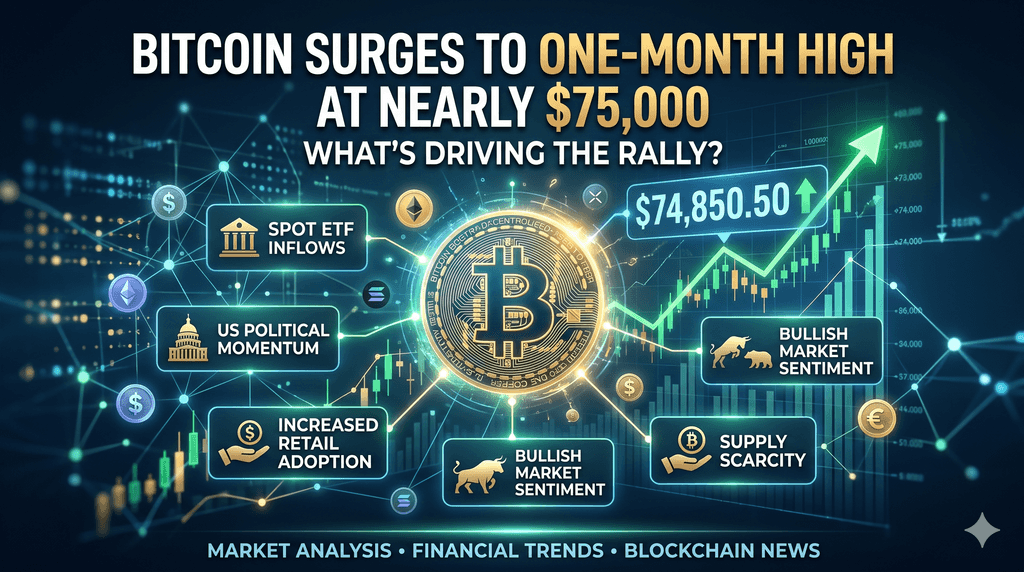
The digital asset landscape is witnessing a significant resurgence today, April 14, 2026, as Bitcoin has decisively reclaimed the $74,000 level, reaching a one-month high and eyeing the psychological $75,000 resistance. This upward trajectory represents a 4.5% climb within a single trading session, a move that has caught many market participants off guard given the prevailing sentiment of "Extreme Fear" that has dominated the headlines for weeks. While retail investors were largely bracing for further downside following recent geopolitical shocks in the Middle East, the current price action reveals a sophisticated tug-of-war between short-term panic and long-term institutional accumulation.
This rally is not merely a technical bounce; it is the culmination of shifting macroeconomic tides, massive inflows into spot ETFs, and a fundamental realignment of Bitcoin as a strategic reserve asset. As the market digests the implications of a sub-1% annual inflation rate following the 2024 halving, the scarcity narrative is hitting the order books with renewed force. Today’s surge highlights a growing divergence between emotional sentiment and cold, hard capital flows, suggesting that the "smart money" is actively fading the retail narrative of a prolonged bear market.
The Institutional Squeeze and Spot ETF Resurgence
One of the primary engines behind today’s climb is the massive reversal in spot Bitcoin ETF flows. After a brief period of consolidation and minor outflows earlier this month, the tide turned sharply over the last 48 hours. Data from New York financial markets confirms that institutional vehicles, led by BlackRock’s iShares Bitcoin Trust (IBIT), recorded net inflows exceeding $358 million in a single session. This influx of professional capital acts as a powerful floor for the market, absorbing sell-side pressure that would have otherwise sent prices lower.
The institutionalization of Bitcoin in 2026 has reached a point of maturity where these funds are no longer just passive observers. With over 16,000 financial advisors now authorized to distribute Bitcoin-linked products through major brokerage channels, the "on-ramp" for traditional wealth has never been wider. Analysts note that these inflows are increasingly "sticky," representing long-term allocations from pension funds and corporate treasuries rather than the speculative "fast money" seen in previous cycles.() This structural demand creates a "supply shock" effect, particularly as the daily issuance of new Bitcoin remains at historic lows.
Geopolitical Resilience and the Safe Haven Pivot
The market’s ability to shrug off the recent "Strait of Hormuz shock" is perhaps the most telling indicator of Bitcoin's evolving role. Just days ago, a Sunday plunge to $70,741 was triggered by escalating tensions in the Middle East and the collapse of key diplomatic talks. In years past, such geopolitical instability would have sent Bitcoin into a tailspin alongside other risk assets. However, the recovery to nearly $75,000 today suggests a shift in investor perception.
As WTI crude oil surges past $104 a barrel and global inflation concerns resurface, Bitcoin is increasingly being traded as "Digital Gold." The correlation between Bitcoin and traditional safe havens like gold has strengthened over the past month, with Bitcoin actually outperforming the yellow metal in several key metrics. This "safe-haven rotation" is being fueled by investors seeking protection against currency debasement and the potential for a "memory chip supercycle" to drive further inflation in the tech sector.
Short Liquidations Fueling the Upward Momentum
While fundamental drivers provide the foundation, the velocity of today's move was significantly amplified by a classic short squeeze. Heading into this week, over $6 billion in short positions were stacked above the $72,200 resistance level. As Bitcoin broke through this cluster, it triggered a cascade of forced liquidations, essentially creating "mechanical fuel" for the rally.
In the world of crypto derivatives, when a short position is liquidated, it results in a market buy order. These forced buys pushed the price rapidly through the $73,500 "short cluster," leaving bears little room to breathe. This phenomenon explains why the price move from $72,000 to $74,400 happened with such suddenness. The "Extreme Fear" recorded by the sentiment indices was, in retrospect, a contrarian indicator, as overcrowded short trades became the very engine for the price surge they were betting against.
Strategic Bitcoin Reserves and Sovereign Adoption
A fresh perspective driving the 2026 rally is the evolving narrative of the U.S. Strategic Bitcoin Reserve. Under the current administration, the vision of the United States as a global "Bitcoin hub" has moved from campaign rhetoric to potential policy reality. Discussion of sovereign-level adoption—once considered a fringe theory—is now a central theme in institutional research notes from firms like Galaxy Digital and ARK Invest.
This "Sovereign FOMO" is not limited to the U.S. Reports of nation-states like the UAE and Norway potentially adding Bitcoin to their sovereign wealth funds have provided a psychological boost to the market. When global powers begin to view digital scarcity as a matter of national economic security, the valuation models for Bitcoin shift from "tech stock" to "global reserve asset." This shift in perspective is a major reason why the market is currently targeting $80,000 as the next major resistance level.
The Post-Halving Supply Squeeze and Scarcity Metrics
We are now deep into the post-2024 halving era, and the mathematical reality of Bitcoin’s scarcity is becoming undeniable. The current annual inflation rate of Bitcoin is now comfortably below 1%, making it significantly "harder" than almost any other fiat currency or commodity. In 2026, every bit of new demand hits the market much harder than it did in previous years because there is simply less new supply coming online.
As MicroStrategy continues its aggressive buying—now holding a hoard exceeding 300,000 BTC—the "circulating supply" available for retail and new institutional entrants is shrinking. This "supply-side liquidity crisis" means that even moderate increases in spot demand can lead to outsized price moves. Today’s rally to nearly $75,000 is a direct manifestation of this imbalance. When a billion dollars in ETF inflows meets a market where the daily production of coins has been cut in half, the path of least resistance is almost inevitably upward.
Regulatory Clarity and the "Atkins Effect"
The regulatory landscape in April 2026 is vastly different from the "regulation by enforcement" era of years past. With leadership changes at the SEC, specifically the transition toward a more pro-innovation framework under Paul Atkins, the "regulatory risk premium" that once weighed on Bitcoin's price is evaporating. Investors are no longer fearing a sudden "ban" or catastrophic legal setback; instead, they are looking at how to integrate Bitcoin into regulated financial products.
This clarity has paved the way for more diverse crypto equities and ETFs. The integration of Bitcoin into traditional payment processors like Block and PayPal has turned digital assets into a mainstream utility rather than a speculative experiment. As the "CLARITY Act" provides a clear roadmap for stablecoin yields and digital asset custody, the barriers for large-scale capital entry have effectively been dismantled. This institutional comfort level is a quiet but powerful driver of the current $74,000 price level.
Conclusion
The climb toward $75,000 is more than just a green candle on a chart; it is a signal of Bitcoin’s growing dominance in the 2026 financial ecosystem. Driven by a potent mix of institutional ETF demand, geopolitical safe-haven status, and a brutal liquidation of short positions, the rally proves that the underlying market structure remains incredibly resilient. While retail sentiment may still be clouded by fear, the data—ranging from $1.5 billion in year-to-date inflows to the sub-1% inflation rate—points toward a maturing asset that is successfully decoupling from traditional risk-on narratives. As Bitcoin tests these monthly highs, the focus now shifts to whether it can flip the $75,000 mark into support, potentially clearing the path for a run toward the elusive six-figure milestone later this year.
FAQs
Q1: Why is Bitcoin rising despite "Extreme Fear" in the market?
The "Extreme Fear" sentiment is often a contrarian indicator. While retail investors may be fearful due to recent news, institutional players often use these periods of low sentiment to accumulate assets at a discount. Today’s rally was driven by "smart money" and large-scale ETF inflows that outweighed the retail panic selling.
Q2: What role did the Middle East conflict play in this rally?
Initially, the conflict caused a dip as investors fled to cash. However, as the situation stabilized and oil prices rose, Bitcoin began to act as a hedge against inflation and currency instability. This "safe-haven pivot" allowed it to recover quickly and reach new monthly highs.
Q3: Will the $75,000 resistance level hold?
Resistance at $75,000 is psychological and technical. While Bitcoin reached nearly $74,400 today, breaking $75,000 would likely require sustained spot demand. Many analysts believe that if the current rate of ETF inflows continues, a breakout above $75,000 could trigger another wave of momentum toward $80,000.
Q4: How is the 2024 halving still affecting the price in 2026?
The effects of a halving are cumulative. By 2026, the reduced supply of new Bitcoin entering the market has created a structural deficit. When demand from ETFs and corporate treasuries stays high while the daily issuance remains low, the "supply squeeze" naturally pushes the price higher over time.
Q5: Are altcoins following Bitcoin’s lead in this rally?
Yes, but with varying degrees of strength. Today, Ethereum saw a 7.5% jump, outperforming Bitcoin’s 4.5% gain. However, some altcoins like Solana and Polkadot have faced more pressure. Bitcoin’s dominance (currently at 57.23%) indicates that it remains the primary driver of the broader market’s direction.