

What Are Strategic Petroleum Reserves (SPR)? A Complete Guide
Introduction: The Fuel Behind National Security
Why do governments around the world spend billions building underground fuel storage facilities?
The answer lies in understanding how modern economies function and what happens when oil supplies are suddenly disrupted. Strategic petroleum reserves (SPR) represent a cornerstone of national energy security, yet most people know almost nothing about these massive fuel stockpiles that governments around the world have spent decades building and maintaining.
From the United States to China, Japan to India, major economies have constructed enormous storage facilities to hold emergency oil reserves that can be released during supply crises, natural disasters, or geopolitical conflicts. These reserves serve as insurance policies against supply disruptions that could cripple economies and fuel social unrest.
This comprehensive guide explores everything you need to understand about strategic petroleum reserves, including how they work, why they matter, the different approaches countries take, and how they might evolve in coming years.
Understanding Strategic Petroleum Reserves
What Are Strategic Petroleum Reserves?
Strategic petroleum reserves are government-controlled stockpiles of crude oil and petroleum products held in massive storage facilities for use during emergencies. These reserves exist to provide a buffer against supply disruptions that could impact national security, economic stability, or public welfare.
The concept emerged following the 1973 Arab oil embargo, when oil-exporting nations restricted shipments to countries supporting Israel, causing severe fuel shortages and economic chaos in dependent nations. This crisis revealed the vulnerability of economies dependent on imported oil and prompted major consuming countries to develop emergency petroleum reserves.
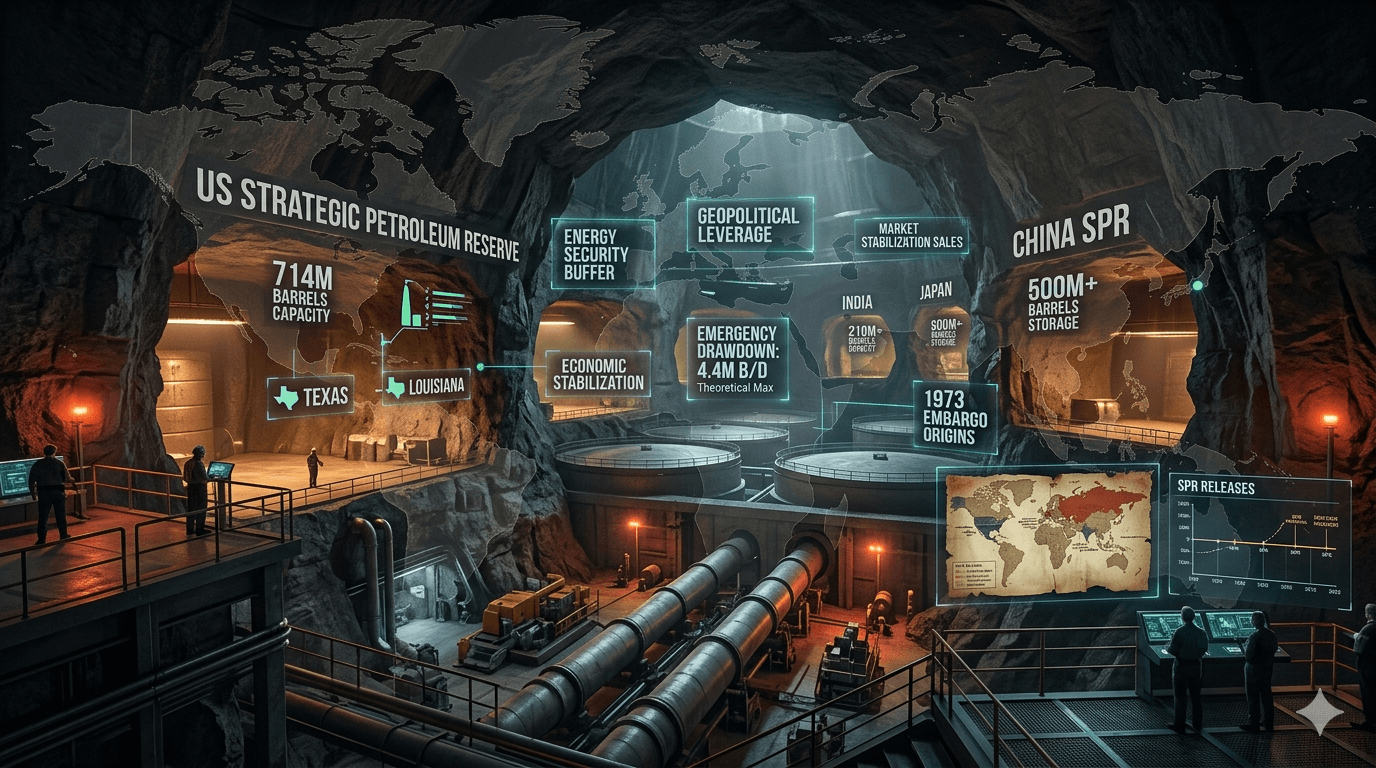
SPR facilities typically consist of large underground salt domes, above-ground tanks, or caverned storage facilities capable of holding millions of barrels of oil. The United States alone maintains storage capacity exceeding 700 million barrels across four primary facilities located along the Gulf Coast.
The primary purpose of these reserves is not profit but national security. Governments maintain these stockpiles to ensure continuity of essential services during supply disruptions, provide strategic leverage in negotiations with oil-producing nations, and stabilize markets during emergencies.
How Do SPR Systems Work?
Strategic petroleum reserve systems operate through a combination of government agencies, storage infrastructure, and release mechanisms that can be activated when needed. Understanding the operational framework reveals how these national security assets function.
In the United States, the SPR is managed by the Department of Energy through the Office of Petroleum Reserves, maintaining facilities in Texas, Louisiana, Mississippi, and Alabama. The department monitors oil market conditions and coordinates with other agencies to determine when releases are appropriate.
Release mechanisms vary by country but typically include emergency drawdowns authorized by top leadership, market stabilization releases conducted through competitive sales, and international cooperation arrangements with allied nations. The decision-making process often involves multiple agencies and requires high-level authorization to prevent political misuse.
The scale of these operations is massive. When the United States released oil from the SPR during past emergencies, daily drawdown rates exceeded one million barrels, providing substantial supply additions to markets experiencing shortages.
History and Development of SPR Programs
Origins of Strategic Petroleum Reserves
The modern concept of strategic petroleum reserves developed in response to the 1973 oil crisis, when the Organization of Arab Petroleum Exporting Countries (OAPEC) imposed an oil embargo against nations perceived as supporting Israel during the Yom Kippur War. This embargo caused severe fuel shortages, economic recession, and social disruption in dependent nations, particularly the United States and Western Europe.
The crisis revealed that oil-importing nations had virtually no defense against supply cuts from major producing regions. The United States, which had become increasingly dependent on imported oil, experienced severe shortages that led to rationing, long lines at gas stations, and economic damage that lasted for years.
In response, the United States enacted the Energy Policy and Conservation Act of 1975, which authorized the creation of the Strategic Petroleum Reserve. Construction began in 1977, and the first oil was deposited in 1978. The program established a model that other nations would later follow.
Similar programs emerged across industrialized nations. Japan, heavily dependent on oil imports, established its own strategic reserve program following the same crisis. European nations coordinated through the International Energy Agency to develop collective response capabilities.
Major Historical Releases
Strategic petroleum reserves have been tapped during several significant energy emergencies over the past decades, demonstrating their operational value and providing insights into how these systems work in practice.
The first major drawdown occurred in 1991 during the Gulf War, when Iraq’s invasion of Kuwait disrupted oil supplies from one of the world’s most productive regions. The United States released oil from the SPR to offset supply losses and prevent price spikes that could have hampered the military operation.
In 2005, following Hurricane Katrina’s devastation of Gulf Coast oil infrastructure, the SPR was tapped to address supply shortages that threatened to cascade through the American economy. The hurricane had knocked out significant refining capacity, creating fuel shortages that affected consumers nationwide.
The most significant recent release occurred in 2022 following Russia’s invasion of Ukraine, when the United States and other IEA members coordinated the largest synchronized release in the organization’s history. This release aimed to stabilize markets amid concerns that sanctions on Russian oil would create severe supply shortages.
These historical examples demonstrate that strategic reserves serve multiple purposes: addressing supply disruptions, stabilizing markets, supporting allied nations, and providing strategic flexibility during international crises.
Countries with Major SPR Programs
United States Strategic Petroleum Reserve
The United States maintains the world’s largest strategic petroleum reserve, with an authorized storage capacity of 714 million barrels distributed across four primary facilities in the Gulf Coast region. The reserve is managed by the Department of Energy’s Office of Petroleum Reserves, which monitors market conditions and coordinates release decisions with the White House and other agencies.
The SPR system consists of four major salt dome storage facilities—two in Texas (Bryan Mound and Big Hill) and two in Louisiana (West Hackberry and Bayou Choctaw)—that utilize solution-mined salt caverns. These caverns provide secure, low-cost storage with minimal environmental impact.
Current oil stocks total approximately 413 million barrels (as of early April 2026), significantly below the historical peak of 726.6 million barrels reached in December 2009. This reduction reflects both emergency releases and periods of limited replenishment.
The United States has drawn down reserves during multiple emergencies, including the Gulf War, Hurricane Katrina, the 2011 Libyan civil war, and the 2022 Ukraine crisis. These releases demonstrated the system’s operational readiness and helped stabilize markets during supply disruptions.
China’s Strategic Petroleum Reserve
China has rapidly expanded its strategic petroleum reserve program over the past decade, recognizing the country’s increasing dependence on imported oil. Previous official statistics indicate storage capacity exceeds 500 million barrels, though some analysts believe actual capacity may be significantly higher.
The Chinese program operates through multiple government agencies and state-owned enterprises, with facilities distributed across the country to ensure geographic diversity. The rapid construction of new facilities reflects Beijing’s strategic priority on energy security.
China’s approach differs from Western models in several ways. The country utilizes both public and “operational” reserves that can be drawn down more quickly during emergencies. Additionally, China maintains commercial inventories alongside strategic reserves, creating multiple layers of supply security.
The strategic reserve program supports China’s broader energy security objectives, including reducing vulnerability to supply disruptions, managing price volatility, and maintaining economic stability during international crises.
Other Major Programs
India maintains strategic petroleum reserves across three locations with combined capacity exceeding 30 million barrels. The program was established following 1970s oil crises and has been expanded as India’s oil imports have grown. India also stores oil at foreign facilities in the United States and other locations to ensure supply diversification.
Japan, as a resource-poor island nation, maintains substantial strategic reserves exceeding 300 days of net imports. The country’s heavy dependence on oil for transportation and industrial activity makes supply security particularly critical. Japan’s reserves are managed by the Ministry of Economy, Trade and Industry.
European nations coordinate through the International Energy Agency, maintaining collective reserves and response capabilities. Germany, France, and other major economies maintain national programs that can be deployed collectively during regional emergencies.
Why SPR Programs Matter
Energy Security Rationale
Strategic petroleum reserves provide essential insurance against supply disruptions that could otherwise devastate economies and societies. Modern economies require enormous quantities of petroleum products to function, from transportation fuel to industrial feedstock to heating oil for residential use. Any significant disruption to supply can cascade rapidly through economic systems.
The geopolitical dimension of oil creates particular risks. Most of the world’s proven oil reserves are located in regions with political instability, including the Middle East, Russia, and parts of Africa. Conflicts, sanctions, or political decisions in these regions can interrupt supplies with little warning, as demonstrated by the 1973 embargo and subsequent crises.
Strategic reserves provide time to respond to supply disruptions without catastrophic economic damage. When oil supplies are interrupted, reserves can be released to bridge the gap until new supplies become available or alternative sources ramp up production. This buffer prevents the most severe consequences of supply shocks.
The strategic value extends beyond immediate emergency response. Countries with substantial reserves have greater leverage in negotiations with oil-producing nations, knowing they can withstand temporary supply interruptions. This strategic flexibility serves national interests across diplomatic contexts.
Economic Stabilization
Beyond emergency response, strategic petroleum reserves provide economic stabilization functions that benefit consumers and businesses. Oil prices can fluctuate dramatically based on supply disruptions, geopolitical tensions, or market speculation. These price swings create uncertainty that affects business planning and consumer budgets.
Strategic reserves can be used to moderate price spikes during supply disruptions by adding oil to markets when shortages would otherwise push prices sharply higher. This stabilization function benefits the broader economy even when reserves are not being actively drawn down.
The credibility of having substantial reserves available during emergencies helps prevent market overreaction to potential supply issues. When markets know reserves exist, they are less likely to panic during minor disruptions, reducing the severity of price movements.
Challenges and Criticisms
Costs and Maintenance
Maintaining strategic petroleum reserves requires substantial ongoing investment in storage facilities, security, and oil inventory. These costs have drawn criticism from fiscal conservatives who question whether the benefits justify the expenses.
The oil itself must be regularly rotated to prevent degradation, creating additional operational costs. Inventory management requires sophisticated systems to track quality, quantity, and age of stored petroleum. These operational expenses accumulate over time.
Storage facilities require ongoing maintenance to ensure structural integrity and security. Salt domes and underground caverns must be monitored for leakage or structural issues. Above-ground facilities require similar attention to prevent environmental contamination.
The opportunity cost of capital tied up in stored oil represents another dimension of expense. Government resources dedicated to oil inventories could potentially be invested in other priorities that might generate higher returns.
Strategic Limitations
Critics argue that strategic petroleum reserves have limitations that reduce their practical effectiveness. Reserves can only address supply disruptions lasting a limited duration, typically months rather than years. Extended supply problems would exhaust reserves before new supplies could be developed.
The release process, while more rapid than many critics assume, still requires time for coordination and implementation. Market reactions during crisis situations may occur faster than government decision-making can respond, limiting the ability to prevent initial price spikes.
Some analysts question whether reserves remain relevant in a changing energy landscape. The transition toward renewable energy reduces long-term oil demand, potentially making large reserves less strategically valuable. This energy transition creates uncertainty about future reserve utility.
Future of Strategic Reserves
Energy Transition Considerations
The global energy transition toward renewable sources creates uncertainty about strategic petroleum reserves’ future role and value. As electric vehicles, renewable electricity, and emerging technologies reduce oil demand growth, the strategic calculus for maintaining large reserves shifts accordingly.
Several countries have reduced reserve expansion plans or drawn down inventories as demand growth slows. The long-term outlook for oil consumption suggests that reserves will become less critical over coming decades, though they will remain important during the transition period.
However, the transition will take decades, and oil will remain a significant energy source throughout. Strategic reserves will continue serving essential security functions, though their relative importance may diminish as renewable alternatives expand.
Modernization efforts focus on improving reserve efficiency, environmental performance, and responsiveness. New storage technologies and management approaches may reduce costs while maintaining operational readiness.
Climate and Environmental Factors
Climate change considerations increasingly influence strategic reserve policies. Some argue that maintaining large fossil fuel reserves conflicts with climate commitments and transition goals. This tension creates policy debates about whether reserves should be gradually reduced.
Environmental regulations affect storage facility operations and expansion. New requirements for leak detection, emissions control, and environmental protection add costs and complexity to reserve management.
The integration of climate considerations into energy security planning requires balancing traditional supply security with emissions reduction objectives. This balancing act presents challenges for policymakers managing multiple priorities.
Conclusion
Strategic petroleum reserves represent critical infrastructure for national energy security, providing insurance against supply disruptions that could otherwise devastate economies. While the energy transition creates uncertainty about their long-term role, these reserves will remain important throughout the coming decades as the world continues depending on oil for significant portions of its energy needs.
For policymakers, the challenge involves balancing reserve maintenance against other priorities while ensuring operational readiness. For investors, understanding SPR dynamics provides context for evaluating energy sector investments and potential supply disruptions. For citizens, these reserves provide peace of mind that emergency fuel supplies exist should crises occur.
FAQs
What is the strategic petroleum reserve used for?
Strategic petroleum reserves provide emergency fuel supplies during supply disruptions, natural disasters, or geopolitical crises. They help stabilize markets, ensure continuity of essential services, and provide strategic flexibility during international emergencies.
How much oil does the US SPR hold?
The United States strategic petroleum reserve currently holds approximately 370 million barrels, down from a peak of over 700 million barrels. Storage capacity exceeds 700 million barrels across four primary Gulf Coast facilities.
How long could the US SPR sustain the country?
At maximum release rates of around 4.4 million barrels per day, the US SPR could theoretically supply the country for several months, though practical considerations and quality maintenance reduce effective duration. Most analysts estimate the reserve could provide meaningful supply support for 60-90 days during severe disruptions.
Who controls strategic petroleum reserves?
In the United States, the Department of Energy manages the strategic petroleum reserve through the Office of Petroleum Reserves. Release decisions require authorization from the President, typically coordinated through the Department of Energy and other agencies.
Can countries use SPR for profit?
Strategic petroleum reserves are not primarily designed for profit, but oil can be sold at market prices when released. Any sales revenue typically flows to the treasury or is reinvested in reserve maintenance and replenishment. The primary purpose is national security rather than commercial profit.
Does China have a strategic petroleum reserve?
Yes, China maintains the world’s second-largest strategic petroleum reserve with capacity exceeding 500 million barrels. The program has expanded rapidly over the past decade as China has increased oil imports and developed energy security strategies.
Are strategic reserves being depleted?
Countries have drawn down reserves during recent emergencies, with the 2022 Ukraine crisis triggering significant releases. Some nations have not fully replenished reserves, leading to current storage levels below historical peaks in several countries.