

Aster vs Hyperliquid: Perp DEX Comparison 2026
Introduction
In September 2025, decentralized finance saw a sudden shift in power. Aster, a platform that had only recently introduced its governance token, captured nearly 70% of global perpetual DEX trading volume. During the same period, Hyperliquid, long regarded as the dominant player in decentralized perpetuals, saw its share drop to around 10%. For a brief window, the balance of the market appeared to change.
That momentum did not last. By January 2026, Hyperliquid had reasserted its position at the top of the sector, processing roughly $40.7 billion in weekly trading volume. Competing platforms struggled to sustain the activity they had briefly generated, and much of the earlier surge proved difficult to maintain. By March 2026, Hyperliquid controlled more than 70% of open interest in decentralized perpetual markets, reinforcing its lead.
This rapid shift raises important questions. What is Aster, and how did it achieve such a dramatic but short-lived dominance? Was its growth driven by sustainable adoption or short-term incentives? More importantly, what does this competition reveal about the evolving structure of decentralized derivatives markets?
This article examines both platforms in detail, comparing their architecture, performance metrics, token models, and risks, while assessing whether Aster has the potential to challenge Hyperliquid’s dominance in 2026 and beyond.
What Is a Perp DEX, and Why Does It Matter in 2026?
A perpetual decentralized exchange, commonly called a perp DEX, is a blockchain-based platform that enables users to trade leveraged derivative contracts on crypto assets without taking ownership of the underlying assets and without relying on a centralized intermediary to custody funds.
Unlike traditional futures contracts, perpetual contracts do not have an expiration date. Traders can maintain positions indefinitely, with funding rates periodically exchanged between long and short positions to keep contract prices aligned with the spot market. This structure replicates the functionality of centralized derivatives markets while preserving on-chain settlement and self-custody.
For much of its early existence, the perp DEX segment remained a niche within decentralized finance. That changed in 2025, as Perp DEXs reached $92.9 trillion in trading volume. This surge signals a broader transition from experimental infrastructure to a core pillar of crypto market activity.
The broader perpetual futures market has also expanded significantly, increasing by about 75% in two years from $4.14 trillion in January 2024 to $7.24 trillion in January 2026. Within that expansion, decentralized exchanges have captured a growing share, roughly one in every ten dollars traded in crypto perpetual markets now flows through decentralized venues.
This growth has drawn increasing attention from both retail and institutional participants. Capital is gradually moving toward on-chain trading environments, ETF proposals are beginning to reference DEX-native assets, and infrastructure competition among leading platforms is intensifying. In this context, perp DEXs are no longer a side segment of DeFi but a central battleground shaping the future of crypto derivatives.
Aster vs Hyperliquid: Leading Perp DEX Platforms Compared
Two platforms define the current structure of the perp DEX market. Hyperliquid leads in liquidity, execution, and consistency, while Aster represents a newer model of rapid growth driven by incentives and market timing.
Comparing them provides a clearer view of how decentralized derivatives are evolving, and what separates short-term traction from sustained dominance.
Hyperliquid: Market Leader in Perpetual DEX Liquidity
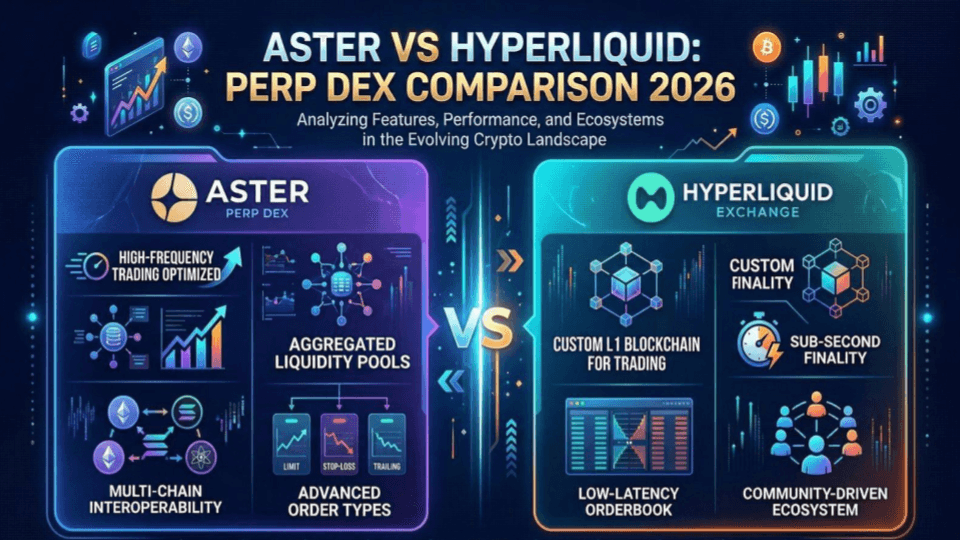
Hyperliquid operates as a purpose-built trading environment rather than a typical decentralized exchange. Its custom Layer 1 architecture is designed for speed, enabling high-frequency trading with low latency and gas-free execution, while maintaining full on-chain settlement.
The platform leads the perp DEX market across key metrics. Open interest stands at approximately $9.57 billion, exceeding the combined total of most competitors. Weekly trading volume regularly crosses $40 billion, reflecting deep liquidity and consistent participation.
Its November 2024 token distribution marked a structural advantage. The HYPE token was allocated to around 94,000 users, with the majority of supply directed to active participants rather than external investors. This approach strengthened user alignment and contributed to sustained trading activity.
As a result, Hyperliquid has maintained its lead even during periods of aggressive competition, supported by a stable base of liquidity and repeat users.
Aster: High Growth Perpetual DEX Challenger
Aster entered the market through the merger of Astherus and APX Finance, combining infrastructure and liquidity strategies into a single platform focused on capital efficiency. From launch, it positioned itself as a direct competitor within the perp DEX category.
The introduction of the ASTER token in September 2025 accelerated adoption. Trading activity increased rapidly, with daily volumes exceeding $600 million during peak periods. Within weeks, Aster captured a significant share of the decentralized perpetual market.
By the end of September 2025, the platform accounted for roughly 20% of perp DEX trading activity, placing it among the top exchanges in the sector. Institutional backing and heightened market attention further supported its early growth phase.
This expansion showed how quickly liquidity can shift within decentralized derivatives. At the same time, it highlighted the challenge of maintaining volume once initial incentives begin to normalize.
Perp DEX Architecture: How Aster and Hyperliquid Are Built
The differences between Hyperliquid and Aster are most visible at the infrastructure level. While both operate within the same perp DEX category, their architectural choices reflect fundamentally different approaches to speed, liquidity, and market design.
Understanding these differences explains not only how each platform performs today, but also how they may scale as decentralized derivatives continue to grow.
Hyperliquid Architecture: Custom Layer 1 Built for Trading
Hyperliquid is designed as a dedicated trading system rather than a general-purpose blockchain. Its custom Layer 1 is optimized for high-frequency execution, allowing trades to be processed with low latency while remaining fully on-chain.
This design removes reliance on external block space and reduces congestion risk, which is common on shared networks. As a result, the platform delivers consistent execution quality, a key factor behind its leading position in perp DEX trading volume and open interest.
A major development in 2026 is the HIP-3 framework. This upgrade enables third-party participants to launch perpetual markets for new assets by staking the HYPE token. Instead of listing assets through a centralized process, market creation becomes permissionless, expanding the range of tradable instruments.
This shift positions Hyperliquid as more than an exchange. It becomes a base layer for decentralized derivatives, where liquidity, market creation, and execution are tightly integrated within a single system.
Hyperliquid Market Design: Liquidity and Incentive Structure
Beyond infrastructure, Hyperliquid’s architecture is reinforced by its fee and incentive model. The platform generates significant trading fees, which are partially recycled into token buybacks, creating continuous demand for the HYPE token.
This mechanism supports liquidity retention. Traders benefit from deep order books and tight spreads, while the protocol maintains a feedback loop between trading activity and token value.
The result is a system where infrastructure and incentives are aligned, contributing to sustained dominance in perp DEX metrics.
Aster Architecture: Multi Chain Liquidity Aggregation
Aster initially approached the market from a distribution perspective. Instead of building a standalone chain, it deployed across multiple networks including BNB Chain, Ethereum, Solana, and Arbitrum.
This strategy reduces liquidity fragmentation by allowing users to trade within ecosystems they already use. Rather than competing for users, Aster aggregates them, improving accessibility and early adoption.
For a growing perp DEX, this approach lowers friction and accelerates market share capture, particularly during initial expansion phases.
Aster Chain: Transition to a Privacy Focused Layer 1
In March 2026, Aster expanded its architecture with the launch of its own Layer 1 network. This marked a shift from aggregation to infrastructure ownership.
Aster Chain introduces privacy as a core feature. Using zero knowledge based encryption and stealth address systems, it limits the visibility of user positions. This addresses a known issue in decentralized derivatives, where fully transparent order books can expose traders to front running and strategy replication.
The network also emphasizes performance, with high throughput and low latency targets aimed at competing with existing trading-focused chains.
This transition reflects Aster’s long-term strategy. Moving from a multi-chain perp DEX to a dedicated blockchain expands its potential role from trading venue to ecosystem layer. Whether this shift translates into sustained liquidity will depend on adoption beyond initial incentives.
Perp DEX Features Compared: Aster vs Hyperliquid Trading Experience
Beyond architecture, the competitive gap between Aster and Hyperliquid becomes clearer at the product level.
In a perp DEX, features such as leverage design, execution quality, and user interface directly influence trading behavior and liquidity concentration. These factors often determine where volume flows, especially in competitive market conditions.
Aster Trading Modes: From Dumb Mode to Professional Execution
Aster structures its trading experience around multiple modes designed for different user profiles.
At one end is Dumb Mode, a simplified interface built for short-term price prediction. It removes most trading complexity and allows users to take directional bets over very short timeframes. This approach introduces a more gamified layer to perpetual trading, lowering the barrier to entry for new participants.
For more experienced users, Pro Mode offers a full order book system with advanced order types, hidden orders, and multi-chain access. This creates a layered product strategy where users can move from simplified trading to more structured execution as they gain experience.
This multi-tiered design expands Aster’s reach across both retail and advanced traders, though it also introduces varying levels of risk depending on the mode used.
Hyperliquid Trading Experience: Depth, Speed, and Consistency
Hyperliquid takes a more focused approach. Instead of segmenting users into different modes, it delivers a unified trading environment centered on performance.
Its order book system closely resembles centralized exchanges, with tight spreads, fast execution, and consistent liquidity across major markets. This makes it particularly effective for traders executing large orders, where slippage and price impact are critical factors.
Rather than competing on extreme leverage, Hyperliquid prioritizes execution reliability. This design choice aligns with its dominance in perp DEX trading volume, where consistent performance attracts repeat activity.
Leverage Design and Risk Profile
Leverage remains one of the most visible differentiators.
Aster pushes the upper boundary of leverage in decentralized derivatives, offering up to 1001x on select pairs. At this level, even small price movements can result in rapid liquidation, making it suitable primarily for short-term strategies and high-risk trading.
Hyperliquid adopts a more conservative range, focusing on sustainable leverage levels that support deeper liquidity and lower systemic risk.
This contrast reflects two different philosophies. Aster uses leverage as a growth driver and user acquisition tool, while Hyperliquid uses controlled leverage to maintain market stability and execution quality.
Product Innovation and Market Access
Aster emphasizes feature-level innovation. Hidden orders allow traders to execute without revealing intent, while stock perpetuals expand access beyond crypto into tokenized equity exposure.
These features position Aster as a bridge between traditional and decentralized derivatives, attracting users seeking broader market access within a single platform.
Hyperliquid approaches innovation at the protocol level. Its system enables the creation of new markets across asset classes, including commodities and synthetic instruments, without relying on centralized listing processes.
The difference is subtle but important. Aster innovates through user-facing features, while Hyperliquid expands through infrastructure and market design.
Aster vs Hyperliquid Trading Volume and Open Interest
At the surface level, perp DEX competition is often framed around trading volume. A deeper analysis shows that volume alone does not fully explain market leadership.
To understand how Aster and Hyperliquid compare, three metrics matter most: trading volume, open interest, and total value locked. Each reflects a different layer of market behavior, from short-term activity to long-term capital commitment.
Trading Volume: Activity Does Not Always Equal Strength
Trading volume measures how much activity flows through a platform over a given period. It is often the most visible metric and can shift quickly in response to incentives, fee rebates, and short-term campaigns.
During its peak in late 2025, Aster captured a significant share of perp DEX trading volume, at times leading the market. This surge was driven by aggressive incentive programs and strong user participation.
However, volume is also the most flexible metric. It can increase rapidly during promotional cycles and decline just as quickly when those incentives are reduced. As a result, it provides limited insight into whether liquidity is sustainable.
Open Interest: Measuring Real Capital Commitment
Open interest offers a more stable view of market positioning. It represents the total value of active positions that remain open, indicating how much capital is committed over time rather than how frequently trades occur.
As of March 2026, Hyperliquid maintains a clear lead with average open interest around $5.15 billion. Aster, while firmly in second position, recorded approximately $899.70 million over the same period.
This gap highlights a structural difference. While Aster has demonstrated the ability to attract short-term trading activity, Hyperliquid continues to retain a larger base of committed capital.
In the context of decentralized derivatives, this distinction is critical. Open interest is less sensitive to short-term incentives and more reflective of trader confidence and liquidity depth.
Total Value Locked: Liquidity Depth and Platform Stability
Total value locked provides another layer of insight, reflecting the capital deposited within each platform to support trading and liquidity.
In March 2026, Hyperliquid held approximately $4.06 billion in TVL, compared to Aster’s $1.05 billion. This difference reinforces the broader trend seen in open interest, where Hyperliquid maintains a deeper and more stable liquidity base.
Higher TVL typically supports tighter spreads, improved execution, and greater resilience during periods of volatility, all of which are important for sustaining trading volume over time.
Interpreting the Metrics: Short-Term Growth vs Long-Term Positioning
Taken together, these metrics clarify the competitive dynamic.
Aster’s rise was driven by rapid increases in trading volume, supported by incentives and product accessibility. This allowed it to quickly gain visibility and market share within the perp DEX sector.
Hyperliquid, by contrast, has maintained leadership through consistently higher open interest and deeper liquidity. These metrics indicate stronger capital retention and a more stable trading environment.
The distinction between activity and commitment sits at the center of the Aster vs Hyperliquid comparison. Volume reflects how often users trade, while open interest and TVL reflect how much capital they are willing to keep on the platform.
As the perpetual DEX market matures, the platforms that retain capital are more likely to sustain long-term dominance.
ASTER vs HYPE Token Models Compared
Token design plays a central role in how a perp DEX attracts users, distributes value, and retains liquidity over time.
While trading volume and open interest reflect market activity, tokenomics determines how that activity translates into long-term incentives. The contrast between Aster and Hyperliquid is particularly clear at this level.
HYPE Token: Deflationary Design and Fee Capture
The HYPE token is structured around value capture from trading activity. Hyperliquid has a fixed maximum supply of 961.67M HYPE tokens, with a significant portion distributed directly to users through its initial airdrop.
A defining feature of the model is its fee mechanism. A large share of protocol revenue is used to buy back and burn HYPE, creating sustained deflationary pressure as trading volume increases.
This design links platform usage directly to token demand. As activity grows, more value is recycled into the token, reinforcing its role within the ecosystem.
Another key factor is distribution. By allocating the majority of supply to users rather than external investors, Hyperliquid aligned ownership with active participants. This has contributed to strong retention and consistent trading activity.
ASTER Token: Utility and Ecosystem Participation
The ASTER token follows a different approach, focusing on utility within the platform and broader ecosystem participation.
Launched in September 2025, the token distribution introduced a large supply into circulation through its airdrop phases. ASTER is used across multiple functions, including governance, fee discounts, and margin collateral within the trading system.
As Aster expands toward its own Layer 1 network, the token is expected to play a larger role in staking and protocol governance.
This design emphasizes flexibility. Rather than concentrating value capture in a single mechanism, ASTER integrates across different parts of the platform.
Tokenomics Comparison: Value Capture vs Utility Expansion
The difference between the two models is structural.
HYPE is designed around direct value capture. Trading activity feeds into buybacks and supply reduction, linking platform growth to token performance.
ASTER is designed around utility and ecosystem expansion. Its value depends on how widely it is used across trading, governance, and infrastructure.
Both approaches can succeed, but they respond differently to market conditions. In environments driven by high trading volume, value capture models tend to perform well. In expansion phases, utility-driven models can gain traction.
For investors and users, the choice reflects a broader question. Whether to prioritize immediate value linkage or long-term ecosystem growth within the perp DEX landscape.
The Verdict: Can Aster Beat Hyperliquid?
The honest answer is not yet, and not easily.
Hyperliquid maintains a structural lead in open interest driven by real trading activity rather than incentives. Its strength comes from deep liquidity, consistent execution, and infrastructure built to support professional traders in the perp DEX market.
The market has also moved beyond short term incentive models as a primary growth driver. Today, sustained trading volume and user retention matter more than temporary rewards, and Hyperliquid continues to benefit from this shift.
Aster remains a strong challenger. It ranks highly in trading volume, supports multi chain access, and introduces privacy features that address a key gap in decentralized derivatives. Its growth shows clear adoption, not just speculation.
In reality, the perp DEX landscape is likely to remain competitive rather than dominated by a single winner. Hyperliquid leads on depth and reliability, while Aster appeals to users looking for flexibility and broader access. Both HYPE and ASTER tokens are also available on platforms such as KuCoin, giving users additional ways to engage with their ecosystems.
Aster can close the gap if it continues converting usage into sustained open interest beyond incentives. Until then, Hyperliquid’s lead remains intact, supported by stronger capital commitment and proven market confidence.
Frequently Asked Questions
-
What is a perp DEX and how does it work?
A perp DEX is a decentralized derivatives exchange that allows users to trade perpetual futures without intermediaries.
-
How does Hyperliquid differ from other perpetual DEX platforms?
Hyperliquid stands out for its L1 infrastructure, deep liquidity, and high open interest driven by real trading activity rather than incentives. It focuses on execution speed, reliability, and capital efficiency.
-
What makes Aster unique compared to Hyperliquid?
Aster differentiates itself with a multi chain approach, privacy features, and utility driven token design. It targets a broader user base with flexible access and higher leverage options.
-
What are HYPE and ASTER tokens used for?
The HYPE token is primarily tied to value capture through fee buybacks and burns, while the ASTER token is used for governance, staking, fee discounts, and ecosystem participation within its perp DEX.
-
Where can users trade HYPE and ASTER tokens?
Both tokens are available on centralized exchanges such as KuCoin, in addition to on-chain platforms where their respective ecosystems operate.