

What Factors Could Enable XRP to Surpass ETH Market Cap in 2026
2026/04/30 16:42:02
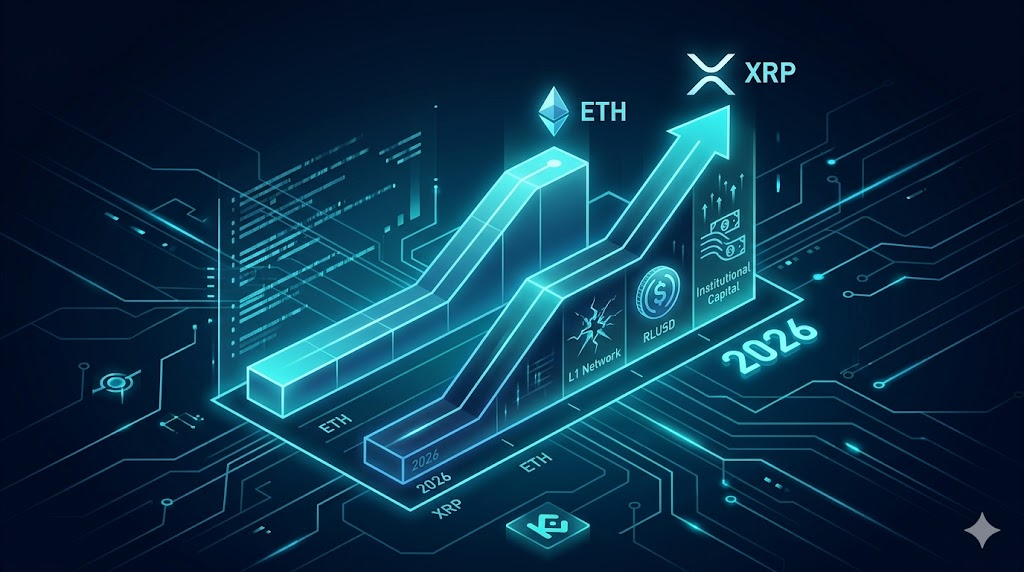
By April 2026, the digital asset market has entered a phase characterized by institutional integration and rigorous regulatory standards. The enactment of the GENIUS Act in 2025 and the advancement of the CLARITY Act provide the necessary legal framework for large financial institutions to expand their business into the digital asset space beyond Bitcoin and Ethereum. While Ethereum has historically dominated the decentralized finance sector, the rise of the XRP Ledger (XRPL) in the real-world asset (RWA) and central bank digital currency (CBDC) markets has created a credible path for a market cap realignment.
XRP’s growth is currently driven by its functional role as a settlement rail for international banking. In contrast, Ethereum faces challenges related to liquidity fragmentation across dozens of Layer 2 networks, which has altered how value is captured on its mainnet. This shift in market dynamics suggests that utility-driven demand from the global banking sector may eventually challenge the developer-driven ecosystem of Ethereum.
Key Takeaways
-
Institutional Regulatory Advantage: XRP achieved full legal clarity following the 2025 resolution of its SEC disputes and the implementation of the CLARITY Act.
-
Data from early 2026 shows the XRPL rapidly narrowing the gap with Ethereum in the treasury-backed Real-World Asset segment.
-
The success of Ethereum's Layer 2 strategy has led to a decentralized but fragmented ecosystem.
-
The launch of RLUSD, Ripple’s dollar-backed stablecoin, provides a dual-asset system that banks use for instant treasury management.
-
XRP’s native alignment with ISO 20022 messaging standards makes it the preferred choice for legacy financial institutions.
The Settlement Engine: RLUSD and the $100 Trillion Market
By April 2026, the widespread adoption of Ripple USD (RLUSD), launched in early 2025, has fundamentally transformed the institutional utility of the XRP Ledger (XRPL). This stablecoin functions as the primary value-transfer vehicle for a global settlement market estimated at over $100 trillion. By providing a dollar-pegged asset backed by reserves at BNY Mellon and verified by Deloitte, RLUSD addresses the primary concern of traditional finance: price stability during the settlement window.
The Unified Liquidity Dashboard
The recent launch of the Ripple Treasury Management System (TMS) represents a significant milestone in corporate finance. Following the $1 billion acquisition of GTreasury in 2025, Ripple has integrated blockchain speed directly into legacy cash management workflows.
Real-Time Visibility: CFOs now use a single dashboard to manage fiat, XRP, and RLUSD simultaneously. This system treats digital assets as core components of corporate liquidity rather than speculative side-pockets.
Capital Liberation: Traditional cross-border payments via SWIFT often take three to five business days to clear. Utilizing RLUSD on the XRPL reduces this window to three to five seconds, allowing companies to redeploy working capital immediately.
Mastercard Integration and the $9 Trillion Flow
A landmark 2026 partnership has linked Mastercard’s network directly to the XRP Ledger. This integration enables near-instant settlement across a $9 trillion global payment flow. In this ecosystem, RLUSD serves as the stable unit of account, while XRP functions as the high-velocity delivery vehicle and the required asset for network fees. This dual-token approach allows banks to settle high-value transactions without exposing their balance sheets to intraday volatility often associated with unpegged digital assets.
Bridging the Nostro/Vostro Gap
The global banking system currently keeps trillions of dollars locked in pre-funded Nostro/Vostro accounts to facilitate international trade. XRP’s role as a neutral bridge asset, combined with the reliability of RLUSD, aims to eliminate the need for this stagnant capital. By providing On-Demand Liquidity (ODL), Ripple enables banks to settle transactions in real-time using RLUSD as the finality layer. This structural efficiency is a primary factor driving XRP’s market cap toward a potential flippening with Ethereum, as it targets the foundational plumbing of the global economy rather than just the decentralized application layer.
Regulatory Clarity as a Growth Catalyst
The Institutional Compliance Advantage
Institutional mandates prioritize regulatory safety as much as they do raw performance. Conservative entities, including sovereign wealth funds and large-scale pension funds, require assets to have an undisputed legal status before allocating capital. XRP meets these criteria. The GENIUS Act further stabilized the environment by standardizing the infrastructure through which these institutions interact with the blockchain. As a result, there is a steady inflow of capital from entities that previously remained on the sidelines.
Ethereum operates in a more complex regulatory environment. Ethereum is widely accepted, yet its proof-of-stake model continues to trigger discussions regarding staking-as-a-service and managed investment schemes. These ongoing debates in various jurisdictions create a specific type of friction that XRP has successfully moved past.
ISO 20022 and Global Standardization
Compliance also extends to technical standards. XRP’s native integration with ISO 20022, the global messaging standard for financial institutions, positions it as a compliant link for the world’s banking systems. The November 2025 deadline for SWIFT's migration has passed, and the financial world now operates on a unified data language. XRP follows this standard natively. This technical alignment reduces the cost of adoption for banks, making it easier for them to choose XRP over assets that require complex, non-standardized middleware.
The combination of statutory clarity and technical standardization provides XRP with a significant lead in the race for institutional dominance. This regulatory environment is a primary factor that could propel its market cap toward, and potentially beyond, that of Ethereum.
Why Ethereum is Vulnerable
Ethereum's scaling strategy, which relies heavily on Layer 2 (L2) rollups like Arbitrum, Optimism, and Base, has inadvertently created a fragmentation issue that threatens its market cap dominance. By moving the vast majority of economic activity away from its base layer, Ethereum faces a challenge in capturing value that XRP’s unified architecture avoids.
The Value Capture Gap
The success of Ethereum’s Layer 2 ecosystem is undeniable. By early 2026, roughly 99% of retail transactions occur on secondary chains. However, this shift has led to a significant compression in fee revenue on the Ethereum mainnet. Weekly fee revenue on Layer 1 has dropped from historic peaks of $30 million to an average of $2.3 million in the first quarter of 2026.
Because Ethereum’s supply-burning mechanism depends on high base-layer fees, this revenue drop has effectively stalled the ultrasound money narrative. ETH supply is currently growing slightly rather than contracting, which creates a headwind for market cap growth. In contrast, every transaction on the XRP Ledger, whether for institutional settlement or NFT trading, directly utilizes the native XRP token, ensuring that network activity translates into direct utility for the asset.
Liquidity Silos vs. Unified Ledger
Liquidity fragmentation is the second major vulnerability for Ethereum. Capital is currently split across dozens of competing L2 silos, making it difficult for large institutions to move significant volume without facing slippage or complex bridging risks. This "fragmented" liquidity profile is less attractive to the global banking sector, which requires deep, unified pools of capital for cross-border settlement.
The XRP Ledger maintains a single, unified liquidity pool. This allowed developers to port Ethereum-based applications into the XRP ecosystem without splitting the network's liquidity. By using mXRP as a bridge asset, the sidechain maintains the security and speed of the mainnet while offering the programmability of Solidity. This unified approach allows XRP to act as a more efficient "Internet of Value" for the $100 trillion settlement market.
The Developer Migration Shift
Builders are increasingly choosing the XRPL for institutional-grade applications because of its native financial infrastructure. While Ethereum remains the home for experimental DeFi, XRP’s ability to provide a predictable, low-cost environment with built-in compliance features like Multi-Purpose Tokens (MPTs) is attracting the specific type of capital needed to challenge Ethereum’s market cap ranking.
The CBDC Interoperability Play
XRP as the Neutral Bridge Asset
Central banks require a bridge asset that is not tied to any single national interest or banking system. XRP serves this role by providing a decentralized, high-liquidity pool that facilitates the instant exchange of one CBDC for another.
To handle the trillions of dollars in daily volume required for global CBDC settlement, analysts in early 2026 suggest that a "structural repricing" is necessary. For the XRPL to process massive transfers without extreme slippage, the native asset must possess a higher "utility-based" valuation than its historical retail-driven price levels.
Ripple's current partnerships with over 20 central banks utilize the XRPL for core issuance. These projects use XRP as the neutral medium for cross-border liquidity, creating a permanent demand loop that is independent of retail market sentiment.
ISO 20022 and the New Financial Language
Technical compatibility is the second pillar of the XRP interoperability play. By the second quarter of 2026, the global financial system's shift to the ISO 20022 messaging standard is nearly complete. XRP is uniquely positioned as the native asset of the ledger to be fully compliant with this standard from its inception.
ISO 20022 allows for rich data to be sent alongside payments, reducing errors and fraud. Because the XRPL speaks this "same language" as the legacy systems used by SWIFT and the Federal Reserve, it removes the need for expensive middleware.
While SWIFT has integrated its own shared blockchain-based ledger in 2026, the XRPL remains the faster and more cost-effective option for wholesale foreign exchange. This technical alignment allows XRP to capture institutional flows that Ethereum’s general-purpose architecture was not specifically designed to handle.
The Institutional Consensus: IMF and BIS Initiatives
The broader institutional landscape has also shifted in favor of private-sector-led settlement rails. In March 2026, the Financial Stability Board (FSB) and the Bank for International Settlements (BIS) concluded a new phase of the G20 Roadmap for Enhancing Cross-border Payments.
These international bodies have recognized that a single "global CBDC" is unlikely. Instead, they are promoting frameworks where private protocols like the XRPL provide the connectivity between various national digital assets.
Strengthening this trend, a recent Nomura report indicates that as energy-induced inflation pressures traditional fiat markets, central banks are accelerating their CBDC timelines to improve domestic economic efficiency. By providing the plumbing for this new system, XRP captures a type of systemic value that is tied to the survival of the global financial infrastructure itself.
Comparing Institutional ETF Flows
The institutional landscape in April 2026 reveals a significant divergence in how capital enters the top three digital assets. While Bitcoin and Ethereum have established their roles as core portfolio holdings, recent data shows a distinct structural rotation toward XRP. This shift is driven by investors seeking a utility-first asset that behaves differently from traditional technology-correlated growth stocks.
The Divergence in Net Inflow Trends
In the first quarter of 2026, Ethereum Spot ETFs experienced a challenging period of liquidity rebalancing. According to reports from DL News, Ethereum investment products saw net outflows of roughly $898 million as investors consolidated their positions. In contrast, XRP investment products demonstrated remarkable resilience.
By early March 2026, cumulative inflows into XRP ETFs surpassed $1.50 billion, and as of April 19, weekly inflows hit a record $55.39 million. This steady accumulation suggests that institutional allocators view XRP as a "structural" addition to their portfolios rather than a speculative trade.
The Goldman Sachs Factor and Wall Street Validation
The profile of XRP ETF holders has also evolved. A recent 13F filing from Goldman Sachs disclosed a $153.8 million position in spot XRP ETFs, making it the largest known institutional holder of the asset in the United States. This disclosure represents a significant milestone in Wall Street’s validation of the XRP Ledger's payment narrative.
Of the top 30 institutional holders currently controlling over $211 million in XRP ETF exposure, traditional banking giants account for a majority share. This concentration of banking-sector capital aligns with XRP’s role in the ISO 20022 ecosystem and its integration into bank-led settlement corridors.
The Diversification Hedge Strategy
Analysts at Bitwise and Franklin Templeton have noted that the demand for XRP is often separate from the demand for Bitcoin or Ethereum. In the 2026 market, XRP is treated as a hedge against the broader tech sector's volatility.
Asset Allocation: Institutional desks are increasingly mixing XRP into their portfolios to capture a unique return profile that is tied more to global trade velocity than to decentralized finance activity.
The CLARITY Act Catalyst: Standard Chartered’s research team suggests that if the CLARITY Act continues its current path toward full adoption by July 2026, institutional inflows could accelerate to as much as $10 billion by year-end.
This steady institutional buy-side pressure, contrasted with the recent outflows from Ethereum's ecosystem, creates a favorable supply-demand dynamic for XRP. As more capital rotates from "growth" assets like Ethereum toward "utility" assets like XRP, the gap between their respective market caps continues to narrow.
Trading the XRP/ETH Flippening on KuCoin
As the market cap gap between XRP and Ethereum narrows in 2026, the strategy for many participants has shifted from simple accumulation to active ratio trading. Capitalizing on a potential flippening requires tools that can handle both institutional-grade analysis and high-velocity execution. KuCoin provides the technical infrastructure to navigate this transition through specialized trading pairs and data-driven insights.
Navigating the Ratio with Precision
Trading the XRP/ETH ratio directly allows you to focus on the relative strength of these two ecosystems without the interference of US Dollar volatility.
The XRP/ETH Spot Pair: Most traders use the KuCoin Spot Market to swap between assets based on macro signals. If you anticipate that XRP’s role in the CBDC market will drive higher growth than Ethereum’s fragmented L2 ecosystem, holding the ratio position is a more efficient play than trading both against USDT.
Leveraged Ratio Trading: For those with higher risk tolerance, KuCoin Futures enables you to go long on the XRP/ETH ratio. This setup profits when XRP outperforms ETH, regardless of whether the broader market is moving up or down.
Conclusion
The potential for XRP to surpass Ethereum in 2026 is rooted in a fundamental change in how the market defines value. Ethereum remains a powerful platform for decentralized experimentation, yet its current scaling path has created a fragmented environment that complicates institutional use. XRP has taken a different route by focusing on unified, compliant, and high-velocity settlement infrastructure for the global banking system.
Through the integration of RLUSD, the establishment of a clear regulatory framework via the CLARITY Act, and the influx of capital from entities like Goldman Sachs, XRP is no longer competing for "speculative attention." It is competing for the role of the global internet of value. Whether the flippening occurs this year or next, the structural shift toward utility-driven assets is a permanent feature of the 2026 financial landscape.
FAQs
Is the "flippening" a guaranteed event in 2026?
No event in the digital asset market is guaranteed. However, the narrowing gap in institutional ETF inflows and the rise of XRP’s cross-border utility provide the most credible case for a ranking shift since 2017.
How does Ethereum’s Economic Zone proposal affect XRP?
The Ethereum Economic Zone (EEZ) aims to fix L2 fragmentation. If successful, it could restore value to the Ethereum mainnet. Until then, XRP’s unified ledger remains the more efficient choice for large-scale financial settlement.
Can I trade the XRP/ETH ratio with leverage?
Yes, KuCoin Futures supports leveraged trading on the XRP/ETH pair, allowing you to profit from the relative performance of the two assets.
What role does RLUSD play in XRP’s market cap?
RLUSD provides the stability needed for banks to use the XRP Ledger. High volume in RLUSD settlement drives demand for XRP as the network's liquidity bridge and fee-payment asset.
How do I use GemSPACE to track this trend?
GemSPACE provides real-time data on the growth of the XRP Ledger ecosystem. Tracking the number of new projects launching on the XRPL EVM sidechain is a great way to gauge developer migration from Ethereum.
Disclaimer:This content is for informational purposes only and does not constitute investment advice. Cryptocurrency investments carry risk. Please do your own research (DYOR).