

Justin Sun's "Eternal Storage Shortage" Thesis: Is Filecoin (FIL) the Crypto Play for 2026?
2026/05/21 15:21:02
Introduction
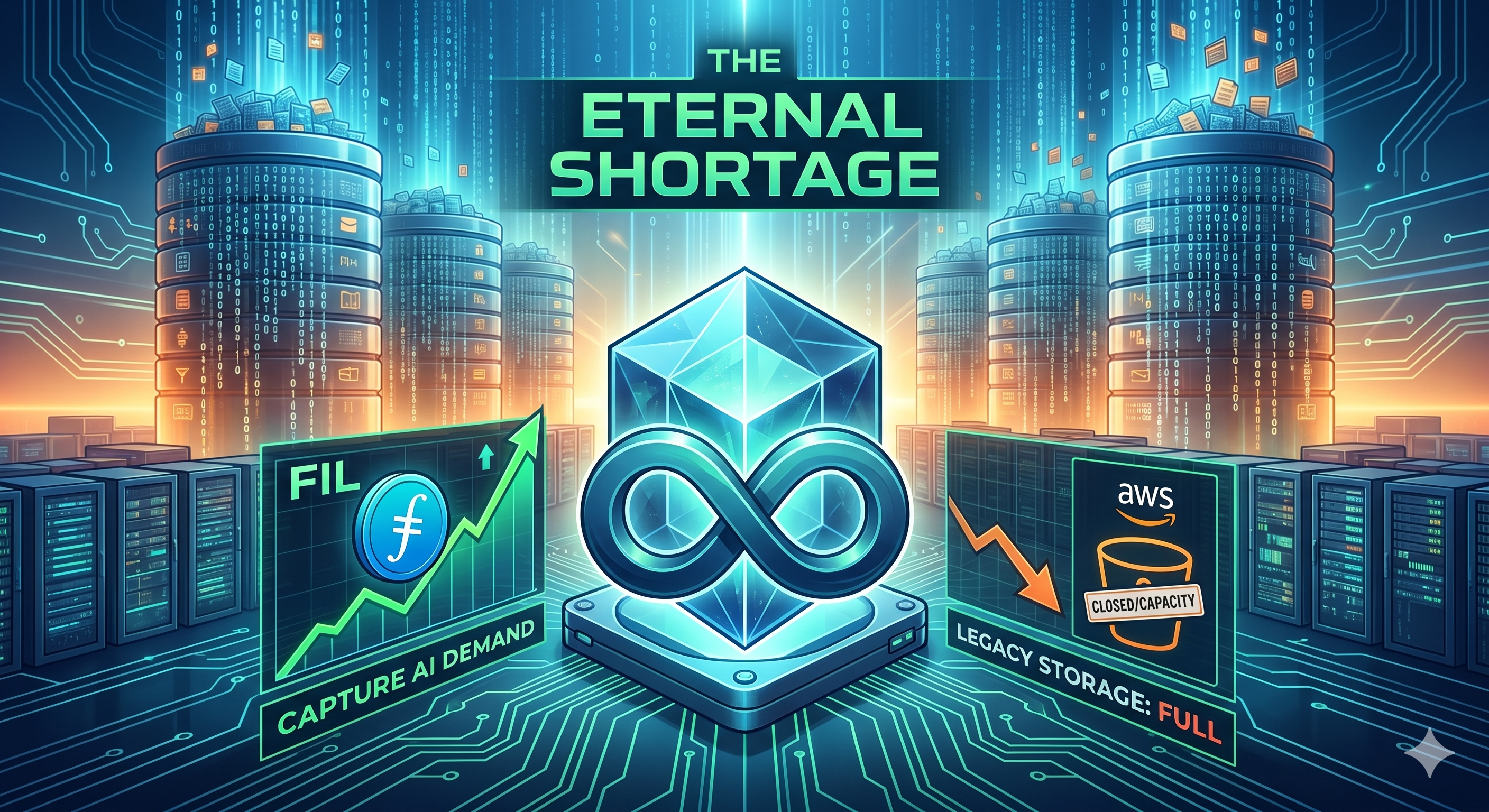
In November 2025, Justin Sun published a single sentence on social media that aged better than almost any macro call of the cycle: "Short-term chip shortage, long-term energy shortage, eternal storage shortage." Six months later, SanDisk stock has run from roughly $35 to $1,439 — a nearly 50x move — and HBM memory capacity at Samsung, SK Hynix, and Micron is fully booked through 2027 and 2028. The storage trade is now the consensus trade in equities.

So the obvious question for crypto investors: does Filecoin (FIL), the largest decentralized storage network, finally get its turn? The macro tailwind is real and structural, Filecoin's 2026 strategy is built to capture it, and the network has just launched the products needed to convert AI demand into paid on-chain storage deals. Below is the full breakdown.
What Exactly Did Justin Sun Predict About Storage?
Justin Sun's thesis is simple: chip and energy shortages are cyclical, but storage shortages are permanent. According to Odaily's May 2026 retrospective on Sun's track record, in November 2025 Justin Sun stated, "Short-term chip shortage, long-term energy shortage, and always storage shortage." The capital market's reaction to this statement only turned fervent in 2026.
The numbers behind that thesis are extraordinary. According to the same Odaily report, SanDisk (SNDK) stock price rose from about $35 to $1,439, a gain of nearly 50x; HBM memory orders are booked through 2027-2028. Production capacity for HBM memory from the three major manufacturers Samsung, SK Hynix, and Micron is fully booked, already sold out for 2026, with orders extending into 2027-2028.
Sun's broader track record gives this call additional weight. Per Odaily, in 2016, Justin Sun recommended "Bitcoin, NVIDIA, Tesla, Tencent," and as of May 2026, NVIDIA's total return is approximately 24,000%, and Tesla's total return is approximately 2,683%. His investment logic is described as "positioning at both ends, not betting on a single company's execution."
Why Storage Demand Is Structurally Different From Chips
Storage demand compounds rather than resets. Every AI training run, every model checkpoint, every inference log, every video frame, every robotics sensor stream — they all leave permanent data behind that has to live somewhere. According to KuCoin Research's May 2026 analysis, AI workloads consume storage at an unprecedented rate, and decentralized networks are positioning themselves as cost-efficient cold and warm storage layers for AI training datasets, model checkpoints, and inference logs.
That is the structural argument behind Sun's "eternal" framing — and it is precisely the demand wedge Filecoin is built to serve.
Is Filecoin Actually Positioned to Benefit From This?
Filecoin's 2026 strategy is purpose-built around exactly this thesis. The Filecoin Foundation has formally pivoted the network from scaling supply to scaling paid demand at the moment AI storage demand is exploding.
According to the Filecoin Foundation's official 2026 Network Strategy published on February 19, 2026, the Filecoin community is shifting focus to demand at just the right moment, as AI creates sustained demand for storage infrastructure and fundamentally changes how data is created and used. The Filecoin community is laser-focused on three network-wide objectives for 2026: driving paid, onchain storage deals, improving network economics, and supporting trusted companies and institutions running real workloads onchain.
Filecoin's existing scale is also already enterprise-grade. Based on the Filecoin Foundation's March 2026 disclosure, the network now stores over 25 exbibytes of active data, with a growing share dedicated to public AI training datasets — including academic LLM corpora, scientific imagery, and genomics data.
Filecoin Onchain Cloud: The Product That Changes the Story
Filecoin shipped the product that closes the gap with AWS S3 in March 2026. According to the official Filecoin website, Filecoin Onchain Cloud is live on mainnet — verifiable, programmable storage for AI agents and pipelines with onchain proofs, smart contract payments, and two-copy replication. The launch was announced on March 26, 2026.
Early traction is meaningful. According to CoinGecko data, since testnet, Onchain Cloud attracted over 100 teams, now holding 49.41 TiB across 478 datasets with 81 connected payment wallets. These are early numbers, but they represent paid, on-chain deals — which is precisely the metric the 2026 strategy is designed to grow.
How to Buy and Trade Filecoin (FIL) on KuCoin
KuCoin offers deep liquidity on FIL across spot and futures markets, making it one of the most efficient venues to position around the storage shortage narrative. Whether you are building a long-term position based on the AI-storage thesis or trading short-term breakouts around catalyst events like new Onchain Cloud integrations and FIL Dev Summit announcements, KuCoin provides the execution tools you need.
To start trading FIL on KuCoin:
-
Create and verify a KuCoin account.
-
Fund your wallet via stablecoin transfer, bank deposit, or card purchase.
-
Navigate to the FIL/USDT spot pair or FIL perpetual futures.
-
Use built-in charting tools to monitor the key levels — current support near $0.90 and resistance at $1.06, $1.21, and $1.45 based on recent technical commentary.
-
Set position size and stop-losses appropriate to FIL's historical volatility, especially given that AI-storage rotations have driven outsized moves in adjacent tokens like STORJ.
New users can now register at KuCoin and Get Up to 11,000 USDT in New User Rewards.

Conclusion
Justin Sun's "eternal storage shortage" call has already paid out spectacularly in equities — SanDisk's 50x run and HBM capacity selling out through 2028 are the proof. The structural argument is straightforward: AI workloads create permanent, compounding storage demand that does not cycle the way chip orders or energy contracts do. That backdrop is the strongest macro setup decentralized storage has ever faced.
Filecoin is the asset best positioned to translate that macro into a crypto-native trade. The network just shipped Filecoin Onchain Cloud in March 2026, the 2026 ecosystem strategy is explicitly designed to convert AI demand into paid on-chain deals, capacity already exceeds 25 exbibytes, and final token vesting unlocks roll off later this year just as cryptoeconomics tighten toward a potentially deflationary regime by late 2026.
The risks are real — demand conversion is unproven at scale, centralized competitors remain formidable, and Justin Sun himself has already rotated his focus to embodied AI and drones. But for investors who believe the storage trade has further to run, FIL offers the cleanest decentralized expression at a price still far below its 2021 highs.
Frequently Asked Questions (FAQs)
Does Justin Sun own or endorse Filecoin specifically?
Justin Sun has not publicly disclosed a Filecoin position or made FIL a named recommendation. His "eternal storage shortage" framing is a macro thesis covering the entire storage stack — DRAM, NAND, HBM, HDD, and decentralized storage. Investors should treat Filecoin as a thematic beneficiary of his thesis, not a personal endorsement.
What is Filecoin Onchain Cloud and how is it different from regular Filecoin storage?
Filecoin Onchain Cloud is a programmable, AI-friendly storage layer launched on mainnet in March 2026 that adds verifiable on-chain proofs, smart contract payments, two-copy replication, and S3-compatible APIs on top of the base Filecoin protocol. It is designed to serve AI agents and pipelines directly, lowering onboarding friction compared to legacy Filecoin storage deals.
When do Filecoin's final token unlocks end?
According to the Filecoin Foundation's 2026 strategy document, the final network vesting periods will end later in 2026, ushering in a new era of token economics. After that point, the only remaining new FIL supply will come from block rewards, which are themselves on a declining issuance schedule — a structurally tightening setup.
How does Filecoin compare to Storj and Arweave?
Filecoin is the largest by total capacity at 25+ exbibytes and has the strongest enterprise adoption pipeline. Storj differentiates with sub-second retrieval times and out-of-the-box S3 compatibility, making it better suited for active warm data. Arweave focuses on one-time-payment permanent storage. Each serves different parts of the AI data lifecycle, and a diversified basket may capture the theme better than any single name.
Is the AI storage trade already priced into FIL?
Not fully. FIL is trading under $1 as of May 2026, far below its 2021 peak above $236, while listed storage equities like SanDisk and Seagate have already re-rated dramatically. The gap reflects skepticism about Filecoin's ability to convert capacity into paid revenue. If Onchain Cloud adoption metrics continue to climb, that skepticism discount could compress meaningfully through the rest of 2026.