

What Are Hard and Soft Forks? Core Mechanics & Projects
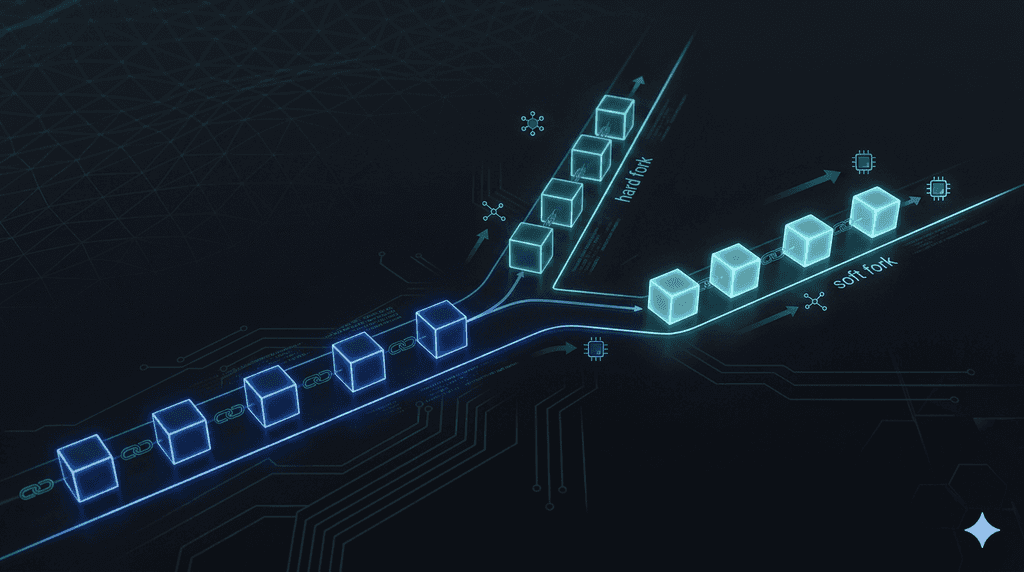
Open-source blockchain networks are not static, unchanging entities. They require constant evolution to survive. Unlike traditional corporate software governed by a centralized board of directors, decentralized protocols rely on thousands of independent nodes and miners operating globally.
To add advanced functionality, optimize transaction gas fees, or patch critical security vulnerabilities, these distributed networks must undergo structured software upgrades known as forks.
A fork acts as the primary decentralized mechanism for software deployment and community conflict resolution. When the underlying rules of a blockchain need to change, core developers propose a code upgrade. If the global community agrees, the network smoothly adopts the new framework.
However, when deep philosophical or technical disagreements arise, these forks can permanently fracture a blockchain in two, instantly creating parallel networks and entirely new digital assets.
For modern market participants, these events are highly actionable and heavily influence market dynamics. Understanding when a network is scheduled to upgrade allows investors to prepare for potential price volatility or incoming token airdrops.
Summary
This comprehensive guide breaks down the critical technical differences between backward-compatible soft forks and network-splitting hard forks. We will explore how these open-source governance mechanisms function and analyze famous historical representative projects born from highly contentious network splits.
Thesis
The primary purpose of this article is to equip modern investors with a clear, technical understanding of how soft forks and hard forks dictate the security, scalability, and financial future of blockchain networks.
The Core Mechanics: What Exactly is a Blockchain Fork?
At its most fundamental level, a blockchain is simply a distributed digital ledger powered by open-source software. This software is actively maintained by a massive, globally dispersed network of independent computers known as nodes.
Unlike traditional centralized databases managed by a single corporation, there is no central administrator or CEO who can simply push a mandatory software update to every user simultaneously.
Instead, every single node on the network must independently verify network transactions against a strict, universally agreed-upon set of mathematical rules. This foundational rulebook is known as the protocol. When all the nodes are operating using the exact same rulebook, the network achieves a continuous state of agreement formally known as consensus.
However, the digital asset industry moves at a blistering pace, and these underlying protocols cannot remain stagnant. Core developers must continuously propose code changes to patch critical security vulnerabilities, optimize transaction processing speeds, or integrate entirely new functionalities to keep the network highly competitive.
A "fork" officially occurs when this underlying codebase is fundamentally altered, upgraded, or copied. It literally represents a divergence in the protocol's developmental path.
When developers finalize and release a new software version, the true decentralized nature of the network takes over. Network participants must actively make a choice. They must individually decide whether to download, install, and enforce the newly upgraded code or simply continue running legacy software.
How the global community navigates this decentralized decision-making process dictates whether the network upgrade becomes a smooth, invisible transition or a highly volatile, permanent network split.
Understanding Soft Forks
A soft fork represents a highly diplomatic, backward-compatible software upgrade to a blockchain network. When core developers initiate a soft fork, they intentionally design the new protocol rules to seamlessly integrate with legacy software.
In this specific scenario, the updated rulebook is strictly tightening existing parameters rather than expanding them or introducing conflicting data structures. Because the new rules are mathematically stricter, any transaction block validated by the upgraded nodes will still be recognized as perfectly valid by the older, non-upgraded nodes operating on the network.
This backward compatibility is the absolute defining feature of a soft fork. It empowers the overarching network to successfully implement critical security patches or introduce new transaction types without forcibly fracturing the community.
Non-upgraded nodes can comfortably continue to interact with the network, verify standard transactions, and maintain continuous consensus. They simply process the data, even if they lack the upgraded software required to fully comprehend or utilize the newly deployed cryptographic features.
Protocol Implementations
The most prominent examples of highly successful soft forks originate from the Bitcoin ecosystem. Because the core community places extreme value on network stability and uninterrupted consensus, developers almost exclusively rely on soft forks for protocol upgrades.
Technical Limitations of Soft Forks
Because they must remain strictly backward-compatible at all times, these upgrades can only restrict or tighten the existing protocol rules.
They absolutely cannot be used to fundamentally expand the network's foundational mathematical parameters.
For example, if developers want to massively increase the hard-coded block size limit from one megabyte to eight megabytes to process more data, executing a soft fork is technically impossible.
The older, legacy nodes would instantly reject the new, larger blocks as completely invalid because they openly violate the original rulebook.
Therefore, when a blockchain requires a radical architectural overhaul or a fundamental shift in its underlying economic structure, core developers are forced to abandon the soft fork approach entirely.
Demystifying Hard Forks
A hard fork represents a permanent, strictly non-backward-compatible upgrade to a blockchain network. Unlike a diplomatic soft fork, this technical mechanism introduces radical new rules that fundamentally conflict with the legacy protocol.
When core developers execute a hard fork, they are essentially drawing a hard line in the sand. Every single node and miner operating on the network must actively download and install the new software to continue participating in the upgraded system. The older software will automatically view the new blocks as entirely invalid.
If the entire global community reaches total consensus and universally upgrades, the blockchain smoothly transitions to the new rulebook without any interruption. However, if a portion of the community vehemently disagrees with the proposed changes and deliberately refuses to upgrade their nodes, the blockchain permanently fractures.
This division instantly creates two parallel, entirely independent networks operating simultaneously. One chain stubbornly continues running the legacy rules, while the newly formed chain executes the heavily upgraded protocol.
Network Splits: Upgrades vs. Ideology
To truly understand why these extreme network splits occur, modern investors must separate them into two very distinct categories:
Planned Technical Upgrades: Many modern, high-throughput blockchains utilize hard forks as a routine administrative scaling tool. When an entire community unanimously agrees that a network needs a massive architectural overhaul, they schedule a non-contentious hard fork.
Because everyone is perfectly aligned on the technical benefits, the legacy chain is quickly abandoned, and the upgraded chain thrives without a chaotic community split.
Ideological Disagreements: These represent the most volatile and closely watched events in the digital asset sector. When a community cannot agree on the fundamental financial future, monetary policy, or governance architecture of a token, a highly contentious hard fork occurs.
Purists refuse to upgrade, forcing the network to violently split as both factions attempt to claim dominance over the project's original identity.
Navigating Token Airdrops During a Split
Because the new blockchain shares the exact same historical ledger data as the original network up until the exact block height of the split, all historical wallet balances are perfectly duplicated.
If you hold one hundred tokens on the original chain right before a hard fork executes, you will automatically possess one hundred newly minted tokens on the newly created chain the moment the network officially splits.
This duplication process is commonly referred to in the industry as a "forked airdrop." It allows investors to actively participate in the new ecosystem without ever losing their original legacy assets.
However, safely claiming these newly forked tokens often requires carefully interacting with upgraded wallet software or relying on tier-one centralized exchanges to correctly credit your account with the newly created representative assets.
Historical Representative Projects Born from Forks
The two most prominent examples in cryptocurrency history beautifully illustrate how ideological disagreements directly forge entirely new, multi-billion dollar financial networks.
Bitcoin Cash (BCH): The Great Block Size Debate
By mid-2017, the original Bitcoin network was facing a severe, existential scalability crisis. As global adoption rapidly accelerated, the network's hard-coded one-megabyte block size limit created massive transaction bottlenecks. Users were suddenly forced to pay exorbitant gas fees and wait hours for basic transaction settlements.
The community violently split over how to solve this specific scaling issue:
The Small Block Faction: Core developers heavily argued for keeping the blocks small to ensure anyone could easily run a node, maintaining ultimate decentralization. They preferred routing excess traffic through off-chain solutions like the Lightning Network.
The Big Block Faction: A massive coalition of miners and early investors argued that Bitcoin must remain a cheap, peer-to-peer electronic cash system. They demanded an immediate hard fork to increase the block size to eight megabytes to process more on-chain transactions natively.
Because the two sides could not reach an agreement, a highly contentious hard fork executed on August 1, 2017. The small block faction maintained the original Bitcoin (BTC) ticker and legacy rules. The big block faction officially split from the main network, giving birth to Bitcoin Cash (BCH). Anyone holding legacy Bitcoin at the exact moment of the fork automatically received an equal amount of the newly minted BCH tokens.
Ethereum Classic (ETC): The DAO Hack and Immutability
In 2016, the Ethereum ecosystem experienced a catastrophic financial crisis that forced its community to choose between recovering stolen funds and protecting blockchain immutability. An early, highly experimental smart contract known as "The DAO" was ruthlessly exploited by a hacker, draining millions of dollars worth of investor funds from the ecosystem.
The Ethereum core development team faced an impossible governance decision:
The Bailout Faction: The vast majority of the community, backed by core developers, voted to execute a hard fork. This upgrade mathematically rolled back the blockchain's transaction history, effectively erasing the hack and returning the stolen funds to the original investors.
The Code is Law Faction: A vocal minority fiercely argued against the bailout. They believed that a decentralized blockchain must remain completely immutable at all costs, arguing that reversing transactions sets a dangerous precedent of centralized interference.
Current Landscape: Major Network Upgrades in 2026
As the digital asset industry matures, leading layer-one blockchains increasingly utilize scheduled, non-contentious hard forks as standard administrative tools.
When a development team and its community are perfectly aligned on the technical roadmap, these network splits act as highly efficient mechanisms for executing massive architectural overhauls.
Instead of fracturing the community, the entire network simply abandons the old software simultaneously and migrates to the newly optimized chain.
Two of the largest high-throughput networks in the world are currently navigating complex hard forks specifically designed to drastically improve execution efficiency and smart contract functionality.
BNB Chain's Osaka/Mendel Efficiency Upgrade
The BNB Chain is currently in the final stages of preparing for a massive network transformation. Scheduled for execution on April 28, 2026, the Osaka/Mendel hard fork represents a critical evolution in the network's pursuit of enterprise-grade performance and sub-second block finality.
A defining feature of this hard fork is the introduction of BEP-652. This proposal implements a hard, protocol-level cap on the maximum gas consumption allowed for a single transaction.
By setting strict computational boundaries, the network eliminates unpredictable edge cases and prevents massive, resource-heavy transactions from degrading global network speeds. Furthermore, the upgrade introduces advanced secp256r1 cryptography support, bridging the gap between decentralized infrastructure and traditional enterprise security systems.
Cardano’s Van Rossem Protocol Transition
Simultaneously, the Cardano ecosystem is actively executing its own highly anticipated network upgrade, officially dubbed the van Rossem hard fork. Scheduled to roll out through April and culminating in a full mainnet transition by mid-2026, this event ushers the blockchain into Protocol Version 11.
The core objective of this hard fork is to massively upgrade Plutus, Cardano's native smart contract language. By introducing brand-new cryptographic built-in functions, the protocol enables developers to execute complex operations natively on-chain.
This directly empowers developers to build faster, significantly more efficient decentralized applications (dApps) without breaking the functionality of older, existing smart contracts.
Conclusion
The evolution of decentralized blockchain networks is an ongoing, dynamic process driven entirely by open-source engineering and community consensus. As we have explored, soft forks offer a highly diplomatic pathway for implementing essential, backward-compatible security patches and transaction efficiency improvements without dividing the user base. Conversely, hard forks remain the ultimate decentralized mechanism for executing radical architectural overhauls or permanently resolving deep ideological disputes.
By actively monitoring these fundamental protocol changes, modern investors can accurately assess network security, strategically manage their digital asset portfolios, and confidently capitalize on the potential emergence of newly forked tokens.
FAQs
What is the fundamental difference between a hard fork and a soft fork?
A soft fork is a backward-compatible upgrade where non-upgraded nodes can still operate. A hard fork creates new, conflicting rules, permanently splitting the network if global consensus fails.
Do I automatically receive new tokens during a cryptocurrency hard fork?
Yes, during a contentious hard fork, your wallet balance is duplicated on the new chain. You will automatically own an equal amount of the newly minted representative asset.
How does the IRS tax the new coins received from a network fork?
The IRS treats newly forked tokens as ordinary income at their fair market value the precise moment you establish complete control over the newly dropped digital assets.
What happens to my digital assets if I do not upgrade my wallet during a fork?
During a soft fork, your legacy assets remain safe and fully functional. During a hard fork, failing to upgrade may completely prevent you from accessing the newly upgraded chain.
Was the creation of Bitcoin Cash the result of a soft or hard fork?
Bitcoin Cash emerged from a highly contentious hard fork in August 2017. The community permanently split over a fundamental ideological disagreement regarding the network's hard-coded block size limits.
Why are Bitcoin developers proposing the BIP-361 quantum defense fork in 2026?
Developers proposed BIP-361 to preemptively defend the network against future quantum computing attacks. It aims to force users to migrate their digital assets to heavily secured, post-quantum cryptographic addresses.
What are the key technical improvements in the 2026 BNB Chain Osaka/Mendel upgrade?
Executed in April 2026, this scheduled hard fork aggressively optimizes network gas fees, caps maximum transaction consumption, and introduces advanced cryptography to support highly efficient enterprise-grade smart contracts.
Can a hard fork ever be reversed once the blockchain has officially split?
No, once a hard fork successfully splits a decentralized network, the action is entirely irreversible. The new blockchain permanently branches off, creating an independent history and distinct digital asset.
Disclaimer
This content is for informational purposes only and does not constitute investment advice. Cryptocurrency investments carry risk. Please do your own research (DYOR).