

IBM Mainframe Sales Drop 42%: How the AI Spending Shift Could Affect Crypto
2026/07/24 14:17:00
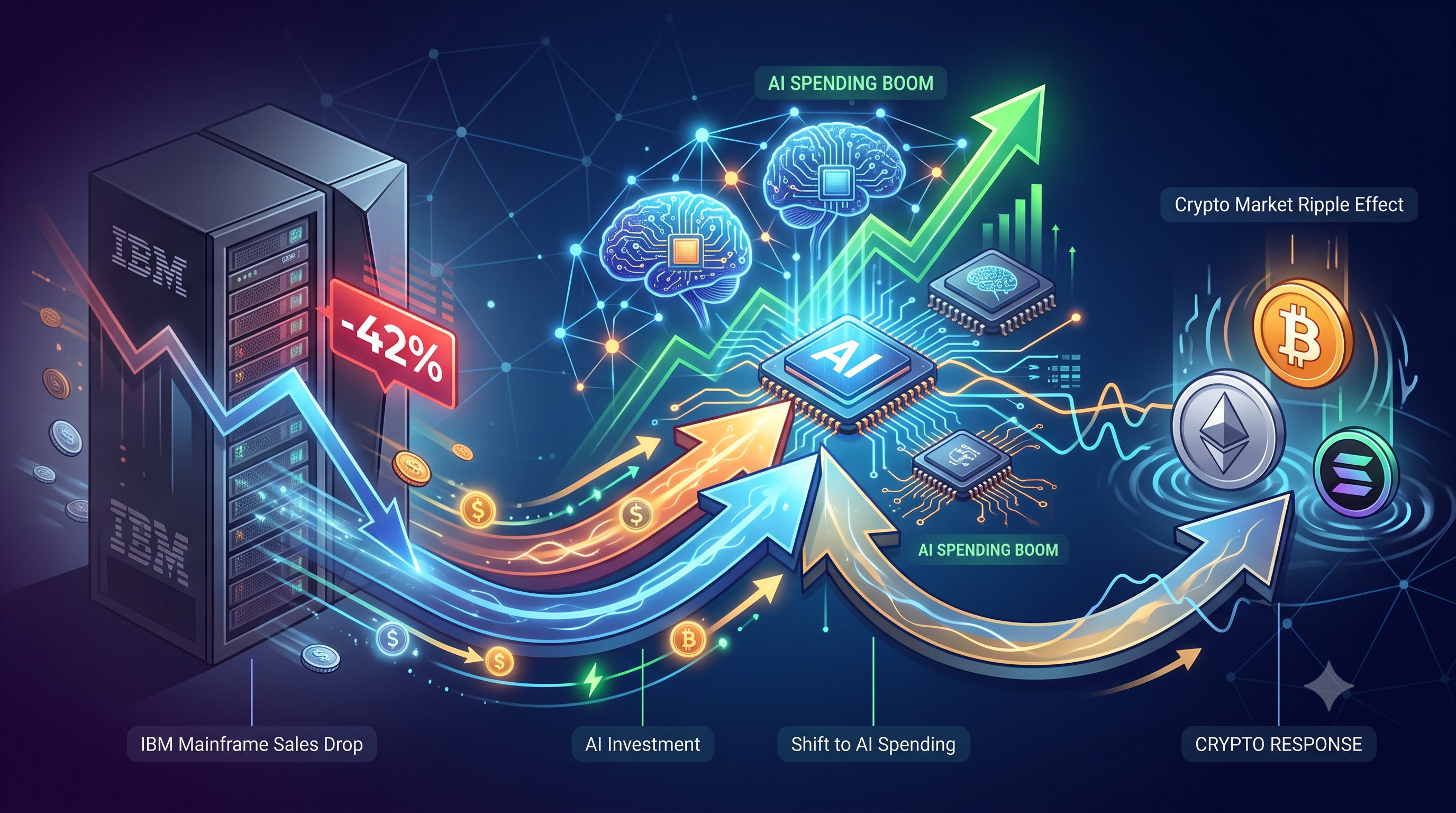
Impact of AI Spending on IBM's Infrastructure Segment
IBM reported a significant decline in its infrastructure segment during the second quarter of 2026, with mainframe sales plummeting 42% year over year. This downturn is largely attributed to customer budget reallocations toward artificial intelligence hardware, as enterprises prioritize investments in AI capabilities. In response to these shifts, the company has adjusted its full-year revenue growth guidance downward, reflecting changes in enterprise capital expenditure priorities. This situation underscores the fast scaling of AI infrastructure and its profound influence on traditional IT spending patterns, with notable implications for energy-intensive sectors such as the cryptocurrency market.
The sharp decline in IBM's mainframe revenue illustrates a broader trend of enterprises prioritizing AI compute resources. This shift presents challenges for legacy IT vendors while simultaneously creating opportunities for cryptocurrency operations that require similar infrastructure. As capital is reallocated across technology budgets, the IT spending space is growing, showing the need for vendors to adapt to these shifting priorities. The implications of this trend extend beyond immediate revenue impacts, suggesting a fundamental transformation in how enterprises allocate resources in the face of advancing AI technologies.
IBM Q2 Results Reveal Significant Mainframe Revenue Pressure
IBM’s second-quarter 2026 financials showed infrastructure revenue declining 7% to $3.84 billion, primarily due to a 42% drop in IBM Z mainframe sales compared to the prior year’s z17 launch cycle. CEO Arvind Krishna attributed the shortfall to customers redirecting budgets toward servers, storage, and memory to secure AI-related supplies amid rising prices and shortages. The company lowered its full-year revenue growth outlook to 4-5% from previous expectations above 5%. Despite the miss, software recurring revenue grew 8%, and distributed infrastructure posted strong gains of 37%. Executives emphasized that the mainframe weakness appears temporary, with clients continuing to add capacity for AI and analytics workloads on existing systems.
Free cash flow stood at $2.5 billion for the quarter. This performance underscores the intensity of AI capital expenditure demands, where supply constraints force prioritization decisions across IT portfolios. For cryptocurrency market observers, such a move in traditional enterprise spending can influence power and hardware availability dynamics relevant to mining operations. IBM’s results provide a window into how AI investments are reshaping overall technology budgets without necessarily diminishing long-term demand for reliable computing platforms. Logical analysis shows that while hardware cycles create quarterly volatility, underlying utilization for hybrid workloads remains robust.
Enterprise Budget Reallocation Toward AI Infrastructure Components
Customers delayed or redirected significant deals in the final weeks of the quarter to prioritize AI hardware procurement, according to IBM executives. Memory chips, servers, and storage systems saw heightened demand as organizations sought to lock in supply before further price increases. This reallocation impacted software and mainframe transactions, which typically require substantial capital commitments. CFO James Kavanaugh noted the mainframe stack’s outsized effect on growth metrics. Distributed infrastructure, including Power Servers, benefited from record backlog levels near $500 million. The pattern shows a structural shift where AI workloads command immediate budget priority due to competitive pressures and projected returns.
Industry reports confirm widespread supply chain tightness in AI components, forcing enterprises to make trade-offs. The same dynamics apply to mining operations in the cryptocurrency space, which compete for the same power and semiconductor resources. IBM’s experience shows how targeted AI spending affects other sectors, but this doesn’t reduce the demand for traditional systems. Earnings call practical examples show clients accelerating AI pilots while maintaining long-term mainframe strategies. This budget environment creates headwinds for legacy vendors and tailwinds for infrastructure providers that serve multiple compute types. Capital expenditure trend data supports the view of temporary compression, then normalization.
Impact of AI Capex on Traditional Data Center and Mainframe Markets
The surge in AI-related capital expenditure has led to notable shifts in data center priorities, with organizations allocating more resources to GPU-heavy environments over conventional mainframe upgrades in the short term. IBM reported that several large transactions slipped due to these reprioritizations. However, executives maintained that core mainframe demand persists for mission-critical workloads, analytics, and hybrid cloud setups. Power server sales within distributed infrastructure rose sharply, indicating continued investment in high-performance computing.
This duality shows enterprises expanding overall capacity rather than fully substituting one technology for another. For cryptocurrency mining, which relies on specialized hardware and significant energy infrastructure, the AI boom introduces competition for chips and power but also drives innovation in efficient data center designs. Shared supply chains mean mining operators may face higher costs or delays, yet increased focus on energy management benefits the sector long-term. Industry metrics reveal AI driving substantial data center expansions, with spillover effects on cooling, networking, and power systems relevant to crypto facilities. IBM’s commentary suggests clients view AI as complementary to existing infrastructure rather than replacement.
Cryptocurrency Mining Hardware and Energy Demand in the AI Era
Cryptocurrency mining operations utilize hardware and energy resources that overlap with AI data center requirements, creating potential supply and cost pressures as AI investments accelerate. The semiconductor shortages noted in IBM’s reporting affect GPU and ASIC availability, key components for both AI training and crypto hashing. Mining farms have adapted by optimizing efficiency and exploring alternative energy sources, yet competition for grid capacity in key regions remains a factor. AI’s power demands have prompted utilities and developers to expand generation and transmission infrastructure, which could eventually alleviate constraints for all high-performance computing users.
In practice, examples could include the co-location of mining companies with AI facilities or investment in renewable projects to secure a stable supply. Market data show that mining profitability is sensitive to energy prices and hardware costs. AI shift ignites mining hardware innovation. Manufacturers respond to demand for more efficient chips. IBM’s results are an indirect reminder of how enterprise AI priorities are remaking the broader computing ecosystem, including crypto infrastructure. Longer term, more data center build-out enables the scalability of decentralized networks.
Power and Data Center Infrastructure Competition Between AI and Crypto
Both AI training clusters and cryptocurrency mining require substantial electricity and specialized facilities, leading to localized competition for resources in certain markets. IBM’s observation of customers prioritizing AI hardware points to budget and supply dynamics that extend to energy procurement. Utilities report heightened demand from technology users, prompting investments in new capacity that ultimately benefits multiple sectors. Crypto miners have historically demonstrated flexibility in siting operations near low-cost or stranded energy sources, a strategy that mitigates some pressures.
In practice, case studies show mining companies are working with renewable developers or using flare gas, reducing their net environmental footprint while accessing power. The AI load profile is continuous, unlike the adjustable load in mining, so they could be combined to optimize the grid. AI is expected to continue driving data center growth, with a small lift from crypto. IBM’s earnings backdrop shows how shifts in the enterprise drive patterns of overall technology infrastructure spend. Over time, coordination among users and providers can relieve bottlenecks. Data from power purchase agreements reveals planning in high-compute industries.
Semiconductor Supply Chain Strains from AI Prioritization
AI infrastructure buildout has intensified demand for advanced semiconductors, memory, and related components, contributing to the mainframe sales softness reported by IBM. Enterprises accelerated purchases to avoid anticipated price hikes and availability issues. This dynamic affects cryptocurrency hardware manufacturers who rely on similar foundry capacity for ASICs and GPUs. Supply chain data indicates allocation challenges, though diversification efforts by chipmakers aim to expand output. Practical responses from the crypto sector include custom silicon development and efficiency improvements to stretch existing resources.
IBM’s robust distributed infrastructure, particularly in Power servers, illustrates that specific market segments can thrive even in challenging times. The surge in AI-driven demand fosters creativity and innovation in semiconductor design, benefiting various computing sectors. While short-term supply constraints may lead to fluctuations, the ongoing investments in long-term capacity are paving the way for future growth. IBM executives view this transitional phase as temporary, anticipating a return to stability as supply chains adapt and catch up with demand.
Long-Term Mainframe Resilience Despite Short-Term Declines
IBM executives have expressed strong confidence in the lasting significance of mainframes for high-reliability workloads. They highlighted ongoing capacity expansions for AI and Linux environments, even in light of a quarterly sales decline. This 42% drop was, in part, due to challenging year-over-year comparisons following the z17 launch. Clients continue to make strategic investments in these robust systems for transaction processing and data management, demonstrating a commitment to reliability. This resilience indicates that mainframes serve to complement, rather than directly compete with, AI accelerators in many deployments.
For cryptocurrency applications, mainframe-grade reliability could inspire hybrid architectures for critical infrastructure like exchanges or custodians. There are practical examples in financial services where legacy systems effectively interface with blockchain layers, showcasing the potential for integration. The broader IT spending landscape encourages diversification across various compute types. IBM’s backlog and software growth metrics reinforce the perspective of sustained demand. The quarterly fluctuations observed are more reflective of capital timing rather than a structural decline. Industry analysis consistently affirms the vital role of mainframes in mission-critical operations, underscoring their importance in today’s technology space
Opportunities for Crypto in AI-Driven Data Center Expansion
The rapid growth of artificial intelligence infrastructure is fueling unprecedented investment in data centers, creating opportunities that extend well beyond AI applications and into the cryptocurrency sector. As organizations deploy larger AI models and process increasingly complex workloads, they require high-performance computing facilities equipped with reliable power, advanced networking, and scalable storage. These investments are also benefiting cryptocurrency operations, particularly mining and blockchain infrastructure, by expanding access to modern facilities with stronger power capacity and improved operational efficiency. Rather than building separate infrastructure from scratch, some operators are leveraging these shared resources to reduce costs and improve performance.
The result is a growing synergy between AI and cryptocurrency, where advances in one industry help strengthen the technological foundation of the other while encouraging greater investment in resilient and future-ready computing infrastructure. At the same time, innovations in power management and cooling technologies are making large-scale computing operations more efficient and sustainable. Modern data centers increasingly rely on advanced liquid cooling, immersion cooling, and AI-powered energy management systems to regulate temperatures, optimize workloads, and reduce electricity consumption. These technologies not only enhance the performance and lifespan of AI servers and cryptocurrency mining equipment but also lower operating costs and improve overall energy efficiency.
Hardware Innovation Cycles in Response to AI and Crypto Demands
Manufacturers are increasingly responding to the growing computational demands of artificial intelligence and cryptocurrency by developing more efficient processors, specialized chips, and advanced computing systems. As both industries compete for processing power, chip designers are prioritizing higher performance while reducing energy consumption and heat generation. IBM’s expanding Power server business demonstrates how enterprise-focused hardware can benefit from these innovations, delivering improved efficiency for AI workloads and high-performance computing applications. At the same time, cryptocurrency-specific application-specific integrated circuits (ASICs) continue to evolve, offering greater hash rates with lower power consumption. These improvements are helping mining operations reduce operational costs while improving overall sustainability.
Competitive pressure among semiconductor manufacturers is further accelerating research into next-generation chip architectures, advanced manufacturing processes, and smarter cooling technologies, ensuring that computing infrastructure can keep pace with the rapid growth of both AI and blockchain ecosystems. Hardware manufacturers are designing platforms capable of supporting diverse workloads, from AI model training and inference to blockchain validation and cryptographic processing, making computing infrastructure more versatile than ever before. This shared demand is encouraging greater investment in specialized accelerators, energy-efficient processors, and scalable server architectures that maximize performance without significantly increasing electricity consumption.
Energy Market Implications of Concentrated Tech Spending
The growth of artificial intelligence and cryptocurrency is changing regional energy markets by driving unprecedented demand for electricity and accelerating investments in modern energy infrastructure. As AI data centers expand and crypto mining operations require greater computing power, utilities are increasingly turning to renewable energy sources such as solar, wind, hydroelectric, and advanced nuclear power to meet demand while reducing carbon emissions. This shift is also encouraging the modernization of electrical grids through smart technologies, battery storage, and demand-response systems that improve efficiency and reliability. At the same time, companies are signing long-term renewable power purchase agreements (PPAs) and adopting stricter energy-efficiency standards for hardware and cooling systems, creating a more sustainable framework for supporting the continued growth of both industries without placing excessive strain on existing power networks.
IBM’s insights into customer behavior reinforce these broader trends, showing that organizations are increasingly treating sustainability as a strategic priority rather than simply a compliance requirement. Businesses deploying AI and blockchain technologies are placing greater emphasis on energy-efficient infrastructure, environmentally responsible operations, and long-term resilience while continuing to pursue innovation and performance. This growing alignment between technology adoption and sustainability is encouraging closer collaboration among energy providers, governments, and technology companies to develop smarter energy management solutions and cleaner computing infrastructure.
Investment and Valuation Considerations for Tech and Crypto Sectors
Enterprise spending patterns are playing an increasingly important role in shaping the valuations of companies across both the technology and cryptocurrency industries. As businesses reassess their priorities, they are directing more capital toward projects that deliver measurable returns while delaying or reducing investments in areas with uncertain short-term outcomes. IBM's recent adjustment to its financial guidance highlights how even established technology companies can experience temporary market pressure when enterprise customers slow their spending or alter purchasing decisions. While these moves may create near-term volatility, they do not necessarily reflect weakening demand for innovation. Instead, they demonstrate how corporate budgeting cycles can influence investor sentiment, earnings expectations, and stock performance, even when the broader outlook for digital transformation remains positive.
Despite these short-term headwinds, the long-term growth drivers supporting artificial intelligence remain firmly in place. Organizations across industries continue to invest heavily in AI-powered automation, data analytics, cloud infrastructure, and machine learning applications to improve efficiency and remain competitive. At the same time, the cryptocurrency sector is positioned to benefit from these technological investments through shared infrastructure, including advanced data centers, high-performance computing, specialized semiconductor development, and cloud services. As enterprises expand their AI capabilities, many of the same technologies and resources can also support blockchain networks, digital asset platforms, and decentralized applications. This convergence creates meaningful infrastructure synergies that strengthen the long-term outlook for both industries.
Conclusion
IBM’s 42% mainframe sales decline in Q2 2026 underscores the powerful reallocation of enterprise budgets toward AI infrastructure, creating short-term pressure on traditional IT segments while highlighting opportunities in shared data center and energy ecosystems relevant to cryptocurrency. The company’s results reveal temporary timing effects rather than fundamental weakness, with distributed infrastructure showing strength and software recurring revenue growing steadily.
For crypto, the AI spending wave intensifies competition for resources but also drives broader infrastructure investment that can support mining and decentralized applications over time. Executives’ confidence in mainframe resilience points to hybrid computing futures in which multiple technologies coexist. Watch for signs of sector interdependencies through capital flow trends, hardware supply metrics, and energy developments. This environment promotes flexibility and innovation across computing paradigms. IBM’s experience is a useful case study in how to handle technology spending cycles.
🔥 Join KuCoin’s 9th Anniversary Trading CampaignKuCoin is celebrating its 9th anniversary with a special platform campaign filled with exclusive rewards, trading activities, and limited-time offers. Don’t miss the chance to participate and enjoy the benefits as the exchange marks nine years of growth and innovation. Visit the official campaign page now:
|

FAQs
What caused the 42% drop in IBM mainframe sales in Q2 2026?
IBM attributed the sharp decline primarily to customers redirecting capital expenditures toward AI-related servers, storage, and memory amid supply constraints and rising prices. The quarter faced tough comparisons with the previous year’s z17 mainframe launch, amplifying the reported weakness. Executives noted several large deals slipped in the final weeks as enterprises prioritized securing AI hardware.
Why are enterprises investing more in AI infrastructure than traditional IT systems?
Enterprises are prioritizing AI infrastructure because AI applications require significant computing power, specialized hardware, and scalable data centers. These investments are expected to deliver long-term competitive advantages, prompting businesses to redirect budgets from some traditional IT upgrades toward AI-focused technologies.
How does increased AI spending affect cryptocurrency mining?
AI infrastructure expansion increases competition for semiconductors, electricity, and data center capacity, which can raise costs for cryptocurrency miners. However, it also encourages investment in new energy infrastructure and more efficient computing technologies that may benefit mining operations over time.
Can AI and cryptocurrency share the same data center infrastructure?
Yes. Many modern data centers are designed to support high-performance computing workloads, allowing AI applications and cryptocurrency operations to share power infrastructure, networking, cooling systems, and other resources more efficiently.
Why are semiconductor manufacturers developing more specialized chips?
Growing demand from both AI and cryptocurrency has encouraged chipmakers to design processors that deliver higher performance while consuming less power. These innovations improve efficiency, reduce operating costs, and support increasingly demanding computing workloads.
Disclaimer: This content is for informational purposes only and does not constitute investment advice. Cryptocurrency investments carry risk. Please do your own research (DYOR).