

Coinbase and Circle Partner with Hyperliquid: USDC Treasury Role, HYPE Staking, and the USDH Transition Explained
Introduction
Hyperliquid's USDC balance crossed $5.8 billion in May 2026, making it one of the largest single-venue USDC reserves in DeFi, according to on-chain data cited by CoinDesk on May 13, 2026. That scale is precisely why Coinbase and Circle just deepened their integration with the perpetuals exchange — and why the move reshapes stablecoin economics across decentralized derivatives. The partnership formalizes Circle as Hyperliquid's primary USDC liquidity provider, enables native HYPE staking through Coinbase, and accelerates the transition toward USDH, Hyperliquid's own stablecoin standard.
This article breaks down what each pillar of the deal means for traders, what changes for HYPE holders, and how the USDH transition will redirect billions in stablecoin yield back into the Hyperliquid ecosystem.
What Is the Coinbase-Circle-Hyperliquid Partnership?
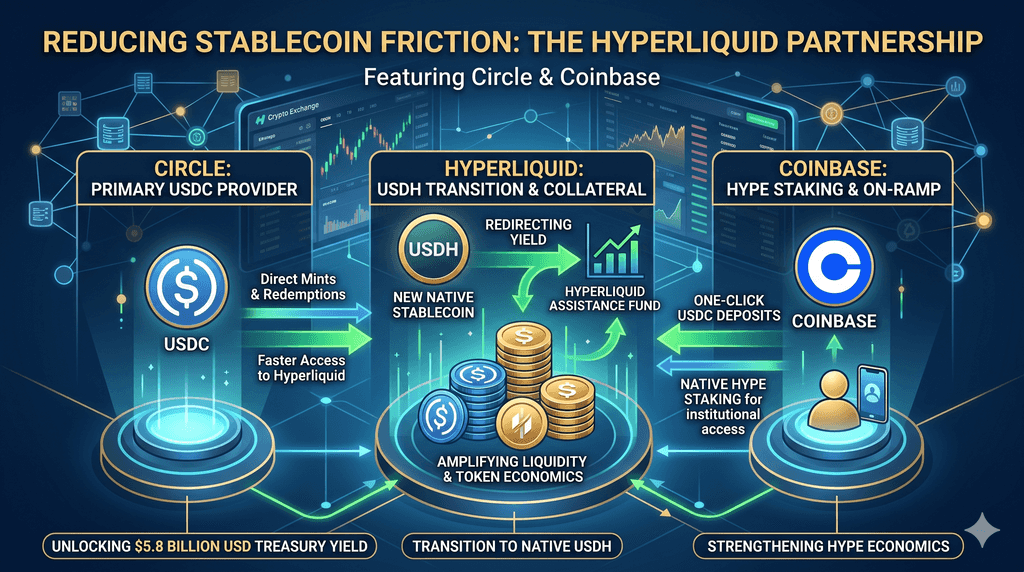
The partnership is a three-way commercial and technical integration that locks Coinbase and Circle into Hyperliquid's core infrastructure. Announced in May 2026, the deal designates Circle as the primary USDC issuer and redemption partner for Hyperliquid, while Coinbase becomes the first major centralized exchange to offer native HYPE staking and one-click USDC routing into Hyperliquid perpetuals.
The three components work together:
-
Circle's role: Direct USDC mint and redeem rails for Hyperliquid, replacing slower cross-chain bridges with native issuance on HyperEVM.
-
Coinbase's role: Native HYPE staking, custody, and a deposit pipeline that lets retail users move USDC from Coinbase to Hyperliquid in a single click.
-
Hyperliquid's role: Transition its dominant USDC collateral base toward USDH, a yield-bearing stablecoin governed by the Hyperliquid Foundation.
According to Hyperliquid's official announcement, the integration is expected to roll out in phases through Q3 2026.
Why Does USDC Dominate Hyperliquid's Treasury?
USDC dominates because Hyperliquid built its perpetuals engine around a single-collateral model, and USDC offered the deepest, most regulated dollar liquidity at launch. More than 97% of Hyperliquid's margin collateral is denominated in USDC, based on dashboards cited by CoinDesk in May 2026.
That concentration created both an advantage and a vulnerability. The advantage is unified liquidity — every perpetual market shares the same collateral pool, which keeps spreads tight and funding rates efficient. The vulnerability is dependency: Hyperliquid generates no revenue from the float, while Circle earns the full Treasury yield on roughly $5.8 billion in idle reserves.
How Much Yield Is at Stake?
At current short-term Treasury rates near 4.2% in May 2026, $5.8 billion in USDC reserves generates approximately $240 million in annualized yield. Historically, that yield flowed entirely to Circle. Under the new partnership, a negotiated share will be rebated to the Hyperliquid Assistance Fund — the protocol-level treasury that backs HYPE buybacks and insurance.
What Does Coinbase's HYPE Staking Integration Change?
Coinbase's HYPE staking integration unlocks institutional-grade access to Hyperliquid's validator economics for the first time. Previously, HYPE staking required self-custody and direct interaction with HyperBFT validators, which excluded most US retail and institutional capital.
With Coinbase as a staking provider:
-
US users can stake HYPE directly from Coinbase accounts without managing keys.
-
Coinbase handles validator selection, slashing protection, and tax reporting.
-
Staked HYPE remains liquid through Coinbase's standard unstaking windows.
What Are the Yield Expectations?
HYPE staking yields currently range between 2.3% and 3.1% APR based on Hyperliquid validator dashboards as of early May 2026. That number is lower than many proof-of-stake L1s because Hyperliquid's emission schedule is conservative — most validator income comes from a share of protocol trading fees rather than new token issuance.
For Coinbase, the integration follows its successful ETH and SOL staking products, both of which generate eight-figure quarterly revenue. For Hyperliquid, it widens the validator base and reduces the share of HYPE held in passive wallets.
What Is USDH and Why Is Hyperliquid Transitioning to It?
USDH is Hyperliquid's native stablecoin, designed to redirect Treasury yield from external issuers back to the protocol and its users. The transition is the most economically consequential part of the partnership because it changes who earns the yield on collateral.
USDH is structured as a fully-backed, dollar-pegged stablecoin issued under the Hyperliquid Foundation's governance, with reserves managed through a Circle-operated framework. According to the protocol's documentation referenced by Zombit on May 13, 2026, USDH will be:
-
1:1 backed by short-duration US Treasuries and cash equivalents
-
Redeemable at par through Circle's institutional rails
-
The default collateral asset for all new Hyperliquid perpetual markets by Q4 2026
How Does USDH Differ from USDC?
The core difference is yield distribution. USDC yield flows to Circle and its commercial partners. USDH yield flows to the Hyperliquid Assistance Fund, which funds HYPE buybacks, market-maker rebates, and protocol insurance.
|
Feature
|
USDC
|
USDH
|
|
Issuer
|
Circle
|
Hyperliquid Foundation (Circle-managed reserves)
|
|
Backing
|
Cash and short-term Treasuries
|
Short-duration US Treasuries
|
|
Yield recipient
|
Circle
|
Hyperliquid Assistance Fund
|
|
Primary use
|
Multi-chain settlement
|
Hyperliquid-native collateral
|
|
Governance
|
Circle
|
HYPE token holders
|
How Will the USDC-to-USDH Migration Work?
The migration will run in three phases through late 2026, designed to avoid liquidity shocks on existing perpetual markets. Hyperliquid has explicitly committed to maintaining USDC support throughout the transition.
Phase one introduces USDH as an optional collateral type alongside USDC, with incentive rebates for early adopters. Phase two routes new perpetual listings to USDH-denominated margin by default. Phase three offers automatic migration tools that let users convert USDC positions to USDH without unwinding trades.
Circle's role in the migration is critical — it provides the mint, redeem, and reserve management infrastructure, which means USDH inherits Circle's regulatory compliance and audit framework rather than building from scratch.
What Are the Risks of the Transition?
The main risks are liquidity fragmentation, smart contract exposure, and regulatory scrutiny. Liquidity could thin temporarily if traders hesitate to migrate before USDH proves its peg under stress. Smart contract risk applies because USDH introduces new mint and redemption contracts that have a shorter operational history than USDC.
Regulatory scrutiny is the most consequential variable. US stablecoin legislation expected to advance in 2026 may impose issuer-specific requirements that affect how USDH is classified and distributed.
How Does This Partnership Affect HYPE Token Economics?
The partnership materially strengthens HYPE token economics through three direct mechanisms. First, USDH yield rebates flow into the Assistance Fund, which has historically used surplus revenue to buy back and burn HYPE. Second, Coinbase staking widens validator participation and reduces circulating supply available for sale. Third, deeper Coinbase liquidity lowers the friction cost for new HYPE buyers entering the market.
On-chain data referenced by CoinDesk on May 13, 2026 shows HYPE buybacks accelerated in the weeks leading up to the announcement, with the Assistance Fund absorbing roughly 1.2% of circulating supply over a 30-day window.
What About HYPE Price Impact?
HYPE traded near $38 in mid-May 2026, up roughly 22% in the week surrounding the partnership announcement, based on market data summarized by CoinDesk. Sustained price appreciation will depend on whether USDH adoption materially increases the buyback rate — not on the announcement itself.
What Does This Mean for DeFi Perpetuals Competition?
The partnership pulls Hyperliquid further ahead of dYdX, GMX, and Drift in the DeFi perpetuals race. Hyperliquid already controlled roughly 68% of decentralized perpetuals volume in early May 2026, according to DeFi dashboards cited by CoinDesk. The Coinbase and Circle integration adds three structural advantages competitors will struggle to replicate quickly:
-
Regulated on-ramps: Direct Coinbase USDC routing removes the bridging friction that has historically kept retail volume on centralized perps venues.
-
Yield-bearing collateral: USDH lets Hyperliquid offer effectively negative net trading costs for active traders, since collateral yield can offset funding and fees.
-
Validator credibility: A Coinbase staking endorsement signals institutional comfort with HyperBFT consensus.
Competitors without similar partnerships face a widening gap in both liquidity depth and user acquisition efficiency.
Conclusion
The Coinbase, Circle, and Hyperliquid partnership is one of the most economically significant DeFi integrations of 2026. It locks Circle in as Hyperliquid's primary stablecoin partner, gives Coinbase exclusive early access to HYPE staking distribution, and sets the technical and regulatory foundation for the USDH transition.
For traders, the immediate impact is smoother USDC on-ramps and lower friction between centralized and decentralized venues. For HYPE holders, the partnership strengthens token economics through expanded staking, accelerated buybacks, and yield rebates funneled into the Assistance Fund. For the broader DeFi perpetuals market, it widens Hyperliquid's lead and raises the bar for competing venues.
The USDH transition is the variable to watch. If Hyperliquid successfully redirects yield from the $5.8 billion USDC reserve back into protocol incentives, it will redefine how decentralized exchanges capture value from their own collateral — a model competitors will be forced to follow.
FAQs
1. Is USDH available to trade right now?
USDH is rolling out in phases through Q3 2026 and is not yet broadly tradable on external exchanges. Initial issuance is concentrated on Hyperliquid itself, with Circle managing reserves. Wider exchange listings are expected once phase two of the migration begins.
2. Can non-US users stake HYPE on Coinbase?
Coinbase's HYPE staking availability depends on regional regulation. US users get access first, while availability in Europe, Asia, and other regions follows Coinbase's standard staking jurisdiction rules. Users in unsupported regions can still stake HYPE through self-custody or other validators.
3. Will USDC be delisted from Hyperliquid?
No. Hyperliquid has committed to maintaining USDC support throughout and after the USDH transition. USDC remains a fully supported collateral asset, and the migration to USDH is opt-in for existing positions.
4. How does the Hyperliquid Assistance Fund use yield revenue?
The Assistance Fund deploys yield revenue primarily into HYPE buybacks, market-maker incentive rebates, and protocol-level insurance reserves. Buybacks are conducted on-chain and have historically reduced circulating supply during periods of strong trading volume.
5. Does this partnership affect Hyperliquid's decentralization?
The partnership introduces commercial dependencies on Coinbase and Circle but does not change Hyperliquid's validator set or consensus mechanism. HyperBFT continues to operate through its independent validator network, and protocol governance remains with HYPE token holders.