

Brent Crude Approaches $100 as Central Banks Prepare for Possible Rate Hikes
2026/07/27 17:26:00
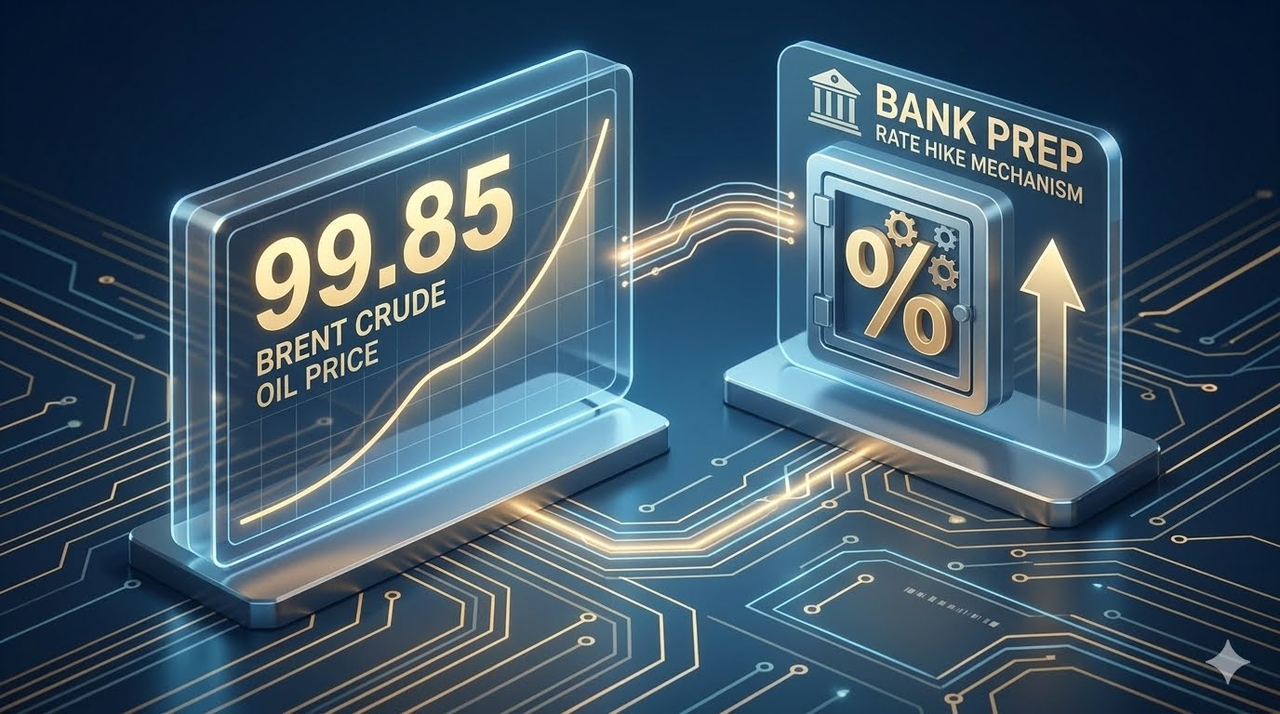
The global financial landscape adjusted as Brent crude oil futures crossed the critical $100 per barrel threshold. Driven by lingering geopolitical friction, this sudden energy price increase altered the market consensus that had previously priced in a synchronized monetary easing cycle for the second half of the year. Although subsequent diplomatic openings in the Middle East led crude prices to stabilize back toward the $92 range, the structural pressure on global supply chains remains a relevant market catalyst. The expectation of imminent, aggressive central bank rate cuts has receded, replaced by a more cautious posture across fixed-income, equity, and digital asset markets.
When global energy prices rise, they tend to pass through as structural inflation across manufacturing, transport, and consumer sectors. Central banks typically respond by maintaining restrictive monetary policies or tightening liquidity—actions that influence the global supply of capital. This article examines how the $100 crude milestone, combined with a more hawkish central bank outlook, impacts the foundational liquidity architecture that influences crypto markets.
Chronology of a Crisis: What Pushed Brent Crude to $100?
Geopolitical Chokepoints Under Fire
The immediate catalyst for the crude oil rally is rooted in a critical escalation within the Middle East. Structural maritime safety came under direct threat following a series of targeted Houthi insurgent attacks on Saudi Arabian commercial tankers operating in the Red Sea corridor. This localized aggression immediately placed two of the world's most vital maritime energy transit routes under operational duress: the Bab al-Mandab Strait and the Strait of Hormuz.
Together, these maritime chokepoints facilitate the daily transit of a massive percentage of global seaborne petroleum liquids. The physical risk of cargo destruction, paired with a compounding escalation in commercial maritime insurance premiums, forced international shipping conglomerates to consider lengthy reroutings around the Cape of Good Hope. This effective reduction in immediate tanker availability caused Brent crude to break upward, crossing the psychologically and economically vital $100 threshold on July 23.
The Multi-Pronged Inflationary Threat
The 2026 energy shock does not exist in a vacuum. Instead, it acts as an amplifier to two other structural macroeconomic forces that were already applying upward pressure on global producer and consumer price indexes:
-
The AI Capital Expenditure (Capex) Explosion: The ongoing global technology race to build out infrastructure for artificial intelligence has triggered a massive, inelastic demand for baseload electrical power. The construction of massive hyperscale data centers requires unprecedented grid capacity, stretching traditional energy supplies and limiting the excess capacity typically used to buffer sudden geopolitical supply shocks.
-
The Impending Tariff Regime: Global supply networks are simultaneously preparing for the implementation of new, comprehensive trade legislations, including anticipated universal tariff brackets ranging between 10% and 12.5% across major Western economies. The expectation of these sweeping trade barriers has caused manufacturing entities to front-load raw material imports, driving up baseline shipping costs and instigating early inflationary expectations.
| Inflationary Driver | Core Mechanism | Immediate Macroeconomic Impact | Timeline & Persistence |
| Geopolitical Chokepoints | Houthi attacks on Saudi tankers; threats to Strait of Hormuz and Bab al-Mandab. | Spiked Brent crude past $100/bbl due to maritime risk premiums. | High volatility; subject to immediate diplomatic or military shifts. |
| AI Capex Expansion | Industrial-scale data center buildouts requiring massive baseload electricity. | Compounds structural demand for underlying fossil and green energy grids. | Long-term structural factor extending across the decade. |
| Universal Tariffs | Anticipated 10%–12.5% broad import duties across major Western consumer economies. | Prompts front-loading of goods; creates structural "Trumpflation" expectations. | Medium-term regulatory implementation window. |
| S&P 500 Index | Structural downside pressure due to elevated corporate energy inputs and margin erosion. | Moderate to High; sensitive to corporate earnings and discount rate adjustments. | Traditional risk benchmark experiencing capital contraction. |
The Central Bank Response: The Resurgence of "Higher for Longer" Expectations
The Federal Reserve’s Dilemma Under Kevin Warsh
The emerging threat of secondary inflation has increased policy pressure on the Federal Reserve. Newly appointed Fed Chairman Kevin Warsh faces an immediate challenge as sovereign bond yields rise across the curve. Prior to the energy disruption, a moderate cooling in the June consumer price index (CPI) data had led markets to forecast steady interest rate reductions. However, the recent multi-week commodities surge has tempered that optimism.
Within the Federal Open Market Committee (FOMC), hawkish voting members have maintained a cautious stance regarding premature monetary easing. Fed Governor Christopher Waller reflected this internal sentiment, stating that "staring at inflation until it melts is not an option." As the July 29 FOMC interest rate decision approaches, consensus data indicates that while the Federal Reserve is highly likely to hold the benchmark federal funds rate stable at its current level, the accompanying policy statement and press conference may project a more hawkish tone. This posture prepares the market for a potential resumption of interest rate hikes in the autumn sessions if core inflationary metrics fail to stabilize.
Europe, the UK, and Japan on High Alert
A renewed focus on managing inflation is visible across other major central banking institutions:
The European Central Bank (ECB): Under the leadership of President Christine Lagarde, the ECB has maintained its benchmark interest rates while signaling that the policy option for a September interest rate increase remains open. With Eurozone consumer inflation projected at an annualized rate of 2.9% for July—driven by regional energy input costs—the central bank is carefully managing the duration of its policy pause.
The Bank of England (BoE): Confronted with persistent service-sector wage growth and rising energy import costs, internal voting dynamics within the BoE's Monetary Policy Committee are shifting. Economists note that the proportion of committee members considering an active rate hike to prevent inflation from unanchoring has increased ahead of their upcoming policy session.
The Bank of Japan (BoJ): The Japanese monetary authority faces challenges on two fronts. The Japanese Yen has experienced depreciation pressures, weakening past the 163 Yen per US Dollar threshold. When a depreciated domestic currency is combined with higher dollar-denominated crude oil prices, the cost of imported energy rises for Japanese corporations. Consequently, the market is anticipating an accelerated policy shift or adjustments to quantitative tightening from the BoJ to stabilize the domestic currency value.
The Macro Transmission Mechanism: How Oil Shocks Bleed Into Crypto Liquidity
The Sovereign Bond Market Adjustment
The shifting monetary policy consensus had impact on global fixed-income markets, where sovereign debt instruments faced noticeable selling pressure. Because bonds pay a fixed yielding stream, the prospect of sustained inflation and potential future interest rate increases by central banks reduces the real value of those future payments. As investors adjusted their portfolios for risk, bond prices fell, driving yields—which move inversely to prices—steadily upward across international markets.
The benchmark United States 10-Year Treasury yield experienced a significant upward move, approaching 4.69%. Parallel movements occurred across European debt markets: the French 10-year sovereign bond yield breached the 4% threshold for the first time since 2009, while United Kingdom 10-year Gilt yields rose to settle near 5.08%. These adjustments reflect a structural recalibration of the baseline cost of capital worldwide.
How Rising Yields Influence Risk Assets
The transmission mechanism through which rising sovereign yields influence cryptocurrency asset valuations can be understood through several established financial channels:
Adjustments in the Risk-Free Rate of Return: When investors can achieve a reliable, federally backed annualized yield approaching 4.7% through US government debt, the relative attractiveness of volatile, non-yielding, or high-risk assets decreases. Consequently, institutional allocators require a higher risk premium to justify positions in cryptocurrencies or growth equities.
Credit Conditions and Liquidity Distribution: Elevated sovereign yields influence the pricing baseline for commercial credit, mortgage rates, and margin financing. As borrowing costs rise, the discretionary liquidity available for alternative financial markets is often moderated, as capital is increasingly directed toward servicing debt or conservative instruments.
Quantitative and Programmatic Portfolio Rebalancing: Institutional desks frequently manage capital using multi-asset risk-parity or quantitative models. When fixed-income volatility rises alongside an upward shift in yields, these automated systems often reduce exposure to highly volatile asset classes, including Bitcoin, Ethereum, and broader digital assets, to maintain predefined portfolio risk boundaries.
Risk Mitigation Patterns: Capital Reallocation and On-Chain Behavior
On-Chain Allocation Ahead of the FOMC Meeting
An examination of underlying blockchain metrics suggests that institutional and large-scale market participants have been adjusting their portfolios ahead of the upcoming central bank policy decisions. On-chain data indicates an increase in stablecoin (USDT and USDC) inflows onto centralized trading platforms, contrasting with a simultaneous moderation in net Bitcoin outflows toward long-term cold storage addresses.
This accumulation of stablecoin reserves on exchanges is often interpreted as a measure of tactical patience. Institutional allocators and large holders appear to be building cash-equivalent reserves. Rather than deploying capital into volatile asset segments during a period of macroeconomic adjustments, these participants are maintaining a more liquid posture, awaiting clarification from the Federal Reserve’s policy press conference regarding future interest rate trajectories.
The Derivatives Market: Open Interest and Funding Rates
This cautious positioning is also reflected across cryptocurrency derivatives markets. Following the recent movement in Brent crude prices, aggregate Open Interest (OI) in Bitcoin and Ethereum perpetual futures contracts experienced a noticeable reduction, pointing to a voluntary reduction in overall risk exposure.
As traders lowered their leverage profiles, funding rates—the periodic payments exchanged between long and short contract positions—settled near neutral thresholds. This reduction in outstanding leverage decreases the probability of the cascading liquidations that can occur when leveraged markets encounter macroeconomic adjustments. Consequently, the digital asset market approaches the central bank decision week with a more adjusted structural foundation.
Portfolio Positioning on KuCoin Under Elevated Energy Prices
Managing Volatility via KuCoin Futures and Options
When macro liquidity is influenced by energy-driven inflation and restrictive central bank policies, increased volatility often becomes a primary market feature. Participants can manage this environment by implementing risk-management strategies on KuCoin Futures.
Capital Preservation via KuCoin Earn and Stablecoin Yields
While sovereign bond yields remain elevated in traditional financial markets, the digital asset ecosystem offers alternative yields within the stablecoin segment. During periods of heightened macroeconomic uncertainty, risk-averse participants frequently transition volatile capital allocations into KuCoin Earn frameworks.
By allocating USDT, USDC, or other dollar-pegged stablecoins into fixed or flexible savings programs, investors can access yields without exposing underlying principal to the daily price fluctuations of spot crypto markets. This strategy functions similarly to the traditional financial allocation toward short-duration Treasury instruments, aiming to preserve capital value while awaiting clearer macroeconomic trends.
Utilizing Automated Dollar-Cost Averaging (DCA)
Timing the absolute market trough during macro-driven corrections presents significant execution challenges. A more systematic approach under current conditions involves utilizing automated KuCoin Trading Bots to execute a Dollar-Cost Averaging (DCA) framework.
By configuring a DCA bot to purchase fixed fiat amounts of established digital assets at regular, predetermined intervals, investors can reduce emotional influence in execution. This strategy ensures that if central bank policy leads to short-term price adjustments, the system acquires more units at lower valuations, adjusting the average entry cost over a longer-term investment horizon.
Join KuCoin 9th Anniversary Trading Campaign
KuCoin is celebrating its 9th anniversary with a special platform campaign filled with exclusive rewards, trading activities, and limited-time offers. Don’t miss the chance to participate and enjoy the benefits as the exchange marks nine years of growth and innovation. Visit the official campaign page now:

Conclusion
The movement of Brent crude oil toward the $100 threshold extends beyond its immediate effects on the transportation and energy sectors. It operates as a relevant macroeconomic factor that influences global inflation expectations, modifies the projected policy trajectories of major central banks, and impacts the broader availability of global investment capital.
While the near-term outlook suggests continued volatility as digital asset valuations adjust to elevated sovereign bond yields, the long-term structural framework for scarce digital assets remains a key consideration for portfolio allocators. By monitoring verifiable on-chain metrics, implementing disciplined leverage management, and employing structured accumulation frameworks, market participants can systematically adapt to this changing macroeconomic environment.
FAQs
Why does a surge in Brent crude oil prices directly impact crypto markets?
Higher crude prices drive up manufacturing and transport costs, escalating global inflation. In response, central banks maintain restrictive high-interest rates, which tightens global liquidity and reduces the surplus capital available for volatile risk assets like cryptocurrency.
How does the AI Capex expansion compound the current energy inflation shock?
The massive technological race to construct hyperscale AI data centers generates an unprecedented demand for baseload electricity. This persistent grid drain absorbs the excess energy capacity typically used to buffer sudden geopolitical supply disruptions, amplifying price shocks.
Is Bitcoin behaving more like "Digital Gold" or a "Risk-On Equity" during this crisis?
Empirical data reveals that during the initial phases of this energy shock, Bitcoin displayed a tighter correlation with the tech-heavy S&P 500 index than spot gold, behaving primarily as a high-beta proxy for equity market risk.
What are the distinct chronological phases of crypto asset performance during a macro energy crisis?
It unfolds in three stages: first, an immediate de-risking liquidity shock causing short-term liquidations; second, a prolonged macro window where fiat currency purchasing power degrades; and finally, a cyclical rotation where capital seeks refuge in scarce hard assets.
What on-chain metrics should investors monitor to gauge market de-risking behavior?
Investors should closely monitor stablecoin exchange inflows and overall derivatives open interest. Increased stablecoin reserves on exchanges alongside flattening contract funding rates typically indicate that institutional whales are deleveraging and adopting a cautious, liquid posture.
Disclaimer
The information provided on this page may originate from third-party sources and does not necessarily represent the views or opinions of KuCoin. This content is intended solely for general informational purposes and should not be considered financial, investment, or professional advice. KuCoin does not guarantee the accuracy, completeness, or reliability of the information, and is not responsible for any errors, omissions, or outcomes resulting from its use. Investing in digital assets carries inherent risks. Please carefully evaluate your risk tolerance and financial situation before making any investment decisions. For further details, please consult KuCoin’s Terms of Use and Risk Disclosure.