

Why Top Global Banks Choose XRP: Is it the Ultimate Institutional Asset for 2026?
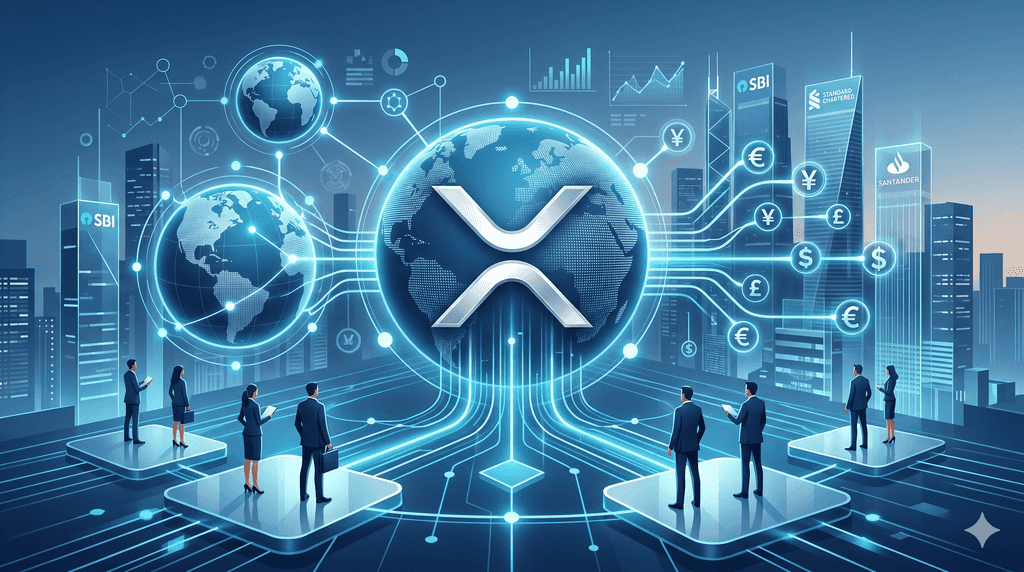
For over a decade, the "XRP vs. the World" narrative dominated headlines, fueled by a relentless legal battle with the SEC. But as we stand in the second quarter of 2026, the dust has settled, and the landscape has fundamentally shifted. The question is no longer "Will XRP survive?" but rather "Why are the world's most conservative financial institutions now building their futures on it?"
From Standard Chartered and Santander to the recent bombshell integration by Rakuten in Japan, the world’s banking giants are moving beyond pilots and into production. As the CLARITY Act moves toward a critical Senate markup this month, XRP has evolved from a speculative "bridge asset" into what many analysts call the "Operating System for Real-World Finance."
This article explores the institutional mechanics driving XRP in 2026, the legislative catalysts that could trigger a move to $2.80 or beyond, and why the "smart money" is no longer sitting on the sidelines.
Key Takeaways:
-
The Regulatory Green Light: Following the March 2026 joint SEC-CFTC classification of XRP as a digital commodity, institutional barriers have officially collapsed.
-
Banking Powerhouses: SBI Holdings, Standard Chartered, and Santander are actively using the XRP Ledger (XRPL) for cross-border settlement.
-
The "CLARITY" Catalyst: The CLARITY Act Senate markup (expected late April) is the primary price driver; passage could target a $8.00 bull case per Standard Chartered.
-
Beyond Payments: The 2026 XRPL roadmap introduces native DeFi lending (XLS-66), allowing banks to earn yield on idle XRP reserves.
-
Real-World Integration: Rakuten Pay just enabled 44 million users in Japan to spend XRP, marking a massive leap in retail-to-institutional synergy.
The Great Pivot: From "Crypto Rebel" to "Bankers' Choice"
The story of XRP in 2026 is one of radical transformation. For years, XRP was the "black sheep" of crypto, avoided by US institutions due to regulatory "clouds." Today, that cloud is gone.
Following the total resolution of the Ripple vs. SEC saga in August 2025 (settled for $125 million), the final piece of the puzzle fell into place on March 17, 2026. On that day, the SEC and CFTC issued joint guidance formally classifying XRP as a digital commodity.
Why Banks Waited—And Why They’re Entering Now
Banks are risk-averse by design. They don't just need a fast technology; they need a legally defensible one.
-
The Commodity Label: This classification allows banks to hold XRP on their balance sheets without the fear of holding "unregistered securities."
-
Fiducial Duty: Institutional custody providers like Gemini and Ripple National Trust Bank (granted conditional OCC approval in late 2025) now offer regulated "safekeeping," allowing pension funds and insurance giants to enter the fray.
The 2026 Banking List: Who Is Actually Using XRP Today?
The "partnership" announcements of 2017 have been replaced by "operational integration" in 2026. Here is a breakdown of the global leaders currently leveraging the XRP Ledger:
SBI Holdings (Japan)
SBI remains the crown jewel of Ripple’s ecosystem. In April 2026, SBI expanded its "XRP for Remittance" program across Southeast Asia, citing a 90% reduction in settlement costs compared to traditional SWIFT methods.
Standard Chartered (UK/Global)
Standard Chartered has integrated XRP into its global payment corridors, particularly for Asia and the Middle East. Their analysts are among the most bullish, recently forecasting a price target of $2.80 as a "conservative" year-end goal for 2026.
Santander (Spain)
Santander uses XRPL-based infrastructure for real-time international transfers between Europe and Latin America. By bypassing the 3–5 day wait times of the legacy banking system, they’ve captured significant market share in the SME (Small to Medium Enterprise) sector.
Mastercard & RLUSD
Perhaps the most significant development of early 2026 is the Ripple-Mastercard partnership. Using Ripple's new RLUSD stablecoin (which crossed $1.3 billion in circulation this month), Mastercard is settling credit card transactions on the XRPL in real-time.
The CLARITY Act: The $100 Billion Legislative Catalyst
If you are tracking XRP’s price in April 2026, you aren't looking at charts—you're looking at Washington D.C.
The CLARITY Act is the most significant piece of crypto legislation in US history. It aims to provide a permanent federal framework for digital commodities.
-
The Deadline: Galaxy Digital’s Alex Thorn recently warned that if the bill doesn't pass the Senate Banking Committee by the end of April 2026, its odds of passing this year drop significantly.
-
The Stakes: Standard Chartered’s Geoffrey Kendrick suggests that a successful CLARITY Act passage could trigger $10 billion in ETF inflows by December.
-
The Price Impact: * Passage: Bull target of $8.00.
-
Failure/Stall: Bear floor of $1.15.
Current market sentiment, as reflected on prediction markets like Polymarket, puts the probability of a successful markup at 55%.
The Evolution of the XRP Ledger: Beyond Simple Payments
In 2026, the XRP Ledger is no longer just a "payment rail." It has evolved into a comprehensive Institutional DeFi Operating System.
XLS-66: The Native Lending Protocol
One of the main reasons banks are choosing XRP in 2026 is the ability to generate yield. The newly launched XLS-66 protocol allows banks like Evernorth (which holds over 470 million XRP) to:
-
Pool Liquidity: Place XRP into "Single-Asset Vaults."
-
Earn Yield: Provide credit to other institutions on-chain without the need for complex, multi-asset liquidity pools.
-
Reduce Sell Pressure: By allowing institutions to earn income on their XRP, the incentive to "dump" reserves during market volatility is significantly reduced.
Tokenization of Real-World Assets (RWA)
Ripple's partnership with Kyobo Life Insurance in South Korea is a prime example. They are now settling tokenized government bonds on the XRPL, turning what used to be a 48-hour process into a 3-second settlement.
Capturing the "Coiled Spring": Timing Your XRP Strategy
With the XRP price currently sitting in a "descending triangle" formation on the daily chart, technical analysts describe the asset as a coiled spring. The resistance level to watch is $1.43. A decisive daily close above this mark would invalidate the bearish trend and signal a move toward the $1.51–$1.57 range.
In a market where a single Senate vote or a new central bank partnership can move the needle by 20% in a few hours, the "how" of your trading becomes as important as the "what."
The Institutional Edge for Retail Traders
Professional traders are currently focusing on liquidity and execution speed. When the CLARITY Act news drops, the "slippage" on smaller, less liquid exchanges could cost a trader 2–3% of their position.
This is where platforms like KuCoin have carved out a niche for XRP enthusiasts. By providing deep liquidity for XRP/USDT and XRP/BTC pairs, and offering specialized Grid Trading Bots, KuCoin allows users to automate their strategy. For instance, many are currently using "Infinity Grids" to capture the volatility between the $1.27 floor and the $1.51 ceiling while waiting for the major breakout.
The curiosity for most isn't just if XRP will move, but how to be positioned before the order books fill up. Whether you are looking for 10x leveraged futures to play the legislative volatility or simply want to stake your XRP for a piece of the institutional DeFi pie, having a versatile toolkit is what separates the "holders" from the "profiteers."
Risks and the "Bear Case": What Could Go Wrong?
No investment is without risk, and XRP in 2026 faces three primary headwinds:
-
Geopolitical Tension: Oil prices exceeding $100/barrel have historically acted as a "risk-off" trigger, causing capital to flow out of altcoins and into gold or Bitcoin.
-
ETF Underperformance: While seven Spot XRP ETFs exist, they currently hold only about $1 billion in AUM (1.2% of market cap). For a $2.80 price target, this needs to scale toward 5-6% to match Bitcoin's institutional conviction.
-
The "Bridge Currency" Skepticism: Critics argue that as stablecoins like RLUSD grow, the need for XRP as a volatile bridge asset may diminish. Ripple counters this by stating XRP remains the most efficient "neutral" asset for pairs that don't involve the US Dollar.
Conclusion: Is XRP the Ultimate Institutional Asset for 2026?
As of April 17, 2026, XRP is arguably the most regulatory-clean altcoin in the United States. While its price performance has lagged behind Bitcoin in the first quarter, the underlying "structural" health of the ecosystem has never been stronger.
Banks are no longer testing; they are building. The integration of RLUSD, the launch of native lending, and the imminent CLARITY Act have created a fundamental "dislocation" between XRP’s current price ($1.44) and its institutional utility.
If the legislative pieces fall into place this month, the $2.80 forecast from Standard Chartered may not just be a target—it might be the floor.
Frequently Asked Questions (FAQ)
Why is the CLARITY Act important for XRP?
The CLARITY Act would provide a permanent federal law classifying XRP as a digital commodity. This would remove the final traces of regulatory uncertainty and likely trigger massive inflows from institutional ETFs.
Which banks are using XRP in 2026?
Major users include SBI Holdings (Japan), Standard Chartered (UK), Santander (Spain), and PNC Bank (USA). These institutions use it primarily for cross-border liquidity and real-time settlement.
Can XRP hit $5 by the end of 2026?
While some analysts like Standard Chartered target $2.80, a "super-bull" scenario involving the passage of the CLARITY Act and $10 billion in ETF inflows could potentially push the price toward $8.00. However, the bear case remains around $1.15 if legislation stalls.
What is RLUSD and does it replace XRP?
RLUSD is Ripple’s regulated USD stablecoin. It does not replace XRP; rather, it complements it. XRP acts as the "bridge" for various currency pairs (e.g., Yen to Euro), while RLUSD is used for dollar-specific settlements and Mastercard integrations.
Disclaimer: This article is for informational purposes only and does not constitute financial advice. Cryptocurrency investments carry high risk. Always perform your own due diligence before trading.