



What is an AI Agent in Crypto? Applications, Value, and 2026 Market Analysis
2026/04/04 06:33:06
While the world has grown accustomed to conversational AI chatbots, the blockchain industry is taking technology a massive step forward through the development of AI agents. Rather than just answering questions, these autonomous entities are actively participating in the decentralized economy, analyzing markets, executing complex trades, and even paying each other in cryptocurrency.
Understanding what an AI agent is, how it functions on blockchain, and where its true application value lies is essential for any investor or developer navigating the modern crypto landscape. Let’s break down everything you need to know about crypto AI agents and their impact on the market.
Key Takeaways
-
Crypto AI agents are autonomous programs capable of executing complex, multi-step financial tasks on the blockchain without constant human intervention.
-
Unlike traditional trading bots that follow rigid rules, AI agents can learn, adapt, and make optimized decisions based on real-time market data and sentiment analysis.
-
By utilizing smart contracts and their own crypto wallets, AI agents can hold assets, pay gas fees, and interact directly with decentralized finance (DeFi) protocols.
-
Their primary use cases include automated portfolio management, predictive market analysis, smart contract auditing, and fueling machine-to-machine (M2M) micro-economies.
-
While many tokens claim to integrate AI, the real long-term value lies in projects building decentralized computing networks, AI infrastructure, and verifiable machine-learning models.
What Are AI Agents in Crypto?
To understand AI agents in the context of cryptocurrency, it helps to first draw a distinction between a standard AI model and an agent.
Most people are familiar with Large Language Models (LLMs) like ChatGPT. These are essentially highly advanced answering machines; they require a human to input a prompt, and they generate a text response. An AI agent, however, is goal-oriented. You give it an objective, and it autonomously figures out the sequence of actions required to achieve that goal, interacting with its environment to get the job done.
When you bring this concept into cryptocurrency space, an AI agent becomes an autonomous piece of software equipped with machine learning capabilities and directly connected to blockchain infrastructure.
Crucially, crypto AI agents have their own digital wallets. This gives them the unprecedented ability to transact. They can hold cryptocurrency, pay network gas fees, sign cryptographic signatures, and interact directly with smart contracts.
For example, a traditional crypto investor might spend hours researching yield farming opportunities, bridging assets across different networks, and manually signing multiple transactions. With a crypto AI agent, the user simply provides a prompt: "Find the highest-yielding, lowest-risk stablecoin pool across Ethereum and Solana, and deploy my 1,000 USDC." The AI agent then autonomously scans the decentralized finance (DeFi) ecosystem, assesses smart contract risks, bridges the funds, and executes the deposit, all while the user steps away from the keyboard.
Crypto AI agents act as highly intelligent, tireless digital assistants capable of navigating the complex Web3 ecosystem on your behalf.
Why is Crypto Obsessed with AI Agents in 2026?
The obsession stems from profound technological synergy: AI needs permissionless money, and crypto needs intelligent automation.
First, consider the limitations of traditional finance. As AI agents become more autonomous, they increasingly need to pay for resources like server compute power, data scraping APIs, or digital assets. However, an AI program cannot walk into a traditional bank, verify its identity, and open a checking account or apply for a credit card. Traditional financial rails are heavily gated and designed exclusively for human identities.
Cryptocurrency, on the other hand, is inherently permissionless, borderless, and programmable. A blockchain does not care if a wallet is controlled by a human in Tokyo or an AI script hosted on a cloud server. By utilizing crypto, AI agents gain their own native financial layer, allowing them to transact value instantly and autonomously across the globe.
Conversely, the Web3 ecosystem is notoriously complex. Managing private keys, bridging assets across fragmented Layer-1 networks, and monitoring highly volatile DeFi yields are major barriers to mainstream crypto adoption. AI agents abstract away this complexity. They serve as the ultimate intelligent interface, turning the intimidating world of decentralized finance into a seamless, automated experience for the end user.
Core Application Scenarios: How AI Agents Are Used in Web3
Autonomous DeFi Portfolio Management
Decentralized Finance (DeFi) is a 24/7 market where yield rates, token prices, and liquidity pools fluctuate constantly. For a human trader, manually tracking and rebalancing a portfolio to capture the best returns is nearly impossible.
AI agents act as tireless, hyper-efficient portfolio managers. You can assign an agent a specific risk profile, and the agent will continuously scan the entire DeFi ecosystem. It can autonomously unstake assets from a declining pool, bridge them to a new blockchain, and deposit them into a higher-yielding protocol, perpetually optimizing your returns while you sleep.
Predictive Market Analysis and Automated Trading
While standard trading bots execute predefined strategies, AI trading agents utilize deep machine learning and predictive modeling.
These agents ingest massive amounts of unstructured data, including real-time on-chain analytics, X sentiment, global macroeconomic news, and historical price action. By recognizing complex, multi-variable patterns that are invisible to the human eye, AI agents can predict market movements with higher probability and autonomously execute high-frequency trades to capitalize on fleeting market inefficiencies.
Machine-to-Machine Payments
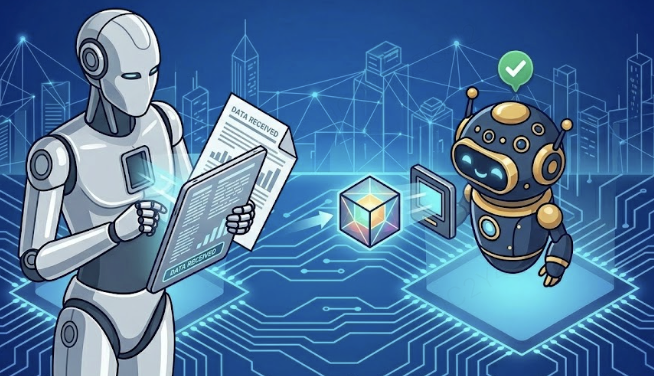
Because AI agents have their own crypto wallets, they can hire and pay each other. For example, a user-facing AI agent tasked with writing a comprehensive research report might realize it needs specialized market data. It can autonomously contact a separate, specialized data-scraping AI agent, negotiate a micro-payment using cryptocurrency, purchase the data, and deliver the final report to the human user. This creates an entirely new, machine-driven economy operating in the background of the internet.
Smart Contract Security and Auditing
Security remains one of the largest hurdles in Web3, with smart contract exploits historically costing the industry billions.
AI agents are now being deployed as continuous, real-time security auditors. Before a user interacts with a decentralized application (dApp), an AI agent can instantly scan the underlying smart contract code, cross-reference it against databases of known exploits, and simulate potential attack vectors. If the agent detects a vulnerability or a potential rug pull mechanism, it can block the transaction, effectively serving as an intelligent, decentralized firewall for crypto investors.
Trend Noise vs. Real Utility in Crypto AI
The cryptocurrency market is historically driven by hype cycles. The current market is flooded with projects attempting to capitalize on the Artificial Intelligence narrative. For investors navigating this landscape, the most critical skill is distinguishing between trend noise and real utility.
The Trend Noise: When a new technology becomes a buzzword, hundreds of projects quickly rebrand. In the crypto AI space, trend noise typically looks like projects slapping "AI" onto their token name without any underlying technological integration. Many of these projects are simply basic user interfaces wrapped around existing, centralized APIs (like OpenAI's ChatGPT) that require a native token to access. They do not offer decentralized machine learning, they do not utilize autonomous on-chain agents, and their tokens often lack long-term sustainable demand.
The Real Utility: The true value in the intersection of crypto and AI lies in infrastructure. Projects building real utility are solving the fundamental bottlenecks of Artificial Intelligence. These include:
-
Decentralized Compute Networks: Platforms that allow users to rent out idle GPU power to help train massive AI models, democratizing access to computing resources away from tech monopolies.
-
Agent Communication Protocols: Networks that establish the standard rules and infrastructure for how independent AI agents can discover each other, negotiate, and seamlessly transact value on the blockchain.
-
Zero-Knowledge Machine Learning (ZKML): Cryptographic proofs that allow a smart contract to verify that a specific AI model was run correctly and securely off-chain, ensuring the data wasn't manipulated before being recorded on the blockchain.
Top Crypto AI Agent Projects to Watch
Artificial Superintelligence Alliance (ASI / FET)
The Artificial Superintelligence Alliance is the result of a historic merger between three of the biggest players in decentralized AI: Fetch.ai, SingularityNET, and Ocean Protocol. This unified network is designed to be the premier open platform for AI.
Its core technology provides the exact framework needed to build, deploy, and monetize autonomous AI agents. These "uAgents" can be programmed to handle everything from supply chain optimization to executing complex DeFi trading strategies, all while transacting with one another using the network's native token.
Bittensor (TAO)
Bittensor approaches decentralized AI differently by creating a peer-to-peer marketplace for machine intelligence. Rather than building a single AI model, Bittensor incentivizes thousands of different machine learning models across the globe to collaborate, train, and share information.
When an AI agent on the network provides a valuable, accurate response to a query, it is algorithmically rewarded with TAO tokens. This creates a constantly evolving, decentralized neural network that aims to rival the capabilities of centralized tech giants.
Autonolas (OLAS)
Autonolas is rapidly becoming the go-to infrastructure for developers looking to build autonomous, off-chain agents that interact with on-chain smart contracts. It is heavily utilized in the DeFi sector and for Decentralized Autonomous Organization (DAO) management. For example, Autonolas agents can be deployed to automatically manage a protocol's liquidity, execute complex smart contract operations, or operate decentralized communication bridges, acting as the automated workforce for the Web3 ecosystem.
How to Leverage AI in Crypto Trading
You do not need to be a machine-learning engineer or a smart contract developer to benefit from the AI revolution. Top-tier cryptocurrency exchanges have integrated AI technology, making it highly accessible for everyday investors to automate their portfolios and optimize their trading strategies.
If you are looking to transition from manual trading to automated wealth generation, the easiest entry point is through AI-assisted trading bots. For example, KuCoin’s AI-powered bots have shown significant efficiency in market forecasting. By utilizing predictive analytics, these tools give you a competitive edge, allowing you to react before the market moves instead of simply chasing trends.
Some of the most impactful AI trading features available today include:
-
High-Accuracy Predictive Models: KuCoin's AI trading models have been backtested across three years of historical data, providing accuracy rates of over 75% in predicting short-term price movements.
-
AI Plus Spot Grid Bot: This tool dynamically adjusts your trading ranges based on real-time market trends, helping you automatically capture more profitable trades without constant manual monitoring.
-
Futures Grid Bot: Users leveraging AI-generated signals within the Futures Grid Bot report up to 30% higher profitability, especially when navigating highly volatile markets.
For those just starting out, reading a comprehensive beginner's guide on how to use AI in crypto trading is the best way to understand how to deploy your first smart bot with managed risk.
Conclusion
To summarize, moving far beyond simple chatbots, these autonomous entities possess their own digital wallets, allowing them to execute complex, multi-step financial application scenarios like predictive market analysis, decentralized portfolio management, and smart contract auditing. While the market contains its fair share of trend noise, projects building real decentralized compute and agent infrastructure offer immense long-term value. Whether you are passively investing in AI tokens or actively deploying autonomous trading strategies on top exchanges, understanding this intersection is crucial for the future of digital finance.
FAQs
What is the difference between an AI agent and a standard crypto trading bot?
A standard trading bot operates rigidly, while a crypto AI agent is autonomous and goal-oriented. It uses machine learning to adapt to real-time market data, optimize its own strategies, and execute complex, multi-step tasks across different blockchains without human intervention.
Are crypto AI agents safe to use?
While AI agents drastically reduce human error and can even audit smart contracts for vulnerabilities, they are not without risk. Because they act autonomously with real capital, a flaw in the agent's logic or a vulnerability in the decentralized protocol it interacts with could lead to financial loss. It is recommended to only use trusted, audited AI tools and to set strict capital limits.
Why do AI agents need cryptocurrency?
AI agents need cryptocurrency because traditional financial rails require human identity verification. Cryptocurrency provides a permissionless, borderless financial layer. With a crypto wallet, an AI agent can autonomously pay for server hosting, data scraping APIs, or compensate other AI agents in machine-to-machine economies.
How can I start using AI in crypto trading today?
The easiest way to start is through major centralized exchanges that offer built-in AI trading bots. These platforms allow you to deploy AI-optimized Grid or DCA bots with a few clicks. You can also participate in exchange-hosted AI campaigns to discover new tokens and learn about the ecosystem with guided, low-risk exposure.