

Integrating Surf AI into Automated Trading: Agent Strategies and Execution Risks
2026/05/14 17:48:02
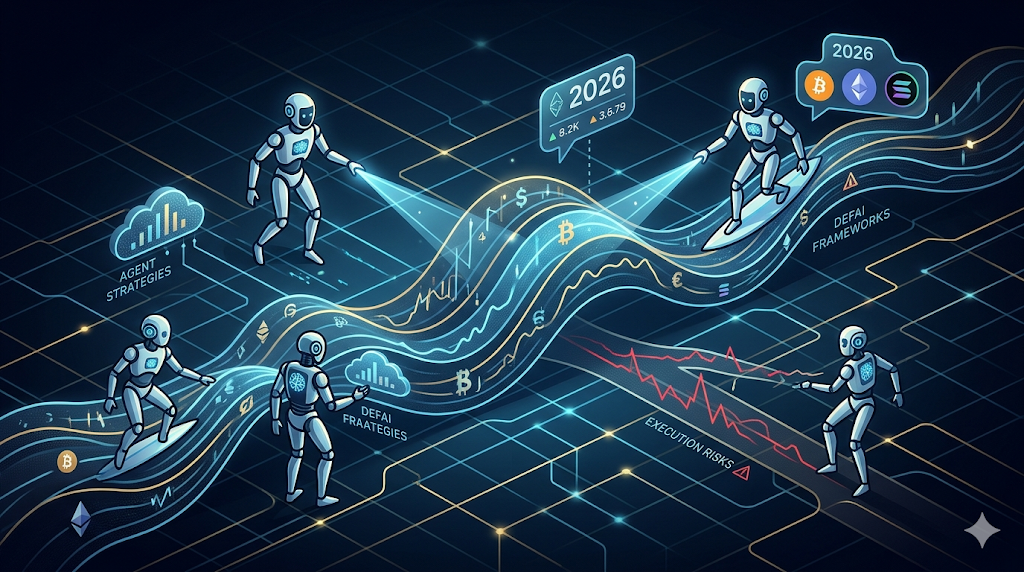
Yes, Surf AI can be integrated into agent-based strategies through modern execution frameworks, but traders face financial risks including API vulnerabilities, algorithmic market manipulation, and high-frequency slippage. Connecting advanced analytical models to automated execution bots transforms passive market observation into continuous, high-speed trading action. According to April 2026 industry statistics, automated frameworks now manage massive portions of decentralized volume. However, delegating financial custody to machine logic demands uncompromising network security and strict risk parameters to prevent catastrophic portfolio losses.
AI crypto bot: An automated trading algorithm using machine learning to execute digital asset strategies.
Agent economy: A blockchain framework where autonomous AI peers operate as financial actors.
DeFAI frameworks: Open-source infrastructure connecting artificial intelligence directly to decentralized finance protocols.
Integrating Surf AI into Automated Trading Systems
The Evolution of Agent-Based Strategies in 2026
Agent-based strategies rely entirely on autonomous models making financial decisions without human intervention. Based on April 2026 network statistics, a single artificial intelligence agent on the Solana network managed more daily transaction volume than the bottom twenty percent of human retail traders combined. This marks a paradigm shift from manual clicking to continuous, algorithmic execution. Developers deploy these agents to scan thousands of liquidity pools simultaneously across multiple blockchains. The automation ensures mathematically optimal entries by eliminating human fatigue and emotional hesitation from the investment process.
Frameworks like ElizaOS and Olas serve as the foundational infrastructure for deploying decentralized AI agents. These open-source systems allow retail investors to build specialized trading bots through simple natural language prompts. Instead of writing complex code, a user commands the framework to maintain a hedged portfolio against macroeconomic inflation. The framework instantly translates this request into actionable smart contract logic. This accessibility accelerates the adoption of automated trading among non-technical cryptocurrency users.
How Surf AI Connects to Execution Layers
Surf AI functions primarily as the cognitive brain that feeds actionable intelligence directly into these execution layers. It processes real-time on-chain flows, social sentiment, and fundamental data to generate high-probability trading signals. Instead of executing trades natively, it passes structured analytics to connected bots via secure API gateways. This separation of research and execution allows traders to utilize best-in-class tools for both analysis and order routing. The integration streamlines the entire pipeline from narrative discovery to finalized market entry.
Connecting Surf AI to an execution bot significantly reduces the latency between market discovery and trade placement. When the software detects a sudden spike in smart money accumulation, it immediately transmits this metric to the automated trading platform. The bot then executes the predefined strategy parameters instantly to capture the arbitrage opportunity. This seamless pipeline outperforms traditional manual research where traders lose critical seconds switching between analytics dashboards and centralized exchange interfaces.
The Role of Multi-Chain Analytics in Bot Decision Logic
Multi-chain analytics provide the necessary context for bots to execute cross-chain arbitrage safely and profitably. The software continuously pulls fragmented data from over forty different blockchains to identify liquidity imbalances and protocol vulnerabilities. By synthesizing this massive data set, the integrated bot knows exactly where to route capital for the highest digital yield. Relying on a single chain severely limits an agent's profitability in a highly interconnected decentralized ecosystem.
Integrating multi-chain data actively prevents execution bots from buying into localized network traps. If a specific altcoin experiences artificial volume on a minor decentralized exchange, the algorithm cross-references the activity with major network hubs. If the broader market shows zero corresponding volume, the agent identifies the anomaly as a wash trading trap and halts execution. Comprehensive network visibility serves as the ultimate defense against isolated market manipulation tactics.
Analyzing the Core Components of Surf AI
Real-Time Social Sentiment Aggregation
Real-time social sentiment directly dictates short-term cryptocurrency price action, making its aggregation vital for automated trading. The algorithm continuously scans over one hundred thousand active accounts on social platforms to quantify market fear and greed. When the system detects a coordinated narrative shift regarding a specific token, it issues an immediate alert. This allows the connected bot to front-run retail investors who rely on slower, traditional news media. Capturing this sentiment mathematically provides a massive edge in volatile markets.
The system filters out coordinated social media spam to prevent bots from buying into artificial hype cycles. By cross-referencing account age, historical accuracy, and engagement quality, the intelligence model identifies genuine organic momentum. This strict filtering process protects automated strategies from executing trades based on fraudulent influencer promotions or paid bot networks. Ignoring social noise ensures the trading bot only allocates capital toward statistically sound market narratives.
On-Chain Flow Deconstruction
Deconstructing on-chain flows reveals the true intentions of institutional whales before their trades impact retail exchange prices. The software monitors centralized exchange inflows, decentralized liquidity migrations, and major wallet accumulations in real time. If a large entity begins bridging assets to a new Layer-2 protocol, the algorithm categorizes this as an early adoption signal. The automated strategy then utilizes this flow data to position itself ahead of the anticipated mass retail migration.
Analyzing transaction metadata prevents trading bots from falling victim to sophisticated blockchain obfuscation tactics. Advanced algorithms trace funds through mixers and complex smart contract interactions to verify the true origin of capital. This transparency ensures that an automated agent does not accidentally execute a strategy based on artificially inflated volume metrics. Accurate on-chain intelligence remains the most critical dependency for any profitable decentralized trading system.
Search-Augmented Verifiability Protocols
Search-augmented verifiability mathematically solves the critical issue of artificial intelligence hallucinating fake financial data. Instead of relying solely on pre-trained memory, the software performs real-time deterministic lookups to validate every metric it processes. If the system detects a twenty percent drop in a protocol's locked value, it instantly cross-references this claim with on-chain explorer data. This strict auditing layer guarantees that execution bots only receive completely factual, verifiable trading signals.
Providing traceable citations for every data point builds necessary trust between human operators and autonomous trading systems. According to April 2026 performance metrics, Surf AI outperformed generic models on industry benchmarks specifically due to this verification architecture. Traders can manually review the cited block explorer links before approving high-risk, large-capital automated strategies. This transparency transforms a dangerous black-box algorithm into a reliable, auditable financial instrument.
Identifying Risks in AI-Driven Crypto Execution
Ethical Concerns and Market Manipulation Tactics
AI-driven execution introduces severe risks regarding automated market manipulation and systemic financial destabilization. Sophisticated algorithms routinely deploy automated wash trading and rapid spoofing tactics to deceive retail investors and artificial analytics tools. By generating massive amounts of fake order book depth, malicious agents easily trigger the stop-loss parameters of competing bots. This creates a highly toxic trading environment where mathematical deception consistently outpaces fundamental investing principles.
These manipulative practices directly erode institutional trust in decentralized cryptocurrency markets. Without robust regulatory oversight, algorithmic exploitation creates an uneven playing field that severely disadvantages human retail participants. The algorithms coordinate bot activity at a scale that traditional exchange security mechanisms simply cannot detect or prevent effectively. The global financial industry currently lacks the necessary technological infrastructure to police autonomous machine-to-machine deception.
Vulnerabilities in API Key Custody
Improper API key management represents the single largest security vulnerability when integrating analytics with trading platforms. If an investor grants their automated bot permission to withdraw funds, a compromised system can instantly drain their entire exchange balance. Security protocols dictate that users must strictly limit interface permissions to read-only and trade-only functions. Ignoring this fundamental custody rule mathematically guarantees catastrophic financial loss during a decentralized network breach.
Whitelisting specific Internet Protocol addresses provides an essential secondary layer of defense against unauthorized exchange exploitation. By restricting bot access solely to a designated secure server, traders prevent malicious actors from utilizing stolen keys remotely. Even if a hacker successfully intercepts the trading credentials, they cannot execute unauthorized transactions from an external geographic location. Strict network security policies are absolutely non-negotiable when operating autonomous financial agents.
Flash Loan Exploits via AI Optimization
Autonomous models possess the computational capacity to identify and exploit complex smart contract vulnerabilities through optimized flash loans. These algorithms scan hundreds of decentralized finance protocols simultaneously to discover microscopic mathematical pricing discrepancies. Once identified, the agent instantly borrows millions of dollars, executes the arbitrage, and repays the loan in a single transaction block. While profitable for the operator, these rapid automated attacks frequently bankrupt emerging blockchain protocols.
The sheer speed of these algorithmic attacks completely neutralizes traditional human response protocols and platform defenses. Development teams cannot patch software vulnerabilities fast enough to defend against an agent that executes complex mathematical exploits in milliseconds. This constant threat forces decentralized applications to spend massive capital on preventative algorithmic auditing rather than core platform growth. Machine optimization fundamentally alters the security landscape of the entire digital asset ecosystem.
Financial and Operational Drawbacks of Automation
High-Frequency Trading Slippage Costs
High-frequency automated trading frequently destroys projected profits through hidden slippage and compounding centralized exchange fees. When a bot executes hundreds of micro-transactions daily, the standard maker and taker fees rapidly consume the realized financial gains. Furthermore, executing large orders on decentralized exchanges inherently causes the asset price to slip negatively against the algorithmic trader. Models must factor these operational costs directly into their decision logic to avoid mathematically guaranteed losses.
Failing to account for low network liquidity leads directly to severe execution failures for automated investment strategies. If an agent attempts to sell a massive position in an illiquid altcoin, the lack of buyers causes the price to crash instantly. The bot ends up selling the asset at a fraction of its anticipated market value, ruining the entire portfolio structure. Proper risk management requires programming the software to avoid low-capitalization markets entirely.
Over-Optimization and Backtesting Fallacies
Over-optimizing an algorithm to perform perfectly on historical data guarantees its failure in live, unpredictable market conditions. Developers frequently tweak bot parameters until they show massive hypothetical profits during past cryptocurrency bull cycles. However, the future market never exactly replicates the past, rendering these hyper-specific rules completely useless for actual trading. This persistent backtesting fallacy leads retail investors to trust fundamentally flawed execution strategies blindly.
Implementing out-of-sample testing remains the only viable method to verify a trading algorithm's true financial effectiveness. Traders must test the bot on a completely separate dataset that the model has never processed previously. If the strategy fails this secondary test, it indicates the software is simply memorizing past charts rather than learning adaptable logic. Rigorous statistical validation prevents catastrophic capital deployment based on false technical confidence.
| Risk Category | Primary Vulnerability | Mitigation Strategy |
| API Custody | Unauthorized fund withdrawal via compromised security keys. | Restrict permissions strictly to read-only and whitelist specific IP addresses. |
| Hallucination | Executing trades blindly based on fake mathematical data. | Utilize search-augmented verifiability to continuously cross-reference block explorers. |
| Profit Slippage | High-frequency execution consuming capital through exchange fees. | Program algorithmic volume limits to completely avoid low-liquidity micro-cap tokens. |
How to trade on KuCoin with AI Agent Integration
Automated trading on KuCoin requires strict adherence to digital security protocols. Log into your account and generate a unique algorithmic key specifically designated for your external analytics software.
Pairing AI Analytics with Spot Grid Bots
Pairing directional AI insights with KuCoin Trading Bots maximizes profits during sideways market consolidation. Once your analytics detect horizontal asset movement, configure the bot within those boundaries.
Implementing Dynamic Risk Management Systems
Dynamic risk management requires your AI agent to adjust portfolio exposure automatically based on real-time volatility metrics. Connect your framework via the KuCoin Skills Hub to stream continuous risk instructions to the platform.
Conclusion
Integrating Surf AI into automated execution architectures provides retail investors with institutional-grade analytical power, but this automation requires meticulous risk management to survive volatile crypto markets. The true value of this technology lies in its ability to synthesize fragmented multi-chain data and social sentiment into actionable, verifiable mathematical signals. By utilizing modern decentralized frameworks, traders efficiently bridge the massive gap between complex fundamental research and instant market execution.
However, the delegation of financial authority to machine logic introduces severe vulnerabilities regarding API custody, algorithmic manipulation, and devastating high-frequency slippage costs. Retail participants must absolutely avoid the backtesting fallacy and understand that historical optimization does not guarantee future financial profitability. Ultimately, success in the emerging agent economy depends entirely on combining superior artificial intelligence analytics with conservative, human-verified security protocols. Automated tools amplify your trading strategy — they do not replace the fundamental need for strict financial discipline.
FAQs
Can artificial intelligence directly withdraw my funds from an exchange?
No, intelligence software cannot withdraw your funds unless you explicitly grant it withdrawal permissions through your exchange API key. You must strictly configure your digital security settings to allow only read and trade functions. Securing your connection guarantees that the analytical software only views market data and executes approved spot orders.
How does the software handle false data hallucinations?
The software utilizes search-augmented verifiability to cross-reference every data point against live blockchain explorers and established market trackers. If the algorithm cannot verify a metric through multiple independent network sources, it flags the data as a hallucination and prevents the execution bot from trading. This deterministic lookup system mathematically ensures operational accuracy.
Do algorithmic bots work effectively during massive market crashes?
Algorithmic bots generally fail during unprecedented macroeconomic crashes because they rely heavily on historical chart ranges that no longer apply. When global volatility spikes dramatically, the pre-programmed mathematical boundaries collapse, often leaving the bot holding rapidly depreciating digital assets. Human operators must manually intervene and activate kill-switches during major unforeseen geopolitical events.
What is the main difference between traditional bots and modern agents?
The primary difference is that traditional bots follow rigid, static rules while modern agents adapt dynamically to real-time sentiment and on-chain flows. An old system simply buys when an indicator reaches a specific programmed number. The modern decentralized agent analyzes why the indicator moved and adjusts its entire strategy based on broader macroeconomic context.
Disclaimer:This content is for informational purposes only and does not constitute investment advice. Cryptocurrency investments carry risk. Please do your own research (DYOR).