

When Will the Strait of Hormuz Reopen? Latest Updates, Shipping Tracker Data, and Crypto Market Impact
2026/05/23 09:34:23
Introduction
Roughly 20 million barrels of oil — about 20% of global petroleum liquids consumption — pass through the Strait of Hormuz every single day, according to the U.S. Energy Information Administration. When this 21-mile-wide chokepoint between Iran and Oman becomes contested, energy markets, shipping rates, and risk assets — including Bitcoin and altcoins — react within hours. So the question traders, shippers, and policymakers keep asking is simple: when will the Strait of Hormuz reopen to normal traffic?
The short answer: U.S. Energy Secretary Chris Wright stated in a recent interview with The Hill that he expects Strait of Hormuz transit to "return to normal in the coming days to weeks," provided no further escalation occurs. Live tracking platforms such as Hormuz Strait Monitor and Hormuz Tracker continue to show partial vessel flow, suggesting the waterway is disrupted but not fully closed.
What Is the Current Status of the Strait of Hormuz?
The Strait of Hormuz remains partially operational, with reduced but ongoing tanker traffic as of mid-May 2026. According to live AIS-based dashboards on hormuzstraitmonitor.com and marinevesseltraffic.com, dozens of crude and LNG carriers continue to transit daily, though insurance premiums and rerouting have visibly increased.
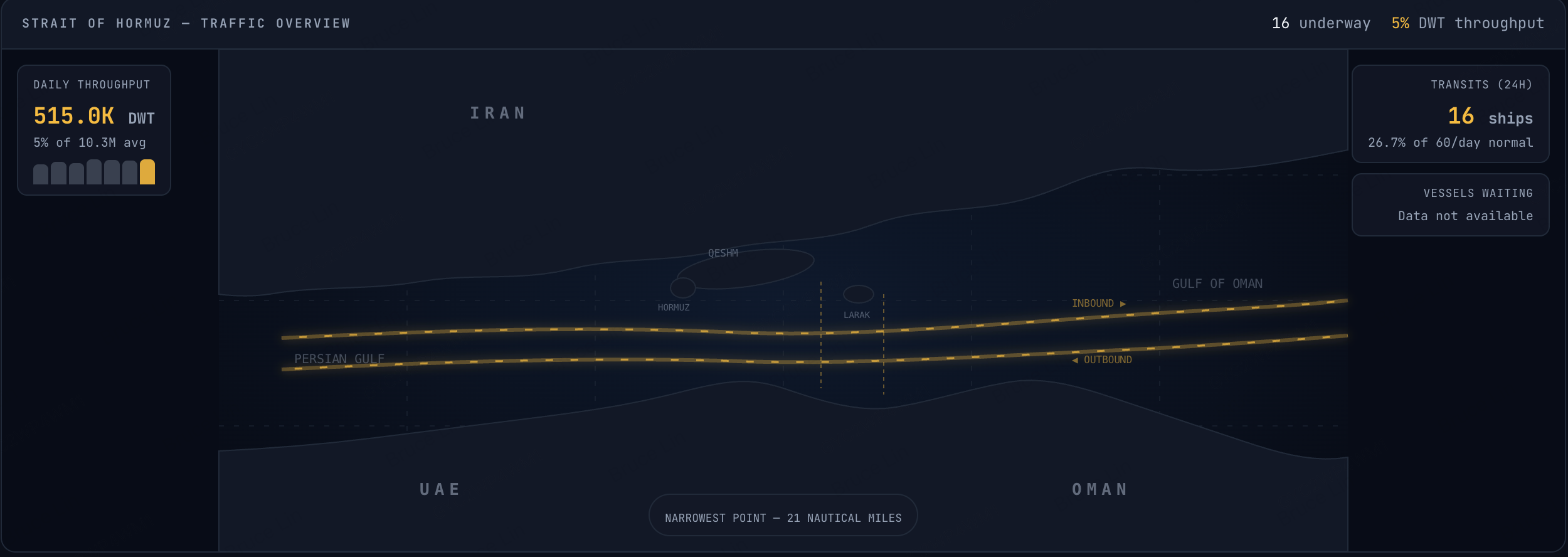
Several conditions define the "current status" picture:
-
Vessel transits: Daily tanker counts have dropped from the typical 50-70 range to roughly 30-45 vessels per day, based on Hormuz Tracker AIS data.
-
GPS interference: Multiple shipping outlets have reported persistent GPS spoofing in the inner Gulf, forcing crews to navigate visually or via backup systems.
-
War-risk insurance: Lloyd's market war-risk premiums for Gulf transits have spiked to multi-year highs, adding hundreds of thousands of dollars per voyage.
The strait has not been formally "closed" by any state actor. Instead, the disruption is best described as a high-friction transit environment where ships still move but at greater cost and risk.
Why Is the Strait of Hormuz Disrupted Right Now?
The current disruption stems from heightened military tensions between Iran, Israel, and the United States, following strikes on Iranian nuclear and military infrastructure. Iran's parliament voted in favor of measures to restrict Hormuz traffic as a retaliatory tool, though the country's Supreme National Security Council has not formally enacted a full closure.
Three drivers are shaping the situation:
Military Escalation
Recent kinetic exchanges in the region have raised the probability of mining, missile, or drone incidents inside the strait. Even without a declared closure, the threat alone deters tanker operators and raises freight costs.
Diplomatic Pressure
Major oil importers — particularly China, India, South Korea, and Japan — have privately and publicly urged restraint. China alone receives roughly half of all Hormuz-transiting crude, giving Beijing strong incentive to lobby Tehran against full closure.
Economic Self-Interest
Iran itself exports the majority of its own crude through Hormuz. A full closure would cripple Iranian revenue, which is why analysts at major banks consistently rate a sustained, total blockade as a low-probability scenario.
When Will the Strait of Hormuz Reopen to Full Capacity?
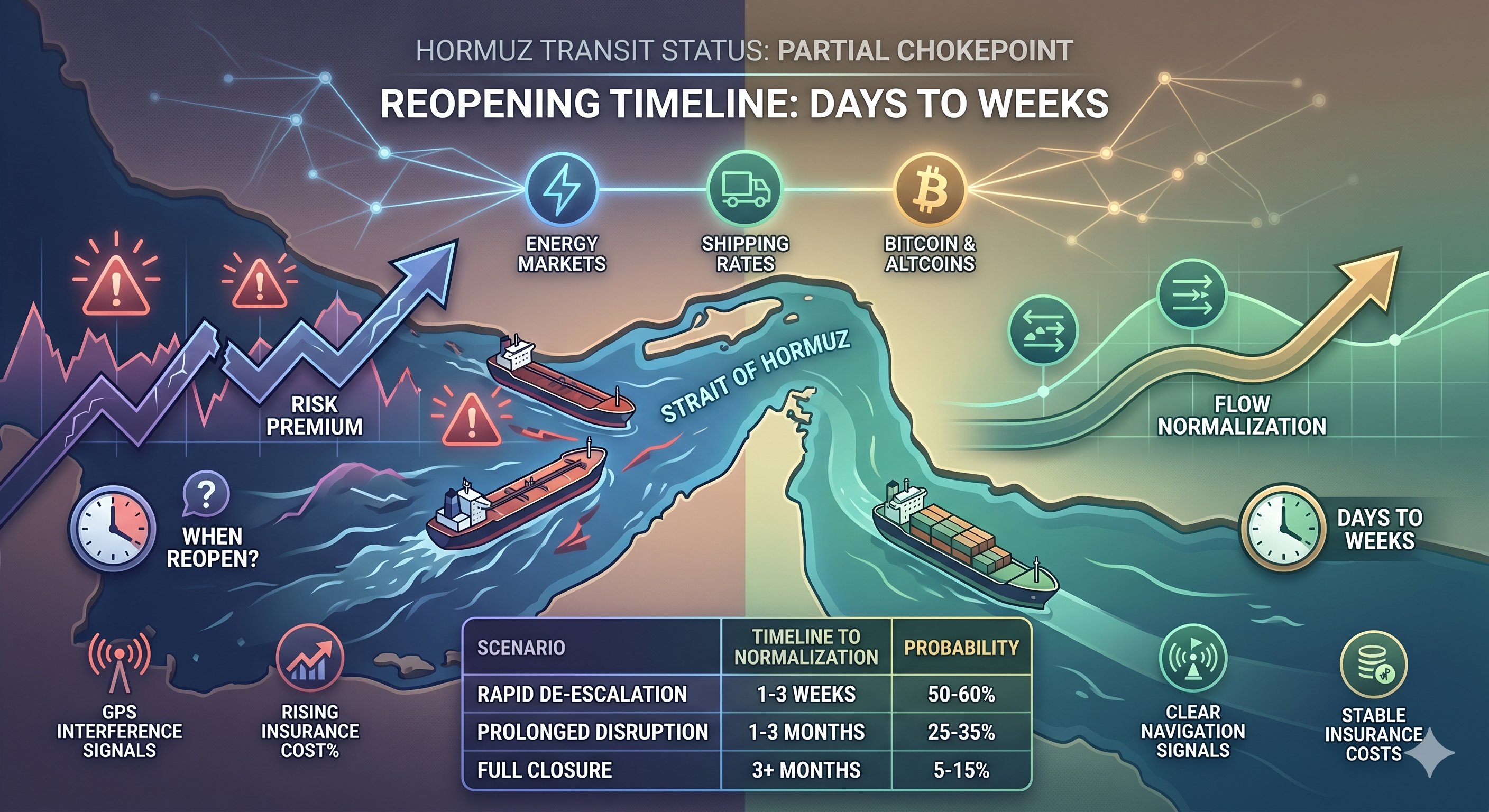
Full normalization is expected within days to a few weeks, according to U.S. Energy Secretary Chris Wright in a recent interview published by The Hill. Wright explicitly stated he anticipates Hormuz traffic to "return to normal" on that timeline, assuming no major new escalation event.
Independent analyst forecasts cluster around three scenarios:
|
Scenario
|
Timeline to Full Normalization
|
Probability (Consensus Range)
|
|
Rapid de-escalation, ceasefire holds
|
1-3 weeks
|
50-60%
|
|
Prolonged low-intensity disruption
|
1-3 months
|
25-35%
|
|
Full closure or major incident
|
3+ months
|
5-15%
|
The base case among most energy desks — including those at Goldman Sachs, JPMorgan, and Citi — is that normal flows resume within weeks rather than months. The reasoning is structural: no major regional actor benefits from a prolonged closure, and the U.S. Fifth Fleet remains positioned in Bahrain to keep the waterway open.
How Can You Track Strait of Hormuz Traffic in Real Time?
Several free, public dashboards let anyone monitor vessel transits, ship counts, and disruption signals in real time. These tools aggregate Automatic Identification System (AIS) data from satellites and coastal receivers.
The most widely used trackers include:
-
Hormuz Strait Monitor (hormuzstraitmonitor.com) — Displays daily transit counts, vessel types, and historical comparison charts.
-
Hormuz Tracker (hormuztracker.com) — Focuses on tanker-specific flows with crude, product, and LNG breakdowns.
-
Marine Vessel Traffic (marinevesseltraffic.com/HORMUZ-STRAIT) — Offers an interactive map showing live ship positions, headings, and speeds.
-
TankerTrackers and Kpler — Paid services used by hedge funds for deeper cargo-level intelligence.
For retail traders, the free dashboards are sufficient to spot directional changes. A sustained drop in daily transit counts below 25 vessels would signal serious disruption; a return to 50+ would signal normalization.
How Does a Strait of Hormuz Closure Affect Oil Prices?
A full closure of the Strait of Hormuz would push Brent crude into the $120-$150 range within days, based on consensus models from major investment banks. Goldman Sachs has previously modeled a $20-$30 risk premium for a one-month disruption and significantly more for a sustained blockade.
The transmission mechanism is direct:
Supply Shock
Removing 20 million barrels per day of seaborne crude — plus roughly 20% of global LNG flows from Qatar — creates an immediate physical shortage that no other producer can backfill quickly.
Strategic Reserves
The U.S. Strategic Petroleum Reserve and the IEA coordinated stocks could offset only weeks of lost flow, not months. This is why even hints of disruption move futures markets sharply.
Refining Margins
Asian refiners — particularly in China, India, Japan, and South Korea — depend heavily on Gulf grades. Substitution with Atlantic Basin or Russian barrels involves logistical lag and quality mismatches, widening crack spreads.
How Does Hormuz Tension Impact Bitcoin and Crypto Markets?
Geopolitical shocks in the Gulf typically trigger short-term Bitcoin volatility, with mixed directional outcomes depending on the broader macro setup. In the first 24-72 hours of major Middle East flare-ups, BTC has historically sold off alongside equities as risk-off flows dominate, before recovering as the "digital gold" narrative reasserts.
Key dynamics traders watch:
Correlation With Risk Assets
Bitcoin's short-term correlation with the Nasdaq remains elevated. A Hormuz-driven equity selloff usually drags crypto down initially.
Inflation Hedge Narrative
Sustained oil prices above $100 reinforce the inflation-hedge thesis for BTC and gold. If Hormuz tensions persist, allocators may rotate into hard assets, supporting crypto over a multi-week horizon.
Stablecoin Demand in MENA
Disruption tends to accelerate stablecoin adoption in the broader Middle East and North Africa region, as residents seek dollar exposure outside traditional banking rails. On-chain data from analytics firms has shown rising USDT and USDC inflows in regional wallets during prior crises.
Energy-Linked Tokens
Tokens tied to commodities, energy infrastructure, or real-world assets (RWAs) may see speculative inflows. Mining-linked equities and tokens also respond to oil-driven energy cost expectations.
What Are the Most Likely Scenarios for Hormuz Reopening?
The most likely outcome is a gradual normalization over 2-4 weeks, anchored by diplomatic backchannels and the economic incentives facing all parties. Three scenarios dominate analyst thinking.
Base Case: Quiet Normalization
A ceasefire or de-escalation announcement triggers a steady recovery in tanker transits. Insurance premiums decline over weeks. Oil retraces toward pre-crisis levels. Crypto regains its prior trend.
Bear Case: Prolonged Friction
No formal closure, but persistent GPS spoofing, occasional vessel incidents, and elevated insurance keep transits depressed for months. Oil holds an elevated premium. Bitcoin trades choppily with inflation-hedge bids appearing on dips.
Tail Risk: Full Closure
A major incident — a mined tanker, a downed warship, or a declared blockade — closes the strait. Oil spikes toward $150. Equities sell off sharply. Bitcoin likely drops 10-20% in the first 48 hours before potentially recovering on safe-haven flows. Central banks pivot dovishly to contain the shock.
What Are Common Misconceptions About the Strait of Hormuz?
Several persistent misconceptions distort how traders interpret Hormuz headlines. Correcting them helps sharpen positioning.
Misconception 1: "Iran Can Close It Indefinitely"
Iran can disrupt traffic significantly but cannot sustain a full closure for long without facing overwhelming military and economic costs. The U.S. Fifth Fleet, allied navies, and Iran's own export dependence on the strait make indefinite closure structurally implausible.
Misconception 2: "Closure Means Zero Ships"
"Closure" in practice usually means dramatically reduced and rerouted flows, not literal zero traffic. Even during the 1980s Tanker War, ships continued to transit, albeit with heavy losses and naval escorts.
Misconception 3: "Saudi Pipelines Can Fully Bypass It"
Existing pipelines — the East-West Pipeline in Saudi Arabia and the UAE's Habshan-Fujairah line — can bypass roughly 6-7 million barrels per day combined, which is far below the 20 million bpd that transits Hormuz. Bypass capacity helps but does not solve the problem.
Conclusion
The Strait of Hormuz is currently disrupted but not closed, and U.S. officials including Energy Secretary Chris Wright expect normalization within days to weeks rather than months. Live trackers — Hormuz Strait Monitor, Hormuz Tracker, and Marine Vessel Traffic — confirm that vessel flow continues at reduced volumes, with elevated insurance and rerouting friction rather than a hard stop.
For markets, the base case points to a measured oil risk premium that fades as transits recover. Tail risks remain real: a full closure could push Brent toward $150 and trigger a sharp initial selloff in risk assets including Bitcoin, before safe-haven and inflation-hedge flows reassert. Crypto traders should expect short-term correlation with equities but a longer-term tailwind for hard-asset narratives if Gulf instability persists.
The practical approach is to monitor AIS-based trackers daily, size positions conservatively, and use exchanges like KuCoin to express directional or hedged views across spot, futures, and yield products. Geopolitical chokepoint risk does not disappear — it merely cycles. Preparation, not prediction, is the edge.
FAQs
How wide is the Strait of Hormuz and why does that matter?
The strait is only about 21 miles wide at its narrowest, with two-mile-wide shipping lanes in each direction. That narrowness makes it geographically easy to disrupt with mines, fast boats, or anti-ship missiles, which is why even a credible threat moves markets.
Has the Strait of Hormuz ever been fully closed?
No, the strait has never been fully closed in modern history. Even during the 1980-1988 Iran-Iraq Tanker War, when hundreds of ships were attacked, transit continued under naval escort. This historical precedent supports the consensus that full closure remains a low-probability scenario.
Which countries depend most on the Strait of Hormuz?
China, India, Japan, and South Korea are the largest importers of Hormuz-transiting crude, with China alone absorbing roughly half. On the export side, Saudi Arabia, Iraq, the UAE, Kuwait, Qatar, and Iran rely on the strait for the bulk of their seaborne hydrocarbon revenues.
Can the U.S. release oil reserves to offset a Hormuz disruption?
Yes, but only temporarily. The U.S. Strategic Petroleum Reserve currently holds several hundred million barrels, and IEA member stocks add more. A coordinated release can offset weeks of lost Hormuz flow, but not the 20 million barrels per day that transit the strait if a sustained closure occurred.
Does Hormuz tension always cause Bitcoin to fall?
No, the directional impact depends on the broader macro setup. In risk-off phases, Bitcoin typically falls alongside equities in the first 24-72 hours. In environments dominated by inflation concerns or fiat distrust, sustained Gulf instability has historically supported BTC over longer horizons as the digital-gold narrative reasserts.