

Iran Demands Bitcoin Payments at Strait of Hormuz: How Geopolitics is Reshaping Crypto's Future
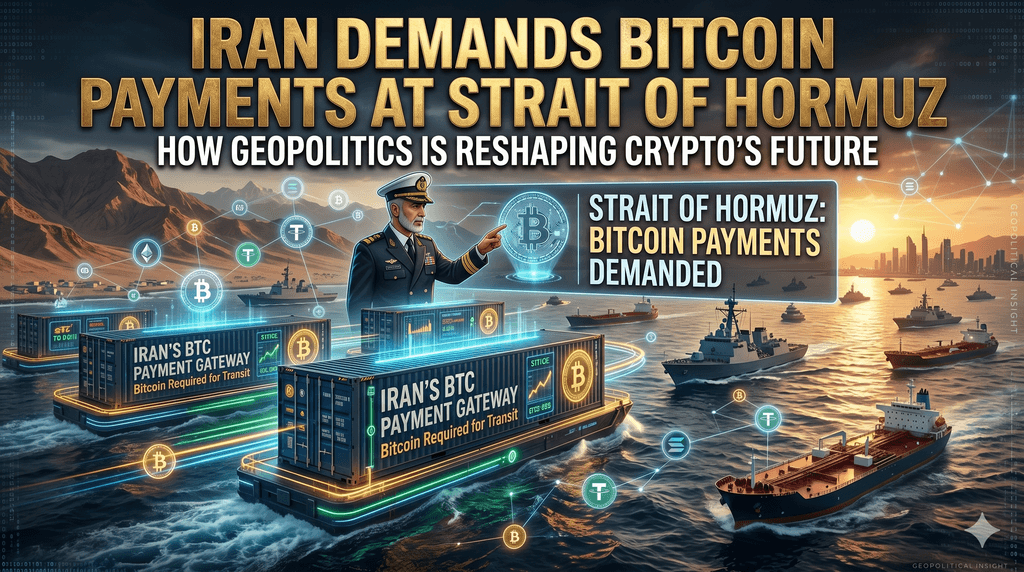
The global financial landscape reached a staggering inflection point on April 14, 2026, as the intersection of maritime power and digital finance fundamentally altered the way sovereign nations interact with the blockchain. For decades, the Strait of Hormuz has been the primary jugular of the global energy trade, a narrow passage where roughly 20% of the world’s petroleum and liquefied natural gas flows. However, the events of the last few weeks have transformed this physical chokepoint into a digital toll booth. Iran’s formal demand for Bitcoin payments from shipping vessels transiting these waters is not merely a regional policy shift; it is a seismic event that signifies the birth of "Crypto-Geopolitics."
As of mid-April 2026, the Islamic Revolutionary Guard Corps (IRGC) has successfully operationalized the "Strait of Hormuz Management Plan," a legislative framework passed by the Iranian parliament in late March. This plan codifies a reality that began as an ad-hoc necessity during the recent regional escalations: shipping companies must now navigate a complex web of digital wallets and blockchain confirmations before their vessels are granted safe passage. By requiring $1 per barrel of oil in Bitcoin or equivalent digital assets, Iran has effectively bypassed the U.S.-led correspondent banking system, creating a precedent that other sanctioned or "outsider" nations are watching with intense scrutiny.
The move has sent shockwaves through both the halls of the United Nations and the digital exchanges of Silicon Valley. For the cryptocurrency market, which has spent much of Q1 2026 grappling with high volatility and a "risk-off" sentiment due to macro shocks, this development provides a dual-edged sword. While it cements Bitcoin’s status as a peerless tool for censorship-resistant value transfer, it also invites a level of regulatory scrutiny and national security concern that the industry has never seen. The narrative of Bitcoin as "digital gold" is being rapidly replaced by its utility as "sovereign fuel," a shift that will likely define the asset's trajectory for the rest of the decade.
The Logistics of a Sovereign Crypto Toll Gate
Understanding how a nation-state enforces a cryptocurrency payment for a physical shipping lane requires looking at the sophisticated infrastructure Iran has built over the last several months. According to recent reports from blockchain analytics firm TRM Labs, the IRGC does not merely "accept" Bitcoin; they have integrated it into a rigid maritime licensing system. Shipping operators are now required to email cargo manifests, vessel ownership details, and crew lists to Iranian authorities in advance. Once approved, the vessel is assigned a specific transaction ID and a set of wallet addresses linked to the IRGC’s financial network.
The efficiency of this system is perhaps its most disruptive feature. Unlike traditional maritime insurance and toll payments, which can take days to clear via SWIFT or international banking rails, these Bitcoin transactions are verified within minutes. Reports from the Financial Times indicate that once a tanker, such as a Very Large Crude Carrier (VLCC) carrying two million barrels, settles its $2 million toll in Bitcoin, it receives a VHF-broadcasted passcode. This digital key allows the ship to enter a "northern corridor" around Larak Island, often under the direct escort of the IRGC Navy.
This process highlights a critical evolution in how states use decentralized technology. By leveraging Bitcoin’s transparency, Iranian authorities can verify payments in real-time without needing a third-party bank to confirm the funds. However, this same transparency has allowed firms like Chainalysis to track approximately $1 billion in IRGC-linked transactions since the start of 2026. The technical setup includes a dedicated "crypto conversion window" on Qeshm Island, where digital assets are likely cycled through various obfuscation layers or used to fund domestic imports, further insulating the Iranian economy from traditional sanctions.
Geopolitical Realignment and the Rise of the Petrobrit
The demand for Bitcoin at the Strait of Hormuz is the most aggressive challenge to the "petrodollar" system since its inception in the 1970s. For over fifty years, the global oil trade has functioned as a massive subsidy for the U.S. dollar, as nations were forced to hold USD to purchase energy. Iran’s move to accept Bitcoin—and notably, the Chinese Yuan via the CIPS system—is a direct attempt to decouple energy security from American financial policy. We are witnessing the emergence of what analysts are calling the "Petrobit" era, where digital scarcity replaces the dollar as the medium of exchange for the world's most vital commodity.
This shift is not happening in a vacuum. Other major players in the Middle East, including Saudi Arabia and the UAE, are currently managing sovereign wealth funds that exceed $6 trillion, with significant exposure to U.S. Treasuries. However, as the conflict in early 2026 drove Brent crude prices above $118 per barrel, the utility of a neutral, non-state-controlled asset like Bitcoin became increasingly apparent. If a vessel can pay a toll and bypass the risk of asset seizure or banking delays, the "convenience yield" of Bitcoin begins to rival that of the dollar.
The geopolitical implications extend to Asia, the primary consumer of Gulf oil. Countries like China, India, and Japan are finding themselves in a difficult position: they must either risk U.S. sanctions by allowing their shipping companies to pay Iran in Bitcoin or face a complete energy cutoff from one of the world’s most important transit routes. This tension is accelerating the development of alternative financial architectures. The 2026 conflict has already seen a surge in oil-linked perpetual futures on decentralized exchanges like Hyperliquid, suggesting that the "financialization" of oil is moving away from Wall Street and toward the blockchain.
Sanctions Evasion vs. Sovereign Utility: A Regulatory Paradox
From the perspective of Washington D.C. and Brussels, Iran’s Bitcoin demand is the ultimate "black swan" for financial regulation. For years, regulators have argued that crypto is too volatile and transparent for state-level sanctions evasion at scale. The current situation in the Strait of Hormuz proves that while it is transparent, it is also incredibly difficult to stop. The U.S. Treasury’s Office of Foreign Assets Control (OFAC) has been aggressively blacklisting wallets, but the decentralized nature of the Bitcoin network means that as long as there is a willing buyer and a willing seller, the transaction can occur.
This creates a paradox for global shipping conglomerates. Companies like Maersk or MSC now face a binary choice: violate international law by sending Bitcoin to an IRGC-linked address or halt operations in a region that provides a fifth of the world's energy. This is no longer a theoretical debate about "regulatory clarity"; it is a matter of national security and global economic survival. The inherent transparency of the blockchain allows law enforcement to see the funds moving, but it does not provide a "kill switch" to stop a sovereign nation from demanding those funds for physical access to its territory.
Furthermore, the role of stablecoins in this ecosystem cannot be ignored. While Iran’s public statements emphasize Bitcoin for its prestige and scarcity, analysts suspect a heavy reliance on stablecoins like USDT for more mundane commercial activities. The IRGC has been documented routing billions through offshore stablecoin infrastructure to exploit low transaction costs. This has placed stablecoin issuers in the crosshairs, as they are now being pressured to act as a "digital police force," freezing assets that are even tangentially related to the Hormuz toll system.
Impact on Bitcoin Market Dynamics and Volatility
The immediate effect of the Iran news on Bitcoin’s price has been a paradox of "geopolitical premium" versus "regulatory fear." In the short term, Bitcoin has often behaved as a risk asset, dropping in tandem with equities during times of uncertainty. However, as the Strait of Hormuz situation solidified in April 2026, we have seen a "decoupling" effect. Bitcoin is increasingly being viewed as a hedge against the very financial system that is currently being weaponized in the Middle East.
Data from early 2026 shows that while the broader crypto market saw negative returns in Q1, Bitcoin and certain financial infrastructure tokens outperformed. This is largely due to the "flight to quality" within the digital asset space. When a sovereign nation demands an asset as payment for oil, that asset gains a level of fundamental value that transcends speculative trading. The "basis" for Bitcoin—the difference between spot and futures prices—has stabilized, suggesting that institutional players are beginning to price in Bitcoin’s role as a permanent fixture of the global energy trade.
However, the volatility remains a concern for the shipping companies themselves. A $2 million toll in Bitcoin could fluctuate by $100,000 in the time it takes a tanker to cross the Gulf. To mitigate this, we are seeing the rise of sophisticated hedging strategies. Shipping companies are increasingly using oil-linked derivatives on decentralized platforms to lock in their "toll costs" in advance. This synergy between energy markets and crypto derivatives is creating a new class of financial products that didn't exist two years ago, further integrating the two industries.
The Future of Decentralized Infrastructure in Global Trade
The Strait of Hormuz crisis is likely just the beginning of a broader trend where physical chokepoints are managed via digital rails. If Iran is successful in maintaining this system without a total economic collapse, other nations may follow. We could see a future where the Panama Canal or the Suez Canal implement similar "on-chain" payment systems to reduce their dependence on the traditional banking sector and to capture more of the value that currently goes to intermediary banks.
This transition is also fueling the growth of "Real World Assets" (RWA) on the blockchain. The ability to tokenize a barrel of oil or a shipping manifest and settle it instantly against a Bitcoin payment is the "holy grail" of supply chain efficiency. While the current motivation is sanctions evasion and geopolitical leverage, the underlying technology is proving to be superior to the legacy systems. In 2026, we are seeing a "great pivot" where even traditional energy giants are exploring how to integrate blockchain fundamentals into their logistics to avoid being left behind in this new paradigm.
Moreover, the role of Artificial Intelligence in this new era cannot be overstated. AI-linked tokens and on-chain agents are being used to automate these complex cross-border payments, ensuring that shipping companies can comply with the new Iranian demands while simultaneously managing their regulatory risks in the West. The need for "on-chain financial rails" for these agents has become a primary driver of network activity, as the speed and complexity of 2026 geopolitics move too fast for human-led banking processes.
A New Era of Digital Sovereignty
The demand for Bitcoin at the Strait of Hormuz marks the end of the "experimentation" phase of cryptocurrency and the beginning of its role as a core pillar of international relations. We have moved beyond the era where Bitcoin was just a speculative asset for retail investors or a niche tool for tech enthusiasts. In 2026, it is a tool of statecraft, a weapon of economic warfare, and a potential bridge to a more multipolar financial world.
As we look toward the second half of 2026, the success or failure of Iran’s "Crypto Toll" will determine the future of global sanctions and the dollar’s hegemony. If the international community is forced to accept this new reality, it will signal a permanent shift toward a world where value is defined not by the decree of a single nation, but by the immutable logic of the blockchain. For investors, the message is clear: the most important developments in crypto are no longer happening on exchange charts, but on the high seas and in the corridors of geopolitical power.
The reshaping of crypto's future is no longer a forecast; it is an active process. The Strait of Hormuz has become the world’s most expensive classroom, teaching us that in a world of increasing fragmentation, decentralized assets provide the only common language that cannot be silenced. Whether this leads to a more stable global economy or a more volatile one remains to be seen, but one thing is certain: the genie of sovereign crypto adoption is out of the bottle, and it is not going back.
FAQs
Q1: Is Iran currently accepting Bitcoin for Strait of Hormuz transit?
Yes, as of April 2026, the Iranian government has officially codified a system where shipping vessels, particularly oil tankers, can pay their transit tolls in Bitcoin. This is part of a broader "Strait of Hormuz Management Plan" designed to bypass traditional financial sanctions and generate sovereign revenue outside of the U.S. dollar system.
Q2: How much does it cost for a ship to pay the crypto toll?
The current rate is approximately $1 per barrel of oil for tankers. For a fully loaded supertanker (VLCC) carrying 2 million barrels, the toll amounts to roughly $2 million. Prices for other types of vessels, such as container ships or LNG carriers, are negotiated individually based on the ship's origin and the nature of its cargo.
Q3: Can shipping companies be sanctioned for paying these tolls in Bitcoin?
Absolutely. Paying these tolls involves transacting with the IRGC, which is a sanctioned entity in the United States and several other jurisdictions. Shipping companies face significant legal and financial risks, including being blacklisted from the U.S. financial system, if they are found to be making these payments without specific licenses or authorizations.
Q4: Why does Iran prefer Bitcoin over other cryptocurrencies?
While Bitcoin is the most publicly cited asset due to its liquidity and global recognition, Iran also utilizes the Chinese Yuan and various stablecoins. Bitcoin’s decentralized nature makes it impossible for any single government to freeze the underlying network, providing Iran with a level of financial "unstopability" that traditional fiat currencies do not offer.
Q5: How has this affected the price of Bitcoin in 2026?
The impact has been complex. While it has created a "geopolitical risk premium" that supports the price as a hedge against systemic collapse, it has also increased the threat of aggressive regulation from Western governments. Overall, it has shifted the narrative of Bitcoin from a speculative "tech stock" to a fundamental "macro asset" linked to global energy markets.
Q6: What is the "Petrobit" and how does it relate to the Petrodollar?
The "Petrobit" is a term used by analysts to describe the emerging system where oil and energy products are settled in Bitcoin rather than U.S. dollars. This directly challenges the "Petrodollar" system, which has been the cornerstone of global trade and U.S. dollar dominance since the 1970s.