

Toncoin Jumps 32% in 24 Hours: Inside the Market's Most Explosive Altcoin Rally
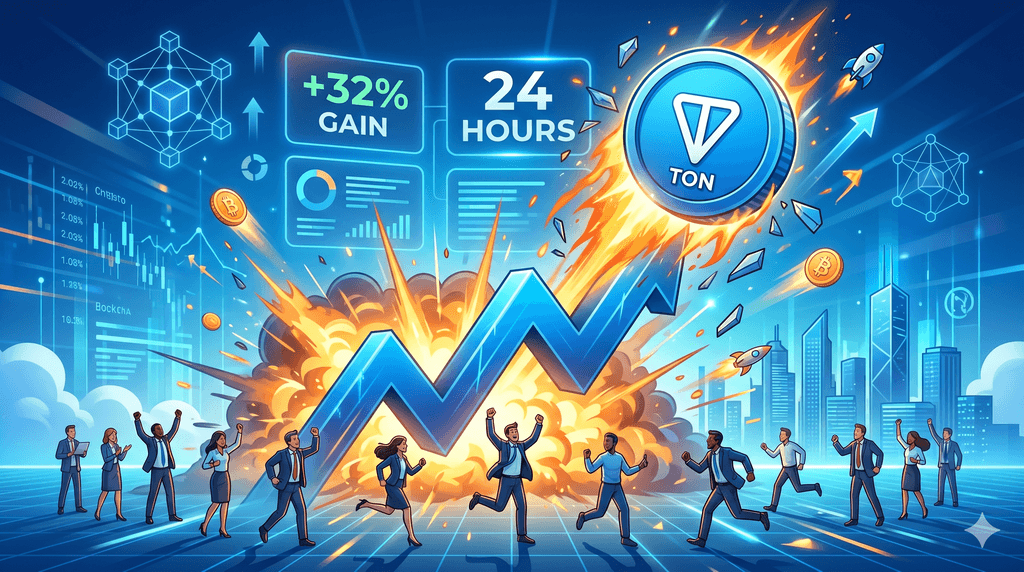
Is the "Telegram-to-Web3" dream finally hitting its stride? In a week where major assets like Bitcoin and Ethereum saw slight pullbacks from their local highs, Toncoin (TON) has staged a historic decoupling from the broader market. As of May 8, 2026, Toncoin has surged by over 32% in the last 24 hours, part of a staggering 115% rally over the past six days. The catalyst for this explosive move isn't just retail hype; it is a fundamental shift in the network's governance.
Telegram founder Pavel Durov officially announced on May 4, 2026, that Telegram will replace the TON Foundation as the primary driving force behind the blockchain, effectively becoming its largest validator. This move formally fuses Telegram’s 950 million active users with the TON architecture, transforming a community-run project into a corporate-backed ecosystem with unprecedented distribution power. TON is no longer just a digital asset; it has become the native currency of a global "Super App" ecosystem.
Key Takeaways
-
Governance Revolution: Telegram has officially replaced the TON Foundation as the primary operator and largest validator of the network.
-
Massive Price Action: TON jumped 32% in 24 hours and over 115% in six days, reaching a multi-year high of approximately $3.42.
-
Fee Reduction: Transaction fees have been slashed to a base fee of roughly $0.0005 (0.00039 TON) to support high-frequency micro-transactions.
-
Technical Upgrades: The Catchain 2.0 upgrade and upcoming v4 sharding allow for sub-400ms block times and throughput exceeding 100,000 TPS.
-
Ecosystem Spillover: TON-native tokens like DOGS and Notcoin have seen triple-digit gains as capital rotates into the Telegram-integrated narrative.
-
The Telegram Takeover: Why Governance is the New Growth Engine
The primary reason Toncoin is currently outperforming every other major Layer-1 blockchain is the formal "homecoming" of Telegram to its original creation. For years, the TON Foundation managed development while Telegram remained a supportive but distinct entity. This changed on May 4, 2026, when Pavel Durov announced that Telegram would take over as the network's largest validator. This integration effectively removes the legal and operational buffers that previously slowed the network's growth, allowing for direct product integration that was previously impossible.
From Community-Run to Telegram-Operated
Telegram's transition into the largest validator means the company now has "skin in the game" at the infrastructure level. By staking millions of TON tokens to secure the network, Telegram has aligned its corporate success with the blockchain’s stability. This shift removes the execution gap that previously existed between Telegram’s massive user base and the TON Foundation’s technical roadmap. Investors are now pricing TON not as an independent altcoin, but as the native currency of a "Super App" that rivals WeChat in functionality but with decentralized settlement. This move also implies that Telegram’s future revenue models—such as ad revenue sharing and premium subscriptions—will be increasingly settled on-chain.
The Validator Power Shift
As the largest validator, Telegram will now earn a significant portion of staking rewards and hold substantial influence over protocol upgrades. While some decentralization purists have raised concerns about this concentration of power, the market has responded with overwhelming optimism. The move is seen as a way to ensure that the blockchain can scale fast enough to meet the demands of nearly one billion users without the friction of community-led governance hurdles. In the high-stakes world of 2026 crypto, efficiency often trumps pure decentralization in the eyes of institutional investors who want to see a clear path to mass adoption.
The Impact on Institutional Perception
Wall Street and global venture capital firms have historically been wary of TON due to its fragmented governance between the Foundation and the messaging app. With the May 2026 announcement, that ambiguity has vanished. Financial analysts now view TON as a "platform play" similar to early-stage Amazon or Google, where the value is derived from the sheer volume of users transacting within a closed-loop ecosystem. This has led to a surge in "Smart Money" inflows, as evidenced by the sharp increase in whale transactions (those over $100,000) which have risen by 400% in the last 48 hours.
-
Fee Slashes and Micro-Payments: The Technical Catalyst
Toncoin's price explosion is being fueled by a radical reduction in network fees, making the blockchain a viable competitor for high-frequency retail use. Effective May 1, 2026, the TON network implemented a new fee structure that reduced transaction costs sixfold. This was a strategic move designed to kill the competition from other "cheap" L1s like Solana and Base by offering prices that are practically negligible.
The Path to Zero-Fee Transactions
Current transaction costs on TON have dropped to a fixed base fee of roughly $0.0005 per transaction. This change is critical for the "Telegram Mini Apps" (TMAs) ecosystem, where users frequently send small amounts of value within games or social interactions. By making the cost of a transaction negligible, Telegram is paving the way for a fully fee-less model in the near future where the platform might subsidize gas fees entirely for premium users. This makes TON the only blockchain capable of handling the "dust" transactions common in social media interactions at a global scale.
Performance Benchmarks: Catchain 2.0 and Beyond
Following the Catchain 2.0 upgrade activated in April 2026, the network has achieved technical benchmarks that place it at the top of the industry.
-
Block Times: Reduced from 2.5 seconds to under 400 milliseconds.
-
Throughput: Theoretical capacity of 100,000+ transactions per second through dynamic sharding.
-
Finality: Instant finality allows for a seamless user experience where the "blockchain" aspect becomes invisible to the average Telegram user.
-
These technical milestones are not just vanity metrics; they are the prerequisites for hosting the next billion users. If a user has to wait more than a second for a payment to clear, they will revert to traditional apps. TON’s 2026 upgrades have finally bridged the gap between blockchain latency and "Web2" speed.
Real-World Application: The Ad Revenue Revolution
One of the most immediate uses of these low fees is the new Telegram Ad platform, which launched its expanded version in late April 2026. Channel owners can now receive 50% of the revenue generated from ads shown in their channels, paid out exclusively in TON. With transaction fees being so low, even small channels with modest traffic can withdraw their earnings instantly without losing a significant percentage to gas. This has created a massive circular economy where TON is both the payment method and the reward, driving constant buy pressure on the open market.
-
Market Performance and Institutional Adoption
Toncoin's 2026 rally has shifted it from a niche asset into an institutional-grade investment. The market capitalization of TON has surged, and its daily trading volume has consistently surpassed $600 million during this rally. This section breaks down exactly where the money is coming from and how the metrics compare to the previous year.
Toncoin Price Performance Comparison (May 2026)
| Metric | Value (May 8, 2026) | 7-Day Change | 30-Day Change |
| TON Price | $3.42 | 0.8722 | 1.0231 |
| Market Cap | ~$9.2 Billion | 0.85 | 0.98 |
| 24h Volume | $632.7 Million | 1.2 | 1.5 |
| TVL (DeFi) | $1.2 Billion | 0.4 | 0.55 |
| Active Wallets | 12.4 Million | 0.65 | 0.9 |
Institutional Entrants: Rakuten and CoinShares
The rally is not purely driven by Telegram users. In mid-April 2026, Rakuten Wallet added Toncoin for spot trading, opening the door for millions of Japanese retail investors. Furthermore, CoinShares has launched a TON-specific staking ETP (Exchange Traded Product) on the SIX Swiss Exchange, allowing European institutional investors to gain exposure to TON yields without the technical burden of managing a private key. This "institutionalization" of TON provides a price floor that was absent in previous cycles, as these products represent long-term capital that is less likely to panic-sell during volatility.
The Rise of TON-Native Stablecoins
A major factor in the $1.2 billion Total Value Locked (TVL) is the expansion of native stablecoins. In May 2026, Tether (USDT) reported that the supply of USDT on the TON network has crossed the $500 million mark. Having a stable, reliable medium of exchange within the Telegram ecosystem allows for complex DeFi activities like lending and borrowing to flourish. Users are no longer just "holding" TON; they are using it as collateral to earn yield, further locking up supply and contributing to the current "supply crunch" that is driving prices higher.
-
The "Make TON Great Again" (MTONGA) Roadmap
Pavel Durov’s "MTONGA" initiative is a seven-step roadmap designed to turn Telegram into the primary interface for the entire crypto world by the end of 2026. This is a bold vision that aims to replace traditional browsers and app stores with a unified Telegram interface.
Expanding the "Mini App" Economy
The explosion in TON’s price is mirrored by the success of Telegram-based games like Notcoin, DOGS, and the newly launched "Hamster Kombat 2.0." These "Mini Apps" live entirely within the Telegram interface, allowing users to earn, trade, and spend crypto without ever leaving the chat app. In Q1 2026 alone, the network processed 1.5 billion transactions, largely driven by these viral gaming ecosystems. These games act as the "on-ramp" for non-crypto users, teaching them the basics of wallet management through play-to-earn mechanics.
Decentralized Storage and Privacy
The roadmap for late 2026 includes a deeper integration with TON Storage and TON Proxy. This will allow Telegram users to host decentralized websites and share encrypted files with significantly lower latency. For the average user, this means that "Secret Chats" and private transactions will become more robust, leveraging zero-knowledge proofs (ZKPs) for high-speed verification on-chain. This positions Telegram as a leader in the "Privacy-Tech" space, a sector that has seen renewed interest from investors in 2026 as global data regulations tighten.
The Future of Cross-Chain Interoperability
By Q4 2026, the MTONGA roadmap aims to implement "TON Bridge 2.0," which will allow for seamless asset transfers between TON, Ethereum, and the Bitcoin Lightning Network. The goal is to make Telegram the "Universal Wallet" where a user can hold BTC, ETH, and TON in one place and swap them instantly using TON as the liquidity backbone. If successful, this would make Telegram the central hub for all retail crypto activity, regardless of which underlying blockchain a user prefers.
As Toncoin transitions into a top-tier digital asset, having a reliable platform to access its liquidity becomes essential for both traders and long-term holders. KuCoin has remained a primary gateway for the TON ecosystem, offering deep liquidity and a wide range of TON-native pairs. Whether you are looking to capitalize on the 32% daily swings or participate in TON staking to earn network rewards, the platform provides the professional-grade tools required for the 2026 market.
The recent surge has also triggered a massive interest in the broader Telegram ecosystem, with many investors looking beyond the native TON token to early-stage projects launching via Telegram's internal incubators. For those curious about how these "Mini Apps" actually function or how to secure their first TON-based assets, the platform's resources provide a comprehensive starting point. The 2026 bull run is defined by accessibility, and platforms that bridge the gap between complex blockchain protocols and user-friendly trading interfaces are leading the charge.
Tips: New to crypto? KuCoin's Knowledge Base has everything you need to get started.
Conclusion
The recent 32% jump in Toncoin’s price is more than just a fleeting candle on a chart; it represents a fundamental repricing of what a social media blockchain can achieve. By Telegram formally assuming the role of the network's largest validator and primary operator, the project has solved its most persistent "overhang"—the gap between Telegram’s massive distribution and the blockchain's technical execution. With transaction fees now at near-zero levels and the Catchain 2.0 upgrade delivering sub-second finality, TON has successfully transitioned from a theoretical concept into a functional Web3 infrastructure.
The market's move to $3.42 reflects a growing consensus that the future of crypto adoption may not lie in complex external wallets, but in the "invisible" integration of blockchain technology into the apps we already use daily. As the "Make TON Great Again" roadmap enters its next phases—including gasless transactions and enhanced privacy features—Toncoin is well-positioned to remain the market's most explosive altcoin story throughout 2026. For investors, the focus now shifts to whether this corporate-led governance can maintain its momentum while preserving the decentralized ethos that originally birthed The Open Network. Whether you are a retail user playing games or an institutional investor looking for the next platform play, TON has proven that it is a force that can no longer be ignored.
FAQs
Who is the largest validator on the TON network?
As of May 4, 2026, Telegram has officially replaced the TON Foundation as the largest validator on the network. This means Telegram itself is now responsible for confirming transactions, securing the blockchain, and earning a share of the network's staking rewards, aligning the company's financial interests directly with the health of the blockchain.
Why did TON fees decrease so significantly in May 2026?
The TON network implemented a fee reduction on May 1, 2026, to a fixed base fee of approximately 0.00039 TON (roughly $0.0005). This change was designed to facilitate high-frequency activity, such as micropayments in Telegram games and social interactions, making the chain more competitive with traditional payment systems and other low-cost Layer-1 blockchains.
What is "Catchain 2.0" and how does it affect TON?
Catchain 2.0 is a major protocol upgrade activated in April 2026 that slashed block times to under 400 milliseconds. It significantly increased the network's throughput and reduced congestion, allowing Telegram's "Mini Apps" to function with the same speed and responsiveness as traditional centralized web applications, which is crucial for mass retail adoption.
Can I earn rewards by staking Toncoin?
Yes, Toncoin holders can participate in network security by staking their tokens. Following recent updates in May 2026, the entry threshold for validators was increased to ensure network stability, but individual users can still participate through staking pools or exchange-based staking products to earn a portion of the network's transaction fees and inflation rewards.
What are Telegram Mini Apps (TMAs)?
Telegram Mini Apps are decentralized applications built directly inside the Telegram messaging interface using HTML5 and TON integration. They allow users to engage in gaming, DeFi, and social activities using the TON blockchain without ever leaving the Telegram app. These apps have been a primary driver of the 1.5 billion transactions processed by TON in early 2026.
Disclaimer: This article is for informational purposes only and does not constitute financial or investment advice. Cryptocurrency investments carry significant risk. Always conduct your own research before trading.