

Token Unlocks: The Predictable Indicators of Crypto Price Pressure
2026/05/12 18:00:00
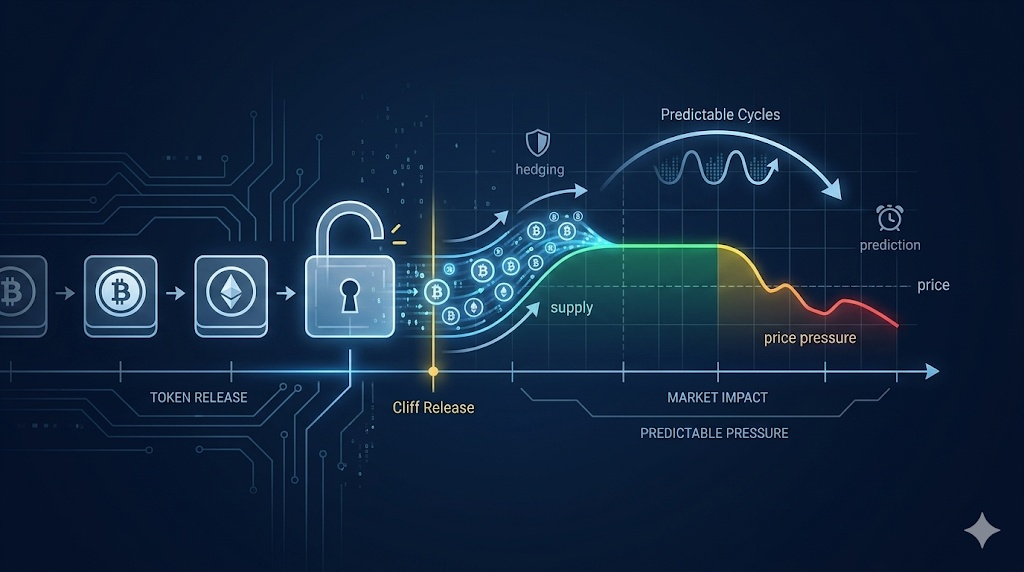
In March 2026 alone, the cryptocurrency market absorbed a massive six billion dollar supply shock from scheduled token releases. Token unlocks are predetermined liquidity events that introduce previously restricted supply into the open market, playing a critical role in dictating short term crypto market cycles. They serve as highly predictable indicators of downward price pressure. When supply outpaces organic demand, basic economic principles dictate an immediate price decline. Traders anticipate these events weeks in advance, altering standard market behaviors to avoid dilution. Understanding these mathematical vesting schedules is mandatory for accurate risk assessment and portfolio protection.
Key Takeaways
-
Token unlocks are highly predictable liquidity events that introduce new supply, mechanically suppressing asset prices through unavoidable market dilution.
-
Cliff unlocks generate immediate and severe market volatility, whereas linear emissions create gradual supply increases that markets absorb easier.
-
Savvy market participants reliably front run these scheduled events, initiating aggressive selling pressure nearly thirty days before the actual release.
-
Releases exceeding twenty percent of the circulating supply or heavily outpacing daily trading volume guarantee severe downward price momentum.
-
Global macroeconomic tightening amplifies the dilution impact, requiring traders to utilize futures contracts to hedge against impending supply shocks.
The Mechanics of Token Vesting in Market Cycles
Token vesting schedules directly dictate the structural supply side of crypto market cycles by mathematically determining when early investors and developers can liquidate their holdings. By restricting initial liquidity, blockchain projects artificially inflate early market valuations. When these restrictions finally expire, the sudden influx of available assets fundamentally alters the balance between buyers and sellers. This mechanical increase in circulating supply overrides standard market sentiment, forcing price discovery lower regardless of the underlying technological developments.
Cliff Releases Versus Linear Emissions
Cliff unlocks generate immediate and severe market volatility, whereas linear emissions create a slow and prolonged drain on asset prices. A cliff event unlocks a massive percentage of the total token supply on one specific date, creating an immediate and devastating liquidity shock. Linear vesting distributes the same amount of tokens gradually over consecutive months or years. According to market analysis from April 2026, linear models allow the market to absorb the new supply incrementally without breaking the order books.
| Vesting Structure | Supply Impact | Volatility Level | Market Adaptation |
| Cliff Release | Immediate Supply Shock | Extremely High | Difficult to Absorb |
| Linear Emission | Gradual Supply Increase | Moderate to Low | Easily Absorbed |
The Dilution of Market Capitalization
Token unlocks artificially suppress individual asset prices even if the overall market capitalization of the project is actively growing. When new tokens enter circulation, the total valuation of the network might increase due to new capital inflows. However, because that value is now divided among a much larger number of tokens, the price of a single unit inherently drops. This dilution effect means retail investors lose purchasing power despite holding a growing network asset.
Sector Specific Impacts in Decentralized Finance
Layer two scaling solutions and decentralized finance protocols experience the most severe price fluctuations during unlock events due to their heavy reliance on liquidity incentives. These sectors frequently utilize aggressive emission schedules to bootstrap early network activity and attract initial capital. When developer and investor allocations vest, the market must absorb millions of dollars in newly available assets simultaneously. Based on decentralized finance reports from May 2026, these specific unlocks often trigger cascading liquidations.
Token Unlocks as Predictable Price Pressure Indicators
Token unlocks serve as highly reliable leading indicators for negative price action because the exact date and volume of the incoming supply are publicly verifiable. Unlike unexpected macroeconomic news or sudden regulatory changes, vesting schedules are hardcoded directly into the protocol smart contracts. Market participants know exactly when the supply shock will occur with absolute certainty. This transparency allows institutional and retail traders to position themselves defensively, ensuring the market prices in the dilution early.
The Phenomenon of Pre Unlock Front Running
Savvy traders consistently drive prices down thirty days before a major unlock by aggressively selling the asset to front run the anticipated supply growth. Market participants do not wait for the actual release date to offload their portfolios. They preemptively exit their positions to avoid the inevitable liquidity crunch.
Statistical Evidence of Negative Price Action
Historical data confirms that ninety percent of major token releases result in significant negative price momentum for the affected digital asset. The sheer volume of new tokens overwhelming the current bid side of the order book creates an unavoidable price decline. In March 2026, the market witnessed a highly concentrated six billion dollar supply injection. Projects involved in this massive release saw their token valuations drop substantially, proving that unlocks are inherently bearish liquidity events.
Post Unlock Capitulation and Recovery
The period immediately following a major token release often presents a strategic accumulation zone once the initial wave of insider selling completely exhausts itself. After the early investors and team members liquidate their newly available assets, the intense selling pressure abruptly stops. If the underlying protocol maintains strong fundamentals, the asset enters a capitulation phase followed by gradual price stabilization. Investors frequently monitor this post unlock stabilization to enter long positions at heavily discounted valuations.
Evaluating the Severity of an Unlock Event
Investors must mathematically evaluate the ratio of unlocked tokens to existing liquidity to determine the actual severity of the impending price pressure. A massive numerical release means nothing if the project already possesses a massive circulating supply capable of absorbing the shock. Conversely, a seemingly small token release can destroy an asset price if the current circulating supply is highly restricted. Traders rely on specific quantitative metrics rather than emotional reactions to gauge true risk.
| Metric Analyzed | High Risk Threshold | Expected Market Reaction |
| Unlock to Circulating Supply | Exceeds 20 Percent | Severe Price Dilution |
| Unlock to Daily Volume | Exceeds 2.5 Multiple | Massive Order Book Slippage |
| Recipient Demographics | Heavy Venture Capital | Aggressive Immediate Selling |
The Unlock to Circulating Supply Ratio
An unlock exceeding twenty percent of the current circulating supply guarantees severe dilution risk and significant negative market reactions. This mathematical ratio measures the proportional increase in available assets entering the secondary market. If a project has one million tokens in circulation and releases another two hundred thousand, the supply expands by twenty percent instantly. According to blockchain analytics from April 2026, ratios above this specific threshold consistently trigger intense panic selling across exchanges.
Assessing the Average Daily Volume Strain
Token releases that exceed two and a half times the average daily trading volume will inevitably break the order book and cause massive price slippage. The daily trading volume represents the exact market capacity to absorb new selling pressure efficiently. If an unlock introduces fifty million dollars of supply into a market that only trades ten million dollars daily, buyers are completely overwhelmed. According to liquidity reports from May 2026, calculating this volume multiple is essential.
Analyzing Recipient Allocations
Tokens allocated to early venture capitalists and project teams generate vastly more selling pressure than tokens distributed for community ecosystem incentives. Early investors possess incredibly low cost bases and are highly motivated to realize their profits immediately upon vesting. Ecosystem funds are generally distributed slower and often require users to participate actively in the protocol. Analyzing exactly who receives the newly unlocked tokens helps traders predict the immediate likelihood of aggressive open market liquidation.
Macroeconomic Factors Amplifying Unlock Volatility
Global macroeconomic conditions directly amplify or mitigate the negative price impact of scheduled token releases by altering overall market liquidity. When global fiat liquidity is rapidly expanding, the market can absorb massive token unlocks with minimal price disruption. However, during periods of economic tightening, there are significantly fewer active buyers available to support the price. Understanding the broader economic context is absolutely vital for predicting how the market will react to a specific supply injection.
Central Bank Policies and Liquidity
Restrictive central bank policies and elevated interest rates drain the capital required to absorb newly unlocked cryptocurrency supplies effectively. When traditional risk free yields are high, institutional capital rotates rapidly out of volatile digital assets. If a major token release occurs during a period of rising Japanese rate hikes or tight American monetary policy, the price crash will be exceptionally severe. According to global financial forecasts from May 2026, tracking these macroeconomic drivers is mandatory.
Impact of Energy Prices on Digital Assets
Volatile energy prices and oil driven inflation reduce retail purchasing power, leaving the cryptocurrency market highly vulnerable to sudden increases in token supply. High energy costs directly impact global inflation metrics and severely reduce the disposable income of everyday retail participants. Furthermore, these elevated costs compress the profit margins of global blockchain infrastructure providers. Based on economic analyses from April 2026, a stressed market cannot sustain the selling pressure generated by massive venture capital token liquidations.
Utilizing Technical Analysis During Unlock Events
Professional traders combine publicly available vesting schedules with advanced technical indicators to precisely time their market entries and exits around supply shocks. Fundamental knowledge of an upcoming unlock provides the overarching bearish thesis, but technical analysis dictates the exact timing of the trade. By applying standard financial tools to cryptocurrency markets, analysts can identify the precise moment front running begins and when the selling exhaustion finally occurs on the chart.
Tracking Momentum with Relative Strength Index
The Relative Strength Index provides clear confirmation when pre unlock front running has pushed an asset into a deeply oversold capitulation zone. As savvy market participants sell aggressively ahead of the vesting date, the downward momentum accelerates rapidly. Traders monitor this specific momentum oscillator to identify when this selling becomes irrational and exhausted. A deeply oversold reading immediately following a massive cliff release often signals that the worst of the supply shock has passed.
Confirming Trend Reversals with Moving Averages
The Moving Average Convergence Divergence indicator allows traders to verify whether a post unlock price stabilization is a genuine reversal or a temporary pause. After the initial wave of insider selling concludes, the asset price may stabilize briefly. Traders utilize these moving average crossovers to confirm that buying volume has genuinely returned to outpace the newly unlocked supply. Relying on these visual momentum shifts prevents investors from catching falling assets prematurely during a distribution phase.
Analyzing Volume Profiles with On Balance Volume
The On Balance Volume indicator exposes hidden institutional distribution weeks before the actual token release date officially occurs on the calendar. Smart money rarely waits for the public unlock date to reduce their overall market exposure. They distribute their existing liquid holdings carefully into periods of high retail demand. By tracking the cumulative buying and selling pressure through volume analysis, traders can detect this institutional exiting behavior.
How to Trade Token Unlocks on KuCoin
KuCoin provides the comprehensive trading infrastructure required to execute advanced defensive and offensive strategies around major token vesting events. Navigating a six billion dollar supply shock requires professional grade market access and superior execution speed. Investors must utilize a platform that offers deep spot liquidity and robust derivative products. KuCoin equips users with the necessary financial tools to hedge their portfolios against dilution or capitalize on the extreme volatility generated by these highly predictable liquidity events.
Traders utilize the KuCoin futures market to open short positions against specific assets, effectively hedging their spot portfolios against the impending unlock dilution. If an investor holds a long term position in a fundamentally strong project facing a massive short term cliff release, selling the spot asset might incur unwanted tax liabilities. Instead, they open a corresponding short position on the futures market. This strategy neutralizes the negative price action during the unlock period.
Spot Market Accumulation Zones
The KuCoin spot market provides the ideal environment for patient investors. Once the unlocked tokens are fully dumped onto the market and the technical indicators signal exhaustion, fundamentally strong projects become severely undervalued. Investors utilize KuCoin spot limit orders to build positions at these heavily discounted levels. This contrarian approach allows market participants to profit securely from the panic selling generated by temporary supply imbalances.
Conclusion
Token unlocks dictate the fundamental supply architecture of cryptocurrency market cycles globally. They act as highly predictable indicators of negative price pressure because they introduce massive quantities of previously restricted assets into the circulating supply. Whether executed through massive cliff events or slow linear emissions, this dilution mechanically suppresses asset valuations across the board. Historical data confirms that the market routinely front runs these events, initiating aggressive selling pressure weeks before the actual distribution date officially arrives.
To navigate these scheduled supply shocks successfully, investors must rigorously evaluate the ratio of unlocked tokens to existing circulating supply and average daily trading volume. Combining these fundamental metrics with macroeconomic indicators and advanced technical analysis is absolutely essential for accurate risk management. By tracking momentum shifts and institutional distribution patterns, traders can identify optimal exit points and lucrative post capitulation accumulation zones.
FAQs
What exactly happens during a cryptocurrency token unlock event?
A token unlock event releases previously frozen or restricted digital assets into the open market, allowing early venture capital investors, developers, and team members to finally sell or trade their holdings freely on public cryptocurrency exchanges.
Why do token unlocks almost always cause the price to drop?
Token unlocks drastically increase the circulating supply of an asset without simultaneously increasing buyer demand. When millions of new tokens flood the secondary market, the basic economic principle of supply and demand dictates that the price must decrease to absorb the excess inventory.
What is the difference between a cliff unlock and linear vesting?
A cliff unlock releases a massive lump sum of tokens on one specific date, causing immediate and severe market volatility. Linear vesting distributes the tokens gradually over an extended period, creating a slow and predictable increase in supply that is easier for the market to absorb safely.
How early do traders start selling before a major token unlock?
Experienced traders typically begin selling or shorting an asset approximately thirty days before a scheduled major unlock. This preemptive behavior aims to secure profits before the newly released tokens can flood the market and crash the price.
Which specific unlock metric is the most important to monitor?
The unlock to circulating supply ratio is the most critical metric for assessing immediate risk. If the scheduled token release exceeds twenty percent of the currently available circulating supply, the event will almost certainly trigger massive dilution and severe downward price pressure.
Disclaimer:This content is for informational purposes only and does not constitute investment advice. Cryptocurrency investments carry risk. Please do your own research (DYOR).