

Developers Switch to OpenAI Codex Over Claude for Faster Coding: New Opportunities for AI Trading in 2026
2026/05/12 11:18:01
Introduction
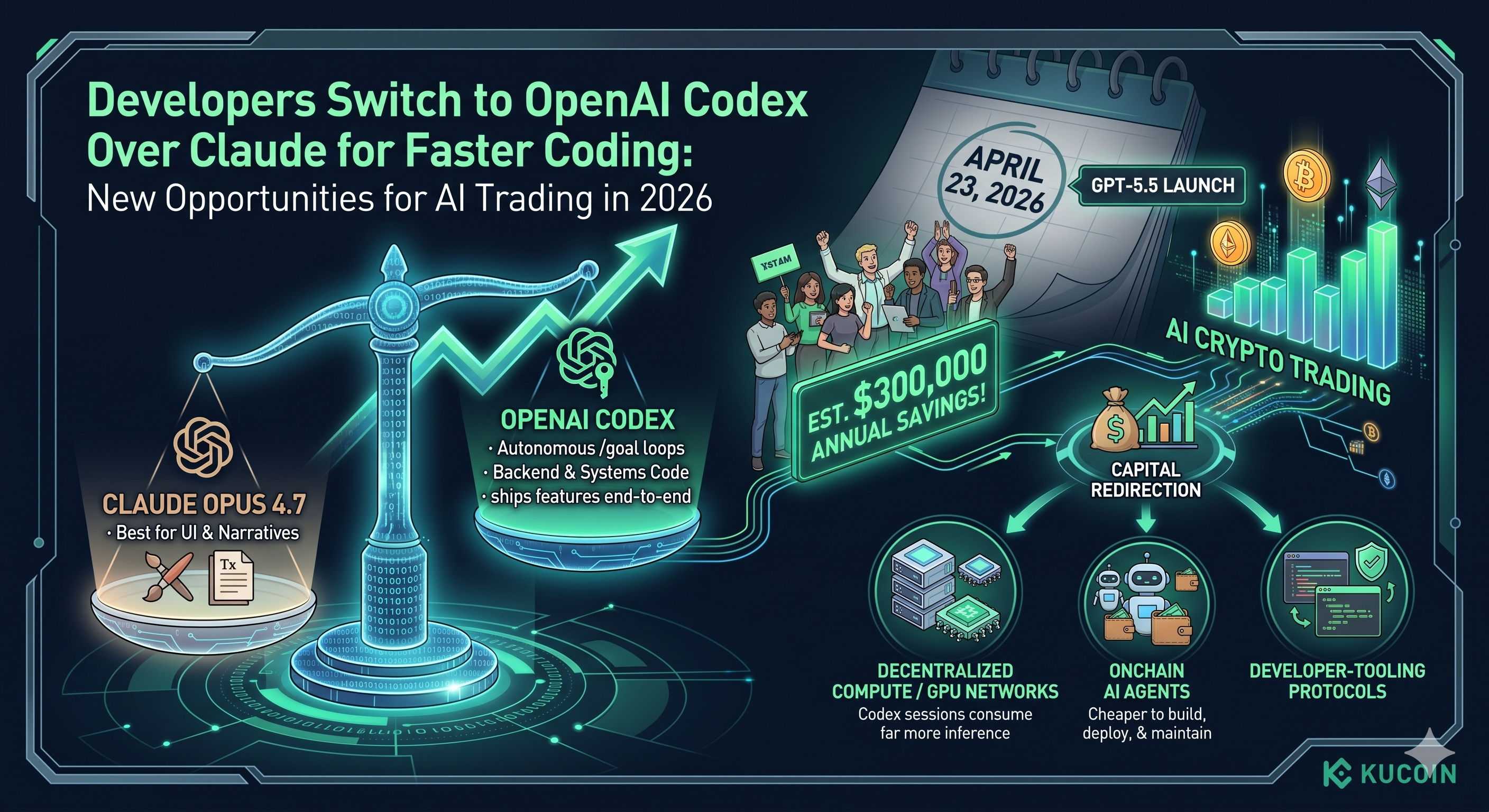
Can a coding agent really save a startup $300,000 a year in contractor fees? According to early adopter reports circulating since OpenAI's GPT-5.5 launch on April 23, 2026, the answer is yes — and that economic shock is now redirecting capital toward AI-linked crypto trades. Developers are switching from Anthropic's Claude Opus 4.7 to OpenAI's Codex for backend coding because Codex's new /goal command runs autonomous plan-act-test-review loops for hours, ships features end-to-end, and self-corrects faster than competing agents. The migration is reshaping not only software workflows but also how traders position around AI-adjacent tokens, GPU-compute networks, and onchain agent infrastructure.
To understand the full context, the below are the recommended readings:
-
AI-Powered Coding examines why agentic developer tools are crypto's biggest 2026 catalyst,
-
Web3 AI Agents covers how Claude-integrated chains like ZetaChain still dominate onchain reasoning,
-
and Crypto Security Risks unpacks what concentrated AI providers mean for Bitcoin.
What Is OpenAI Codex and Why Are Developers Switching from Claude?
Developers are switching to OpenAI Codex because GPT-5.5 ships full features autonomously while Claude Opus 4.7 still requires more human steering on backend tasks. Codex, released alongside GPT-5.5 on April 23, 2026, is an agentic coding system available through a CLI, a desktop app, and direct IDE integrations. According to OpenAI's launch documentation, Codex handles bug fixes, refactors, and entire codebase analysis without continuous prompting.
The headline upgrade is the /goal command. Once a developer sets a persistent objective — for example, "ship a working order-book matching engine with tests" — Codex enters a multi-hour plan-act-test-review loop. It writes code, runs the tests, reads the failures, patches itself, and continues until the goal is met or it surfaces a blocker.
How Codex Differs from Claude Opus 4.7 in Practice
Codex outperforms Claude on backend throughput, while Claude Opus 4.7 still wins on UI nuance and design taste. Based on developer testimonials posted across X and Hacker News in late April and early May 2026, the consistent split is:
-
Backend, infra, and systems code → Codex
-
Frontend, design systems, and product copy → Claude
Several teams report keeping both subscriptions active and routing tasks by domain, rather than fully replacing one with the other.
Why Is the Codex Launch a Catalyst for AI Crypto Trading?
The Codex launch is a catalyst for AI crypto trading because faster, cheaper code production accelerates the deployment of onchain agents, trading bots, and compute-demand applications — all of which are tracked by liquid crypto tokens. When developer productivity jumps, the throughput of new dApps, agents, and MEV strategies rises with it.
According to multiple early-adopter accounts shared since the April 23 release, small teams are reporting up to $300,000 in annual contractor savings by replacing junior development cycles with Codex sessions. That capital, in many cases, is being redirected into:
-
AI infrastructure tokens (decentralized compute, inference, data)
-
Agent-framework tokens that let LLMs transact onchain
-
GPU and storage networks supplying the inference layer
Which Crypto Sectors Benefit Most From Faster AI Coding?
Three crypto sectors benefit most: decentralized compute, onchain AI agents, and developer-tooling tokens. Decentralized compute networks gain because Codex-style agents burn far more inference tokens than human developers ever did. Onchain agent platforms gain because Codex makes it trivial to wrap an LLM in a wallet, a strategy, and a risk module. Developer-tooling protocols gain because more shipped code means more audits, more deployments, and more contract activity.
How Does Codex Change AI Trading Bot Development?
Codex changes AI trading bot development by collapsing the build-test-deploy cycle from weeks to hours. A strategy that previously required a quant, a developer, and a DevOps engineer can now be scaffolded by a single operator using /goal — with Codex writing the data ingestion, signal logic, backtest harness, and execution layer in one continuous session.
Faster Iteration on Strategy Research
Faster iteration is the largest unlock. Traders can now spin up dozens of variant strategies in parallel, backtest them across historical regimes, and discard losers within a single afternoon. Before April 2026, that workflow typically required a dedicated engineering hire.
Lower Barriers for Retail Quants
Retail quants benefit disproportionately because Codex's /goal command absorbs the steepest part of the learning curve — connecting exchange APIs, normalizing market data, and writing reliable order-management code. A trader who understands market microstructure but not Python idioms can now ship a working bot.
Risks of Agent-Generated Trading Code
Agent-generated trading code introduces new risks that traders must explicitly manage. Codex can hallucinate API endpoints, mis-handle decimal precision on token amounts, and silently swallow exceptions. Production deployment without human review has already produced documented losses in the wider AI-agent ecosystem since 2025, and concerns around concentrated model providers tie directly into broader Crypto Security Risks that affect the entire industry.
What Are the Best Crypto Sectors to Watch After the Codex Release?
The best crypto sectors to watch after Codex are decentralized GPU networks, onchain agent platforms, and oracle infrastructure. Each captures a different layer of the AI-coding boom.
|
Sector
|
Why It Benefits From Codex
|
Trade Thesis
|
|
Decentralized GPU / compute
|
Codex sessions consume far more inference than humans
|
Demand-side growth in inference markets
|
|
Onchain AI agents
|
Agents are cheaper to build, deploy, and maintain
|
More live agents = more onchain volume
|
|
Oracle and data infra
|
Agents need reliable price and event data
|
Usage-based fee capture
|
Decentralized Compute Networks
Decentralized compute networks are the most direct beneficiary because every Codex session is paid inference. Even if the inference itself runs on OpenAI infrastructure, the downstream applications Codex builds — trading bots, agents, indexers — often deploy on decentralized GPU rails for cost reasons.
Onchain Agent Platforms
Onchain agent platforms benefit because Codex removes the engineering bottleneck that kept agent counts low. Cross-chain agent infrastructure, including projects integrated with Anthropic's stack, expands the addressable surface — a theme covered deeply in Web3 AI Agents research.
How Should Traders Position Around the Codex vs Claude Narrative?
Traders should position around the Codex vs Claude narrative by separating short-term sentiment trades from long-term structural exposure. The narrative itself — "OpenAI is winning backend, Anthropic is winning UI" — produces predictable rotations whenever either company ships a major release.
Short-Term Sentiment Trades
Short-term, expect AI-token rallies on every major OpenAI or Anthropic release. The April 23 GPT-5.5 launch produced measurable spikes in AI-sector tokens within 24 hours, according to onchain volume dashboards tracked by major analytics providers. Traders selling premium can lean into elevated implied volatility around announced release windows.
Long-Term Structural Exposure
Long-term, the structural trade is exposure to the picks-and-shovels layer: compute, data, and agent infrastructure. The specific model winner matters less than the fact that agentic coding is now a permanent productivity layer. Selecting tokens with real fee capture — rather than pure narrative tokens — reduces drawdown risk across the cycle.
Hedging the Concentration Risk
Hedging concentration risk matters because two US-based labs now produce most of the world's frontier coding agents. Any regulatory, security, or outage event at either OpenAI or Anthropic propagates directly into crypto-AI token prices. Diversifying across open-weight model ecosystems and decentralized inference networks reduces single-provider exposure.
What Are the Risks of Over-Relying on Codex for Crypto Development?
The risks of over-relying on Codex for crypto development include supply-chain centralization, hallucinated dependencies, and regulatory exposure to a single US provider. Each risk has concrete onchain consequences.
Supply-Chain Centralization
Supply-chain centralization is the largest systemic risk. When a meaningful share of new Solidity, Rust, and Move code is written by one model from one provider, a subtle bug class introduced by that model propagates across the ecosystem. Independent audits remain essential even when code is agent-generated.
Hallucinated Dependencies and Phantom Packages
Hallucinated dependencies are a documented attack vector. Coding agents occasionally invent package names that do not exist; malicious actors then register those package names with backdoored code, waiting for the next agent to install them. Crypto repos are particularly attractive targets.
Regulatory and Jurisdictional Exposure
Regulatory exposure is rising. OpenAI and Anthropic both operate under US jurisdiction, and any sanctions, export-control, or compliance ruling can instantly affect access for non-US development teams. Builders working on permissionless protocols should maintain at least one open-weight model in their workflow as a fallback.
How Do Codex and Claude Compare on Crypto-Specific Tasks?
Codex and Claude differ measurably on crypto-specific tasks: Codex leads on Solidity refactors, indexer code, and trading-bot scaffolding, while Claude Opus 4.7 leads on documentation, security narratives, and DAO governance writing. Both models can handle most tasks, but the productivity delta is meaningful at scale.
|
Crypto Task
|
Codex Strength
|
Claude Strength
|
|
Smart contract refactor
|
High — autonomous test loops
|
Medium
|
|
Frontend dApp UI
|
Medium
|
High — design taste
|
|
Trading bot scaffolding
|
High — /goal end-to-end
|
Medium
|
|
Audit narrative writing
|
Medium
|
High — explanatory prose
|
|
Onchain agent logic
|
High
|
High
|
The practical recommendation from active builders is to run Codex as the primary engineering driver and use Claude as a second-opinion reviewer — particularly for security-sensitive contracts where adversarial reasoning matters. This dual-agent pattern is becoming standard practice in serious crypto teams, and it connects directly to broader trends in AI-Powered Coding across the industry.
Conclusion
OpenAI's April 23, 2026 release of GPT-5.5 and Codex has shifted the agentic coding landscape decisively toward autonomous, multi-hour workflows. Developers are migrating to Codex for backend tasks because the /goal command delivers end-to-end feature shipping with self-correcting test loops, while many still rely on Claude Opus 4.7 for frontend polish and documentation. The reported $300,000 annual contractor savings per team is real productivity capital being redirected into AI-adjacent crypto exposure.
For traders, the opportunities cluster around three layers: decentralized compute that absorbs the inference demand, onchain agent platforms that scale because building agents is now cheap, and oracle infrastructure that feeds the agents reliable data. Short-term sentiment trades around release events, combined with long-term structural exposure to picks-and-shovels tokens, form a balanced playbook.
The risks — supply-chain centralization, hallucinated dependencies, and regulatory concentration on two US labs — argue for diversification across open-weight ecosystems. The Codex era is not a Claude killer; it is a productivity unlock that broadens the entire AI-crypto opportunity set.
FAQs
Is OpenAI Codex free to use?
No. Codex requires an active OpenAI subscription tier that includes GPT-5.5 agent access. Pricing is metered by inference tokens, and heavy /goal sessions can consume significant credits per hour. OpenAI offers tiered plans for individual developers, teams, and enterprises, with enterprise plans including extended context windows and priority compute.
Can Codex write production-ready smart contracts without review?
No, and no responsible team deploys agent-generated contracts without human audit. Codex can produce syntactically correct Solidity, Move, or Rust contracts, but smart contract security depends on adversarial reasoning that current models still miss. Independent audits and formal verification remain mandatory for any contract handling user funds.
Which AI tokens reacted most to the GPT-5.5 launch?
Tokens tied to decentralized GPU compute and onchain AI agents reacted most visibly to the April 23, 2026 launch, with sector-wide volume spikes documented within 24 hours according to major onchain analytics dashboards. Individual token performance varies, and traders should check current data before sizing positions.
Will Claude lose market share permanently to Codex?
Unlikely in the short term. Anthropic's Claude Opus 4.7 retains a clear advantage on UI design, narrative writing, and security reasoning. Most serious teams now run both agents in parallel, routing tasks by domain rather than choosing one provider exclusively. The competitive dynamic favors users through faster release cycles on both sides.
How can a non-developer trader benefit from the Codex narrative?
Non-developer traders benefit by gaining exposure to AI-infrastructure tokens through spot or futures markets, without writing any code themselves. The thesis does not require building anything — it requires identifying which onchain sectors capture the productivity surplus that agentic coding creates, then sizing positions with disciplined risk management around known release catalysts.