

Warning Signals in US July PMI: Weak New Orders, Supply Chain Delays, and Sticky Inflation
2026/08/04 17:49:00
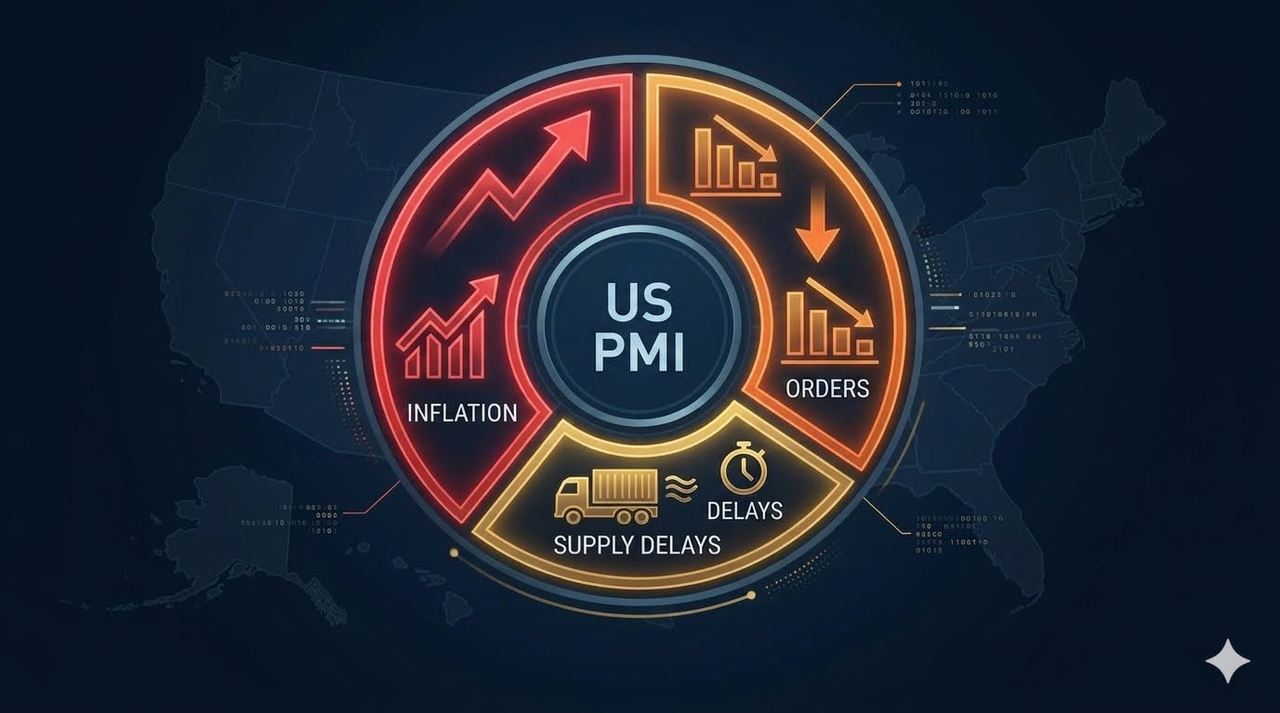
The macroeconomic landscape is shifting, and the July US Purchasing Managers' Index (PMI) data has flashed several warning signals that require immediate attention from both traditional financial markets and the digital asset sector. While headline economic indicators often present a stable facade, the underlying PMI metrics reveal a complex scenario marked by weakening demand, severe supply chain bottlenecks, and persistent inflationary pressures.
For cryptocurrency traders and investors, liquidity is the lifeblood of the cryptocurrency market. The flow of capital into Bitcoin, Layer-2 networks, and the broader decentralized finance (DeFi) ecosystem is directly tethered to fiat liquidity conditions, which are heavily influenced by the metrics detailed in these PMI reports.
This article breaks down the objective data from the July PMI release, dissecting the three critical factors—weak new orders, supply chain delays, and sticky inflation. By examining these factual data points, we can better understand their direct impact on dollar liquidity, Federal Reserve policy expectations, and the resulting valuation models for the cryptocurrency market.
Decoding the July US PMI: What Do the Numbers Actually Say?
To understand the macro headwinds currently facing global markets, we must look past the aggregate PMI score and examine the underlying sub-indices. The data points from manufacturing surveys, such as those conducted by the Institute for Supply Management (ISM) and S&P Global, provide a granular view of factory-level realities.
The Slowdown in New Orders
The New Orders Index is widely regarded as one of the most reliable leading indicators of future economic activity. In July, this metric demonstrated a clear and factual deceleration. While some segments of manufacturing maintained a baseline of expansion, the rate of growth in new business intake slowed significantly.
This slowdown is not occurring in a vacuum. Consumer pushback against elevated prices has reached the manufacturing level. Clients are increasingly hesitant to commit to large future orders when the cost of capital remains high and end-consumer demand is visibly softening. Furthermore, the data suggests that some of the earlier order volume may have been artificially inflated by front-loading—companies ordering early to avoid anticipated tariffs or future logistical headaches. This temporary stockpiling inevitably results in a subsequent vacuum in genuine new orders.
Four-Year Highs in Supply Chain Delays
Perhaps the most alarming factual development in the July data is the severe deterioration of supply chain efficiency. The Supplier Deliveries Index, where a higher reading indicates slower delivery times, registered its most significant deceleration in recent months, reaching delay levels not seen in four years.
These delays are rooted in quantifiable real-world events. Ongoing geopolitical conflicts, particularly the disruptions in the Red Sea shipping routes, have forced vessels to take longer, more expensive detours. Concurrently, manufacturers attempting to front-load raw materials ahead of potential global trade tariffs have created artificial bottlenecks at major ports. This combination restricts the availability of input materials, forcing factories to operate below maximum efficiency despite available labor.
The Persistent Threat of Sticky Inflation
Supply chain delays directly translate into higher input costs, creating a feedback loop of "sticky" inflation. The Prices Index within the PMI data remains uncomfortably elevated. Despite the aggressive monetary tightening cycle executed over the past years, inflation at the production level refuses to cool down to the central bank's target rate.
Manufacturers are facing a dual threat: the cost of raw materials is rising due to scarcity and elevated energy prices, while the cost of logistics has surged due to the aforementioned shipping reroutes. Faced with compressed profit margins, manufacturers are forced to pass these elevated costs down the line to the end consumer. This dynamic ensures that core inflation remains entrenched within the economy.
| Economic Indicator | Official July Data | Why |
| Headline PMI | Strong Expansion | Boosted artificially by delivery delays & restocking panic. |
| New Orders Index | Expanding | Driven entirely by AI/Chips; traditional demand is flat. |
| Supplier Deliveries | 4-Year High | Red Sea rerouting & tariff front-loading causing bottlenecks. |
| Prices Index | Severe Inflation | Input shortages passing directly to consumers. |
The "Stagflation" Narrative and Federal Reserve Policy
The combination of data points highlighted in the July PMI report points toward an economic environment that central bankers fear most. When demand slows down simultaneously with rising operational costs, the economy flirts with stagflation.
Why Stagflation is a Worst-Case Scenario
Stagflation is defined by the simultaneous occurrence of stagnant economic growth (evidenced by weak new orders) and high inflation (evidenced by the elevated Prices Index). Historically, this is one of the most challenging environments for risk assets, including equities and cryptocurrencies.
In a standard recession, central banks can cut interest rates and inject liquidity to stimulate growth. In a purely inflationary boom, they can raise rates to cool down an overheating economy. However, in a stagflationary environment, the central bank's tools contradict each other. Stimulating the economy worsens the inflation, while fighting inflation pushes the stagnant economy deeper into a recession. For risk assets, this typically means a prolonged period of compressed valuations as corporate earnings drop but the cost of capital remains high.
The Fed’s Dilemma: Rates Higher for Longer?
The sticky inflation revealed in the July PMI data directly complicates the Federal Reserve's policy path. Market participants who were pricing in rapid and aggressive interest rate cuts must now recalibrate their expectations based on this factual pricing pressure.
If inflation remains structurally elevated due to supply chain constraints—which monetary policy cannot fix—the Federal Reserve is forced to maintain a "higher for longer" stance on interest rates. When the risk-free rate (such as the yield on US Treasury bonds) remains elevated, it acts as a vacuum for global liquidity. Capital naturally flows away from higher-risk, volatile assets and toward guaranteed yields, directly impacting the capital available for the cryptocurrency markets.
Direct Impact on the Cryptocurrency Market
The cryptocurrency market does not operate outside the laws of global macroeconomics. The factual tightening of fiat liquidity and the looming threat of stagflation transmit directly into digital asset valuations, trading volumes, and on-chain activity.
Bitcoin (BTC)
Bitcoin's reaction to macro data releases often highlights its dual narrative. On one hand, proponents argue it is a digital store of value and an inflation hedge. On the other, empirical trading data consistently shows that Bitcoin trades heavily as a high-beta risk asset, moving in tandem with tech equities and global liquidity conditions.
In a scenario where inflation remains sticky but economic growth stalls, Bitcoin faces a structural stress test. A strong US Dollar (fueled by high interest rates) typically exerts downward pressure on BTC pricing. Institutional flows, easily tracked via ETF net inflows and outflows, often show risk-averse behavior when macroeconomic data points to prolonged restrictive monetary policy. Until there is a clear pivot toward global liquidity expansion, Bitcoin's upward price mobility faces significant macroeconomic resistance.
DeFi Ecosystem and Layer-2 Networks
The decentralized finance (DeFi) sector is arguably the most sensitive to macroeconomic interest rates. The core utility of much of DeFi revolves around yield generation. When traditional finance (TradFi) offers risk-free yields near 5% through government treasuries, the risk premium required to attract capital to DeFi smart contracts increases significantly.
-
Liquidity Contraction: High macro rates pull capital out of liquidity pools. If a user can earn a guaranteed yield in a traditional bank, the incentive to lock capital in a smart contract—bearing protocol and exploit risks—diminishes.
-
On-Chain Leverage: Weak economic outlooks generally suppress the appetite for leverage. As borrowing demand on platforms like Aave or Compound drops, the yields paid to lenders also fall, further exacerbating capital flight from the ecosystem.
-
Layer-2 TVL: Total Value Locked (TVL) across Layer-2 networks is highly dependent on active capital seeking yield and airdrop opportunities. A macro-driven liquidity crunch natively limits the amount of fresh capital bridging over to these scaling solutions.
Stablecoins
When PMI data signals economic headwinds, capital within the crypto ecosystem often rotates out of volatile altcoins and parks itself in stablecoins. This is not necessarily capital leaving the crypto ecosystem entirely, but rather shifting to a defensive posture. A rising dominance of stablecoins relative to the total crypto market cap is a factual indicator of risk-off sentiment among digital asset investors preparing for prolonged macro uncertainty.
Strategic Moves for Crypto Investors Amidst Macro Uncertainty
Navigating a market defined by weak economic growth and sticky inflation requires a shift from aggressive accumulation to capital preservation and strategic allocation. Based on the factual macro environment, traders and investors often deploy specific risk management frameworks.
Monitor the Dollar Index (DXY): The US Dollar Index remains one of the most reliable inverse indicators for cryptocurrency performance. A strengthening dollar, driven by sticky inflation and high rates, historically acts as a headwind for crypto assets. Tracking the DXY provides real-time context for crypto market movements.
Assess DeFi Yields vs. Risk-Free Rates: Before deploying capital into DeFi protocols, rationally compare the advertised APY against the current US Treasury yield. Ensure that the excess yield adequately compensates for the smart contract, de-peg, and volatility risks inherent in decentralized platforms.
Avoid High Leverage During Data Releases: The publication of major macroeconomic reports (PMI, CPI, Non-Farm Payrolls) routinely triggers severe volatility spikes. Maintaining high leverage during these windows exposes traders to erratic liquidations. De-leveraging prior to these known events is a standard risk management practice.
Focus on Fundamental Value: In an environment where capital is expensive and liquidity is tight, pure speculation loses momentum. Market capital tends to rotate toward protocols and ecosystems that generate factual, verifiable revenue and possess strong fundamental utility, rather than relying solely on token emission narratives.
Join KuCoin 9th Anniversary Trading Campaign
KuCoin is celebrating its 9th anniversary with a special platform campaign filled with exclusive rewards, trading activities, and limited-time offers. Don’t miss the chance to participate and enjoy the benefits as the exchange marks nine years of growth and innovation. Visit the official campaign page now:

Conclusion
The July US PMI data serves as a stark reminder that the macroeconomic environment remains fragile. The factual convergence of weakening new orders, severe supply chain disruptions, and sticky input costs creates a complex landscape that central banks will struggle to navigate without inflicting some degree of economic pain.
For the cryptocurrency sector, these are not distant traditional finance problems; they are immediate liquidity realities. Digital assets are deeply integrated into the global financial system, and their near-term performance will continue to be heavily dictated by these macro crosswinds. Mastering the interpretation of indicators like the PMI is now a prerequisite for advanced crypto market analysis. Until the data confirms a structural decline in inflation that allows for genuine monetary expansion, the cryptocurrency market will likely continue to face a stringent macroeconomic stress test.
FAQs
Why did the July Headline US PMI hit a 4-year high if demand is weak?
The surge is mathematically distorted. Geopolitical bottlenecks in shipping lanes significantly delayed supplier delivery times. In PMI modeling, slower deliveries are counted as a positive factor, artificially inflating the overall index score despite flattening underlying consumer demand.
How does a strong ISM New Orders Index co-exist with a weak economic outlook?
The new orders growth is highly asymmetric. It is driven almost entirely by aggressive AI infrastructure spend, microchip demand, and defensive front-loading to beat incoming tariffs. Traditional manufacturing and broader consumer goods sectors remain flat or contracting.
Why can't the Federal Reserve easily fix this specific type of inflation?
Monetary policy only regulates aggregate demand. Current inflation pressures stem from cost-push factors, including Red Sea shipping reroutes and international trade tariffs. Raising interest rates cannot clear shipping ports or lower geopolitical trade barriers.
Why does Bitcoin trade as a risk asset instead of an inflation hedge?
Empirical data shows Bitcoin correlates heavily with tech equities and fiat liquidity. When central banks maintain restrictive rates to fight inflation, institutional capital flees volatile, high-beta assets for guaranteed yields, capping Bitcoin’s near-term upward mobility.
Which core metrics should crypto investors watch most closely right now?
Prioritize the US Dollar Index (DXY) as an inverse liquidity gauge, alongside the ISM Prices Paid index. Additionally, track Bitcoin ETF net flows and on-chain stablecoin dominance to evaluate institutional risk appetite and market turning points.
Disclaimer
The information provided on this page may originate from third-party sources and does not necessarily represent the views or opinions of KuCoin. This content is intended solely for general informational purposes and should not be considered financial, investment, or professional advice. KuCoin does not guarantee the accuracy, completeness, or reliability of the information, and is not responsible for any errors, omissions, or outcomes resulting from its use. Investing in digital assets carries inherent risks. Please carefully evaluate your risk tolerance and financial situation before making any investment decisions. For further details, please consult KuCoin’s Terms of Use and Risk Disclosure.