

Michael Burry Predicts SpaceX, Anthropic & OpenAI IPOs Will Raise More Than the Entire 2000 Dot-Com Bubble: His $1B AI Short Exposed
2026/06/09 17:27:00
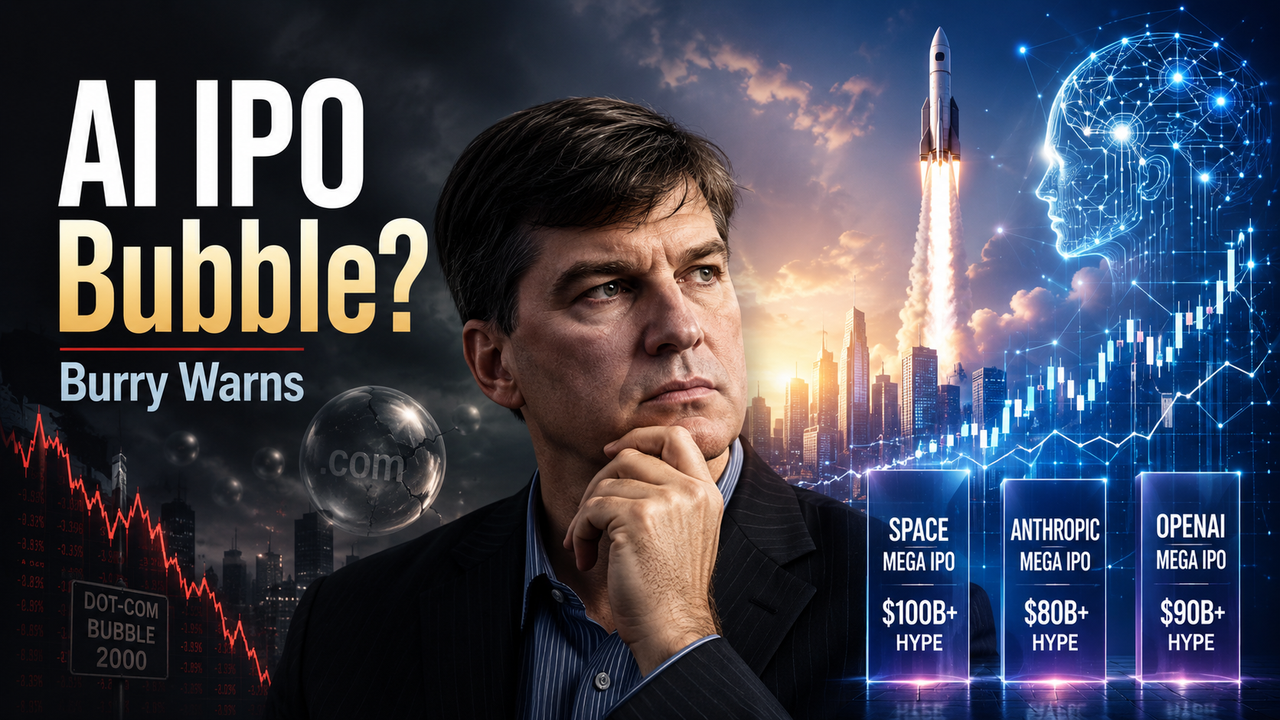
Michael Burry is once again challenging one of the strongest investment narratives in the market.
The investor made famous by The Big Short has turned his attention toward artificial intelligence, mega-cap technology valuations and the potential IPO wave involving SpaceX, Anthropic and OpenAI. His warning has attracted attention because it connects today’s AI boom with one of the most famous speculative periods in financial history: the 2000 dot-com bubble.
According to recent market coverage, Burry suggested that possible IPOs from SpaceX, Anthropic and OpenAI could raise an amount of capital comparable to, or even greater than, the money raised by hundreds of internet and technology companies during the dot-com era. The comparison is striking because it suggests that a small group of private technology giants could absorb a huge amount of public-market capital.
At the same time, Burry’s reported bearish exposure against Nvidia and Palantir has added another layer to the discussion. The phrase “$1B AI short” has become popular in headlines, but it needs context. Burry was not directly shorting SpaceX, Anthropic or OpenAI. The reported exposure was linked to put options against Nvidia and Palantir, two of the most visible public-market symbols of the artificial intelligence boom.
This makes the story bigger than one investor’s warning. It raises a broader question for markets: is the AI boom creating long-term technological value, or are investors beginning to repeat the same valuation mistakes seen during the dot-com bubble?
Michael Burry’s Dot-Com Bubble Warning: Why SpaceX, Anthropic and OpenAI IPOs Matter
Michael Burry’s warning about SpaceX, Anthropic and OpenAI has become one of the most discussed market stories because it brings together three powerful themes: artificial intelligence, mega-IPOs and investor psychology.
The comparison to the 2000 dot-com bubble does not mean Burry believes AI is fake or that these companies have no value. OpenAI has become one of the most influential names in generative AI through ChatGPT. Anthropic has built strong momentum with Claude and enterprise AI tools. SpaceX has become a major force in rockets, satellite internet and space infrastructure.
The concern is not whether these companies matter. They clearly do. The concern is whether public investors may be asked to buy into them at valuations that already assume years of strong future growth.
-
Why Burry Is Comparing AI IPOs to the 2000 Dot-Com Bubble
The dot-com bubble was not built only on weak companies. It was also built around a real technological revolution that investors priced too aggressively.
The internet truly changed the world. E-commerce, search, online advertising, cloud computing and digital media became central parts of the modern economy. But during the late 1990s and early 2000s, many internet companies went public before they had strong revenue models, stable profits or clear long-term business plans.
The same risk can appear during the AI boom. Artificial intelligence is real, useful and already changing how people work. But investors can still overpay for AI-related companies if they assume future success is guaranteed.
That is why Burry’s comparison matters. His warning is focused on valuation discipline. In simple terms, a company can be innovative and still become a risky investment if the entry price is too high.
A few concerns stand out:
-
AI IPO hype may push valuations beyond fundamentals.
-
Public investors may buy after private investors have already captured major upside.
-
Mega-IPOs could pull capital away from other technology stocks.
This is the core of Burry’s dot-com bubble warning. He is not saying every AI company will fail. He is warning that investors should be careful when excitement becomes stronger than financial analysis.
-
Why SpaceX, Anthropic and OpenAI IPOs Could Reshape Public Markets
A potential IPO wave from SpaceX, Anthropic and OpenAI would not be ordinary. These are some of the most closely watched private technology companies in the world.
OpenAI represents the generative AI boom. Its products have changed how consumers, developers and businesses interact with artificial intelligence. Anthropic represents a major competing force in advanced AI model development, especially through Claude and enterprise-focused AI use cases. SpaceX represents a different but equally powerful story: reusable rockets, Starlink satellite internet, defense-related infrastructure and the commercialization of space.
If these companies go public around the same period, they could become a major test for public-market liquidity. Large institutional investors may need to decide how much capital to allocate. Retail investors may also be attracted by brand recognition and fear of missing out.
This could create a major market moment. Investors would not only be buying shares in individual companies. They would be buying into the broader future of AI, space infrastructure and next-generation technology.
The problem is that famous names can create emotional demand. Investors may focus more on the story than the price. That is exactly how bubbles often form.
-
Why IPO Valuation Matters More Than Company Popularity
One of the biggest mistakes investors make is confusing a great company with a great investment.
A company can have strong products, famous leadership, high customer demand and long-term potential. But if the valuation is too high, future returns may still disappoint. This is especially true for IPOs, where public investors often enter after private valuations have already increased significantly.
For SpaceX, Anthropic and OpenAI, valuation will be the central issue. Public investors will need to ask whether these companies can grow into their expected prices. They will also need to examine revenue, margins, capital spending, competition and long-term profitability.
The key question is simple: are these IPOs giving public investors early access to future winners, or are they transferring late-stage private-market risk to public buyers?
That question is why Burry’s warning has gained attention. It reminds investors that even exciting companies need to be evaluated with discipline.
The $1B AI Short Explained: What Burry’s Nvidia and Palantir Bets Reveal About Market Risk
Michael Burry’s reported “$1B AI short” has become a major part of the wider debate around artificial intelligence stocks and market risk. The phrase sounds dramatic, but it needs context.
Burry’s bearish exposure was reportedly tied to put options against Nvidia and Palantir. These two companies became public-market symbols of the AI boom. Nvidia represents AI infrastructure through GPUs and data-center demand. Palantir represents enterprise AI software, government contracts and commercial AI adoption.
By taking bearish exposure against these names, Burry appeared to be questioning whether AI-linked stocks had become too expensive. This does not mean he believes artificial intelligence has no future. It means he may believe the market has already priced in too much optimism.
-
What the “$1B AI Short” Really Means
The reported $1B AI short does not necessarily mean Burry spent $1 billion in cash. The figure mainly refers to the notional value of put-option exposure.
A put option gives an investor the right to benefit if a stock declines below a certain level, depending on the contract terms. Public filings may show the value of shares connected to the options, but they do not always show the exact premium paid, strike price, expiration date or complete trading strategy.
That distinction is important. A headline number can sound much larger than the actual cash used in the trade.
The main takeaway is that Burry’s position was a bearish signal on AI market valuations. It was not a direct billion-dollar cash short against the entire AI industry.
A few points help clarify the story:
-
The reported exposure was tied to Nvidia and Palantir.
-
It was not a direct short against OpenAI, Anthropic or SpaceX.
-
The $1B figure refers to exposure, not necessarily cash spent.
This makes the trade important, but it should not be misunderstood. Burry was not saying AI is worthless. He was warning that AI stocks may have become too crowded and expensive.
-
Why Nvidia and Palantir Became Symbols of the AI Boom
Nvidia and Palantir became natural targets for AI market analysis because both are closely linked to the artificial intelligence narrative.
Nvidia is the backbone of AI infrastructure. Its chips are widely used for training and running large AI models. As demand for AI data centers increased, Nvidia became one of the biggest winners of the AI investment cycle.
Palantir represents the software side of the AI trade. Its AI platform attracted attention from investors looking for companies that could turn artificial intelligence into practical tools for governments and corporations.
Both companies have real businesses. But that does not remove valuation risk. When a stock becomes the symbol of a major theme, investors can push prices higher than fundamentals justify.
For Burry, Nvidia and Palantir likely represented two sides of the same AI trade:
-
Nvidia: AI chips, GPUs and data-center infrastructure.
-
Palantir: AI software, enterprise adoption and government demand.
-
Both stocks: strong momentum, high expectations and valuation sensitivity.
This is why his bearish exposure attracted so much attention. It suggested that one of Wall Street’s most famous contrarian investors believed the AI trade may have become too crowded.
-
What Burry’s AI Short Reveals About Market Risk
Burry’s Nvidia and Palantir bets reveal a broader concern: the market may be pricing AI winners as if growth will continue without interruption.
That is a dangerous assumption in any sector. Even strong companies can fall sharply if expectations become too high. AI investors face several risks, including slower revenue growth, rising infrastructure costs, stronger competition, regulatory pressure and reduced investor appetite for expensive growth stocks.
This matters even more as private AI companies such as OpenAI and Anthropic move closer to public markets. If public AI stocks are already trading at aggressive valuations, mega-IPOs could increase pressure by adding even more high-priced AI exposure for investors to absorb.
Burry’s warning is not a guarantee that Nvidia, Palantir or AI IPOs will crash. It is a reminder that momentum can reverse when valuation, earnings and investor psychology move out of balance.
For investors, the lesson is clear: AI may remain one of the most important technology trends of this cycle, but that does not remove market risk.
AI Mega-IPOs and Investor Psychology: Is the Market Repeating the 2000 Tech Bubble?
The coming wave of AI mega-IPOs has raised a serious question: is the market entering a new phase of innovation-driven growth, or is it repeating parts of the 2000 tech bubble?
Burry’s warning matters because it focuses not only on company fundamentals, but also on investor psychology. During major technology cycles, markets often move beyond normal valuation logic. Investors become excited by a powerful story, capital flows quickly into the same theme, and private companies rush toward public listings while demand remains strong.
This pattern appeared during the dot-com bubble. Some analysts now see similar behavior in the artificial intelligence boom.
AI is not just hype. The technology is already changing software, cloud computing, enterprise tools, search, automation and digital infrastructure. However, history shows that real innovation can still create financial bubbles when investors pay too much too early.
-
Why AI Mega-IPOs Could Test Investor Discipline
AI mega-IPOs from companies such as OpenAI, Anthropic and SpaceX could become a major test of public-market discipline.
These companies are not ordinary listings. They carry huge brand recognition and strong investor attention. Their stories are connected to some of the most powerful themes in markets: artificial intelligence, space infrastructure, automation, satellites and the future of technology.
That kind of attention can create intense demand before investors fully examine valuation, profitability and long-term risk.
In a normal IPO market, investors study revenue, margins, growth rate, competitive position and cash flow. But during hype-driven cycles, famous names can attract buyers mainly because investors fear missing the next major technology winner.
This creates several risks:
-
Investors may buy the story before checking the numbers.
-
IPO prices may already include years of expected growth.
-
Short-term demand may create volatility after listing.
The danger is not that OpenAI, Anthropic or SpaceX lack real value. The danger is that public investors may be asked to pay prices that assume very optimistic futures.
-
How Investor Psychology Can Turn Innovation Into a Bubble
Technology bubbles usually begin with a real idea.
The internet was real in 2000. Artificial intelligence is real today. The problem starts when investor psychology turns a real trend into an unstoppable narrative.
When markets become too confident, investors often stop asking basic questions. They focus on total addressable market, future disruption and brand power, while ignoring valuation risk, competition and execution challenges.
The 2000 tech bubble showed how this can happen. Many internet companies went public with exciting stories, but weak revenue models and uncertain profitability. Investors believed the internet would change everything, and they were right about the technology. But many were wrong about which companies would survive and what prices made sense.
AI investors face a similar challenge now. The industry may continue growing for years, but not every AI company will become a durable winner. Competition is increasing, infrastructure costs are high, and profitability may take longer than expected.
That is why Burry’s warning is important. It reminds investors that a powerful trend does not remove the need for valuation discipline.
A simple rule applies: a great technology can still become a risky investment if the entry price is too high.
-
Is the Market Really Repeating the 2000 Tech Bubble?
The current AI market is not an exact copy of the 2000 dot-com bubble.
Many leading AI companies are more advanced, better funded and more commercially relevant than many internet startups of that era. Nvidia, Microsoft, Google, Amazon, OpenAI, Anthropic and other major AI players are connected to real products, real infrastructure and real enterprise demand.
However, some warning signs are similar.
Investor enthusiasm is extremely high. Private-market valuations have risen quickly. AI infrastructure spending is massive. Public-market winners have attracted crowded trades. And now, some of the most famous private technology companies may be moving toward IPOs at very large valuations.
This does not prove that a crash is coming. But it does suggest that investors should become more selective.
For investors watching the AI IPO market, the key questions are:
-
Can these companies turn rapid growth into sustainable profits?
-
Are valuations based on realistic business results or future hype?
-
Will public investors benefit, or are they buying after most private-market upside has already happened?
The market may not be repeating 2000 exactly, but it may be repeating one important lesson: innovation alone is not enough. Price, timing, profitability and investor behavior still matter.
Conclusion
Michael Burry’s warning about SpaceX, Anthropic and OpenAI is less about rejecting innovation and more about questioning valuation discipline. AI and space technology may continue to reshape the market, but mega-IPOs at extreme prices could test investor patience and liquidity. His reported Nvidia and Palantir bets add to the concern that AI enthusiasm may be running ahead of fundamentals. The main lesson is simple: powerful technology can create real growth, but investors still need to respect price, risk and market psychology.
FAQs
What did Michael Burry say about SpaceX, Anthropic and OpenAI IPOs?
Michael Burry warned that potential IPOs from SpaceX, Anthropic and OpenAI could raise an amount of capital comparable to, or even greater than, the major internet and technology IPO wave during the 2000 dot-com bubble. His point was not that these companies are worthless, but that public-market investors may be facing extremely high valuations during a powerful AI and technology hype cycle.
Why is Michael Burry comparing AI IPOs to the dot-com bubble?
Burry’s comparison is mainly about investor behavior. During the dot-com bubble, many internet companies attracted huge capital because investors believed the internet would change the world. That belief was correct, but many valuations became too aggressive. Burry appears to see a similar risk today, where AI and technology companies may be priced as if future success is already guaranteed.
Is OpenAI going public?
OpenAI has reportedly filed confidential paperwork for a U.S. IPO, but the company has not confirmed a final listing date, valuation or offering size. A confidential filing is an important step toward going public, but it does not guarantee that the IPO will happen immediately.
Is Anthropic also planning an IPO?
Yes, recent reports say Anthropic has also moved toward public markets. This is important because Anthropic is one of OpenAI’s biggest AI competitors through its Claude models. If both companies go public around the same period, it could become one of the biggest AI IPO moments in the market.
Is SpaceX planning an IPO?
SpaceX IPO speculation has increased, but investors should be careful because timing, valuation and final IPO details can change. SpaceX is closely watched because of Starlink, reusable rockets, satellite internet, defense-related space infrastructure and its connection to Elon Musk. A SpaceX IPO would likely attract strong investor attention if it happens.
What is Michael Burry’s $1B AI short?
The “$1B AI short” refers to Burry’s reported put-option exposure against Nvidia and Palantir. It does not mean he directly shorted OpenAI, Anthropic or SpaceX. It also does not necessarily mean he spent $1 billion in cash. The figure mainly refers to the notional value of the underlying exposure connected to those options.
Why did Burry target Nvidia and Palantir?
Nvidia and Palantir became two major public-market symbols of the AI boom. Nvidia represents AI chips, GPUs and data-center infrastructure, while Palantir represents enterprise AI software and government/commercial AI adoption. Burry’s bearish exposure suggests concern that AI-related stocks may have become too expensive after strong market rallies.
Does Burry think AI is a bubble?
Burry’s warning does not necessarily mean he believes AI technology is fake. The concern is more about valuation. AI may be a real and powerful technology, but investors can still overpay for AI stocks and AI IPOs. His warning is that market excitement may be running ahead of fundamentals, profits and realistic growth expectations.
Could SpaceX, Anthropic and OpenAI IPOs crash the stock market?
There is no guarantee that these IPOs would crash the market. However, mega-IPOs can absorb a large amount of investor capital and create volatility, especially if valuations are very high. The bigger risk is that public investors may buy into famous companies at prices that already reflect years of expected growth.
What should investors learn from Michael Burry’s warning?
The main lesson is that innovation and valuation are different things. OpenAI, Anthropic and SpaceX may be important companies, and AI may continue to grow as a major technology trend. But investors still need to examine revenue, profitability, cash flow, competition, capital spending and IPO pricing before assuming these companies will deliver strong returns.
Disclaimer
The information provided on this page may originate from third-party sources and does not necessarily represent the views or opinions of KuCoin. This content is intended solely for general informational purposes and should not be considered financial, investment, or professional advice. KuCoin does not guarantee the accuracy, completeness, or reliability of the information, and is not responsible for any errors, omissions, or outcomes resulting from its use. Investing in digital assets carries inherent risks. Please carefully evaluate your risk tolerance and financial situation before making any investment decisions. For further details, please consult KuCoin’s Terms of Use and Risk Disclosure.