

“No Bailouts for Crypto” – Why Fed's Latest Stance Is a Wake-Up Call for Stablecoin Holders
Introduction: The Day the Safety Net Disappeared
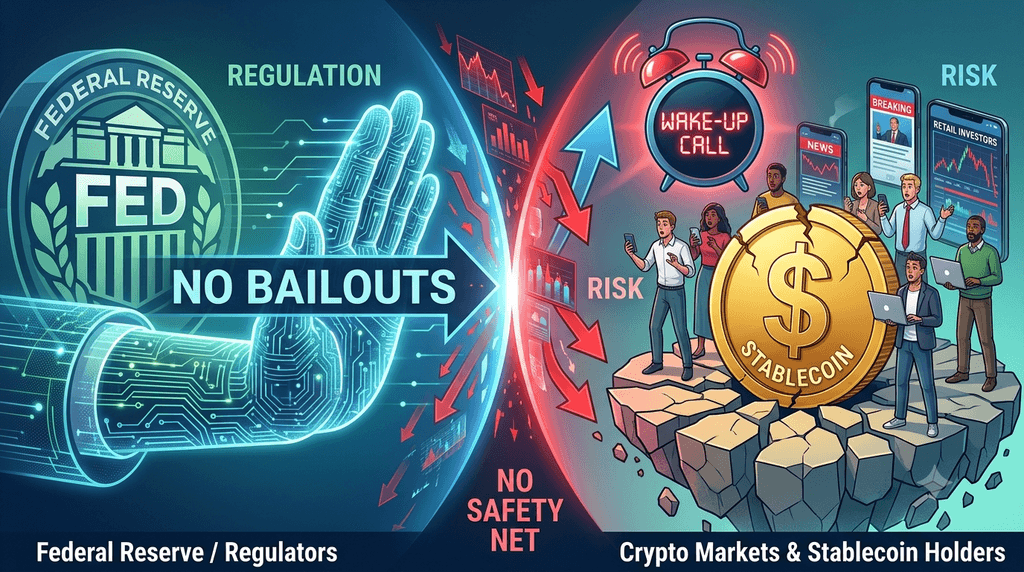
On July 14, 2026, the atmosphere inside the House Financial Services Committee hearing room turned icy. Despite recovering crypto prices, newly confirmed Federal Reserve Chair Kevin Warsh delivered a stark warning to the Web3 ecosystem. When grilled by Representative Brad Sherman on whether the central bank would deploy emergency lending tools to rescue a collapsing stablecoin ecosystem, Warsh drew a definitive line in the sand: “We want to be in a position where we're not bailing out anybody, including crypto.” For years, market participants operated under the assumption that the Fed would step in to prevent a systemic digital asset collapse. Warsh shattered that illusion. This is not mere regulatory posturing; it is a fundamental shift in macroeconomic policy. For anyone holding pegged digital assets, the central bank's refusal to act as a lender of last resort means the era of subsidized risk is officially over.
1. Who is Kevin Warsh, and Why Do His "Scars" Matter?
To understand the gravity of this statement, investors must understand the man delivering it. Kevin Warsh is not a typical career bureaucrat; he is a crisis-tested policymaker. As the youngest Federal Reserve Governor during the 2008 Great Financial Crisis (GFC), Warsh was on the front lines of the Wall Street collapses, orchestrating the controversial bailouts of legacy banking institutions like Bear Stearns and AIG.
During the hearing, Warsh remarked, “I still have the scars from the 2008 financial crisis... We do not want to be in the bailout business. Full stop.” This perspective shapes his entire approach as Fed Chair. Having witnessed how emergency liquidity injections distort free markets and anger the public, Warsh is fiercely opposed to extending those same privileges to unregulated, decentralized, or private digital currencies. His philosophy dictates that if an industry chooses to operate outside the traditional banking perimeter, it must also accept the consequences of its own systemic failures.
Warsh's appointment in May 2026 was largely seen as a return to "monetary discipline." Unlike his predecessors, who occasionally flirted with the idea of integrating decentralized finance into the central bank's liquidity network under the guise of financial innovation, Warsh sees a clear line between public sovereign money and private digital tokens. His "scars" represent a deep-seated institutional distrust of financial engineering that promises high yields without a structural foundation. For the crypto industry, having an inflation hawk and a crisis veteran at the helm of the Fed means that the window for regulatory leniency has closed.
2. The Great Illusion: Why Crypto Thought the Fed Had Its Back
For years, the crypto industry suffered from a collective delusion of implicit government backing. When the Fed rescued money market funds in 2008, and intervened during the Silicon Valley Bank and Signature Bank failures in 2023, it set a dangerous precedent. Market participants assumed that if a stablecoin grew "too big to fail"—threatening the broader U.S. financial system—the Fed would inevitably deploy emergency liquidity facilities (such as the Discount Window or the Bank Term Funding Program) to halt a systemic contagion.
Rep. Brad Sherman’s aggressive questioning exposed this exact vulnerability. By asking point-blank if public funds would backstop a stablecoin run, he forced Warsh to address the industry's moral hazard. In economics, moral hazard occurs when an entity takes on excessive risk because it believes someone else will bear the cost of failure.
For nearly a decade, stablecoin issuers enjoyed the profits of high-yield Treasury investments while pushing the systemic risk of a "run" onto their users, secretly hoping the Fed would step in as a backstop. By publicly ruling out a rescue package, the Fed has intentionally injected fear back into the market, forcing issuers and investors to realize that no federal printer will rescue them from a bad smart contract, a black swan de-pegging event, or a run on reserves. This policy separation between sovereign fiat and private digital dollars is crucial for the long-term stability of the U.S. financial system, even if it introduces short-term volatility to the crypto markets.
3. The GENIUS Act: The Looming Regulatory July Deadline
Warsh’s hardline stance coincides with a massive legislative milestone. The Federal Reserve is working around the clock to finalize comprehensive stablecoin frameworks before the July 18, 2026 deadline mandated by the GENIUS Act, which passed exactly one year ago.
The GENIUS Act represents the first comprehensive federal effort to bring stablecoins into the formal regulatory perimeter. The upcoming framework will establish legally binding rules for "payment stablecoins" operating within the United States. The rules focus heavily on three pillars: strict 1:1 reserve backing with ultra-safe assets, rigorous licensing for issuers, and the complete segregation of customer funds. Under this new regime, the stablecoin landscape will be starkly divided by risk profiles, as shown in the table below.
| Stablecoin Type | Pre-GENIUS Act Status | Post-July 2026 Fed Standard | Risk of "De-pegging" |
| Fiat-Backed (USDT/USDC) | Voluntarily audited, diverse reserves | Audited daily, strict Federal oversight | Low to Medium |
| Crypto-Collateralized (DAI) | Over-collateralized by on-chain assets | Excluded from official payment classification | Medium to High |
| Algorithmic Stablecoins | Unbacked, rely on market arbitrage | Deemed highly speculative; Zero legal protection | Extremely High |
The implementation of these standards will effectively create a dual-class system in the crypto ecosystem. "Class A" stablecoins will be highly regulated, fully compliant, and closely monitored by the Federal Reserve. They will be safe, but their yields will be practically identical to short-term Treasury bills, offering little appeal to yield-seeking DeFi participants. "Class B" and unclassified stablecoins will be pushed to the fringes of the global financial system, operating with higher risk, higher yields, and a total lack of regulatory validation. By creating this clear boundary, the Fed is making it easy for institutional allocators to choose compliance while ensuring that those who choose high-risk alternatives do so at their own peril.
4. The Transatlantic Playbook: Bankruptcy vs. Bailout
The Fed is not acting alone. The U.S.-U.K. Transatlantic Working Group recently released a joint roadmap for digital assets that formalizes the transition from "Bailouts" to orderly "Bail-ins" and structured bankruptcies. This international regulatory alignment is designed to prevent jurisdictional arbitrage, ensuring that crypto firms cannot simply flee to London or New York to escape strict risk-management obligations.
Instead of printing money to prop up a failing issuer, regulators are building a legal framework that dictates exactly what happens during an insolvency event. The core focus of this roadmap is establishing a clear priority claim for stablecoin holders. If a regulated issuer goes bankrupt, the law will dictate that the underlying reserve assets (such as U.S. Treasury bills) belong exclusively to the token holders, bypassing corporate creditors, marketing partners, and venture capital backers.
This legal shift is a massive departure from traditional corporate bankruptcy proceedings. In a standard corporate bankruptcy, retail customers are often treated as unsecured creditors, sitting at the very bottom of the priority ladder while banks and institutional bondholders are paid out first. The new transatlantic framework flips this hierarchy. By establishing that stablecoin reserves are held in segregated, bankruptcy-remote trusts, the government is telling investors: "We will not bail you out with central bank funds, but we will ensure that the remaining collateral is legally protected and returned to you as quickly as possible."
5. The Ripple Effect: How This Impacts Different Crypto Profiles
The elimination of the implicit Fed backstop changes the risk calculus for every participant in the Web3 ecosystem, from high-frequency DeFi traders to long-term institutional allocators.
DeFi Yield Farmers and Liquidity Providers
For years, decentralized finance (DeFi) protocols treated stablecoins as risk-free baseline assets. Liquidity pools on platforms like Curve or Uniswap paired various stablecoins under the assumption that a "peg is a peg." The elimination of a systemic safety net means that yield rates must now accurately reflect underlying smart contract and liquidity risks. DeFi protocols can no longer rely on the assumption that stable asset pegs are guaranteed by macroeconomic interventions. Yield farmers must demand higher premiums for holding non-compliant or algorithmic stablecoins, leading to a natural fragmentation of liquidity.
Retail Stablecoin Holders
For the average retail user, the burden of due diligence now rests entirely on their own shoulders. Holding a stablecoin is no longer equivalent to holding physical cash in a commercial bank account. Retail users can no longer afford to be passive. They must actively monitor issuer transparency, jurisdiction, and audit frequency. If an offshore stablecoin issuer fails due to bad asset management, the retail investor has zero recourse, zero insurance, and zero chance of a government-backed recovery.
Institutional Allocators and Web3 Founders
Large-scale capital and treasury management teams will inevitably migrate toward heavily regulated, domestic "payment stablecoins" that comply fully with the GENIUS Act framework. Offshore, unaligned, or algorithmic alternatives will likely face severe liquidity stagnation as institutions refuse to touch assets lacking clear legal structures. Web3 founders will have to restructure their treasuries, prioritizing regulatory compliance over marginal yield increases to reassure their investors that their operating capital is secure.
6. Actionable Guide: How to Stress-Test Your Stablecoin Portfolio
Navigating this new "no-safety-net" environment requires an active approach to capital preservation. Investors must treat their stablecoin holdings with the same level of scrutiny as high-yield corporate bonds.
Step 1: Auditing the Audit Reports
Stop relying on simple marketing claims or vague "attestations." Look for monthly or daily attestation reports verified by reputable, independent, tier-one accounting firms. Ensure the reserves consist almost entirely of "Cash and Cash Equivalents" or short-term U.S. Treasuries with maturities under 90 days. Avoid issuers holding significant percentages of commercial paper, corporate bonds, or illiquid digital assets. If an issuer is hiding their reserve breakdown behind proprietary corporate structures, treat it as an immediate red flag.
Step 2: Diversification Across Jurisdictions
Do not pool all your liquidity into a single asset, issuer, or jurisdiction. Balance your portfolio by holding stablecoins regulated under the U.S. framework alongside assets compliant with European MiCA (Markets in Crypto-Assets) regulations or Asian jurisdictions like Singapore and Japan. This protects your capital from localized regulatory crackdowns, sudden tax changes, or isolated regional infrastructure failures. A truly resilient portfolio utilizes multiple compliant issuers across independent legal frameworks.
Step 3: Self-Custody vs. Exchange Custody
If an exchange collapses during a broader stablecoin run, the Fed will not intervene to rescue either entity. Utilize non-custodial hardware wallets for assets not actively engaged in trading or immediate operational deployment. By holding your own private keys, you ensure that even if the issuer of your stablecoin undergoes a structured bankruptcy, you maintain direct, unmediated legal ownership of your digital tokens.
Conclusion: The End of Crypto's Infancy
Kevin Warsh’s refusal to bail out the digital asset sector marks the official end of crypto’s infancy. For years, the industry operated under the assumption that it could enjoy the massive upside of decentralization while secretly relying on the safety nets of traditional finance. By removing the possibility of a federal rescue, the Federal Reserve has challenged the ecosystem to mature. True financial independence requires operating without institutional crutches. The upcoming GENIUS Act rules will provide the legal guidelines for compliant operation, but survival depends entirely on risk management, transparency, and fiscal discipline. In this new era, the market will reward robust structures and ruthlessly eliminate the fragile. Capital preservation is now entirely in your hands. (132 words)
🔍 FAQs:
What is the difference between a Fed "bailout" and bank deposit insurance (FDIC)?
FDIC insurance is a pre-funded government program that automatically protects retail bank depositors up to $250,000 if an insured commercial bank fails. It is funded by premiums paid by the banks themselves. A Fed bailout, by contrast, is an emergency, discretionary injection of public funds or central bank liquidity designed to rescue an entire institution or market segment from systemic collapse to prevent economic contagion. Stablecoins do not possess FDIC insurance.
Will the Fed's stance cause USDC or USDT to de-peg immediately?
No. The Fed's announcement is a statement of policy regarding future crisis management, not an attack on current operations. Well-collateralized stablecoins backed 1:1 by transparent, liquid reserves like short-term U.S. Treasuries face no immediate threat from this stance. It simply means that if an issuer mismanages its funds and goes bankrupt, the Fed will not step in to cover the deficit.
How does the GENIUS Act affect non-US stablecoin issuers?
Non-U.S. issuers who wish to maintain access to U.S. exchanges, institutional liquidity, or U.S.-based retail users must meet the strict transparency and reserve standards enforced by the Fed. Failure to comply will result in geofencing, restricted access to U.S. dollar banking rails, and potential blacklisting by domestic financial entities.
Can the Fed physically "stop" or "ban" algorithmic stablecoins?
The Federal Reserve cannot alter decentralized blockchain code or stop peer-to-peer smart contracts directly. However, through the GENIUS Act framework, the Fed can prohibit regulated banks and compliant exchanges from providing fiat on-and-off ramps for unbacked or algorithmic stablecoins, effectively isolating them from the traditional financial system.
Disclaimer: This content is for informational purposes only and does not constitute investment advice. Cryptocurrency investments carry risk. Please do your own research (DYOR).