

CBR Rate Decision on July 24: Will the Regulator Extend the Pause or Return to Tightening?
2026/07/17 16:01:00
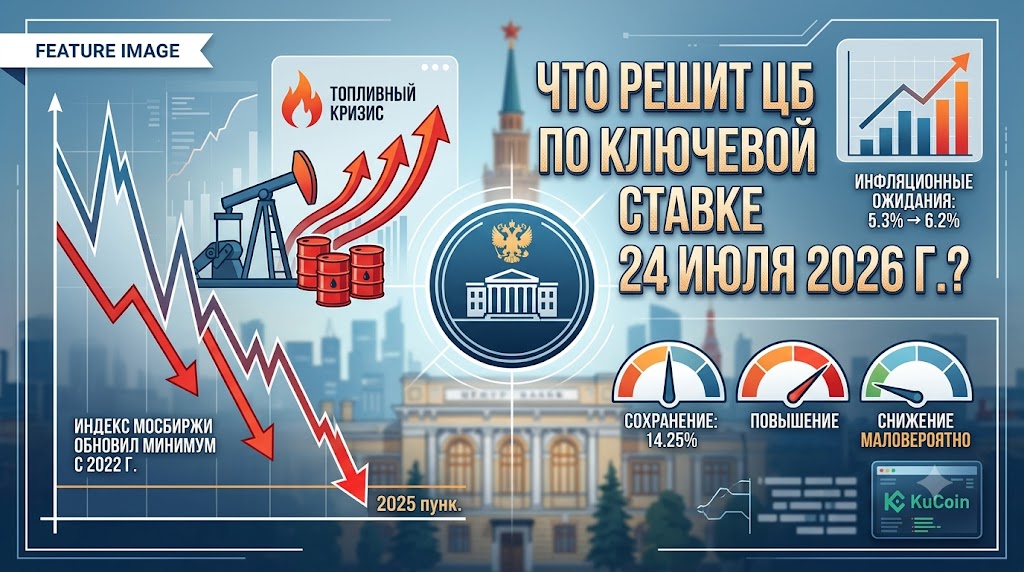
In July 2026, the MOEX index hit its lowest level since October 2022, dropping below 2,025 points, while year-end inflation expectations rose from 5.3% to 6.2%. That signals the market is pricing in not a rate cut, but a hold — or even a hike. According to the consensus forecast of most surveyed analysts, on July 24, 2026, the Bank of Russia will most likely keep the key rate at 14.25% per annum, though a hike driven by the fuel crisis and accelerating price growth has not been ruled out. Below is a breakdown of the factors shaping the rate decision, what it means for the stock market, and how traders might respond to this period of uncertainty.
What Will the CBR Decide on the Key Rate on July 24, 2026?
The base case among most economists is holding the rate at its current level of 14.25% while tightening the tone of communication. According to SberCIB, its base scenario does not anticipate a July rate cut: the regulator will most likely keep the rate unchanged and send a neutral-to-hawkish signal. The main drivers are accelerating inflation, rapid money supply growth, and a geopolitical escalation that could stoke global inflation.
Some analysts have not ruled out a hike. According to economists interviewed by Life.ru, just a few months ago most expected the central bank to steadily cut rates at every meeting, but by July that consensus shifted: the regulator will most likely keep the rate at 14.25%, though a hike will also be on the table given the lack of clarity on how the fuel crisis will play out.
July 24 is a "pivotal meeting" — meaning the rate decision will be accompanied by an updated medium-term forecast covering inflation, economic growth, and the rate trajectory for 2026–2028. That forecast, rather than the rate figure alone, is usually what moves the market most.
How the CBR Rate Moved Ahead of the July Meeting
The regulator's path to the current rate level hasn't been a straight line. At its June 19, 2026 meeting, the Bank of Russia cut the key rate by 25 basis points to 14.25% per annum, continuing the easing cycle it had begun earlier in the year. Yet at the April pivotal meeting, the regulator had already raised its forecast for the average key rate in 2026 and 2027, and by July the tone from both the CBR and surveyed analysts had noticeably hardened.
As recently as early 2026, the market was pricing in far more aggressive easing — a rate cut at nearly every meeting. Market participants now acknowledge that scenario is unlikely, and some analysts openly float the idea of a hike at some point before year-end if the fuel crisis and inflation expectations keep worsening.
Why Have Inflation Expectations Among Households and Businesses Risen?
The key driver is the fuel crisis, which has accelerated price growth across the economy. According to Bank of Russia data, participants in the central bank's July macroeconomic survey raised their year-end inflation forecast from 5.3% to 6.2%. Annual inflation, per Rosstat data, stood at around 6% as of early July, with prices up 4.17% since the start of the year.
Fuel prices have jumped sharply and almost everywhere. Gasoline price changes were recorded in 82 regions of Russia, and in just the last week of June alone, gasoline prices rose 1.6% and diesel 2.2%, with prices at some filling stations already exceeding 100 rubles per liter.
The issue isn't just fuel's direct contribution to the price index but also indirect effects. Andrei Gangan, director of the Bank of Russia's monetary policy department, explained that gasoline and diesel are a significant component of logistics costs, and that cost gradually feeds through into the prices of other goods — with the extent depending on the inflation expectations of businesses and households.
What Rosstat Data Shows About the Pace of Price Growth
Month-over-month figures show a clear acceleration. Monthly inflation stood at 0.14% in April 2026 and 0.17% in May, before accelerating markedly in June, when prices rose 0.85% for the month. In just the week of June 23–29 alone, prices rose 0.22%, with increases seen not only in fuel but also in a range of socially significant goods.
The Bank of Russia still attributes most of this acceleration to temporary factors rather than sustained demand-side pressure. Even so, the regulator's own analysts warn explicitly that rising fuel costs could affect both inflation expectations and the future trajectory of prices if the trend isn't reined in quickly.
How Is the Fuel Crisis Shaping the Regulator's Decision?
The fuel shock is directly reducing the odds of monetary easing in July. Deputy Governor Alexei Zabotkin effectively tied the rate decision to the fuel market in mid-July, stating that the regulator has no right to turn a blind eye to fuel prices and inflation expectations. According to him, the country hasn't seen this scale of a monthly price jump since late 2024 — setting aside the January spike driven by a VAT increase.
The Bank of Russia still regards the fuel shock as a temporary factor. Governor Elvira Nabiullina has stressed that it's important to prevent secondary effects working through inflation expectations, noting that June surveys of households had not yet shown a clear reaction to rising pump prices — though that could turn out to be temporary.
That's why many analysts are talking not about a return to cuts, but about a pause. One expert interviewed by NGS.ru noted that against this backdrop, a pause in the rate-cutting cycle looks more likely, since the regulator needs to understand how quickly the fuel market normalizes and whether inflation expectations among households and businesses will keep climbing.
How Long Could the Fuel Crisis Last?
The scope of the problem has already spread beyond individual regions. Gasoline price changes were recorded in 82 regions of Russia, and some filling stations have temporarily stopped selling fuel at night — a sign of a supply shortfall, not just rising costs. Authorities in individual regions, including Krasnodar Krai, have already discussed specific measures to respond to the crisis.
The Bank of Russia is working on the assumption that measures being taken by the government will be enough to normalize the fuel market. The regulator believes that, with well-calibrated monetary policy, a return to the 4% inflation target by 2027 remains achievable — but the speed of fuel-market normalization will be one of the key arguments in the July 24 rate discussion.
What Will Happen to the MOEX Index If the Rate Stays High?
The MOEX index has already reacted to expectations of a pause or tightening by falling to multi-year lows. According to Kommersant, the index dropped to its lowest level since December 2022, briefly falling below 2,100 points, while Vedomosti reported it fell below the 2,025-point mark for the first time since October 2022. One session saw the sharpest single-day drop since September 2022 — down 4.24%.
The market logic is straightforward: a high rate makes deposits and federal bonds (OFZ) a more attractive and reliable alternative to stocks, pulling capital away from equities. PSB analyst Evgeny Loktyukhov had already forecast back in late June that the MOEX index would fall further toward 2,200 points; by mid-July, the index was trading well below that mark.
Additional pressure on stocks is coming from falling oil prices — Brent crude futures traded below $85 per barrel — geopolitical risks, and dividend cutoffs at a number of companies, which temporarily depress those stocks.
Is There a Chance of a Rebound Before Year-End?
Long-term forecasts diverge far more sharply than short-term ones. Based on the consensus forecast of dozens of surveyed analysts, over a 12-month horizon the MOEX index could rise by tens of percentage points from current levels, with the main driver cited as the regulator's expected gradual shift toward cutting the key rate to 12–13% by year-end. Foreign quantitative models, by contrast, are far more pessimistic and factor in a further decline in the index amid sanctions and recession risks.
That spread in forecasts underscores the point: the direction of the MOEX index over the coming months will be shaped less by the single July 24 decision and more by how quickly the fuel market normalizes and the rise in inflation expectations is contained.
Below is a comparison of three rate scenarios and their likely impact on the stock market.
| July 24 Scenario | Probability per Analyst Estimates | Impact on MOEX Index |
| Rate held at 14.25% | Base case for most analysts | Pressure persists, no sharp rebound expected |
| Rate hike | Considered one of the possible options | Additional short-term pressure on stocks |
| Rate cut | Least likely scenario for July | Possible rebound, but requires sustained disinflation |
What Rate Scenarios Are Analysts Weighing for the Rest of 2026?
The consensus forecast for the average key rate in 2026 has worsened and shifted toward higher values. According to Interfax, macroeconomists' consensus forecast for the average key rate in 2026 rose from 14.1% to 14.5%, while the inflation forecast rose from 5.3% to 6.2%.
In the Bank of Russia's own April base case, the average key rate for 2026 was set in a range of 14–14.5%, for 2027 at 8–10%, and for 2028 at 7.5–8.5%. Some experts believe the rate could fall to near 13% by the end of 2026 in the absence of new shocks, while a level around 11% currently looks less likely — a scenario that would require the regulator to see a sustained decline in inflation risks and greater clarity on the budget and price dynamics.
Expectations for the 2027 rate have also shifted upward — from 10.6% to 12.2% according to the consensus forecast of surveyed analysts. At the same time, the average maximum deposit rate at Russia's top 10 banks also rose, climbing from 12.76% to 12.79% in the first ten days of July, indirectly reflecting market expectations for the regulator's future rate path.
The situation remains highly sensitive to the news flow. The final decision will only be known once the Bank of Russia publishes its official press release on July 24 — until then, any statements about the future rate, including those cited in this article, remain analyst forecasts rather than the regulator's official position.
Should You Trade Assets on KuCoin Amid CBR Rate Uncertainty?
Before making a decision, it's worth weighing a few factors. A high CBR rate makes ruble deposits and bonds a higher-yielding, lower-risk alternative, which can temporarily reduce capital flows into riskier assets, including crypto. A more hawkish signal from the regulator on July 24 could amplify short-term volatility, making position sizing and the use of stop orders especially important.
Features on KuCoin such as demo trading and its market analytics section allow users to test a strategy against historical and current data before opening a real position. Having both spot and derivatives markets on the platform also means users can choose an instrument that matches their individual risk tolerance — from a straightforward asset purchase to hedging positions via futures.
It's important to understand that the CBR's July 24 rate decision will only be known once the meeting concludes, and any actions taken before that date should be based on one's own risk analysis rather than assumptions. This material does not constitute individual investment advice — crypto trading carries significant risk, and decisions to open positions are made by traders at their own discretion.
Conclusion
The Bank of Russia's July 24, 2026 meeting is one of the most closely watched events for the Russian market this year. The base case among most analysts calls for holding the rate at 14.25% while hardening the tone and raising the inflation forecast, though some experts have not ruled out a hike. The main reason for the regulator's caution is the fuel crisis, which has driven accelerating price growth across the economy and pushed year-end inflation expectations up from 5.3% to 6.2%.
The MOEX index has already reacted to these expectations by falling to multi-year lows, as a high rate pulls capital toward deposits and bonds, while analysts' long-term forecasts for the index in 2026 range from pessimistic to moderately optimistic depending on how quickly the regulator shifts toward easing. Until the regulator's official decision on July 24, any forecasts — including those cited above — remain analyst estimates rather than a guaranteed outcome. For traders active in both equity and crypto markets, this period calls for heightened attention to risk management and a quick response to the meeting's outcome and the subsequent press conference by the Bank of Russia's governor.
Frequently Asked Questions
1. When is the CBR's next pivotal meeting after the July one?
The Bank of Russia's next pivotal meeting on the key rate is scheduled for October 23, 2026, and will likewise be accompanied by an updated medium-term forecast covering inflation, GDP, and the rate trajectory. Before then, the regulator will also hold one non-pivotal meeting, at which typically only the rate decision is announced without a revision to the long-term forecast.
2. Why does the fuel crisis have such a strong impact on the rate decision?
Gasoline and diesel are a significant component of the economy's logistics costs, so a sharp rise in their prices gradually feeds through into the prices of other goods and services via the inflation expectations of businesses and households. It's precisely the speed and scale of that pass-through that the Bank of Russia is trying to assess ahead of its rate decision.
3. What does the term "pivotal meeting" mean for the CBR?
It refers to a meeting of the Bank of Russia's Board of Directors at which the rate decision is accompanied by the publication of a medium-term forecast covering inflation, GDP, and the key rate trajectory several years ahead. In 2026, such meetings are scheduled for February 13, April 24, July 24, and October 23.
4. Could the CBR hike the rate on July 24 instead of just holding it?
Yes, given accelerating inflation and rising inflation expectations amid the fuel crisis, some analysts view a hike as one of the possible outcomes, though the base case among most surveyed experts remains holding the rate at 14.25% while tightening the tone and raising the inflation forecast.
5. How could the CBR's rate decision affect the ruble's exchange rate?
Holding the rate at a high level or tightening it further typically supports the ruble, since it makes ruble deposits and bonds more attractive to investors, while a shift toward rate cuts could potentially add pressure on the currency. Oil price movements in July and the broader geopolitical backdrop are also weighing on the ruble's exchange rate.