

The ETH/BTC Rebound: What Bitmine’s 279,000 ETH Accumulation Signals for the 2026 Market
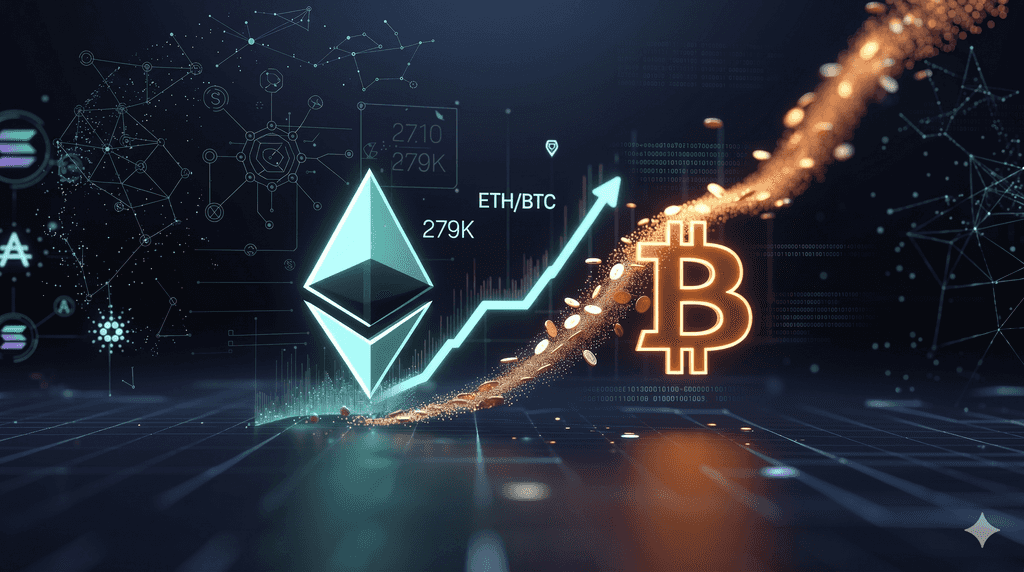
While the broader market was distracted by geopolitical tremors and fluctuating oil prices, the ETH/BTC ratio quietly reclaimed a six-month high, touching the crucial 0.032 level. This technical surge coincides with a massive institutional "buy-wall" from Bitmine Immersion Technologies (BMNR), which has hoarded an astounding 279,000 ETH over the past month.
For professional traders, it is a signal that the fundamental value proposition of digital assets is being rewritten by the world’s largest corporate treasuries.
Key Takeaways
-
The ETH/BTC ratio hit a six-month high of ~0.032 in mid-April 2026, ending a long period of Bitcoin dominance.
-
Bitmine Immersion Technologies has accelerated its buying pace, acquiring 279,000 ETH in the last 30 days to reach a total holding of nearly 5 million ETH.
-
Bitmine is now 82% of the way toward its stated goal of owning 5% of the total Ethereum supply.
-
Institutional demand is being driven by the need for ETH to power Agentic AI nodes and tokenized Wall Street assets.
-
ETH has risen 41% from its February lows, outperforming the S&P 500 and reclaiming its narrative as a "wartime store of value" during global geopolitical tensions.
Breaking the 0.031 Resistance
The ratio's decisive break above 0.031 on April 8, and its subsequent climb to a six-month high of 0.0317 by mid-month, signaled the definitive end of the Q1 drawdown.
This breakout was catalyzed by a risk-on rotation following the de-escalation of geopolitical tensions between the U.S. and Iran. According to Tom Lee’s keynote at Paris Blockchain Week 2026, this rebound is the first step in a "massive consolidation breakout" that could see ETH reclaim its historical dominance.
For technical analysts, the breakout above 0.031 is a change of character.
Support Flip: The 0.031 level, which previously saw heavy selling pressure, has now flipped into a primary support zone.
Volume Confirmation: The breakout was accompanied by a surge in ETH spot volume, much of which can be attributed to the aggressive 279,000 ETH accumulation by Bitmine.
Momentum Divergence: While Bitcoin faced resistance near its $74,000 peak, Ethereum outperformed the S&P 500 by over 2,000 basis points, showcasing its status as the leading "beta" play in a recovering market.
By maintaining this six-month high, the ratio has effectively re-anchored the market's expectations. Professional traders are no longer asking if Ethereum will survive the winter, but how quickly it will lead the charge toward the next macro bull cycle.
To stay ahead of these shifts, you can use KuCoin’s advanced charting tools to monitor the ratio's stability above this new support.
The Bitmine Signal: Institutional Whales Shifting from Store of Value to Utility
The staggering purchase of 279,000 ETH by Bitmine Immersion Technologies (BMNR) over the last 30 days is more than just a treasury expansion, it is a fundamental vote of confidence in Ethereum’s evolving role. In the previous market cycle, institutional interest was almost exclusively focused on Bitcoin as a Store of Value.
However, April 2026 data suggests a Great Rotation is underway. Led by Bitmine’s Chairman Tom Lee, institutional whales are increasingly treating ETH as a high-yield utility asset, a digital bond that offers both capital appreciation and protocol-native revenue.
The "Alchemy of 5%" Strategy
The goal is simple but transformative: acquire and stake 5% of the total circulating supply of Ethereum (approximately 6 million ETH). As of April 21, 2026, Bitmine has amassed 4.976 million tokens, representing 4.12% of the total supply.
By targeting this milestone, Bitmine is effectively turning a volatile digital asset into a recurring revenue engine. This Treasury-first model mimics the aggressive Bitcoin accumulation seen by MicroStrategy in 2020, but with a critical 2026 twist: yield. Bitmine isn't just holding ETH; they are putting it to work through their MAVAN (Made in America Validator Network), generating an estimated $330 million in annualized staking rewards.
Why Velocity Matters for the Ratio
The velocity of Bitmine’s accumulation, averaging over 70,000 ETH per week in April, has created a massive supply shock that the ETH/BTC ratio is only now beginning to reflect. When a single entity absorbs nearly 0.25% of the total supply in a single month, it dries up the sell-side liquidity on major venues.
This institutional behavior provides a clear signal: the "smart money" is no longer content with the passive holding of BTC. They are seeking the "native yield" of the Ethereum network. To capitalize on this trend, you can move your ETH into KuCoin Earn, allowing them to mirror Bitmine’s strategy by capturing staking rewards while the ETH/BTC ratio continues its upward trajectory.
Ethereum as Computational Fuel for Wall Street’s AI Nodes
Bitcoin serves as the bedrock of digital value storage, Ethereum has cemented its status as the world’s premier programmable settlement layer. The catalyst behind this shift is the explosive rise of Agentic AI, autonomous systems that require a neutral, public blockchain to transact value and secure data.
The Rise of Agentic AI
According to Bitmine Chairman Tom Lee, 2026 is the year where "the machine economy meets the capital market." Wall Street is increasingly utilizing Agentic AI nodes to automate complex financial workflows, from cross-border settlement to real-time asset rebalancing. These AI agents do not use traditional banking rails; they use Ethereum.
Native Settlement: AI agents use ETH to pay for the "gas" required to execute smart contracts, making Ether the essential fuel for an increasingly automated financial system.
Neutral Infrastructure: In a world of fragmented geopolitical interests, Ethereum’s decentralized nature provides the "neutral ground" required for autonomous systems to interact without intermediary friction.
Bitmine’s MAVAN and the Staking Utility
Through their MAVAN (Made in America Validator Network), Bitmine is not just holding ETH; they are powering the very nodes that validate these AI-driven transactions. By staking 4.12% of the supply, Bitmine is effectively securing a significant portion of the world's most valuable financial digital infrastructure.
Wall Street’s RWA Tokenization Pivot
The demand for ETH is further bolstered by the maturation of Real-World Asset (RWA) tokenization. Major wirehouses like Morgan Stanley and JPMorgan have fully integrated Ethereum-based tokenized funds into their discretionary portfolios. For these institutions, Ethereum provides the most liquid and secure operating system for tokenizing everything from Treasury bills to commercial real estate.
In this ecosystem, Bitmine’s holdings act as a massive liquidity reserve. This means that every new AI agent deployed and every RWA tokenized on-chain creates a permanent buy pressure on Ether. The signal from Bitmine is clear: Ethereum is the infrastructure of the 21st-century economy, and owning the "fuel" is the ultimate strategic decision.
Why ETH is Outperforming in 2026
As geopolitical tensions regarding the Strait of Hormuz strategy sent shockwaves through traditional markets earlier this month, Ethereum emerged as a surprisingly resilient Wartime Defensive Asset. While global oil prices spiked and the S&P 500 faced significant volatility, Ethereum’s 41% climb from its February lows showcased a unique decoupling from traditional risk-on assets.
The Tech-Hedge Evolution
Bitmine Chairman Tom Lee has been vocal about this shift, arguing that in a landscape defined by decentralized infrastructure, Ethereum acts as a "tech-hedge." Unlike gold, which is passive, or Bitcoin, which is primarily a value store, ETH represents the operational resilience of the global digital economy.
Network Effect as Security: During periods of high geopolitical uncertainty, the demand for censorship-resistant, autonomous settlement increases. Ethereum provides the rails for this.
Petrodollar Diversification: Bitmine’s aggressive accumulation of 279,000 ETH reflects a strategic move into an asset class that thrives on the "network state" rather than the nation-state.
Quantifying the Outperformance
While many expected capital to fly toward BTC, the ETH/BTC ratio actually expanded. This is because Ethereum’s utility in the Machine Economy makes it indispensable for the autonomous systems that Wall Street now relies on to manage risk during high-volatility periods.
The Volatility Delta
When comparing the two assets, institutional desks are looking at the Relative Volatility Index (RVI). In 2026, Ethereum has exhibited a "sticky" price floor, largely due to the massive staking commitments from entities like Bitmine.
RVI (ETH/BTC) = σ (ETH) / σ (BTC)
While σ (volatility) has traditionally been higher for ETH, the massive reduction in circulating supply through staking has leveled the playing field. For the first time in history, ETH is showing Bitcoin-like stability during macro shocks while maintaining its Tech-Growth upside.
Strategic Implementation
The Smart Rebalance
The most effective tool for capturing the ETH/BTC rotation is the KuCoin Smart Rebalance Bot. This bot is designed to maintain a fixed ratio between assets.
The Strategy: Set a 50/50 or 60/40 allocation between ETH and BTC.
The Mechanism: If the ETH/BTC ratio surges, as it did during the 279,000 ETH Bitmine buy-wall, the bot automatically sells a portion of the outperforming ETH to buy more BTC at the "old" price. Conversely, during a Bitcoin rally, it siphons BTC profits back into Ethereum.
Why it works in 2026: This bot effectively automates flippening. It forces you to mathematically sell high and buy low, securing incremental gains from the ratio's oscillation while ensuring you are never over-exposed to a single asset's temporary local peak.
Infinity Grid
While standard grid bots work in sideways markets, the KuCoin Infinity Grid Bot is the superior choice for the current breakout above 0.031. Unlike traditional grids that have a "ceiling," the Infinity Grid has no upper price limit.
Infinite Upside: As the ETH/BTC ratio climbs toward its 2026 targets, the bot continues to execute sell orders to lock in profits while keeping the total value of your ETH holdings constant in USDT terms.
Capital Efficiency: This strategy is ideal for traders who believe Ethereum has entered a sustained "leadership phase" and want to capture every percentage of the climb without being stopped out by range boundaries.
Integrating KuCoin Earn
Bitmine’s strategy succeeds because they earn a native yield on their holdings. On KuCoin, you can replicate this by moving your "rebalanced" ETH into KuCoin Earn.
The Yield Edge: While you wait for the ratio to hit your next target (e.g., 0.035), you can earn between 3.5% and 4.2% APY on your ETH.
Compounding Effect: By combining trading bot profits with staking yields, you create a dual-revenue stream that mirrors the "Alchemy of 5%" model, turning your portfolio from a static holding into a productive institutional-grade treasury.
Conclusion
The surge in the ETH/BTC ratio to a six-month high is not a fluke; it is the mathematical result of an institutional sea change. By understanding the technical breakout above 0.031, the shifting utility of the Ethereum network, and the strategic implementation of KuCoin’s automated tools, traders can position themselves on the right side of the 2026 flippening. Whether ETH is your Wartime Defensive Asset or your Machine Economy bet, the signal from Bitmine is clear: the smartest money in the room is no longer just holding, it's accumulating and staking at scale.
FAQs
Why is the 0.031 level so important for the ETH/BTC ratio?
Historically, 0.031 has acted as a multi-year pivot point. Breaking above it in April 2026 signaled a trend reversal, moving Ethereum out of its underperformance phase and into a period of market leadership.
Is Bitmine really the "MicroStrategy of Ethereum"?
Yes. By adopting the Alchemy of 5% strategy and controlling over 4.12% of the supply, Bitmine has taken on the role of the primary institutional accumulator, providing a massive price floor for ETH similar to MicroStrategy’s impact on BTC.
Can I mirror Bitmine’s strategy if I don’t have millions of dollars?
Absolutely. By using the KuCoin Smart Rebalance Bot, you can maintain a targeted ETH/BTC allocation with as little as $100, effectively automating the same accumulation and rebalance logic used by institutional desks.
What are "Agentic AI nodes" and why do they need ETH?
Agentic AI nodes are autonomous systems that perform financial tasks. They require Ethereum to pay for "gas" and settle smart contracts.
How does geopolitical tension affect the ETH/BTC ratio?
In 2026, Ethereum has shown "wartime resilience" due to its utility in decentralized finance and its decoupling from the traditional petrodollar system, often causing it to outperform both the S&P 500 and BTC during macro shocks.
Disclaimer:This content is for informational purposes only and does not constitute investment advice. Cryptocurrency investments carry risk. Please do your own research (DYOR).