

Spotify Reaches 300 Million Paid Subscribers in Q2 2026 as Stock Declines on Soft Guidance
2026/08/05 15:53:00
Introduction
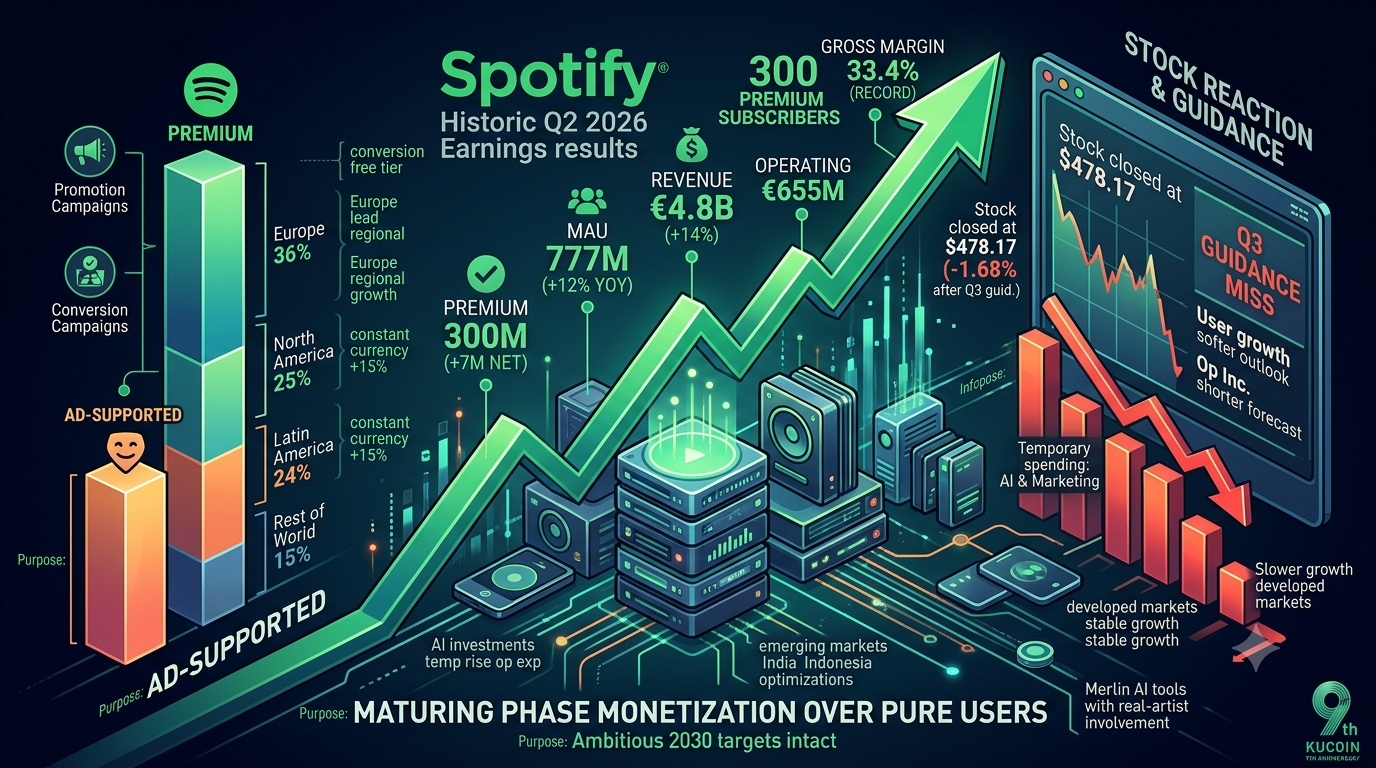
Spotify Technology became the first audio streaming service to hit 300 million Premium subscribers in the second quarter of 2026, adding 7 million net paid users while monthly active users climbed 12% year-over-year to 777 million. Revenue rose 14% to €4.8 billion and operating income reached €655 million with a record gross margin of 33.4%, according to the company’s official Q2 2026 earnings release dated August 4, 2026. Shares still closed lower as third-quarter guidance for monthly active users and operating income fell short of analyst expectations.
The milestone underscores Spotify’s scale and improving profitability even as higher marketing and AI spending, plus slower growth in mature markets, tempered investor enthusiasm. Net income hit €545 million, reversing a prior-year loss. The stock ended the day at $478.17, down 1.68%, based on market data from the same session.
What Drove Spotify’s Subscriber Growth to 300 Million in Q2 2026?
Spotify’s Premium base reached exactly 300 million at the end of Q2 2026, up 9% year-over-year and 1 million above its own prior guidance of 299 million. Net additions of 7 million outpaced the guided 6 million, with growth reported across every region—Europe, North America, Latin America, and Rest of World.
Monthly active users totaled 777 million, a 12% year-over-year increase and 16 million sequential gain. Ad-supported users stood at roughly 494 million, up 14%. Premium growth reflected strong promotional campaigns and continued conversion from the free tier, according to the company’s shareholder materials. Europe accounted for about 36% of Premium subscribers, North America 25%, Latin America 24%, and Rest of World 15%.
The company noted year-over-year and sequential gains in all regions despite recent price increases in several markets. Engagement metrics remained healthy, supporting the shift toward higher-value paid users.
How Did Spotify’s Financial Results Perform Against Expectations?
Total revenue increased 14% year-over-year to €4.8 billion (15% in constant currency), landing in line with guidance. Premium revenue grew 15% to €4.33 billion, while advertising revenue rose just 1% to €446 million.
Gross margin expanded approximately 193 basis points year-over-year to a record 33.4%, exceeding the guided 33.1%. Operating income reached €655 million, beating the €630 million guidance and rising 61% year-over-year. Net income came in at €545 million. These figures come directly from Spotify’s August 4, 2026 earnings release and accompanying shareholder deck.
Operating expenses rose on temporary investments in marketing and cloud/AI infrastructure. Social charges were lower than forecast due to share-price movements during the quarter. Free cash flow also hit a record high in the period.
Why Did Spotify Stock Fall Despite Hitting 300 Million Subscribers?
Spotify shares declined 1.68% to close at $478.17 on August 4, 2026, after the company issued third-quarter guidance that missed consensus estimates on key metrics. Investors focused on the softer outlook for user growth and operating income rather than the strong Q2 delivery.
The drop occurred even though Q2 results largely met or exceeded expectations on subscribers, revenue, margin, and profit. Pre-market trading had shown steeper declines of around 5% in some reports before the close moderated the move. Year-to-date the stock remained under pressure, down roughly 16–18% according to contemporaneous market summaries.
Concerns centered on elevated near-term spending and signs of slower expansion in developed markets. Management described the expense increases as temporary and reaffirmed longer-term 2030 targets of 35–40% gross margins, operating margins above 20%, and 1 billion subscribers.
What Does Spotify’s Q3 2026 Guidance Reveal About Future Growth?
Spotify guided for 788 million monthly active users at the end of Q3 2026, implying roughly 11 million net additions—below analyst expectations that clustered near 793–794 million. Premium subscribers are expected to reach 305 million, an addition of about 5 million that aligned with consensus.
Revenue is projected at approximately €5.0 billion. Gross margin is guided to 32.9%. Operating income is forecast at €670 million, short of the roughly €678 million Wall Street average. The guidance incorporates about €9 million in social charges based on the Q2-end share price and assumes a foreign-exchange tailwind of around 200 basis points.
Management attributed the more measured MAU outlook partly to product optimizations in emerging markets such as India and Indonesia that support future monetization and pricing power. Developed-market growth rates were described as stable. Marketing and AI-related investments are expected to add approximately €200 million in incremental operating expense for the full year, with moderation anticipated in the fourth quarter.
How Is Spotify Investing in AI and New Features?
Spotify is expanding AI-powered tools while emphasizing real-artist involvement. In Q2 it deepened a partnership with independent-rights body Merlin to extend AI remix, cover, and related features to more than 30,000 independent labels, with plans to offer some capabilities as paid add-ons.
New product launches included Personal Podcasts (AI-generated short episodes tailored to individual listening habits, in beta for U.S. Premium users), Studio by Spotify Labs (a desktop research preview for personalized discovery), expanded DJ experiences in additional languages and markets, conversational “Talk to Spotify” capabilities, and Running Mode for tempo-matched workouts. Reserved by Spotify, a fan-first concert-ticket program with Live Nation, reserved nearly 100,000 tickets in its early U.S. rollout.
Audiobooks and magazine-article audio expanded, along with new Audiobooks+ tiers. Management stressed that AI efforts focus on empowering authentic creators rather than synthetic artists. These investments contributed to the temporary rise in operating expenses.
What Challenges Does Spotify Face in Mature Markets and Competition?
Growth is slowing in the highly penetrated markets of North America and Europe, prompting a greater emphasis on monetization and pricing over pure user acquisition. Ad-supported revenue growth remained muted at 1%, though management expects an inflection toward double-digit gains in the second half of 2026 as automated ad tools scale.
Competition continues from other streaming platforms, video services, and AI music tools. Spotify has introduced artist-verification systems and optional labeling for AI-generated content to address quality and copyright concerns. Price increases implemented earlier in 2026 have so far coexisted with subscriber growth, but further monetization steps in emerging markets carry execution risk.
Cash and cash equivalents stood at €9.4 billion at quarter-end with minimal debt beyond leases, providing flexibility for continued investment and potential shareholder returns.
Conclusion
Spotify’s Q2 2026 results delivered a historic 300 million Premium-subscriber milestone, solid revenue growth of 14% to €4.8 billion, a record 33.4% gross margin, and operating income of €655 million. Net additions of 7 million paid users exceeded guidance, and profitability metrics improved sharply year-over-year. The stock nevertheless declined 1.68% to $478.17 as third-quarter forecasts for monthly active users (788 million) and operating income (€670 million) came in below expectations, reflecting higher near-term AI and marketing spend plus measured growth in mature markets.
The company continues to invest in personalization, AI tools that involve real artists, concert-ticket features, and audiobooks while reaffirming ambitious 2030 targets. Challenges remain around advertising acceleration, emerging-market monetization, and competition. Overall, the quarter demonstrated that Spotify can scale profitability alongside users, even if the near-term guidance introduced caution. Investors and market participants will watch Q3 execution closely for signs that the temporary expense elevation yields lasting engagement and margin gains.
FAQs
What was Spotify’s exact Premium subscriber count at the end of Q2 2026?
Spotify reported exactly 300 million Premium subscribers, up 9% year-over-year after adding 7 million net users.
By how much did Spotify’s stock fall after the Q2 2026 earnings?
Shares closed down 1.68% at $478.17 on August 4, 2026, according to market data for that session.
What is Spotify’s Q3 2026 guidance for monthly active users?
The company expects 788 million monthly active users, implying about 11 million net additions.
Did Spotify’s Q2 revenue meet expectations?
Revenue of €4.8 billion was in line with the company’s own guidance and essentially matched or came very close to consensus estimates.
How is Spotify approaching AI-generated music?
Spotify is partnering with Merlin to bring AI remix and related tools to independent labels while stressing that real artists should remain central to AI features and introducing verification and labeling measures.