

RAVE Liquidations Hit $30M+ Trailing Only BTC and ETH: Inside Crypto's Latest Volatility Explosion
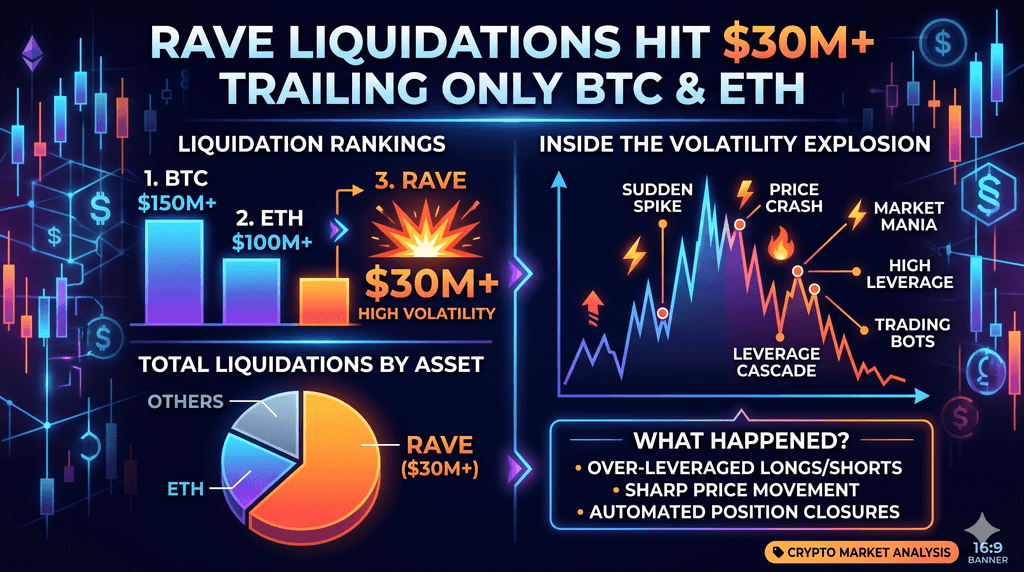
RAVE, the token tied to the RaveDAO music and events project, just delivered one of the most intense trading sessions in recent crypto memory. Over the past 24 hours, exchanges liquidated roughly $30.6 million worth of RAVE futures positions, placing it directly behind Bitcoin at $236 million and Ethereum at $143 million. At the same time, the token price shot up more than 100 percent in a single day, briefly touching a new all-time high near $19 before settling around $13 to $14 levels. Traders watched in real time as leveraged bets unraveled across exchanges, with short positions taking the heaviest hits at about $23.67 million. This spike in forced closures came during a broader market session where total crypto liquidations reached $660 million, yet RAVE stood out for its outsized impact relative to its still-nascent market cap.
The numbers tell a clear story of extreme leverage meeting sudden momentum. Data tracked through Coinglass shows RAVE consistently ranking in the top three for daily liquidations during this stretch, a rare feat for any altcoin. A low-profile token that traded under $0.25 just weeks ago has now delivered gains exceeding 6,000 percent in seven days, turning a $60 million market cap into billions at its peak. Yet the real action unfolded in the futures market, where open interest ballooned and thin liquidity amplified every price tick. This setup created the perfect conditions for cascading liquidations that wiped out both over-leveraged longs and an even larger pool of shorts betting against the rally.
RAVE's Jaw-Dropping 6000 Percent Weekly Gain That Shocked Crypto Traders Worldwide
RAVE's rise surprised nearly everyone; from roughly $0.25 at the start of April 2026, the token climbed past $10 within days and kept pushing higher, hitting fresh records above $19 by April 15. That translated into roughly 40 times growth in a single week and more than 60 times over 30 days, pushing its market capitalization from around $60 million to peaks near $4 billion before some pullback. Trading volume on futures contracts exploded past $10 billion in 24 hours at one point, far outpacing many established altcoins. Early participants who bought near the lows locked in life-changing returns, but the rally also drew in waves of speculators chasing momentum. On-chain records reveal heavy buying pressure in spot markets even as futures traders piled into short positions, expecting a quick reversal. The disparity between spot strength and derivatives bets created the conditions for the subsequent squeeze.
CoinGlass figures confirm the token's 24-hour price change often exceeded 100 percent during the height of the move, with hourly candles showing 18 percent jumps that triggered automatic margin calls across platforms. Traders monitoring order books noticed how small buy orders in low-float conditions could move the price enough to cascade liquidations worth millions. This kind of velocity is what separates RAVE's run from steadier gains in larger-cap assets and explains why its liquidation totals rivaled those of coins with market caps hundreds of times bigger.
Exactly How $30.6 Million in RAVE Futures Got Liquidated in One Chaotic Day
A breakdown of the numbers paints a clear picture of the damage. According to BlockBeats reporting via Coinglass on April 15, 2026, RAVE saw $30.6 million liquidated in 24 hours, with longs accounting for just $6.93 million while shorts absorbed $23.67 million in losses. That imbalance highlights how aggressively bears had positioned themselves against the ongoing uptrend. The largest single liquidation hit a $1.1 million short position on the RAVE-USDT swap at around $13.27, followed by multiple six-figure shorts on OKX and Bitget. Across Binance alone, RAVE-USDT perpetuals contributed millions more as prices breached key resistance levels every few hours.
Funding rates plunged deeply negative, hitting averages of minus 1.3695 percent across major venues, meaning shorts paid hefty fees to maintain positions while longs collected the payments. Exchanges even adjusted settlement frequencies temporarily to hourly and raised rate caps to plus or minus 2 percent in response to the frenzy, pushing annualized costs into the thousands of percent for some holders.
These mechanics turned holding a short into an expensive gamble, as every upward tick eroded margins faster than traders could react. The result was a self-reinforcing loop where liquidations themselves fueled further buying pressure from forced covering. Total trader liquidations across crypto hit 183,514 people in the period, but RAVE's share stood out for its concentration in a single asset.
The Short Squeeze Dynamics Pushing RAVE Prices to Fresh All-Time Highs
Short squeezes intensify when rising prices compel bears to repurchase tokens to close their positions, thereby exacerbating the situation. In RAVE's case, the dynamic played out textbook style. As spot prices climbed on strong volume, futures shorts faced mounting losses and automatic closures. Data from multiple exchanges showed short liquidations outnumbering longs by roughly four to one during peak hours. One popular trading account on X, Evening Trader Group, described the sequence: large token transfers to Bitget first signaled a possible dump that lured shorts in, only for the tokens to move back on-chain while spot buying accelerated. This maneuver, whether intentional or not, created the bait-and-pump effect that wiped out bearish bets worth tens of millions.
Observers noted how the low circulating supply, estimated at just 24 percent of total tokens, made it easier for coordinated buying to dominate order books. Once shorts started covering en masse, the price accelerated beyond technical levels, triggering even more liquidations in a feedback loop. By the time the dust settled, RAVE had not only survived the expected pullback but posted a new high, proving the squeeze's power in illiquid conditions. This pattern echoes classic squeezes in crypto history but stands out for the scale achieved by a project still building its user base.
RaveDAO's EDM Events and On-Chain Ticketing Powering Real Utility Buzz
RaveDAO built its story around live electronic dance music experiences rather than pure speculation. The project started small in late 2023 as a 200-person afterparty at a crypto conference in Istanbul and grew into events drawing 3,000 attendees on average across cities like Dubai, Singapore, Amsterdam, and Miami. Total participation now exceeds 100,000 people, with more than 70,000 NFT tickets issued for on-chain entry and rewards. Attendees use RAVE tokens for tickets, VIP access, merchandise, and governance votes on future lineups or locations. A portion of event revenue flows into automatic buybacks and burns of the token, creating a deflationary link to real-world activity.
Recent highlights include co-hosting the 2026 Lisbon Dance Summit and partnerships with artists such as Vintage Culture, Don Diablo, and Miss Monique, plus organizations like Warner Music and 1001Tracklists. One sold-out event in 2025 reportedly generated millions in gross proceeds that directly supported token mechanics. This tangible utility narrative helped sustain buying interest even as derivatives volatility spiked. Community members who attended events described the mix of music, blockchain payments, and philanthropy as a fresh way to engage with crypto beyond charts. The project also channels 20 percent of proceeds to causes like sight-restoring surgeries and meditation programs, giving holders a sense of purpose that pure meme coins lack.
Team-Controlled Wallets Holding Nearly 90 Percent of RAVE Supply Explained
Supply distribution adds another layer to the volatility story. On-chain analytics from Arkham Intelligence reveal that nearly 90 percent of all RAVE tokens sit in just three Gnosis Safe multi-signature wallets widely believed to belong to the team or project treasury. One wallet alone holds about 75 percent, with the others at roughly 10 percent and 5 percent. The circulating supply hovers near 24 percent of the 1 billion total maximum, meaning most tokens remain locked or controlled. This concentration creates a low-float environment where even modest buying pressure can drive outsized price moves. At current valuations, the locked portion carries a notional value of several billion dollars on paper.
These setups, commonly employed in early-stage projects for vesting and development funding, also raise concerns about potential future sell pressure. For now, the tight supply has worked in favor of the rally by limiting available tokens for shorting or dumping. Traders monitoring wallet activity saw large transfers between team addresses and exchanges during the run-up, which some interpreted as strategic positioning. The mechanics explain why RAVE could achieve a billion-dollar market cap with relatively modest absolute trading volumes compared to blue-chip coins.
On-Chain Transfers That Allegedly Baited Shorts Before the Big Pump
Detailed blockchain records show a pattern that fueled speculation about coordinated moves. Analysts tracked transfers of roughly $30 million worth of RAVE to Bitget around April 10 to 13, which initially sparked fears of an imminent large sell-off and encouraged short entries. Shortly afterward, those same tokens moved back off-exchange to other wallets while spot prices began their aggressive climb. The timing aligned perfectly with the heaviest short liquidations.
On X, pseudonymous on-chain researcher Columbus remarked that such plays often adhere to familiar scripts, ensnaring retail shorts in the middle. The debate surrounding whether these transfers were a result of legitimate treasury management or a more tactical approach continues in trading circles, but the outcome was clear: bears suffered as prices soared. This episode shows how on-chain visibility in crypto can both inform and mislead participants. Similar patterns have appeared in other low-float tokens, but RAVE's scale drew global attention. The combination of visible wallet activity and explosive price action turned what might have been a quiet accumulation phase into a public spectacle that amplified FOMO among spot buyers.
Negative Funding Rates Turning Bearish Bets Into Costly Nightmares for Traders
Funding rates provide a real-time gauge of market sentiment, and RAVE's went deeply negative during the surge. Averages across platforms reached -1.3695 percent, forcing shorts to pay longs at elevated clips just to stay in positions. In extreme moments, hourly rates spiked so high that annualized equivalents reached thousands of percent, draining capital from bearish holders minute by minute. This cost structure made it unsustainable for many to hold shorts overnight, leading to voluntary closes or forced liquidations. Long holders, by contrast, collected steady income from the fees, reinforcing their conviction. The imbalance encouraged more short covering, which pushed prices even higher in a virtuous cycle for bulls. Data from Coinalyze and Coinglass confirmed open interest remained elevated even as liquidations mounted, showing fresh money entering the fray. Traders who ignored the funding signals often found themselves paying more in fees than they lost on price moves alone. This environment turned what looked like a straightforward contrarian bet into a capital-eroding trap for anyone fighting the trend.
Trader Stories From the Front Lines of the RAVE Liquidation Bloodbath
Real people felt the impact firsthand. One trader posting on X described watching a $210,000 short position evaporate in minutes as prices gapped upward on Bybit, leaving him with nothing but a margin call notification. Another early entrant who bought near $0.25 shared screenshots of six-figure gains but admitted selling too early and missing the final leg to $19. Community threads filled with screenshots of liquidation notices showing losses from $50,000 positions that seemed safe at 10x leverage. A Vietnamese trader recounted how friends who shorted the token at $5, expecting a reversal, ended up covering at $15 after repeated hourly settlements drained their accounts.
Some called for exchanges to compensate users, labeling the move manipulative due to supply control. Others celebrated the squeeze as a lesson in respecting momentum over fundamentals. These personal accounts spread rapidly across social platforms, blending frustration with awe at the speed of events. The stories underscore how leveraged trading turns abstract volatility into direct financial pain or a windfall, depending on which side of the trade a person sits.
Why RAVE's Low Float Creates Insane Leverage Opportunities for Speculators
Low circulating supply turns modest capital into a massive price impact. With only about 239 million tokens freely trading out of a 1 billion maximum, a few million dollars in buys can shift the market cap by hundreds of millions. This dynamic attracts speculators who use high leverage on futures to amplify returns. Open interest on RAVE contracts reached hundreds of millions during the peak, far higher than many peers with similar market caps.
The result is exaggerated moves in both directions that reward precise timing but punish hesitation. Speculators monitor liquidation heatmaps on Coinglass to place bets near clusters of stop-loss levels, knowing a breach could trigger chain reactions worth tens of millions. The setup mirrors past low-float runners but benefits from RAVE's narrative around music and events, giving it staying power beyond pure hype. Risk managers warn that such conditions also invite sharp reversals once profit-taking begins, especially if team wallets start distributing. For now, the float mechanics continue to support the volatility that keeps traders glued to charts.
Partnerships With Centralized Exchanges and More Supercharging RAVE Trading Volume
Listings and support from major exchanges added rocket fuel. RAVE secured visibility on reputable exchanges, which boosted liquidity and drew institutional-grade traders. These platforms listed perpetual contracts early, enabling the high-leverage environment that later produced the liquidation spike. Partnership announcements with Polygon, BNB Chain, and entertainment brands like Warner Music lent credibility that translated into higher trading interest. Volume on spot and futures combined often exceeded $400 million daily at its height, placing RAVE among the most actively traded assets regardless of size.
The exchange backing created a global audience that amplified news flow and FOMO. Traders noted how straightforward it became to enter and exit large positions compared to smaller venues, though slippage remained a factor during volatile hours. This infrastructure helped turn RaveDAO from a niche music project into a market-moving token almost overnight.
How RAVE Compares to Other High-Volatility Altcoin Runs in Recent Months
RAVE's performance echoes other explosive moves but stands apart in speed and liquidation intensity. Similar short-squeeze rallies in tokens with cultural narratives have appeared before, yet few matched the 6,000 percent weekly gain paired with top-tier liquidation rankings. The combination of real event revenue, low float, and derivatives frenzy created conditions more extreme compared to many meme-driven pumps. While past runs often faded quickly after the squeeze, RAVE maintains a utility layer through ticketing and governance that some traders see as a differentiator. Market observers track whether it can sustain attention beyond the initial frenzy or follow the path of tokens that returned to obscurity. The current cycle shows how niche stories can still capture massive capital flows when leverage aligns with momentum.
Critical Support and Resistance Levels Emerging After the Latest Liquidation Spike
After the chaos, attention moved to technical levels that could dictate the next phase. Traders watch $12 as immediate support, where previous resistance turned into a floor during the climb. A break below might test $10, a psychologically important round number from earlier in the surge. On the upside, $19 remains the all-time high that could act as resistance if retested, with $15 serving as a midpoint battleground. Volume profiles show heavy activity around $13 to $14, suggesting potential congestion if prices consolidate.
Liquidation heatmaps on platforms like Coinglass show clusters of stops above $20 and below $11 that could spark fresh moves. Open interest remains elevated, meaning any decisive break could trigger another wave of activity. Market participants monitor funding rates and wallet flows closely for signs of continued squeeze or profit taking. The coming days will test whether the momentum can persist or if the liquidation cleanup leads to a healthier base for the next leg.
FAQs
Q1: What exactly triggered the massive spike in RAVE liquidations over the past 24 hours?
The surge stemmed from a powerful short squeeze and explosive spot buying, which caught leveraged bears off guard. Prices rose more than 100 percent in a day on strong volume, forcing shorts to cover and triggering automatic liquidations totaling $30.6 million, according to Coinglass data referenced across major outlets. Negative funding rates made holding shorts expensive, accelerating the unwind, while low circulating supply amplified every upward move.
Q2: Is RAVE's price action driven purely by speculation, or does the project offer real utility?
RaveDAO ties the token to live EDM events through NFT ticketing, on-chain payments, staking for revenue shares, and governance. The project has hosted events for over 100,000 attendees and generated millions in reported revenue that funds buybacks and burns. While derivatives trading fueled the recent volatility, many holders value the cultural and philanthropic aspects, including charity donations from event proceeds. This utility layer distinguishes it from tokens lacking real-world activity.
Q3: How concentrated is RAVE's token supply, and what does that mean for volatility?
Nearly 90 percent of the supply sits in three Gnosis Safe wallets linked to the team, leaving only about 24 percent in circulation. This low float makes the price highly sensitive to buying or selling pressure, which explains the extreme swings and liquidation cascades. It also creates opportunities for rapid gains but increases reversal risk if large holders distribute. Arkham Intelligence data confirms the concentration pattern.
Q4: What lessons can traders learn from the RAVE short squeeze?
Respect momentum over contrarian bets in low-float assets, monitor funding rates closely, and avoid over-leverage during parabolic moves. Many shorts entered expecting a quick reversal after early transfers but faced rapid losses as spot strength persisted. Using liquidation heatmaps and setting tight risk controls helps navigate such setups. The episode shows how quickly sentiment can shift in crypto derivatives.
Q5: Will RAVE continue to see high liquidation volumes in the near term?
High open interest and ongoing volatility suggest yes, especially if price action remains choppy around key levels. Any sharp move higher or lower could trigger fresh cascades given the leverage still present. However, as the token potentially matures and more supply enters circulation, the intensity may ease. Traders should watch volume, funding, and wallet activity for clues.
Q6: How does RaveDAO plan to sustain interest beyond the current hype cycle?
The team focuses on expanding global events like the upcoming Lisbon Dance Summit, securing more artist partnerships, and growing the DAO's governance role. Revenue from ticket sales and sponsorships supports token burns and real utility, aiming to build a lasting community around music and Web3 experiences rather than relying solely on price action. Consistent event delivery remains central to the long-term vision.