

AI Storage Chip Shortage Intensifies: Morgan Stanley Predicts 25% Price Surge and Super Cycle to 2028
2026/07/23 16:55:00
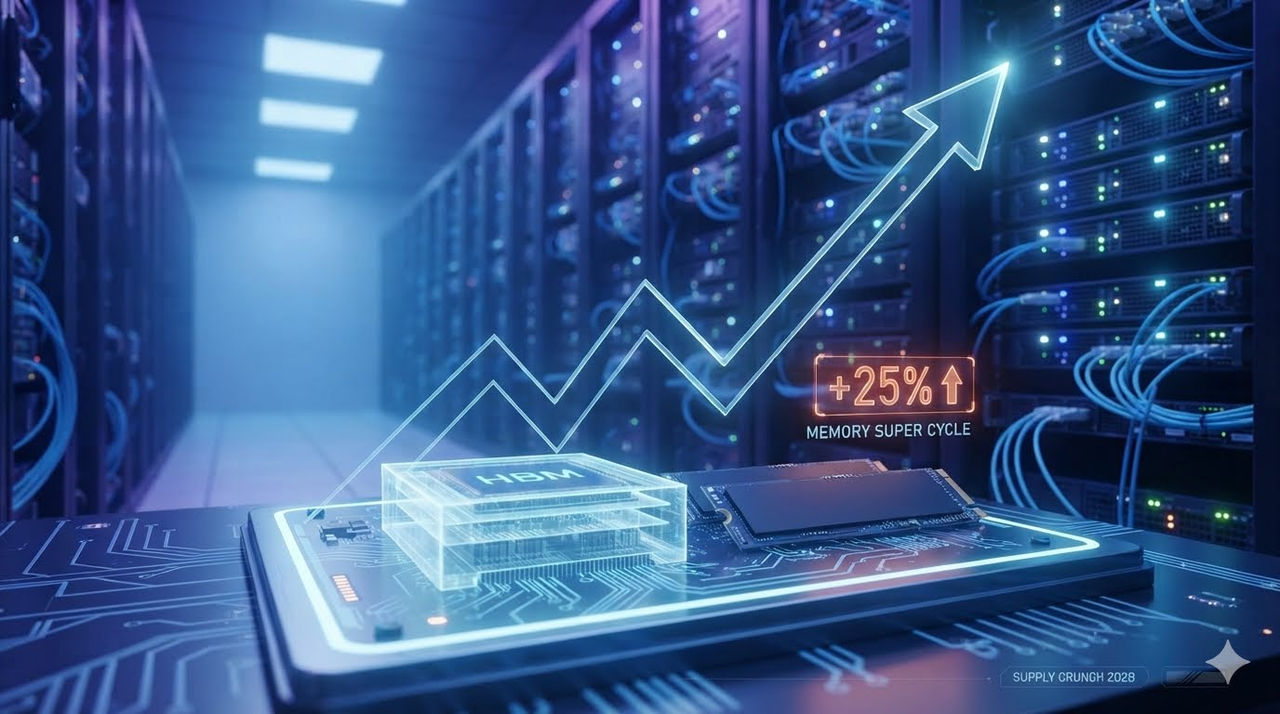
For the past several quarters, the global artificial intelligence narrative has centered almost exclusively on graphics processing units (GPUs). Investors and enterprises alike tracked the exponential rise of processing power, treating computational capacity as the solitary metric of AI advancement. However, a landmark market research note published by Wall Street investment bank Morgan Stanley signals a paradigm shift. The primary bottleneck impeding artificial intelligence infrastructure has officially migrated from processing power to memory and storage architecture.
According to lead semiconductor analyst Joseph Moore, the supply chain for advanced memory and high-capacity storage chips is entering a state of severe, unprecedented constraint. Morgan Stanley explicitly projects that contractual prices for enterprise storage and memory solutions will surge by at least 25% quarter-over-quarter. More importantly, the financial institution emphasizes that this is not a short-term cyclical blip. Instead, the global technology sector is entering an extended "memory super cycle" projected to last continuously until 2028.
For cryptocurrency market participants, Web3 builders, and Decentralized Physical Infrastructure Network (DePIN) investors, this structural deficit represents an ideological and economic turning point. As traditional centralized infrastructure hits a physical supply wall, the cost structures of the Web2 cloud are poised to experience significant upward pressure. This macroeconomic environment provides a data-backed case study for the necessity of decentralized alternative networks.
Key Takeaways
-
Morgan Stanley predicts a 25% quarter-over-quarter rise in enterprise storage and memory prices due to supply constraints.
-
Unprecedented AI data center demands are driving a prolonged memory super cycle lasting until 2028.
-
Physical limits and equipment backlogs for new fabrication plants, causing a 3-to-5 year delay in expanding supply.
-
Shifting production toward High-Bandwidth Memory (HBM) will cause a 15% component deficit in traditional consumer PCs by 2027.
-
Decentralized physical infrastructure networks (DePIN) provide cost-effective storage alternatives by leveraging idle, distributed hardware.
Dissecting the Morgan Stanley Report
Why Past Memory Cycles No Longer Apply
Historically, the semiconductor memory market, primarily consisting of Dynamic Random-Access Memory (DRAM) and NAND flash storage, has been notoriously volatile. The industry traditionally operated on predictable boom-and-bust cycles: a period of high prices led to aggressive factory expansion, resulting in market oversupply, which subsequently triggered steep price collapses and production cuts.
Morgan Stanley’s core thesis is that this historical pattern is officially broken. The structural demand originating from global AI data centers is decoupled from legacy consumer technology cycles. Artificial intelligence training and inference workloads do not merely require standard storage; they demand vast data pipelines capable of feeding hundreds of billions of parameters to processors without latency. This unprecedented technical requirement has altered the baseline consumption metrics of enterprise memory permanently.
The 3-to-5 Year Fab Bottleneck
The secondary factor cementing this prolonged shortage is the physical limitation of semiconductor fabrication expansion. Resolving a hardware deficit requires building new fabrication plants (fabs) and cleanrooms. In the advanced semiconductor sector, the operational trajectory for a greenfield facility spans a strict three-to-five-year window.
This timeline is further exacerbated by severe equipment backlogs. Key manufacturers of advanced lithography and packaging machinery are facing multi-year order queues. Consequently, even though major memory manufacturers possess the capital reserves to fund massive expansion projects, the physical machinery required to scale production cannot be deployed fast enough to match the velocity of AI data center construction before 2028.
The "False Flag" Dip and Wall Street’s $1T Recovery
Prior to the release of Morgan Stanley’s report, the semiconductor sector experienced a notable equity correction. Mixed demand signals from legacy consumer industries, specifically a slower-than-expected recovery in personal computer shipments and standard smartphone upgrades, caused general market panic. This led to a short-term contraction in major memory stock valuations, with some assets declining between 20% and 40% from their yearly highs.
Morgan Stanley categorically labels this market pullback as a "False Flag" dip. The investment bank noted that while consumer retail demand exhibited seasonal friction, the institutional demand for AI server hardware remained completely unyielding. Following the publication of the note, Wall Street reacted with institutional force. SanDisk surged by over 14%, Western Digital advanced more than 11%, and Micron Technology experienced a 12% rally, successfully reclaiming its historic $1 trillion market capitalization milestone. This aggressive institutional accumulation underscores the validity of the structural deficit.
Macro Consequences: The Dawn of 'Chipflation'
The primary driver behind the broader hardware crunch is a phenomenon known as production capacity displacement. High-Bandwidth Memory (HBM)—the specialized, ultra-fast memory stacks packaged alongside flagship AI processors—requires significantly more silicon wafer real estate compared to conventional DRAM. Specifically, producing one unit of HBM chip capacity consumes up to three times the physical manufacturing resources of standard memory.
As major semiconductor conglomerates aggressively reallocate their limited cleanroom capacities to maximize HBM output for AI clients, the supply of standard enterprise and consumer components is experiencing a severe contraction. This displacement is driving an ecosystem-wide inflationary pressure termed "chipflation."
By 2027, the displacement of manufacturing capacity is projected to leave the global personal computer ecosystem with a 15% structural deficit in baseline storage components—equivalent to a shortfall affecting roughly 58 million computing units. Downstream hardware manufacturers will be forced to choose between absorbing these escalating component costs, reducing the onboard storage specifications of their base models, or passing the inflationary premium directly to the end consumer.
The Vulnerability of Centralized Web2 Clouds
As centralized hyperscalers (such as Amazon Web Services, Microsoft Azure, and Google Cloud) navigate this multi-year hardware deficit, their internal capital expenditure models are being heavily stressed. The 25% price surge in foundational storage components directly inflates the cost of building out the sprawling "Data Lakes" required to hold modern AI training corpora.
To maintain their corporate operating margins, these monolithic Web2 providers are systematically adjusting their enterprise service-level agreements. Artificial intelligence startups, research labs, and enterprise developers are consequently facing compounding subscription fees for cloud storage and compute allocations.
Furthermore, this centralized paradigm introduces extreme geographic and operational vulnerabilities. When a vast portion of the world's digital intelligence relies on hardware concentrated within a handful of corporate data centers—which are themselves constrained by regional power grids and localized component allocations—the global AI ecosystem inherits a dangerous single point of failure.
The Rise of DePIN and Storage Protocols
The converging crises of centralized chip shortages, cloud inflation, and capacity displacement serve as a macro catalyst for Decentralized Physical Infrastructure Networks (DePIN). DePIN protocols bypass the multi-year fabrication bottleneck entirely by utilizing an economic model that aggregates and optimizes existing, underutilized storage capacity distributed across the globe.
Filecoin (FIL): The Institutional Data Lake for AI
Filecoin operates as a decentralized, peer-to-peer storage network that turns data storage into a verifiable commodity market. Through architectural framework upgrades like the Filecoin Virtual Machine (FVM) and institutional pipelines like Filecoin Plus (Fil+), the network is specifically designed to house massive, static datasets. For artificial intelligence enterprises, Filecoin offers a highly secure, cryptographically verified repository for massive training models at a fraction of the operational cost levied by traditional Web2 providers. Because the network incentivizes providers using native cryptographic tokens rather than relying on hyper-localized hardware purchasing cycles, its pricing model remains insulated from traditional semiconductor supply shocks.
Arweave (AR): Permanent Storage and Data Provenance
Arweave utilizes a unique "permaweb" architecture backed by a sustainable endowment model, ensuring that data is stored permanently for a one-time upfront fee. In the era of proliferation of generative artificial intelligence, Arweave addresses a critical technical necessity: data provenance. As algorithmic models increasingly ingest data from the internet, verifying the authenticity, historical lineage, and human origin of training datasets becomes paramount. Arweave provides an immutable, time-stamped ledger for data verification, ensuring that critical AI training sets remain unaltered and verifiable across decades.
Other Rising Contenders: Storj, Render, and Akash
Beyond primary storage layer networks, decentralized ecosystems are developing holistic hardware alternatives. Networks like Storj provide enterprise-grade, S3-compatible cloud storage that integrates directly into existing developer workflows while maintaining a completely decentralized backend node matrix. Concurrently, compute-focused DePIN networks like Akash and Render are aggregating decentralized GPU resources. When paired with distributed storage layers, these protocols form a highly resilient, market-driven, and completely decentralized alternative to the traditional Web2 tech stack.
Hedging 'Chipflation' on KuCoin
As Morgan Stanley's projected 2028 super cycle unfolds, digital asset traders and macro investors have a distinct opportunity to position themselves ahead of the capital migration from legacy tech into Web3 infrastructure. Navigating this paradigm shift requires a disciplined approach to sector allocation:
Short-to-Medium Term Allocation (The Infrastructure Premium): Track token ecosystems tied directly to immediate storage optimization and data hosting. As enterprise Web2 cloud costs climb throughout 2026, look for protocols showing consistent growth in active data storage metrics (Data Stored vs. Raw Capacity).
Long-Term Strategic Positioning (The DePIN Ecosystem Expansion): Position capital within foundational DePIN networks that bridge the gap between processing networks and storage layers. The synchronization between decentralized computing layers and decentralized storage layers will likely be a primary driver of the next digital asset expansion cycle.
Risk Management and Liquidity Monitoring: Utilize the robust spot and derivatives markets on KuCoin to manage exposure. Because the DePIN sector is heavily influenced by both crypto-native sentiment and real-world macroeconomic indicators (such as quarterly semiconductor earnings reports and supply chain data), maintaining a flexible, diversified position across multiple leading protocols is critical.
Conclusion
The investigative findings presented by Morgan Stanley reveal a reality: the centralized infrastructure underpinning the modern digital economy is hitting its physical limits. A structural shortage extending to 2028, coupled with a persistent 25% price surge for critical enterprise components, demonstrates that the Web2 cloud model cannot scale infinitely in its current, siloed form.
By crowdsourcing capital expenditures, programmatic token distributions, and utilizing global idle hardware capacity, DePIN protocols offer a scalable, market-driven alternative to centralized infrastructure monopolies. For forward-thinking investors, the traditional memory crunch is not a crisis, it is the ultimate macro-economic entry point for the decentralized future.
FAQs
What is causing the severe AI storage chip shortage?
The crisis is driven by exponential demand from global AI data centers for High-Bandwidth Memory (HBM). This shift has aggressively displaced the production capacity of standard DRAM and NAND flash memory components, creating a widespread supply crunch.
Why does Morgan Stanley expect the super cycle to last until 2028?
Building new semiconductor fabrication plants typically requires a strict three-to-five-year timeline. Due to critical equipment backlogs and long deployment phases, meaningful new supply cannot physically catch up with the velocity of AI infrastructure demand before 2028.
How will the 25% price surge impact everyday consumers?
Dubbed "chipflation," this surge forces downstream electronics manufacturers to absorb costs or pass them to consumers. Expect rising retail prices or reduced memory/storage configurations in future personal computers, smartphones, and gaming consoles.
What is DePIN and how does it solve this hardware crisis?
Decentralized Physical Infrastructure Networks (DePIN) crowd-source and aggregate underutilized storage capacity globally. By transforming idle consumer and enterprise hard drives into a unified network, DePIN bypasses multi-year manufacturing bottlenecks and offers a cost-effective alternative.
How does the chip shortage benefit the Filecoin (FIL) ecosystem?
As traditional Web2 cloud storage rates skyrocket due to hardware inflation, Filecoin offers a highly secure, cryptographically verified alternative. It allows AI enterprises to store massive data sets at a fraction of centralized hosting costs.
Why is Arweave (AR) important for artificial intelligence models?
Arweave provides permanent, immutable storage on the "permaweb." In the AI era, it acts as a critical ledger for data provenance, proving the historical origin and authenticity of training datasets to combat AI-generated misinformation.
Disclaimer
The information provided on this page may originate from third-party sources and does not necessarily represent the views or opinions of KuCoin. This content is intended solely for general informational purposes and should not be considered financial, investment, or professional advice. KuCoin does not guarantee the accuracy, completeness, or reliability of the information, and is not responsible for any errors, omissions, or outcomes resulting from its use. Investing in digital assets carries inherent risks. Please carefully evaluate your risk tolerance and financial situation before making any investment decisions. For further details, please consult KuCoin’s Terms of Use and Risk Disclosure.