

ENJ Short Squeeze +50%: Why It Happened and Which Gaming Tokens Could Move Next
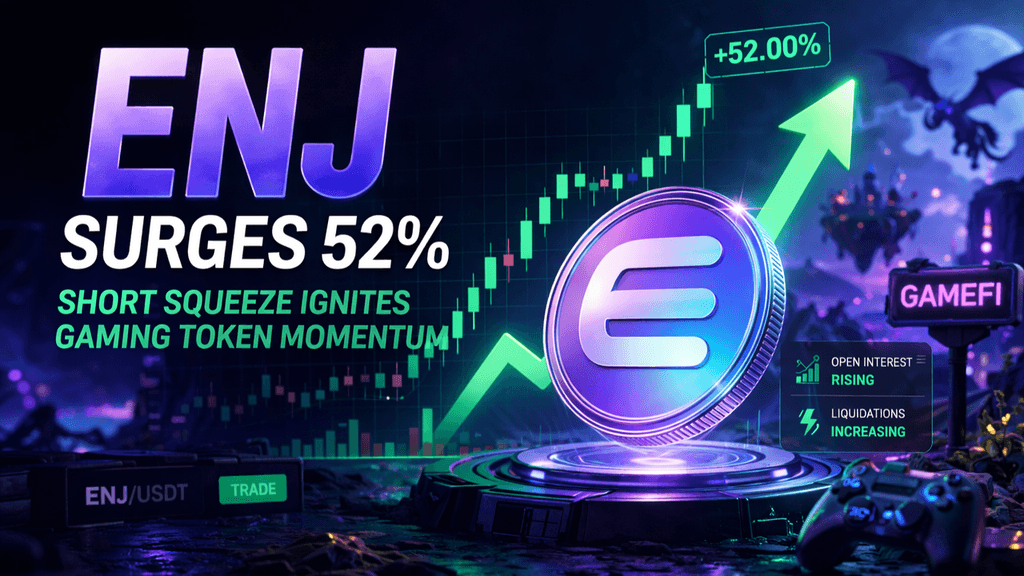
Enjin Coin did not quietly drift back into relevance. It exploded higher, ripping more than 50% in a move that instantly pulled traders, speculators, and GameFi watchers back toward one of crypto’s oldest gaming-linked tokens. Sharp rallies happen all the time in altcoins, but ENJ’s breakout stood out because it had the exact ingredients that tend to produce violent price dislocations in crypto: leverage building under the surface, short sellers leaning too hard into weakness, and a fresh ecosystem catalyst arriving at the moment positioning became dangerously crowded. KuCoin’s market coverage described the rally as a 52% price surge during an otherwise bearish backdrop, while CoinGlass’ ENJ futures pages show the kind of open-interest and liquidation framework traders use to track squeeze conditions in real time.
That matters because the story is bigger than a single green candle. When a token rises because of simple spot demand, the move can be significant, but it is often gradual. When a token rises because bearish traders are trapped and forced to buy back exposure, the rally can become reflexive and disorderly. Losses on the short side create urgent buying, that buying pushes price higher, and higher prices force even more bears to unwind. In a market like crypto, where liquidity can thin out fast and derivatives positioning can become crowded quickly, that chain reaction can turn an ordinary breakout into a full-blown squeeze.
ENJ is the governance and utility token powering the Enjin blockchain and its broader product stack, while recent Enjin changelog updates show the project is still shipping chain-level improvements rather than simply relying on legacy brand recognition. That gave traders a reason to talk about ENJ as more than a chart pattern. It became a market structure story supported by a real project-development angle.
The bigger question now is whether ENJ was just a one-off squeeze or the first sign that gaming tokens are starting to matter again. That is where this move becomes more interesting. Once one recognizable GameFi token catches fire, traders usually start scanning the rest of the sector for names with similar ingredients: active ecosystems, visible infrastructure upgrades, better onboarding, stronger token utility, or enough mindshare to benefit from a sudden return of speculative attention. ENJ may not be the only chart the market ends up watching.
What Fueled ENJ Explosive Rally
The clearest driver behind ENJ’s move was rising activity in the derivatives market. The 52% surge in ENJ even while the broader technical picture remained fragile, and it pointed specifically to overbought conditions and rising open interest. That matters because open interest is one of the strongest signals that leverage is building. When price climbs alongside expanding open interest, it usually means traders are adding fresh positions rather than simply rotating spot holdings. That kind of setup can make price action far more unstable in the short term.
Several forces came together at once, turning ENJ’s rally from a routine breakout into a much more aggressive squeeze-driven move. The setup was not built on price action alone. It was reinforced by leverage, short-covering pressure, project-level developments, and the broader appeal of the gaming-token narrative.
-
Leverage built beneath the surface: The CoinGlass tracks futures volume, open interest, long-short ratios, funding conditions, and liquidation data for ENJ, which gives traders a clearer read on whether a rally is being driven by leverage rather than natural spot demand. In ENJ’s case, the token did not just move higher on ordinary buying pressure. It traded inside the kind of market structure where squeeze conditions can develop quickly.
-
Short sellers were forced to react: The second major driver was short pressure. A short squeeze happens when traders expecting further downside suddenly find themselves trapped in a fast-rising market. Since short positions cannot absorb unlimited losses, they eventually have to be closed. That means buying back exposure, and that forced buying adds even more momentum to the rally. This is why short squeezes often look irrational from the outside. They are not only driven by bullish conviction, but also by traders being forced out of losing positions. ENJ’s sharp repricing fits that pattern closely.
-
Bearish positioning became vulnerable: KuCoin’s flash coverage described the surge as happening during an otherwise bearish trend, which is an important detail. It suggests that many traders were still leaning negative just as ENJ started breaking higher. Once price pushed beyond those expectations, bearish positioning became fuel for the rally rather than resistance against it.
-
A fresh Enjin narrative supported the move: The third driver was a live project-level catalyst. Enjin’s official site still presents ENJ as the governance and utility token at the center of its blockchain ecosystem, and the company’s changelog points to ongoing upgrades across relaychain and matrixchain infrastructure. Those improvements are aimed at network functionality, speed, and usability, showing that the project is still actively evolving instead of relying only on old brand recognition.
-
Technical updates gave traders a reason to care: Recent changes have also included wallet improvements and token-teleporting features that make the ecosystem more usable. On their own, those updates may not seem dramatic enough to trigger a breakout. But in a market where leverage is already building, even practical technical improvements can give traders the narrative justification they need to reprice a token aggressively.
-
Gaming-sector recognition amplified the move: The fourth driver was category recognition. ENJ sits inside a market theme traders already understand well: blockchain gaming. That matters because strong narratives travel faster when they belong to an established sector. A gaming token with a recognizable history can attract attention much more quickly than a technically complex token with no obvious story attached to it.
-
ENJ already had a clear market identity: Once ENJ started breaking out, the market did not need time to figure out what the token represented. Traders already knew how to frame it: GameFi, gaming infrastructure, NFT-linked ecosystems, and legacy Web3 gaming exposure. That familiarity helped the rally spread faster across trading circles and made the breakout easier for momentum-driven participants to follow.
What ENJ Breakout Could Mean for Gaming Tokens
The most important takeaway is not that ENJ suddenly became the undisputed leader of crypto gaming. It is that gaming tokens may be entering one of those periods where the market becomes willing to price in their narratives again.
Narrative sectors in crypto tend to go dormant for long stretches. During those phases, even solid project updates can fail to move price because liquidity is focused elsewhere. Then a catalyst lands, a squeeze erupts, or one token grabs attention, and the whole category comes back into focus almost overnight. ENJ’s surge has that feel. It may not single-handedly restart GameFi, but it has reminded the market that gaming-linked assets can still produce outsized moves when leverage and narrative align.
That matters because gaming tokens are especially sensitive to sentiment. They sit at the intersection of crypto speculation, user-growth expectations, infrastructure expansion, and consumer-facing narratives. A token does not need to become fundamentally perfect to rally. It only needs a believable story, active ecosystem signals, and enough attention to attract both traders and momentum capital. ENJ had that combination for a brief but powerful window. The rest of the sector is now being judged through that lens.
Which gaming tokens could move next
The smarter way to look for follow-on candidates is not to chase the smallest token or the most dramatic social-media thread. It is to identify projects with live ecosystem momentum, visible product evolution, and narratives that are easy for the market to understand quickly.
1.Immutable (IMX)
Immutable remains one of the strongest infrastructure names in blockchain gaming. Its Passport product page highlights frictionless onboarding, single-login identity, and wallet integration, while noting that more than 700 funded games are building with Immutable. That scale matters because infrastructure projects tend to outperform in narrative revivals when they can point to developer adoption rather than just token speculation.
There is also a current structural story around the chain itself. Recent coverage of Immutable’s network consolidation described the merging of Immutable X and zkEVM into a more unified chain architecture, with the goal of simplifying developer experience and reducing fragmentation. Even where outside reporting fills in some details, the broader direction is consistent with Immutable’s current positioning: simplify onboarding, unify the ecosystem, and make Web3 gaming easier to build on and use.
Passport adoption adds another layer. Immutable’s own recent updates state that Passport signups have passed 3 million, while earlier company material highlighted previous milestones on the way there. In a sector where user friction is often the biggest barrier to growth, a product aimed at reducing that friction can become a meaningful part of the investment narrative around the token.
2.Ronin (RON)
Ronin has one of the clearest gaming identities in the market. It is not a general-purpose chain trying to borrow GameFi relevance after the fact. Ronin’s brand and ecosystem are built around gaming from the start. Its “Homecoming to Ethereum” update described the network evolving from an Ethereum sidechain into a fuller layer-2 while keeping a focus on gamified experiences, faster transactions, and more apps and games. That is a significant narrative because it combines technical evolution with sector consistency. Ronin is upgrading, but it is not abandoning the core identity that made it recognizable.
The broader ecosystem numbers help too. Ronin’s current site highlights billions in all-time DEX volume, billions in NFT volume, significant TVL, and a long list of featured or upcoming games. Those figures do not automatically make RON the next squeeze candidate, but they do show that Ronin still has visible network activity and a meaningful gaming footprint. In speculative rotations, familiarity and ecosystem depth can matter almost as much as near-term token-specific catalysts.
3.Gala (GALA)
Gala remains one of the better-known names in blockchain gaming, and recent project updates show it still has live ecosystem momentum. Gala News reported in March that GalaChain had processed more than 28 million blocks, framing the chain as an ecosystem already operating at scale. That kind of milestone helps counter the idea that GameFi projects are only narrative shells. It gives the market something measurable to point to.
The recent cadence of GalaChain updates is also notable. Gala’s own news pages reference ChainMeter, GalaSwap growth, access to more than 60 tokens across GalaChain, and ecosystem-linked launches such as Shrapnel’s Steam Early Access move tied to GalaChain infrastructure. That steady stream of development is useful in speculative markets because it gives traders multiple angles to work with: chain growth, token access, ecosystem tooling, and game-linked distribution.
4.SuperVerse (SUPER)
SuperVerse stands out because it has made token utility central to its pitch. The project’s main site describes SuperVerse as a Web3 gaming network focused on liquidity protocols and says SUPER is being integrated into industry-leading Web3 games. Its docs go further, calling SUPER a multichain token that powers transactions, governance, and value capture across the broader ecosystem. That is important because when traders rotate into gaming tokens, they often prefer assets that have a clear “what does this token actually do?” answer. SuperVerse has made that answer easy to communicate.
There is also an active staking and DAO layer around the token. SuperVerse’s staking pages say community members can stake SUPER and eligible NFTs to receive ETH rewards generated by ecosystem fees and royalties, while the docs describe a staking design tied to decentralized network participation rather than a simple fixed-reward model. That gives SUPER a live utility-and-engagement framework instead of a purely narrative identity.
Its integration story matters too. The integrations page positions SUPER as a connective token across multiple gaming titles, which is exactly the kind of cross-ecosystem pitch that can gain traction if the market starts looking for broad GameFi exposure instead of single-game bets.
What to Watch Before the Next Gaming Token Move
If ENJ’s rally is an early sign that gaming tokens are starting to attract attention again, the next step is not to assume every GameFi token will immediately follow. A better approach is to watch for the same signals that made ENJ’s breakout stand out in the first place.
-
Open interest growth: If another gaming token starts climbing while open interest also rises, that can be an important sign that leverage is building behind the move. This matters because rallies supported by growing derivatives exposure often have a higher chance of turning into squeeze-driven moves rather than simple spot-led price increases.
-
Signs of leverage, not just price strength: Futures data can help show whether a rally is gaining strength from leveraged positioning or just drifting upward on ordinary buying. When a token moves higher alongside stronger open interest, funding activity, and liquidation pressure, the structure becomes much more interesting.
-
A real catalyst behind the move: The market usually reacts much more strongly to meaningful developments than to vague announcements. Real upgrades, ecosystem mergers, onboarding improvements, network expansion, and user-growth milestones tend to carry more weight than generic hype posts or recycled roadmap promises.
-
Project-specific narratives that traders can understand quickly: ENJ had a clear combination of leverage and narrative. Other gaming tokens also have stories the market can follow. IMX has ecosystem simplification and Passport growth. Ronin has a strong Ethereum layer-2 evolution story. Gala has visible chain growth and frequent ecosystem updates. SuperVerse has cross-game utility and staking mechanics that are easy for traders to understand.
-
Confirmation from the broader gaming-token sector: If gaming tokens are truly rotating back into focus, the move should not remain limited to one name for long. Traders should watch for signs that multiple tokens in the sector are starting to attract stronger price action, more attention, and better participation.
-
Evidence that ENJ was the spark, not the whole story: A genuine sector revival does not need every token to explode at once, but it should show at least some follow-through across the category. The goal is not to look for instant mania. It is to see whether ENJ’s breakout was the first sign of a wider shift in sentiment rather than a single isolated event.
Follow ENJ Live on KuCoin
Who want to keep a closer eye on the move can follow ENJ directly on KuCoin, where live market data offers a more practical view of how the token is trading in real time. The ENJ price page on KuCoin gives access to current price action, chart movement, and broader market activity, making it useful for tracking how momentum is developing. For those who want a more direct market view, the ENJ/USDT trading pair on KuCoin provides a closer look at one of ENJ’s main trading markets.
Watching ENJ on KuCoin allows readers to follow the token beyond the headline, see how active the market remains, and better understand whether momentum is still building or starting to cool.
Conclusion
ENJ’s sharp rally was more than a routine altcoin spike. It showed how quickly a gaming token can move when leverage builds, bearish positioning gets crowded, and a live project narrative gives the market a reason to pay attention. That combination is what turned ENJ from a quiet chart into one of the more closely watched moves in the sector.
Just as importantly, the rally has reopened the conversation around gaming tokens more broadly. It does not mean every GameFi project is about to break out, and it does not guarantee that ENJ’s momentum will continue at the same pace. What it does suggest is that traders are once again willing to react to strong narratives, visible ecosystem progress, and sector-wide momentum when the setup is right.
For readers following this trend, the bigger takeaway is not just what happened to ENJ, but what it could mean for the rest of the market. If attention keeps spreading across gaming-linked assets, the next move may come from tokens with similarly strong stories, improving ecosystems, and the kind of trading activity that can attract both momentum and renewed speculative interest.
FAQs
Why did ENJ rise more than 50%?
ENJ surged because several bullish factors came together at once. Rising open interest, short-covering pressure, and renewed attention around Enjin’s ecosystem helped create the conditions for a sharp move higher.
Was ENJ’s rally a short squeeze?
It had many of the characteristics of a short squeeze. The rally happened while bearish sentiment was still present, and the combination of rising leverage and forced buybacks likely added momentum to the move.
What is a short squeeze in crypto?
A short squeeze happens when traders betting on lower prices are forced to close their positions as the market moves against them. Since closing a short requires buying back the asset, that buying pressure can push the price even higher.
Why does open interest matter in a move like this?
Open interest helps show whether new leveraged positions are entering the market. When price rises alongside growing open interest, it can suggest that leverage is building, which often makes price action more aggressive and less stable.
Does ENJ’s rally mean GameFi is back?
Not necessarily, but it does suggest that gaming tokens are getting more attention again. One strong move does not confirm a full sector-wide comeback, though it can be an early sign that sentiment is improving.
Which gaming tokens could traders watch after ENJ?
Tokens such as IMX, RON, GALA, and SUPER are often mentioned because they have active ecosystems, recognizable market narratives, and ongoing developments that could attract attention if interest in gaming tokens continues to grow.
What should traders watch next after ENJ’s breakout?
The most important things to watch are open interest, liquidation activity, sector-wide follow-through, and whether other gaming tokens start seeing stronger narratives and rising market participation. Those signals can help show whether ENJ was a one-off move or part of a bigger shift.
Disclaimer: The information provided on this page may originate from third-party sources and does not necessarily represent the views or opinions of KuCoin. This content is intended solely for general informational purposes and should not be considered as financial, investment, or professional advice. KuCoin does not guarantee the accuracy, completeness, or reliability of the information, and is not responsible for any errors, omissions, or outcomes resulting from its use. Investing in digital assets carries inherent risks. Please carefully evaluate your risk tolerance and financial situation before making any investment decisions. For further details, please consult our Terms of Use and Risk Disclosure