



Original author: Ben Weiss
DeepFlow Tech
Overview: Fortune reporters obtained a batch of unpublished financial disclosure documents from the SEC, revealing that the assets under management (AUM) of top-tier crypto VCs—including Paradigm, Pantera, a16z crypto, and Multicoin—all declined in 2025. However, the decline isn’t entirely negative—a16z crypto returned capital to LPs at market peaks, achieving a DPI of 5.4x for its first fund. The only firm to grow逆势 was Haun Ventures, which successfully bet on the stablecoin sector through its investment in BVNK’s acquisition by Mastercard.
Top crypto VCs couldn't avoid the 2025 market crash.
Fortune reporter Ben Weiss obtained a batch of previously unreleased investment advisor financial disclosure documents from the U.S. Securities and Exchange Commission (SEC). The data is straightforward: top-tier firms like Paradigm and Pantera Capital collectively saw their AUM decline in 2025.
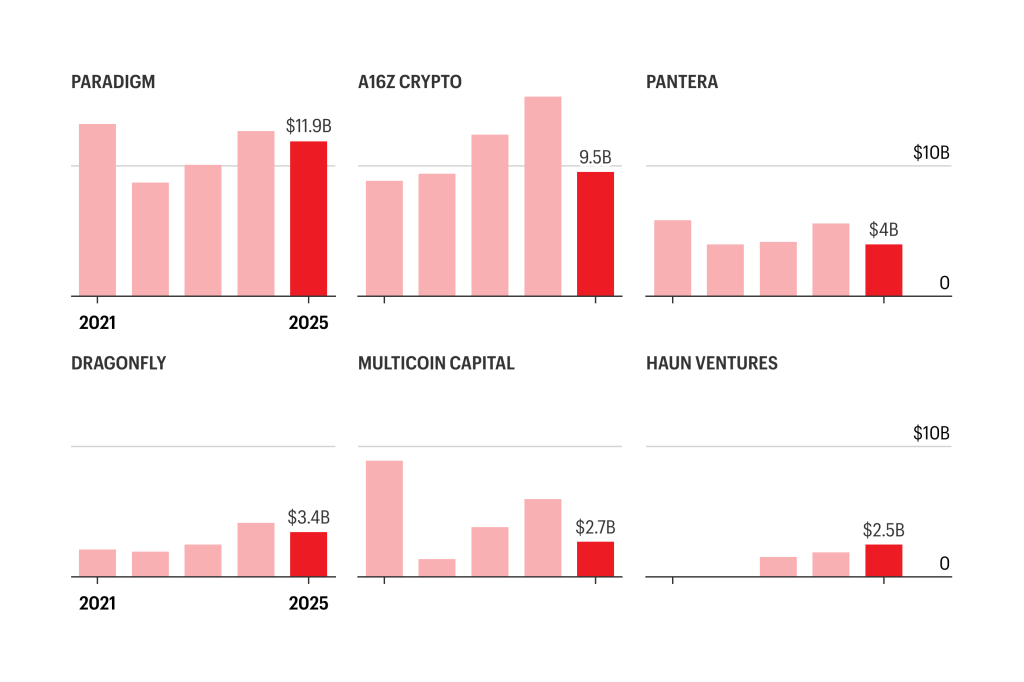
Caption: Change in Assets Under Management (AUM) of Top Crypto VCs from 2021 to 2025
Illustration: Ben Weiss / Fortune
But before listing the numbers, it’s important to clarify one key point: AUM is not a good metric for measuring the success of VCs. It does not reflect new fund raises, LP exit distributions, or capital calls. Cryptocurrency asset prices themselves are highly volatile—just one tweet from an emotionally unstable individual can send prices on a rollercoaster ride (choose any one: Musk, Trump, CZ). Established crypto VCs have experienced the surge in asset values during the 2021 NFT boom, as well as the subsequent sharp declines during the “crypto winter.”
Original author Ben Weiss also emphasized: True top investors ultimately return money to LPs. AUM fluctuations in the short term do not reflect performance quality.
Understand this premise before looking at the specific data.
a16z Crypto: AUM shrank by nearly 40%, but funds were returned to LPs
The combined AUM of a16z Crypto’s four crypto funds dropped nearly 40% in 2024 to $9.5 billion. During the same period, the parent company Andreessen Horowitz’s assets under management grew to over $100 billion.
One reason for the decline is that the firm has begun distributing returns from its first three funds back to LPs. According to knowledgeable sources, a16z crypto intentionally chose to make these distributions at the peak of the 2025 crypto market.
How did it perform? According to Newcomer’s data, a16z’s first crypto fund achieved a net DPI (distributions to paid-in capital) of 5.4x. This return is notably strong compared to other VC funds raised in 2018 on the Carta platform.
In other words, the reduction in AUM at a16z crypto is more a result of profiting and returning capital to LPs, rather than a collapse in portfolio holdings.
Multicoin: AUM halved to $2.7 billion
Multicoin Capital's fate is deeply tied to the cryptocurrency market. During the 2021 crypto boom, its AUM nearly tripled in one year, approaching $9 billion. After the FTX collapse, it plummeted directly, then gradually recovered over the following two years.
But the 2025 downturn pushed it back down again. From 2024 to 2025, Multicoin’s AUM shrank by more than half, falling to approximately $2.7 billion. Since Bitcoin began its sharp decline in October 2025, all crypto assets have retraced, and Multicoin’s structure—simultaneously operating a hedge fund and a venture capital fund—has been hit hardest.
Background addition: Kyle Samani, co-founder of Multicoin, left the company in February this year to pursue investments in other areas of technology.
Pantera: Five portfolio companies go public, returning capital to LPs
Pantera Capital's AUM also declined, but, similar to a16z, part of the reason was active distributions to LPs.
According to sources familiar with the matter, Pantera had five portfolio companies go public in 2025, including Circle and BitGo. These exits generated significant cash returns.
Haun Ventures: The only fund with growth despite market conditions, AUM increased by over 30%.
Amidst a wave of cutbacks, Haun Ventures was the only exception.
The firm, founded by former a16z crypto partner Katie Haun, has seen its AUM grow more than 30% year-over-year, nearing $2.5 billion. This growth is partly due to successful bets on emerging sectors—such as its investment in the stablecoin company BVNK, which was acquired by Mastercard for up to $1.8 billion. Additionally, Haun Ventures itself raised a new $1 billion fund in 2025.
A new funding round has been launched.
Although AUM has contracted, leading institutions have not slowed down:
Paradigm is raising a new fund of up to $1.5 billion. a16z crypto is raising up to $2 billion. Dragonfly has just closed its fourth fund at $650 million. After the article was published, Fortune added a correction: a Dragonfly spokesperson actually responded, confirming the data was “accurate” and stating, “We are actively deploying capital.”
Speakers from Paradigm, Pantera, a16z crypto, Multicoin, and Haun Ventures declined to comment.
The Cyclical Fate of Crypto VCs
The original text ends here, but a few contextual details are worth adding.
Crypto VCs differ fundamentally from traditional tech VCs. Traditional VCs invest in equity and exit through IPOs or acquisitions. Many crypto startups have their own tokens, so VCs’ holdings are directly exposed to token price volatility.
Multicoin is the most extreme example: according to Fortune, its assets surged by 20,287% from 2017 to 2021, then declined by 90% in 2022—a magnitude unimaginable in traditional venture capital.
According to Pantera Capital’s early-year outlook report, the total market capitalization of non-BTC cryptocurrencies (excluding ETH and stablecoins) has declined by approximately 44% from its peak at the end of 2024. However, historically, bear markets have also presented buying opportunities. Several leading institutions are currently raising funds aggressively, betting on the next cycle.
According to a prior exclusive report by Fortune, a16z crypto’s fifth fund plans to complete fundraising in the first half of 2026, led by Chris Dixon, and will continue to fully bet on blockchain. Meanwhile, according to the Wall Street Journal, Paradigm’s new fund will expand into AI and robotics. The two strategies are clearly distinct: a16z remains all-in on crypto, while Paradigm opts for cross-sector hedging.