





While the broader crypto market spent February 2026 moving sideways amid global uncertainty, one ecosystem seemed to follow a different path.
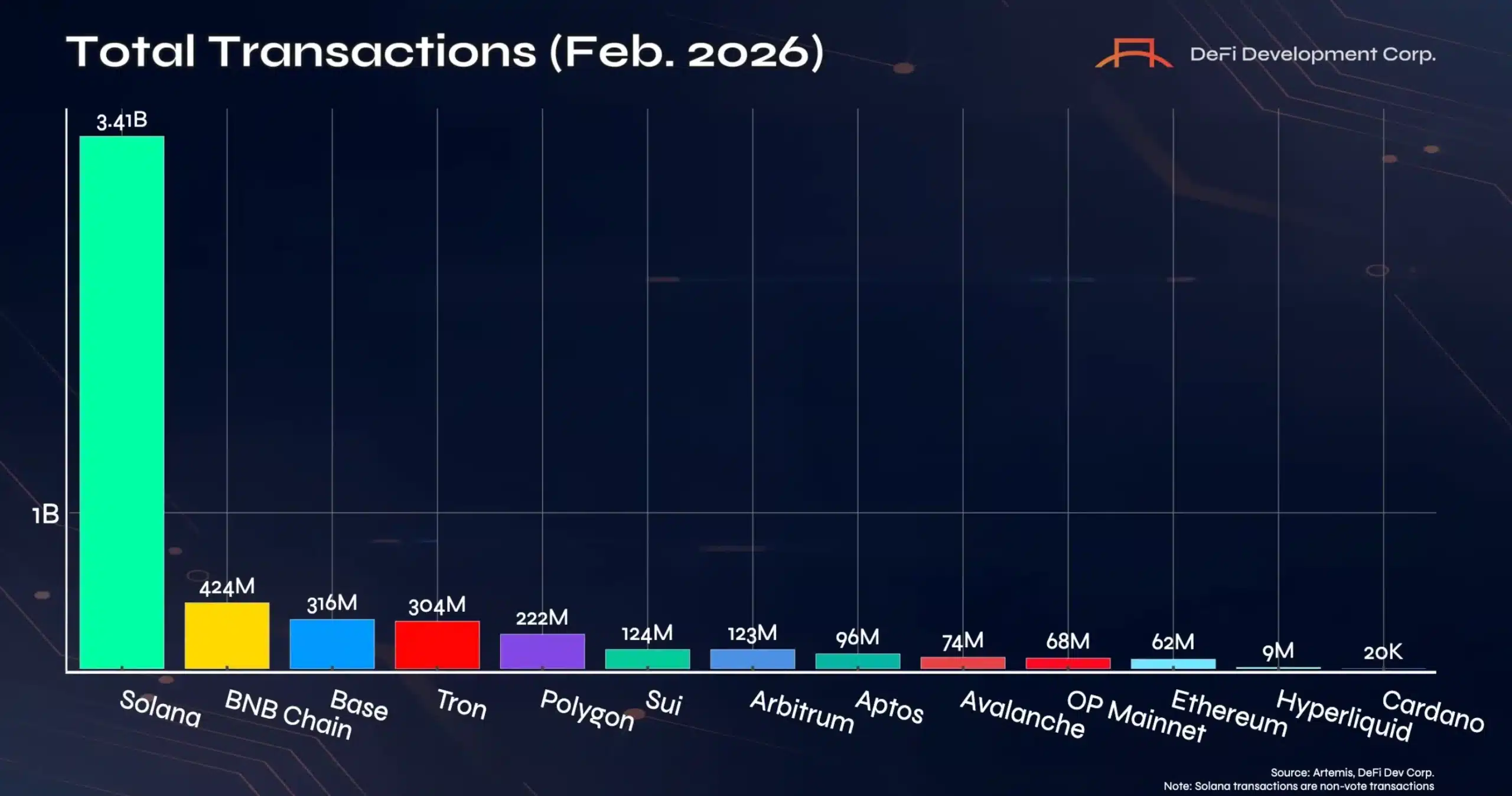
New data from DeFi Dev Corp. (DFDV) shows that Solana [SOL] processed over 3.4 billion transactions in February, marking an 11% increase compared to January.
This is noteworthy because during the same period, major networks like Ethereum [ETH] and Bitcoin [BTC] saw activity slow down as market sentiment weakened.
How are other chains performing?
Following behind Solana is the second-largest network, BNB Chain, which handled around 424 million transactions.
This means that Solana processed about eight times more activity than its closest competitor, dwarfing other networks’ on-chain activity.
Source:
DeFi Dev Corp./X
The data also reveals an important trend within the Ethereum ecosystem wherein Ethereum’s main network recorded only 62 million transactions, placing it near the bottom of the list.
Is Ethereum in trouble?
Even though Ethereum’s main network saw significantly fewer transactions, this does not mean the ecosystem as a whole is declining.
Instead, much of the activity has moved to Layer-2 networks, which offer lower costs and faster transactions.
For example, Base, the Layer-2 network backed by Coinbase, processed 316 million transactions, showing strong retail activity. Meanwhile, Arbitrum recorded 123 million, and Optimism recorded 68 million, and continued to see stable usage.
This suggests that Ethereum’s biggest competitor may not be another Layer-1 chain. Instead, its own scaling networks are gradually absorbing most of the activity, though even these networks still fall far behind Solana’s transaction volume.
Solana witnsses strong institutional push
Beyond network activity, Solana also saw strong support from institutional investors.
Since their launch, Spot Solana ETFs have attracted around $950 million in net inflows with mostly inflow streaks, according to data from Farside Investors.
Meanwhile, on the price front, like many assets that struggled to find direction in February, SOL too witnessed a monthly decline of over 12%, but at press time, it traded around $90.09, rising 7.46% within 24 hours.
Moreover, this coincided with AMBCrypto’s report about Solana holding ~53% of the $15.34 billion USDC supply, making it one of the largest hubs for stablecoin activity.
What is the data saying?
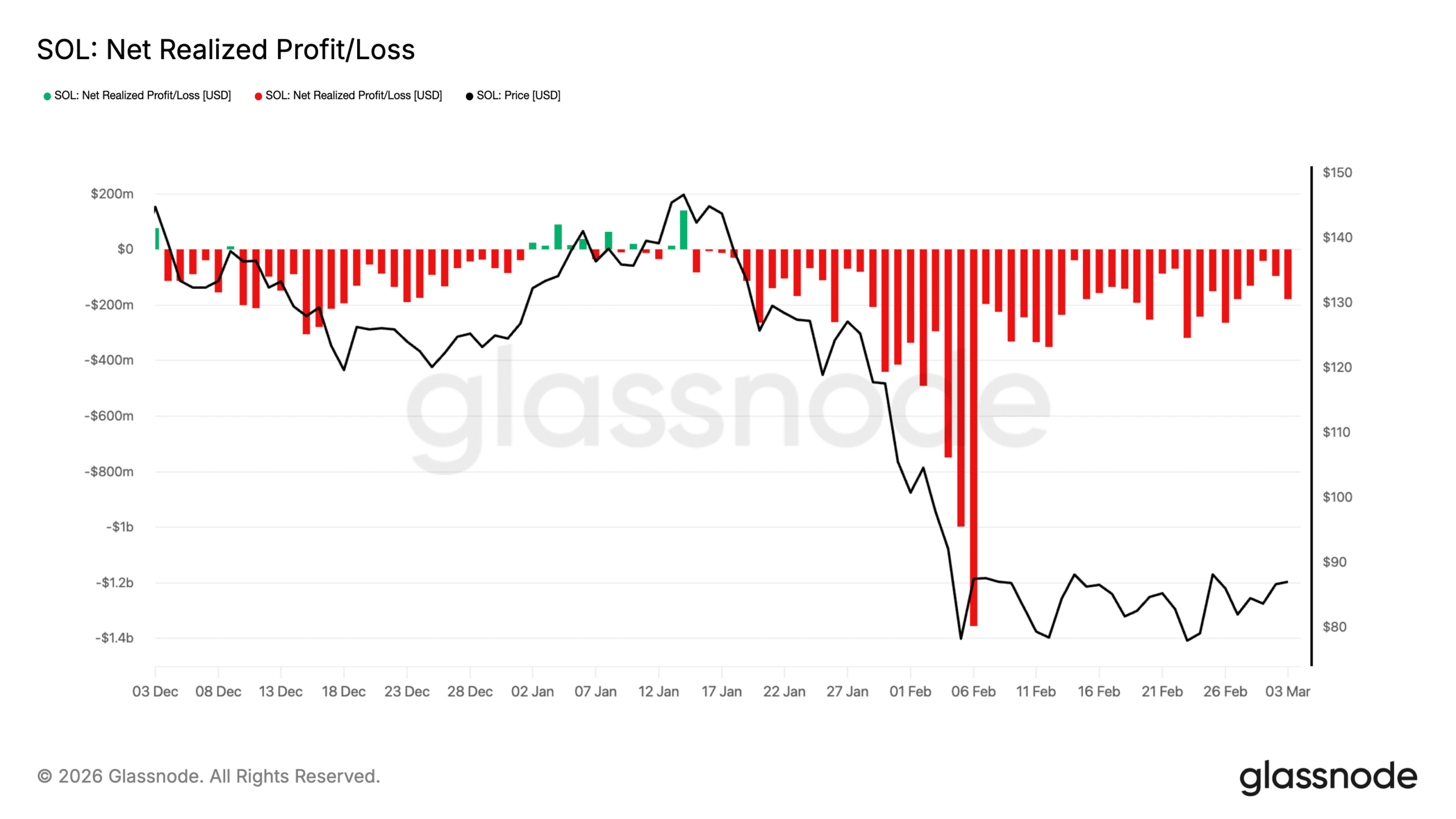
According to Santiment data, Solana’s Net Realized Profit/Loss remained largely negative throughout late January and February, with most bars turning red. This signals that many holders were selling their tokens at a loss as prices declined.
Source: Glassnode
Furthermore, a major spike in early February shows losses nearing $1.3 billion, suggesting a wave of panic selling as SOL dropped sharply from around $140 to below $90.
Since then, the size of the loss bars has gradually decreased, indicating that selling pressure is easing as the price stabilizes between $80 and $90.
This trend suggests that much of the forced selling may already have occurred, with the market entering a more stable phase.
Yet, despite the strong numbers, an important question remains: can this momentum continue in the months ahead, or will market conditions begin to slow it down?
Final Summary
- Processing 3.4 billion transactions in a single month places Solana far ahead of competing blockchains in raw activity.
- Realized loss data shows that much of the panic selling may have already occurred, with selling pressure gradually easing as the price stabilizes.