


Volatility Intensifies as Strait of Hormuz Tensions Fluctuate
Summary
-
Macro: Geopolitical tensions continued to escalate, with Iran claiming full control of the Strait of Hormuz, sending global oil prices sharply higher and pushing U.S. equities to open lower. The U.S. later announced military protection and insurance support for oil tankers transiting the strait, easing concerns over surging energy costs. Crude oil, the U.S. dollar, and Treasury yields retreated significantly from intraday highs, while U.S. equity indices narrowed their losses.
-
Crypto Market: Bitcoin moved in line with U.S. equity futures, declining during the Asian session before rebounding and trimming losses. The market remained range-bound throughout the day, with fear sentiment largely unchanged. Bitcoin dominance rose for a second consecutive day to 59.12%, indicating a gradual concentration of capital into BTC.
Project Updates
-
Trending Tokens: FORM, RIVER, CLAWNCH
-
FORM: Four.Meme released its AI Agent roadmap, aiming to accelerate AI adoption on BNB Chain.
-
1INCH: 1inch completed a platform upgrade, reducing median transaction execution time to 14 seconds.
-
CLAWNCH: Clawnch is a token launch platform built specifically for AI Agents on the Moltbook platform. Bots can post via Moltbook and deploy tokens rapidly on the Base chain using the Clawnch API, based on the Clanker protocol. $CLAWNCH is the first token deployed through the platform. Social media discussion has surged, with market cap rebounding to $7 million and a 15% gain over the past 24 hours.
-
POWER: The POWER team transferred $29 million worth of tokens, with the token price plunging nearly 90% today.
Major Asset Changes
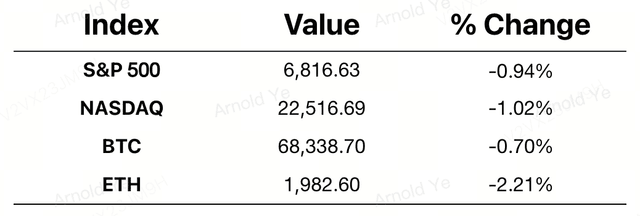
Crypto Fear & Greed Index: 10 (24h ago: 14) — Extreme Fear
Today’s Focus
-
U.S. February ADP Employment Change
-
Federal Reserve Beige Book release
Macro Highlights
-
Trump: A five-month window remains to impose a 15% tariff on various countries, after which country-specific tariffs will be gradually announced.
-
Fed’s Kashkari: The conflict has clouded the monetary policy outlook; if inflation cools, one to two rate cuts later this year could be appropriate.
-
Fed’s Schmid: The U.S. is expected to introduce substantial fiscal stimulus in 2026.
-
Trump: Short-term oil price increases are tolerable, prioritizing the elimination of the Iranian threat.
-
Iran claims full control of the Strait of Hormuz; over a dozen oil tankers reportedly struck by shells.
-
The U.S. will provide insurance and naval escorts for tankers transiting the Strait of Hormuz.
Policy Developments
-
Trump urged passage of the “Clarity Act,” accusing the banking sector of obstructing legislative progress.
-
The U.S. SEC halted a new round of high-leverage ETF proposals.
-
Indiana’s governor signed a Bitcoin Rights bill, allowing digital assets in state retirement plans.
-
Brazil’s central bank now requires crypto exchanges to provide daily proof of reserves and segregate client funds.
Industry Highlights
-
KuMining 2.0 is now officially launched. By introducing innovative features, it transforms cloud mining from a “sales revenue expectation” model into a highly flexible “hashrate service” and “actual hashrate holding” model.
-
Sony Bank partnered with yen stablecoin JPYC, enabling users to purchase JPYC directly from bank accounts.
-
Tether and the City of Lugano, Switzerland, will jointly invest CHF 5 million to advance Phase II of the Plan B initiative.
-
A U.S. government-linked address transferred two additional BTC transactions, totaling 0.3346 BTC within two hours.
Deep Dive: Industry Dynamics Analysis
KuMining 2.0: A Paradigm Shift from "Revenue Expectations" to "Hashrate Sovereignty"
The official launch of KuMining 2.0 marks a fundamental restructuring of the cloud mining industry’s underlying logic. Traditionally, cloud mining has been treated as a financial product where users essentially purchase an "expectation" of future returns; however, the 2.0 version transforms this into a flexible hashrate service and actual hashrate holding model. By introducing innovative features such as dedicated "Hashrate Accounts" and flexible payment structures (e.g., post-paid electricity fees), users can now manage their digital mining power with the same precision as physical assets across various cycles (7–360 days). This shift enhances transparency and liquidity, turning cloud mining from a "black box" investment into a verifiable, tradable digital resource.
Sony Bank & JPYC: Bridging the "Last Mile" Between Fiat and Stablecoins
Sony Bank’s partnership with JPYC represents a strategic move to pave a highly competitive "on-ramp" within Japan’s regulatory framework. The core of this collaboration lies in direct bank-to-stablecoin integration, allowing users to purchase the yen-pegged stablecoin, JPYC, directly from their bank accounts without the friction of interbank transfers or exchange intermediaries. Beyond simplifying entry into the Web3 space for retail users, the initiative aims to expand JPYC’s utility into Sony’s vast entertainment ecosystem—including gaming and music—positioning stablecoins as the foundational settlement layer for the next generation of digital content consumption.
Tether & Lugano: Phase II of Plan B as an Experiment in "Digital Sovereignty"
The joint investment of CHF 5 million by Tether and the City of Lugano for Phase II of the Plan B initiative signals that cryptocurrency application is moving from "payment method" to "urban infrastructure." Following a successful Phase I, which onboarded over 400 merchants and saw the issuance of digital bonds, Phase II focuses on long-term institutional integration. This includes developing decentralized identity (DID) systems, fostering local AI ecosystems, and strengthening the city’s digital resilience. This is no longer just about Bitcoin adoption; it is a global pioneering experiment in how a modern city can achieve technical autonomy and reduce its reliance on centralized financial systems.
U.S. Government Wallet Activity: "Micro-Transfers" Under the Global Spotlight
A U.S. government-linked address recently executed two Bitcoin transactions totaling 0.3346 BTC within a two-hour window. While the amount is negligible in market terms (approx. $22,000), such movements are often interpreted as "test transactions" by market analysts. Given that the U.S. government remains one of the largest holders of Bitcoin—primarily seized from criminal cases like Silk Road—any activity from these wallets triggers heightened sensitivity. These small-scale transfers typically precede larger asset liquidations or transfers to institutional custodians, reflecting the ongoing professionalization and compliance-driven nature of government-held digital asset management.
