



Escalating Geopolitical Tensions Weigh on Risk Markets; Bitcoin Volatility Intensifies but Impact Remains Contained
Summary
-
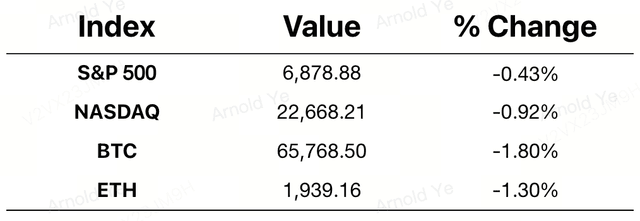
Macroeconomy: Renewed inflationary pressure combined with worsening geopolitical tensions delivered consecutive shocks to global risk assets. The Nasdaq and S&P 500 posted their largest monthly declines since March last year, while global equities broadly opened lower on Monday. Safe-haven flows rapidly shifted into gold and crude oil—both highly sensitive to geopolitical risk. Gold briefly surged above $5,300, and oil spiked to $75 before retracing, indicating a partial release of risk-off sentiment.
-
Crypto Market: Amid escalating geopolitical conflict over the weekend, crypto markets were among the first to react. Bitcoin fell to a low of $63,000 before rebounding. Compared with previous geopolitical flare-ups, the overall market impact was relatively manageable, with no disorderly sell-off. However, sentiment indicators remain in the “Extreme Fear” zone, and short-term risk appetite has yet to recover.
-
Project Updates:
-
Hot Tokens: XAUT/PAXG, AAVE, UNI
-
UNI: Uniswap initiated a multi-chain fee-sharing governance vote. The proposal plans to redirect at least one-sixth of transaction fees from certain networks—currently allocated to liquidity providers—into a “token jar,” to be distributed to UNI holders who burn an equivalent amount of UNI.
-
AAVE: The “Aave Will Win” Temp Check proposal has passed. The proposal aims to transition Aave Labs toward a fully token-centric model, allocating 100% of product revenue directly to AAVE token holders.
-
Major Asset Movements
Crypto Fear & Greed Index: 10 (24h ago: 14) — Extreme Fear
Today’s Outlook
-
ENA unlock: 0.53% of circulating supply (~$4.3 million).
Macroeconomy
-
The United States and Israel launched military strikes against Iran; multiple Iranian military commanders were confirmed killed.
-
Donald Trump stated that operations against Iran may last up to four weeks until objectives are achieved.
-
U.S. January PPI rose 0.5% MoM (vs. 0.3% expected) and 2.9% YoY (vs. 2.6% expected).
Policy & Regulatory
-
The SEC Chair stated that the U.S. had previously “missed significant opportunities” in crypto and is now working to catch up.
-
UK regulators are considering allowing cryptocurrencies for gambling payments.
-
Minnesota proposed legislation to ban crypto ATMs to combat scams targeting the elderly.
Industry Highlights
-
KuCoin Ranks Among Top Three Exchanges in Animoca Brands Research 2025 Listing Report
-
Michael Saylor again posted a Bitcoin Tracker update, potentially signaling further accumulation disclosures next week.
-
X platform introduced a “Paid Partnership” label to enhance content transparency; promotions related to crypto and investment services may not qualify under the updated policy.
-
Vitalik Buterin stated Ethereum’s scalability roadmap will proceed in two phases (short-term and long-term), introducing multidimensional gas to prevent state bloat.
-
U.S. Crypto-chartered bank SoFi now supports Solana network deposits.
-
Morgan Stanley applied for a U.S. trust bank license to expand into crypto custody and staking, with plans to offer Bitcoin custody, trading, yield, and lending services.
-
MoonPay unveiled PYUSDx, a stablecoin issuance framework backed by PayPal’s PYUSD, enabling applications to launch their own stablecoins.
-
Barclays is exploring a blockchain-based payments platform, potentially incorporating stablecoins and tokenized deposits.
-
Citi plans to launch institutional-grade Bitcoin custody services in 2026.
-
SBI Holdings announced the launch of a yen-backed stablecoin, JPYSC.
Deep Dive: Industry Dynamics Analysis
-
KuCoin Ranks Among Top Three in Animoca Brands 2025 Listing Report
This report signifies a shift in exchange competition from "blind expansion" to "structured curation." KuCoin’s position in the top three for primary listings of major tokens (with a 31% year-over-year increase) demonstrates its prowess in identifying high-quality projects and managing risk. Notably, the report highlights that liquidity is concentrating in mid-to-large-cap projects ($100M+ FDV); KuCoin's market share in this segment reflects its ability to attract institutional capital seeking certainty rather than just chasing low-cap "meme" traffic.
-
Michael Saylor Posts Another Bitcoin Tracker Update
Saylor’s social media activity is widely interpreted as a signal that MicroStrategy is nearing the disclosure of its 99th Bitcoin acquisition. Following their massive "$42/$42" financing plan (raising $84 billion through equity and debt to buy BTC), these updates usually precede formal SEC filings. Amid global macro volatility, Saylor’s unwavering "Bitcoinization of the balance sheet" strategy is testing the limits of corporate treasury management while providing a formidable psychological floor for Bitcoin’s price.
-
X Platform Introduces “Paid Partnership” Label and Tightens Crypto Policy
This move is a direct response to global regulators (like the US SEC and FTC) demanding transparency in influencer marketing. By excluding financial products—including crypto and lending services—from certain paid partnership perks, X is dealing a blow to startup projects that rely on viral "shilling." Consequently, crypto information will transition toward organic reach or heavily vetted official ads, reducing the space for deceptive "stealth marketing" that often misleads retail investors.
-
Vitalik Buterin Outlines Ethereum’s Two-Phase Scalability Roadmap
The focus here is the "Glamsterdam" hard fork. In the short term, the introduction of Multidimensional Gas allows Ethereum to price resources like storage and computation independently, directly tackling "state bloat." In the long term, the roadmap shifts toward zkEVM integration and Data Availability Sampling (Peer DAS), aiming to boost mainnet throughput by 1,000x. This confirms Ethereum’s evolution from a simple smart contract platform into a highly efficient, sustainable global settlement layer.
-
SoFi Bank Supports Solana Network Deposits
As a US-chartered bank with over 13.7 million users, SoFi’s decision to allow direct SOL deposits is a landmark moment for public chain integration into traditional finance. This not only boosts Solana's liquidity but provides users with a bank-grade asset management experience within a regulated framework. It signals that the US financial establishment now views Solana as a top-tier institutional asset alongside BTC and ETH.
-
Morgan Stanley Applies for US Trust Bank License for Crypto Expansion
By applying for a "Morgan Stanley Digital Trust" charter, the investment giant is moving beyond selling ETFs to owning the underlying infrastructure. If approved, the bank could legally provide native custody, staking, and lending for assets like Bitcoin and Solana. This shift from "distributor" to "custodian" will significantly lower the technical barriers for massive pension and insurance funds, ushering in a true "Wall Street Custody Era."
-
MoonPay Unveils PYUSDx Stablecoin Framework
The core significance of PYUSDx lies in the "customization of stablecoins." Through MoonPay’s partnership with M0, developers can launch brand-specific stablecoins backed by PayPal’s PYUSD without rebuilding compliance or payment rails. This "plug-and-play" model drastically shortens the launch cycle for AI infrastructure, gaming, or e-commerce apps, while cementing PayPal’s leadership in the RWA (Real World Asset) settlement space.
-
Barclays Explores Blockchain-Based Payments Platform
Barclays’ exploration reflects the urgency major banks feel regarding payment efficiency. By evaluating stablecoins and tokenized deposits, Barclays aims to bypass the slow, high-cost clearing processes of the traditional SWIFT system. This puts them in direct competition with JPM Coin, suggesting that over the next few years, global retail banks will increasingly adopt "in-house chains" to enable 24/7 liquidity for fiat currencies on blockchain rails.
-
Citi Plans to Launch Institutional Bitcoin Custody in 2026
With roughly $30 trillion in assets under custody, Citi’s entry into the Bitcoin market will rewrite the competitive landscape. Unlike crypto-native custodians, Citi will integrate traditional tax reporting, compliance auditing, and API connectivity directly into crypto asset management. Their focus on "asset segregation and collateral management" addresses the primary concerns of institutional clients, paving the final mile for trillions in traditional assets to enter the space.
-
SBI Holdings Announces Launch of Yen-Backed Stablecoin JPYSC
Launched by SBI and Startale, JPYSC is a heavyweight product resulting from Japan’s amended Payment Services Act. As a "Type III Electronic Payment Instrument" backed by trust banks, it combines the efficiency of blockchain with high regulatory compliance. In the strictly regulated Japanese market, JPYSC is poised to become a vital bridge for B2B settlements, driving the practical use of "Digital Yen" in global financial ecosystems.
