



Macro Risks Trigger a Sharp Rise in Risk Aversion, Pressuring Cryptocurrencies
Summary
-
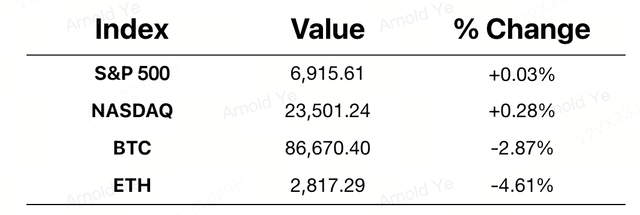
Macroeconomy: A rare “price inquiry” by the New York Fed was interpreted by markets as a signal that the U.S. may tolerate—or even assist—Japan in FX intervention, driving a sharp rebound in the Japanese yen. At the same time, the probability of a U.S. government shutdown by month-end surged to 75%, accelerating investors’ flight from risk assets. Nasdaq futures fell more than 1%, while safe-haven assets rallied sharply: gold broke above USD 5,000/oz for the first time in history, and silver surged past USD 100/oz.
-
Crypto Market: Heightened risk-off sentiment stemming from macro factors was amplified first in crypto markets, with overall sentiment remaining firmly in fear territory. Bitcoin fell to USD 86,000 during U.S. trading hours on Sunday, closing down 2.87% on the day. Ethereum underperformed further, declining 4.61%, while altcoins weakened broadly in tandem. In the short term, crypto assets remain clearly constrained by macro risk shocks.
-
Project Updates
-
Trending tokens: XAUT, TAIKO, PENGUIN
-
XAUT / PAXG: Risk-off sentiment propelled gold to a historic breakout above USD 5,000
-
TAIKO: Fabric plans to launch the ROBO token, with a public sale on Kaito starting Jan 26. TAIKO surged 48%, leading gainers
-
PENGUIN: Binance Alpha listed PENGUIN, combined with Elon Musk’s reply to a Grok-generated PENGUIN video, driving the meme token’s market cap to USD 160 million
-
AVAX: The VanEck Avalanche Spot ETF will begin trading on Nasdaq on Jan 26, 2026
-
BNB: Grayscale has submitted an S-1 filing to the U.S. SEC for a proposed BNB ETF
-
Major Asset Performance
Crypto Fear & Greed Index: 20 (25 24 hours ago), classified as Extreme Fear
Today’s Outlook
-
VanEck Avalanche Spot ETF to begin trading on Nasdaq
-
Fabric to launch ROBO token; public sale on Kaito starts Jan 26
-
BGB token unlock: 10.53% of circulating supply, worth approx. USD 508 million
Macroeconomy
-
U.S. January one-year inflation expectation (final): 4.0% (vs. 4.2% expected)
Policy Watch
-
India bans trading of privacy coins and requires exchanges to delist anonymous tokens
-
U.S. SEC drops its lawsuit against Gemini Earn
-
Official White House account posts that “the U.S. is already the global crypto capital,” with the CFTC set to follow up with regulatory and rules modernization
Industry Highlights
-
UBS plans to offer crypto trading services to select clients
-
Google Photos launches “Me Meme,” an AI-generated meme feature
-
Nasdaq applies to the SEC to remove position limits on Bitcoin and Ethereum ETF options
-
Bitcoin spot ETFs recorded net outflows of USD 1.328 billion last week, the second-largest on record
-
Nomura Holdings, SBI Holdings, and others plan to launch Japan’s first crypto ETFs
-
Michael Saylor released another Bitcoin Tracker update, potentially signaling additional purchases to be disclosed next week
Deep Dive into Industry Highlights
-
UBS to Offer Selective Crypto Trading Services
This move marks a historic shift for one of the world's largest wealth managers. By opening Bitcoin and Ethereum trading to select private banking clients in Switzerland, UBS is transitioning from a cautious observer to an active participant in the digital economy. For high-net-worth individuals (HNWIs), this provides a regulated, institutional-grade gateway to diversify portfolios, effectively bridging the gap between traditional private banking and the decentralized future.
-
Google Photos Launches "Me Meme" AI Feature
Google is leveraging generative AI to turn personal data into social capital. The "Me Meme" feature allows users to transform their own photos into AI-generated memes, signaling a broader trend where AI becomes a primary tool for digital identity and expression. This move highlights how tech giants are moving beyond simple storage and into the territory of AIGC (AI-Generated Content), which is increasingly overlapping with the NFT and digital collectibles sectors.
-
Nasdaq Petitions SEC to Remove ETF Option Position Limits
Nasdaq’s request to remove the 25,000-contract limit on Bitcoin and Ethereum ETF options is a critical step toward market maturity. By aligning crypto ETF options with the framework used for traditional equities, Nasdaq aims to provide institutional traders with the "liquidity depth" needed for sophisticated hedging and income-generation strategies. This regulatory evolution is essential for reducing the volatility of the underlying spot markets.
-
Record Net Outflows of $1.328 Billion from Bitcoin Spot ETFs
The second-largest outflow on record indicates a significant "de-risking" phase among institutional investors in early 2026. This trend suggests that capital is rotating out of high-beta assets in response to macro-economic uncertainty or shifts in central bank policy. However, while the $1.3 billion exit is substantial, it must be viewed in the context of the tens of billions in cumulative inflows, representing a healthy "market rebalancing" rather than a total exit from the asset class.
-
Japan’s First Crypto ETFs Planned by Nomura and SBI
Japan is entering a new era of institutional adoption as its largest asset managers prepare for the 2026 regulatory overhaul. The push by Nomura and SBI to launch crypto ETFs follows a potential shift in Japanese law that would reclassify digital assets as financial securities. This not only opens a compliant entry point for Japan’s massive retail and institutional capital pools but also positions Japan as a key competitor to Hong Kong and Singapore in the Asian digital asset race.
-
Michael Saylor Signals Imminent Bitcoin Purchase Disclosures
Michael Saylor’s recent "Bigger Orange" social media updates serve as a sophisticated signaling mechanism for MicroStrategy’s (MSTR) ongoing accumulation strategy. Having already acquired 22,305 BTC earlier this month, another imminent disclosure would reinforce Saylor's "Bitcoin Standard" treasury policy. For the market, these updates act as a psychological support level, demonstrating that institutional "conviction buyers" remain active even during periods of ETF outflows.
