


AI's disruptive impact triggers panic as Bitcoin hits new phase low
Summary
-
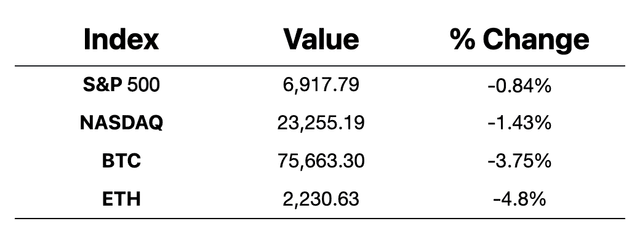
Macroeconomy:President Trump signed a funding bill, temporarily ending parts of the U.S. government shutdown and marginally easing near-term policy risks. However, a newly released AI tool by Anthropic sparked concerns about potential disruption to software business models, triggering panic selling in software stocks and dragging U.S. equities sharply lower. All three major U.S. indices closed down, with the Nasdaq falling nearly 1.5%. Capital rotated out of tech stocks into small-cap equities and gold: small caps rose 0.3% against the trend, while precious metals rebounded strongly—spot gold jumped more than 6% on the day, and silver’s intraday gain briefly approached 12%.
-
Crypto Market:The crypto market moved lower in tandem with the Nasdaq. Bitcoin briefly dropped to $72,835, breaking below its pre-tariff low from April last year. Despite a notable rebound into the close, the market remains in a weak recovery phase overall.
-
Project Updates
-
Hot Tokens: HYPE, STX, XAUT
-
HYPE: The Hyperliquid ecosystem is advancing the HIP-4 proposal and preparing to launch a prediction market. Revenues of Hyperliquid’s HLP surged due to liquidations of large whale positions. Meanwhile, dissatisfaction within the crypto community toward CEXs following the “10/11” incident has fueled FOMO around DEX narratives. These factors combined to push HYPE up more than 18%.
-
WLFI: The White House has drawn a red line, opposing crypto-related legislative provisions proposed by Democrats targeting Donald Trump.
-
XAUT / PAXG: Gold reclaimed the $5,000 level once again.
-
BIRB: Upbit announced the listing of BIRB in KRW, BTC, and USDT markets, driving a short-term surge of over 46%.
-
CLAWD: Supported by ClawFomo incentives, CLAWD’s market cap rebounded to $20 million, with a 24-hour gain exceeding 80%.
-
OWL: The number of OWL holders surpassed 90,000, with recent average daily trading volume of $2–2.5 billion. Owlto plans to develop a new meme project in 2026.
-
CLAWSTR: An AI-agent-related token in the Base ecosystem, up more than 33x in 24 hours.
-
Major Asset Movements
-
Crypto Fear & Greed Index: 14 (vs. 17 24 hours ago), indicating Extreme Fear
Today’s Watchlist
-
U.S. January ADP Employment Report
-
U.S. January ISM Non-Manufacturing PMI
-
Tether-backed Stable mainnet upgrade to v1.2.0
Macroeconomic Updates
-
Trump signs funding bill, ending parts of the U.S. government shutdown
-
Federal Reserve Governor Milan has resigned as Chair of the White House Council of Economic Advisers
Policy Signals
-
Trump: “I am a firm supporter of cryptocurrencies and the one who has spoken up the most for the crypto industry.”
-
The White House is reportedly holding internal discussions with crypto firms and banks on stablecoin yield issues
-
The Reserve Bank of India proposes advancing “BRICS digital currency interconnectivity,” planning to build a cross-border settlement “bridge” using a consortium blockchain
-
Nevada files a civil lawsuit against Coinbase, alleging it offered sports event contracts without proper authorization
Industry Highlights
-
German retail banking giant ING Deutschland opens access for retail investors to Bitcoin, Ethereum, and Solana ETPs
-
Kalshi records over $9.5 billion in notional trading volume in January, a new single-month all-time high
-
Billiton Diamond and Ctrl Alt complete the tokenization of $280 million worth of polished diamonds in the UAE, using Ripple custody and the XRP Ledger
-
Elon Musk responds to the “Dogecoin to the Moon” timeline: possibly next year
-
ZKsync to launch a ZKnomics staking pilot program
Deep Dive: Industry Highlights (Feb 04, 2026)
Integration of TradFi and Crypto
ING Deutschland Opens Access to Major Token ETPs
As one of Germany’s largest retail banks, ING’s move signals that Traditional Finance (TradFi) is entering a "deep-water zone" of compliance. By offering ETPs (Exchange Traded Products) for Bitcoin, Ethereum, and Solana, the bank removes technical barriers and custody risks for retail investors. Notably, the inclusion of Solana in the initial lineup suggests that institutional recognition of high-performance Layer 1 chains has reached maturity. This will not only bring in incremental capital but also provide a "stamp of approval" through traditional banking channels, accelerating the mainstream financialization of crypto assets.
Explosive Growth in Prediction Markets
Kalshi Records $9.5B+ Notional Volume in January
Kalshi’s record-breaking volume confirms that Prediction Markets are becoming a new growth engine for finance. This surge is driven by deep integration with crypto ecosystems (such as Tron network support and Phantom wallet integration) alongside strong demand from sports betting and political events. Prediction markets are no longer niche gambling platforms; they have evolved into high-liquidity tools that provide real-time feedback on societal expectations and hedge real-world risks. If this momentum continues, the industry could leap from an "alternative investment" to a backbone sector worth hundreds of billions by 2026.
Incentive Wars in the Move Ecosystem
Aptos Lending Protocol Echelon Opens Airdrop Claims
As a core lending protocol in the Aptos ecosystem, Echelon’s airdrop ($ELON) is not just a reward for early users, but a secondary activation of liquidity for the Move-based ecosystem. The airdrop design is sophisticated, covering point holders, veTHL holders, and stakers via Ethena collaborations, reflecting a trend toward modular liquidity partnerships. Amidst fierce Layer 1 competition, the success of such high-quality protocol launches will directly determine whether Aptos can maintain on-chain activity and continue attracting top-tier developers.
Generational Leap in Blockchain Performance
Solana Hits Record 148 Million Daily Non-Vote Transactions
The impact of this data is profound: Solana’s weekly transaction volume now roughly equals the total volume processed by Ethereum over the past two years. This "asymmetric" performance advantage stems from its high-concurrency architecture, which meets the demands of high-frequency trading, Meme speculation, and RWA (Real World Asset) settlement. While the market continues to debate Solana's "value capture" relative to its massive traffic, its position as the "on-chain Nasdaq" is now firmly established. As average TPS stabilizes above 1,500, Solana is transitioning from an experimental chain to a global-scale settlement infrastructure.
Real-World Asset (RWA) Implementation
$280 Million in Diamonds Tokenized on XRP Ledger
This is a landmark event for the RWA sector. By tokenizing physical diamonds in the UAE, Billiton Diamond addresses long-standing issues in the jewelry trade: poor liquidity, complex appraisals, and long settlement cycles. Utilizing Ripple’s enterprise-grade custody and the XRP Ledger’s rapid settlement capabilities, high-value diamonds are converted into divisible, traceable digital units. This proves that blockchain is penetrating physical commodity markets, paving the way for trillions of dollars in luxury goods and commodities to be upgraded via digital rails.
Social Media and the Meme Premium
Elon Musk Responds to "Doge to the Moon": Possibly Next Year
While Elon Musk’s renewed comments on the Dogecoin moon mission sparked community interest, the market reaction is significantly more rational than in 2021. The DOGE-1 mission is essentially a cross-disciplinary experiment between "meme culture" and "hard science." Although short-term price swings are sentiment-driven, Musk’s long-term goal likely involves integrating Dogecoin as a payment medium for SpaceX or a future Martian economy. For investors, this is more than just a "shill"—it is a continuation of a social experiment regarding crypto as a "digital native currency."
Evolution of L2 Economic Models
ZKsync Launches ZKnomics Staking Pilot Program
The launch of this staking program marks the maturity of ZKsync’s governance and tokenomics (ZKnomics). By introducing a 6-month pilot with up to 10% APR, ZKsync aims to provide long-term holders with incentives to lock their tokens, deeply binding them to governance voting rights. This not only reduces circulating supply pressure but also helps establish a robust security layer within the ecosystem. As a leader in the Layer 2 space, the success of ZKsync’s staking model will serve as a vital blueprint for other ZK-Rollup projects.
