


(Industry Update)
US Stocks Resume Gains, Precious Metals Rebound; Bitcoin Swings Widely and Tests 79K
Summary
-
Macroeconomy:
The US and India reached a trade agreement that reduces tariff barriers between the two sides, boosting market sentiment that had recently been repeatedly hit by geopolitical disruptions.
The US January ISM Manufacturing Index surged to 52.6, far exceeding expectations, reinforcing the resilience of the US economy.
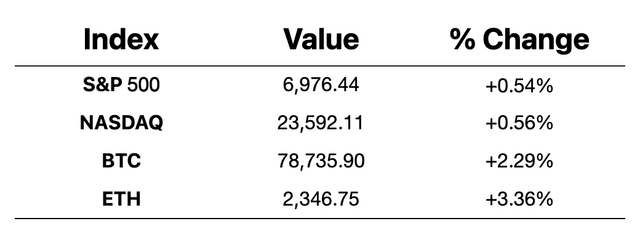
Supported by multiple tailwinds, US equities regained upward momentum and kicked off February with a strong start, with all three major indices closing higher.
After a sharp sell-off, precious metals rebounded, with gold returning to $4,800/oz.
-
Crypto Market:
Following a major pullback, the battle between bulls and bears intensified significantly. Bitcoin posted an intraday amplitude of 6.3%, reaching a session high of $79.4K.
Altcoin markets continued to see heavy volume, with trading activity hitting a new year-to-date high, maintaining around 60% of total market share.
Market sentiment recovered slightly from the weekend but remains stuck in the “Extreme Fear” zone.
-
Project Updates
-
Trending Tokens: HYPE, XRP, ZAMA
-
HYPE: Hyperliquid announced that HyperCore will support outcome trading (HIP-4).
-
XRP: Ripple obtained a “full EMI license” from Luxembourg’s CSSF, enabling expansion of blockchain payments and digital asset services across the EU.
-
ZAMA: Coinbase, Binance, Bybit, HTX, Bitget, and others have rapidly listed spot and derivatives products, while disclosing staking and DPoS mechanisms.
-
UNI: Uniswap launched an on-chain auction feature (CCA) on its web interface; Rainbow token RNBW will be auctioned via CCA.
-
JUP: Jupiter is bringing Polymarket to Solana and secured a $35M strategic investment in JUP from ParaFi.
-
CLANKER: Activity in the Base ecosystem remains strong, with Clanker generating over $8M in protocol fees last week, a record high.
-
DEEP/WAL: Coinbase added DeepBook (DEEP) and Walrus (WAL) to its listing roadmap.
-
Purch: Circle CEO Jeremy Allaire mentioned the Purch project on X, triggering a rapid market cap surge for the Solana-based token PURCH.
Major Asset Moves
-
Crypto Fear & Greed Index: 17 (14 twenty-four hours ago) — Level: Extreme Fear
Today’s Watchlist
-
2027 FOMC voter and Atlanta Fed President Raphael Bostic will deliver remarks
-
CoinList will launch the public sale of AC’s new project Flying Tulip (FT)
-
US December JOLTs job openings data postponed due to the government shutdown
Macroeconomic Developments
-
Trump released positive tariff-related signals: US tariffs on India reduced to 18%
-
US January ISM Manufacturing Index jumped to 52.6, the highest since February 2022
-
Due to the partial US government shutdown, January employment data will not be released on schedule
-
Fed’s Bostic: Inflation remains elevated; rate cuts are unlikely in 2026
Policy & Regulatory Signals
-
Hong Kong Monetary Authority plans to issue the first batch of stablecoin licenses in March
-
EU warned 12 member states for failing to implement crypto tax rules
Industry Headlines
-
Trump on Abu Dhabi royal family’s $500M investment into WLFI: Unaware; matters handled by his son
-
WSJ: Cboe plans to relaunch binary options trading to compete directly with prediction markets
-
BitMine added 41,788 ETH last week; Tom Lee said weak sentiment still reflects the lingering shock from the 10/11 crash
-
CoinShares: Digital asset investment products saw $1.7B net outflows last week, turning year-to-date flows negative
-
Ripple obtained Luxembourg CSSF’s full EMI license, enabling EU-wide expansion of blockchain payment and digital asset services
Deep Dive: Industry Highlights (Feb 03, 2026)
Trump on Abu Dhabi royal family’s $500M investment into WLFI
Trump’s statement that he was unaware of the Abu Dhabi royal family’s reported $500 million investment into WLFI, attributing oversight to his son, underscores the increasingly blurred line between political families and large-scale private capital flows. From a market perspective, the key issue is not personal awareness but governance structure and disclosure. Sovereign-linked capital entering private ventures tied to politically exposed families can raise regulatory, reputational, and transparency questions, particularly if WLFI operates in regulated financial or digital asset sectors. For investors, this reinforces the importance of scrutinizing control mechanisms, related-party risk, and potential future political scrutiny rather than focusing solely on headline capital inflows.
WSJ: Cboe plans to relaunch binary options trading to compete with prediction markets
Cboe’s reported plan to relaunch binary options reflects a strategic response to the rapid growth of on-chain and off-chain prediction markets, which have attracted retail traders seeking simple, event-driven payouts. By re-entering the binary options space, Cboe is likely attempting to recapture demand within a regulated exchange framework, positioning itself as a compliant alternative to crypto-native platforms. The competitive tension here lies in product design and regulatory arbitrage: while prediction markets benefit from decentralization and global access, Cboe can leverage institutional credibility, clearing infrastructure, and regulatory approval. This move may signal a broader convergence between traditional derivatives markets and crypto-inspired financial primitives.
BitMine added 41,788 ETH; Tom Lee cites lingering shock from the 10/11 crash
BitMine’s accumulation of 41,788 ETH during a period of subdued sentiment highlights a growing divergence between institutional positioning and broader market psychology. Tom Lee’s comment that sentiment remains depressed due to the lingering effects of the 10/11 crash suggests that investors are still risk-averse, even as some entities quietly increase long-term exposure. Historically, such sentiment dislocations have preceded periods of gradual repricing rather than immediate rebounds. From a market structure standpoint, ETH accumulation at scale during weak sentiment may reflect confidence in Ethereum’s long-term role in tokenization, settlement, and on-chain financial infrastructure rather than a near-term speculative bet.
Strategy buys another 855 BTC, raising average cost to $76,052
Strategy’s purchase of an additional 855 BTC at elevated price levels reinforces its position as a structurally price-insensitive buyer, prioritizing long-term Bitcoin exposure over short-term volatility management. By lifting its average cost basis to $76,052, the firm is implicitly signaling confidence in Bitcoin’s asymmetric upside and its role as a treasury reserve asset rather than a tactical trade. However, this strategy also increases balance-sheet sensitivity to macro shocks and liquidity conditions, especially if risk assets experience a broad de-rating. For the wider market, Strategy’s continued buying provides psychological support but should not be interpreted as a near-term price floor.
CoinShares: $1.7B net outflows push YTD digital asset flows negative
The $1.7 billion in net outflows from digital asset investment products, pushing year-to-date flows into negative territory, points to a meaningful shift in institutional risk appetite. Rather than signaling outright capitulation, the data suggests portfolio rebalancing amid higher rates, equity market volatility, and uncertainty around crypto-specific catalysts. Importantly, sustained outflows from structured products can exert indirect pressure on spot markets through reduced passive demand, even if on-chain activity remains stable. This trend highlights the growing influence of traditional asset allocators in shaping crypto market cycles, making macro conditions increasingly decisive for near-term price action.
Ripple obtains Luxembourg CSSF EMI license, enabling EU-wide expansion
Ripple’s acquisition of a full EMI license from Luxembourg’s CSSF marks a significant regulatory milestone, enabling it to passport payment and digital asset services across the European Union. This development strengthens Ripple’s positioning within the EU’s evolving regulatory framework, particularly ahead of broader MiCA implementation, and enhances its credibility with banks and enterprise clients. Beyond compliance, the license allows Ripple to integrate blockchain-based settlement with regulated payment rails, potentially accelerating real-world adoption of tokenized money and cross-border payments. Strategically, this move signals Ripple’s focus on jurisdictional certainty as a competitive advantage in an increasingly regulated global crypto landscape.
