

Top 10 Public Blockchains Compared in 2026: Which Chain Has the Real Shot at Challenging Ethereum’s Crown
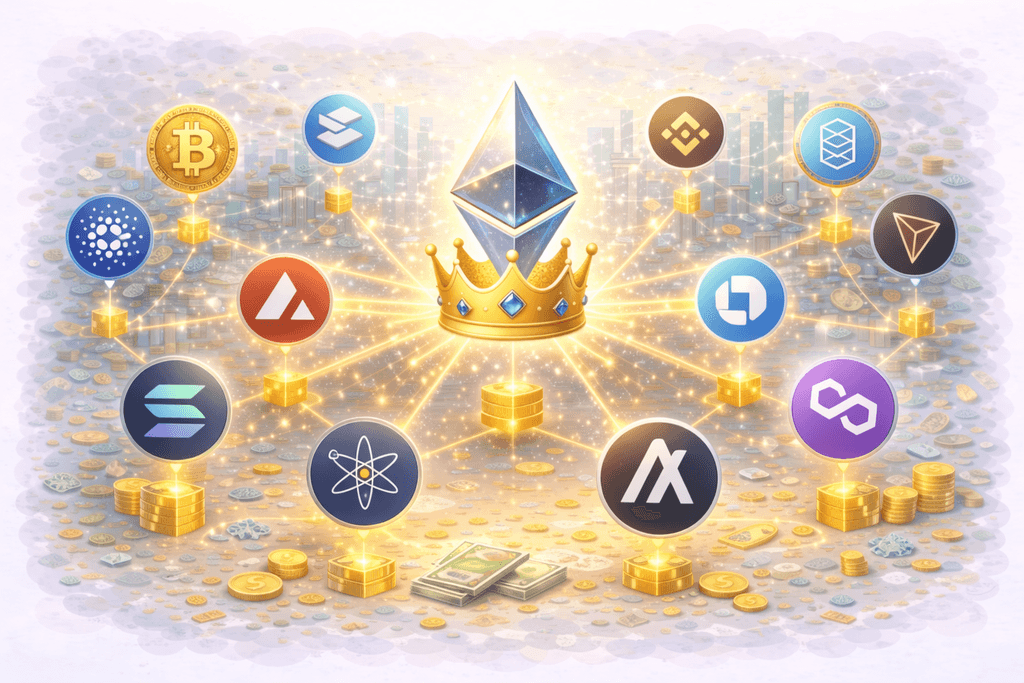
Dive into the latest metrics for Ethereum, Solana, BNB Chain, Tron and more in 2026. See TVL, users, speed and developer trends to discover which Layer 1 stands the best chance of narrowing the gap with Ethereum.
Thesis Statement
Ethereum still commands the largest share of locked value and institutional liquidity in early 2026, yet Solana’s explosive growth in daily users, transaction volume and real-world activity positions it as the single Layer 1 with the clearest momentum to challenge that lead over the coming years.
Introduction
Ethereum continues to set the standard for decentralized finance and smart contracts more than a decade after launch. Its total value locked sits around 54 billion dollars, dwarfing every other public chain and anchoring more than half of all stablecoin supply on blockchain networks. Developers still flock to Ethereum because of mature tooling, battle-tested security and deep liquidity that lets large trades execute without massive slippage.
At the same time, the mainnet processes far fewer transactions per second than newer rivals, pushing most everyday activity onto Layer 2 solutions that settle back to Ethereum for final security. This modular approach keeps Ethereum as the settlement layer of choice for institutions and high-value assets, even as fees on the base chain remain higher than on faster competitors. The network’s staking participation hit record levels with more than 37 million ETH locked, showing strong holder conviction. Real-world asset tokenization also thrives here, with billions in treasuries, bonds and funds now living on-chain. These strengths create a powerful moat that no single chain has fully breached yet, but the gap in user experience and cost has narrowed noticeably across the broader ecosystem.
Ethereum’s Massive Liquidity Lead and Why It Still Matters Most
Institutions and large traders continue to favor Ethereum because the network holds the deepest pools across every major DeFi category. Stablecoins alone total more than 168 billion dollars on Ethereum, giving users instant access to the digital dollars they need for trading, lending or payments. This liquidity translates into tighter spreads and lower slippage even during volatile periods, something smaller chains struggle to match. Developers building serious applications know they can tap into established oracles, audited libraries and cross-chain bridges that route value back to Ethereum for security. The chain’s upgrade path, including recent improvements in data availability and blob transactions, has kept fees reasonable on Layer 2s while preserving the base layer’s role as the ultimate source of truth.
Enterprise pilots for tokenized real estate, carbon credits and private credit all settle here because regulators and custodians already understand Ethereum’s security model. While newer chains boast higher raw throughput, Ethereum’s economic security and network effects keep it at the center of serious capital flows. The result is a self-reinforcing cycle where more value locked means more activity, which attracts even more developers and users.
Solana’s User Explosion and Record-Breaking Transaction Volumes
Solana stands out as the chain delivering the highest daily active addresses and raw transaction counts in early 2026. Networks routinely process more than 75 million non-vote transactions per day, with peaks hitting 148 million during busy periods driven by memecoins, payments and decentralized exchanges. Average fees hover around two-tenths of a cent, making high-frequency activities like gaming micro-transactions or frequent swaps feel instant and nearly free.
The Alpenglow upgrade rolled out in phases throughout 2025 and early 2026 cut finality times dramatically, giving users near-instant confirmation that rivals still chase. Daily active users regularly top 2.5 million, far ahead of Ethereum’s mainnet numbers, as retail participants rotate into fast, low-cost experiences. DeFi TVL climbed above 11 billion dollars while DEX volumes often exceed those on Ethereum itself for weeks at a time. Builders praise the single-layer design that avoids the complexity of multiple rollups, letting applications scale directly on the base chain. This speed advantage turned Solana into the go-to network for consumer-facing apps where every millisecond counts.
BNB Chain’s Retail Dominance and Seamless On-Ramp Experience
BNB Chain keeps drawing millions of everyday users through its tight integration with the world’s largest centralized exchange and ultra-low fees that feel invisible. Daily active addresses hover around 2.6 to 4 million, fueled by simple swaps, gaming titles and emerging-market payments that run smoothly on mobile.
The EVM-compatible environment lets developers port Ethereum code with almost no changes, speeding up ecosystem growth. TVL sits comfortably above 5 billion dollars, supported by strong liquidity in popular pairs and yield opportunities tailored to retail appetites. Binance’s distribution muscle funnels new users straight onto the chain, creating a steady pipeline that many independent networks lack. Recent upgrades improved cross-chain bridging and reduced congestion during peak meme-trading days, keeping the experience reliable even when volumes spike. The chain’s focus on accessibility turned it into a gateway for millions entering crypto for the first time, proving that ease of use can drive adoption faster than raw technical specs alone.
TRON’s Stablecoin Superhighway and Everyday Payment Volume
TRON carved out a unique niche by becoming the preferred network for stablecoin transfers, especially USDT, with billions moving daily at costs measured in fractions of a cent. Daily active users stay above 3 million, driven largely by remittances, merchant payments and simple value storage in regions where traditional banking feels expensive or slow. The chain’s delegated proof-of-stake model delivers consistent performance without the congestion spikes seen elsewhere.
TVL hovers near 4.8 billion dollars, but the real story lies in on-chain activity rather than locked assets. High transaction counts reflect genuine usage rather than speculative holding, as people move money across borders or between wallets multiple times per week. Developers building payment rails and micro-lending apps choose TRON because finality arrives quickly and fees never surprise users. This practical focus keeps the network relevant even as flashier competitors grab headlines for speed records.
Avalanche’s Subnet Flexibility and Institutional Pilot Success
Avalanche lets enterprises spin up custom subnets that run their own rules while still benefiting from the main chain’s security and interoperability. This architecture attracted pilots for tokenized funds, supply-chain tracking and private credit that need controlled environments without sacrificing blockchain transparency. TVL exceeds 1.5 billion dollars across the C-Chain and growing subnets, with steady growth in real-world asset experiments. The network’s three-chain design balances speed and customization, giving developers tools to tune performance for specific use cases.
Recent partnerships with traditional finance players shows Avalanche’s ability to bridge on-chain efficiency with off-chain compliance needs. Gas fees remain competitive, and the ecosystem’s focus on institutional-grade tools sets it apart from pure retail chains. Builders appreciate the EVM compatibility that shortens development cycles while the subnet model offers isolation when required for sensitive data or regulated assets.
Sui’s Parallel Processing Power and Move Language Momentum
Sui’s object-centric model processes transactions in true parallel, delivering sub-second finality and handling massive concurrent activity without bottlenecks. TVL climbed past 2.6 billion dollars while daily transactions frequently top 160 million, showing the architecture delivers on its promises. Developers using the Move language report faster iteration times and fewer security headaches when managing digital assets. Gaming studios and DeFi protocols built natively on Sui enjoy smooth user experiences that feel closer to Web2 than typical blockchain apps.
The network’s storage fund mechanism creates sustainable economics for validators while keeping fees predictable. Growth in developer numbers outpaced many peers, with monthly active builders nearly doubling year-over-year. This technical edge turned Sui into a favorite for high-throughput applications where every extra millisecond of latency matters to user retention.
NEAR’s Intent-Centric Design and AI-Powered User Flows
NEAR focused on making blockchain invisible to end users through intent-based transactions and account abstraction that hide complexity behind simple clicks. Daily active addresses grew steadily as consumer apps adopted the chain’s fast finality and low costs. TVL sits in the low billions but shows consistent organic growth from real usage rather than incentive farming. The chain’s integration of AI tools for transaction routing and smart contract optimization caught the attention of developers building the next wave of intelligent applications.
Cross-chain messaging improved dramatically, letting NEAR act as a hub between ecosystems without forcing users to manage multiple wallets. The developer experience emphasizes simplicity, attracting teams that want to ship products quickly rather than wrestle with low-level blockchain details. This focus on usability positions NEAR as a dark horse for mainstream consumer adoption beyond crypto natives.
Cardano’s Measured Upgrades and Focus on Real-World Impact
Cardano continues its deliberate pace of development, rolling out governance and scalability features backed by academic research. The chain’s TVL remains modest compared to leaders, yet on-chain activity in Africa and emerging markets reflects genuine utility in identity, lending and supply-chain projects. Recent upgrades improved transaction throughput while preserving the network’s energy-efficient proof-of-stake design. Developers praise the formal verification tools that reduce smart contract bugs before deployment.
Community governance gives token holders real influence over roadmap decisions, creating a sense of ownership that keeps long-term participants engaged. While speed records go to faster chains, Cardano’s emphasis on sustainability and inclusivity resonates with projects targeting social impact. The measured approach built a resilient ecosystem that avoided many hype-driven pitfalls plaguing quicker competitors.
Aptos’ Move Language Edge and Secure DeFi Growth
Aptos shares the Move programming model with Sui but carved its own path with account-based architecture optimized for certain DeFi patterns. TVL sits around half a billion dollars while daily transactions show healthy growth from lending and trading protocols. The chain’s focus on parallel execution delivers low latency without sacrificing safety guarantees.
Developers report strong tooling support and clear documentation that speeds onboarding. Recent tokenomics changes introduced deflationary pressure through fee burning, aligning incentives for long-term holders.
Gaming and NFT projects found a welcoming home here because asset ownership semantics work naturally with the language. While smaller than Sui in absolute numbers, Aptos maintains steady progress through targeted improvements rather than chasing every trend.
Polkadot’s Parachain Ecosystem and Cross-Chain Connectivity
Polkadot connects specialized parachains through a shared security model that lets each project inherit robust finality without building its own validator set from scratch. The relay chain handles coordination while parachains focus on their unique use cases, creating a diverse ecosystem under one umbrella. TVL and activity remain lower than single-chain leaders, yet interoperability shines when moving assets between parachains without wrapped tokens or third-party bridges.
Developers appreciate the substrate framework that accelerates building custom logic. Recent auctions and crowdloans brought fresh projects into the network, expanding available applications. The shared security approach reduces fragmentation risks that plague multi-chain worlds, giving users smoother experiences when jumping between specialized environments.
Developer Activity Trends Across the Top Public Chains
Ethereum still hosts the largest absolute number of monthly active developers, but Solana and Sui posted the fastest percentage growth in 2025 and early 2026. Builders cite easier onboarding, faster iteration cycles and lower deployment costs as reasons for shifting focus. BNB Chain benefits from EVM familiarity while newer chains like Sui win with modern languages that reduce common errors.
Data shows Solana leading in certain high-velocity categories such as memecoins and real-time gaming where developer velocity matters most. Ethereum retains dominance in complex financial primitives and institutional tooling, creating a split where different chains serve different developer personas. This diversification strengthens the overall ecosystem even as competition intensifies for mindshare and talent.
Revenue Generation and Network Fee Dynamics in 2026
Solana briefly overtook Ethereum in monthly network revenue during February 2026 thanks to high transaction counts and optimized fee markets. TRON followed closely on the strength of stablecoin volume, while Ethereum’s fees came mostly from high-value Layer 2 settlements. BNB Chain captured steady income from retail activity without the extreme spikes seen elsewhere.
These revenue figures highlight how usage patterns differ: Solana monetizes volume, Ethereum monetizes value, and TRON monetizes frequency. The shift shows that raw transaction numbers increasingly translate into sustainable economics for chains that keep fees low enough to encourage constant interaction.
Why Solana Stands the Best Chance of Narrowing Ethereum’s Lead
Solana combines the highest user engagement, fastest real-world throughput and strongest retail-to-institutional pipeline among all challengers. Its single-layer scaling avoids the fragmentation that complicates Ethereum’s Layer 2 ecosystem, giving developers and users a simpler mental model. Upgrades continue to deliver meaningful speed and reliability gains without compromising the core value proposition. While Ethereum’s liquidity moat remains wide, Solana’s activity metrics and developer influx suggest it can capture a growing share of new users and applications that prioritize speed and cost over absolute security guarantees.
No chain is likely to fully replace Ethereum as the settlement layer in the next few years, but Solana’s trajectory makes it the clearest contender for becoming the primary home for everyday on-chain activity. The race remains open, yet current trends point to Solana as the chain best positioned to keep closing the gap.
FAQs
1. Which public chain currently holds the highest total value locked in 2026?
Ethereum remains far ahead with more than 54 billion dollars locked across its DeFi protocols and stablecoin reserves, giving it unmatched liquidity depth that institutions rely on for large trades and long-term storage.
2. How does Solana compare to Ethereum in daily transaction volume right now?
Solana routinely processes between 75 million and 148 million non-vote transactions per day while Ethereum’s mainnet stays much lower, though its Layer 2 ecosystem adds significant activity that settles back to the base chain.
3. What makes Sui and Aptos stand out among newer Layer 1 chains?
Both use the Move programming language and parallel execution models that deliver sub-second finality and strong security for asset management, attracting developers focused on high-throughput DeFi and gaming applications.
4. Can any chain realistically surpass Ethereum’s dominance in the next few years?
Solana shows the strongest momentum through user numbers and activity, but Ethereum’s network effects, security track record and institutional liquidity create a high bar that no single competitor has cleared yet.
5. Why do some developers still prefer BNB Chain and TRON over faster alternatives?
These chains offer seamless integration with existing tools, extremely low fees for everyday use and massive retail user bases that provide instant liquidity and distribution for new projects.
6. What role does developer activity play in deciding a chain’s long-term success?
Higher developer numbers lead to more applications, better tooling and stronger network effects, which in turn attract users and capital in a self-reinforcing cycle that determines which chains thrive over time.