

WEMIX$ Hack Explained: 5.23M Tokens Minted and $724K Moved Across Chains
2026/07/27 18:57:00
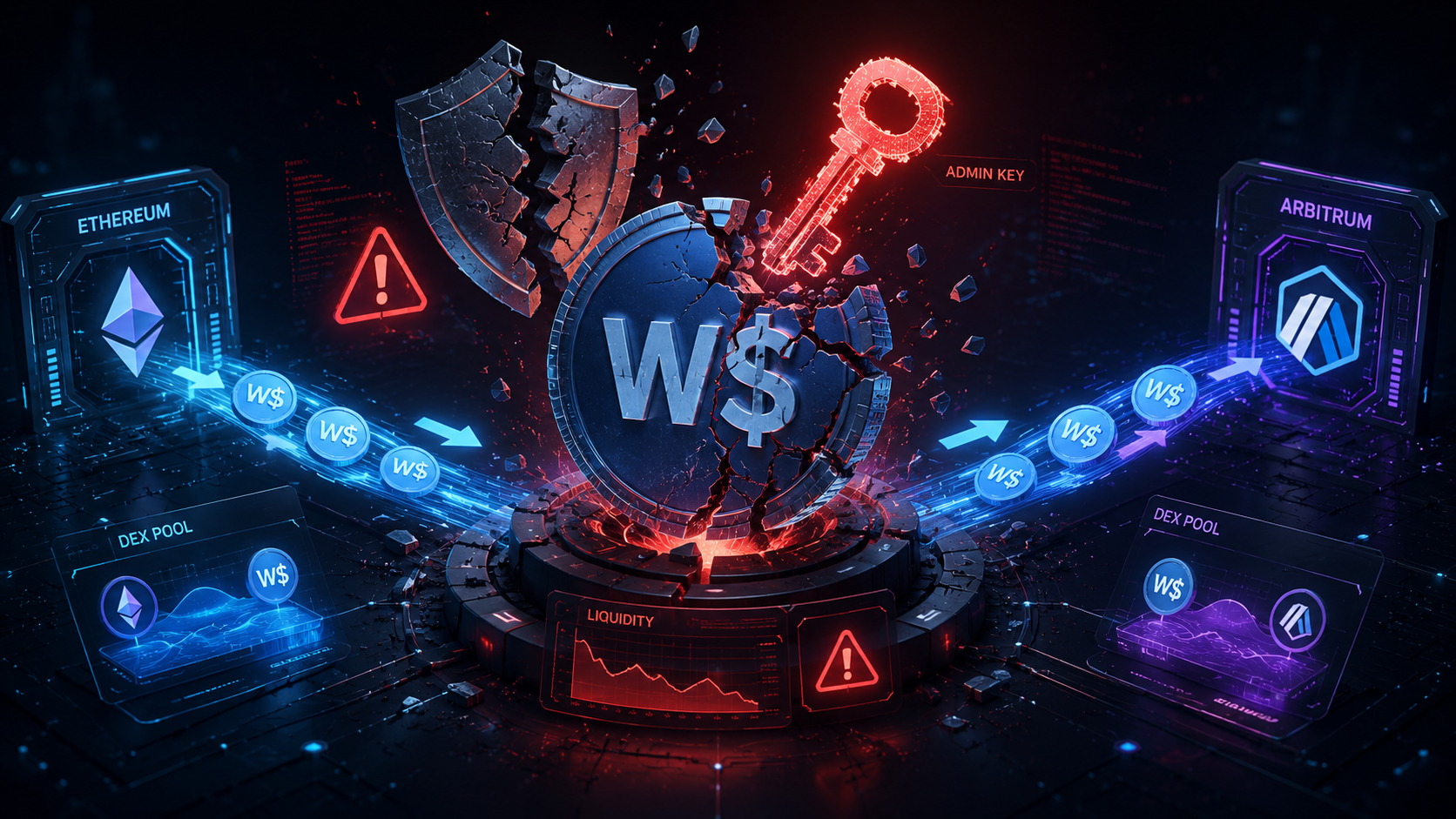
The WEMIX ecosystem faced a new security crisis on July 26, 2026, after an attacker gained privileged control over a contract connected to the WEMIX$ stablecoin.
This was not a typical wallet theft or a simple decentralized exchange exploit. The attacker appears to have obtained contract ownership or an equivalent administrative permission that allowed approximately 5.23 million WEMIX$ tokens to be created without authorization.
Part of the newly minted supply was then exchanged for 30,736 WEMIX and approximately 724,198 USDC.e. The USDC.e was transferred from WEMIX3.0 to Ethereum and BNB Smart Chain, converted into other liquid assets, and divided among several wallets.
WEMIX responded by suspending bridges, affected liquidity pools, the WEMIX$ conversion module, and the PNIX decentralized exchange. The company also contacted exchanges and stablecoin-related service providers in an effort to freeze suspicious funds.
The incident was therefore about more than the reported $724,000 in transferred USDC.e. It exposed a deeper security problem: an attacker temporarily gained the authority to create stablecoins and use the ecosystem's liquidity to convert those unauthorized tokens into assets with real market value.
Key Takeaways
-
An attacker gained privileged control over a contract associated with WEMIX$.
-
Approximately 5.23 million WEMIX$ tokens were minted without authorization.
-
Part of the unauthorized supply was exchanged for 30,736 WEMIX and 724,198 USDC.e.
-
The USDC.e was bridged to Ethereum and BNB Smart Chain before being converted and distributed.
-
WEMIX suspended bridges, liquidity pools, the WEMIX$ Module, and PNIX while investigating the breach.
-
The final loss, root cause, and amount that may be recovered were still being assessed when the initial updates were released.
What Happened to WEMIX$?
WEMIX initially warned that ownership of a contract connected to its WEMIX Dollar stablecoin might have been compromised. A later update confirmed that the affected permission had been used to issue tokens without authorization and move assets through the ecosystem.
The abnormal activity began on July 26, 2026. Once the attacker gained control of the relevant administrative permission, approximately 5.23 million WEMIX$ tokens were created. These tokens were not part of the normal issuance process and may not have been supported by corresponding reserves.
The affected token was WEMIX$, a dollar-linked asset used within the WEMIX3.0 ecosystem. It is separate from WEMIX, the network's native cryptocurrency. Although the attacker later obtained some WEMIX through swaps, the unauthorized minting involved the stablecoin rather than the native token.
There is currently no public evidence that the attacker took control of the WEMIX3.0 consensus system, its validator network, every user wallet, or the underlying issuance rules of the native WEMIX token.
The incident should therefore be described as a privileged contract breach rather than a complete compromise of the WEMIX3.0 blockchain.
That distinction is important, but it does not make the event minor. For a stablecoin, the ability to control supply is one of the most sensitive permissions in the entire system. If that authority is compromised, an attacker may be able to create new claims on the ecosystem's liquidity without providing any real collateral.
The WEMIX$ Attack Timeline
The attacker did not benefit simply by creating millions of WEMIX Dollar tokens. Unauthorized tokens only become economically valuable if they can be exchanged for assets that other traders and protocols recognize.
The attack therefore moved quickly from unauthorized minting to liquidity extraction.
| Stage | What Happened |
| Privileged access | The attacker gained ownership or administrative control over a WEMIX$-related contract |
| Unauthorized mint | Approximately 5.23 million WEMIX$ were created |
| Asset conversion | Part of the supply was exchanged for WEMIX and USDC.e |
| Cross-chain transfer | About 724,198 USDC.e was moved to Ethereum and BNB Smart Chain |
| Asset distribution | Funds were converted into assets such as ETH and USDT and divided among several wallets |
| Emergency response | WEMIX suspended bridges, pools, and several ecosystem services |
The conversion stage was the most important part of the attack. By using existing liquidity pools, the attacker exchanged newly created WEMIX$ for assets with broader market demand.
USDC.e was particularly useful because it could be transferred to other networks and converted into more widely traded assets. Once the funds reached Ethereum and BNB Smart Chain, they became harder to contain because investigators had to coordinate across several networks, bridges, exchanges, and service providers.
WEMIX identified wallets associated with the incident and asked centralized exchanges and relevant companies to freeze suspicious assets. Some addresses were reportedly restricted, but the complete amount frozen or recovered had not yet been publicly confirmed.
How Contract Ownership Enabled the Attack
Many crypto users assume that smart contracts operate without human control after deployment. In practice, stablecoins, bridges, and blockchain gaming platforms often retain administrative permissions.
These permissions may be necessary for upgrades, emergency responses, regulatory compliance, or supply management. However, they can also become dangerous single points of failure.
What Contract Ownership Means
A contract owner or administrator may have powers that are unavailable to ordinary users. Depending on the contract design, those powers may include:
-
Minting or burning tokens
-
Pausing transfers
-
Updating important parameters
-
Managing approved addresses
-
Upgrading contract logic
-
Controlling connected bridge or redemption modules
The complete permission structure of the affected WEMIX contract has not yet been explained in a full technical report. However, the attacker clearly obtained enough authority to issue millions of WEMIX outside the normal process.
A regular user must follow the public rules written into the smart contract. An attacker using a legitimate administrator account may instead be recognized by the contract as a trusted party.
As a result, the malicious transaction can appear valid on-chain even though it was not approved by the real project team.
Why This Was Different From a Normal Code Exploit
A conventional smart contract exploit usually involves a flaw that can be triggered through a public function. Examples include incorrect price calculations, reentrancy, collateral manipulation, or accounting errors.
A privileged access breach is different. The contract may have operated exactly as designed. The problem is that the person sending the command was not the legitimate administrator.
WEMIX had not confirmed whether the breach resulted from a stolen private key, compromised signing infrastructure, a multisignature failure, an internal account breach, or a problem with an upgrade mechanism.
Until a complete post-mortem is released, it would be inaccurate to claim that one particular failure caused the incident.
The investigation must therefore examine more than the public contract code. It should also review key storage, signer devices, multisignature policies, employee accounts, deployment systems, backend credentials, and any other contracts that shared the same administrative structure.
Where Did the 5.23 Million WEMIX$ Go?
The reported flow of funds can be summarized as follows:
Unauthorized WEMIX$ mint, liquidity pool swaps, WEMIX and USDC.e extraction, cross-chain transfers, conversion into other assets, and distribution across multiple wallets.
The attacker did not convert all 5.23 million WEMIX$ at a one-dollar price. Instead, part of the supply was exchanged for approximately 30,736 WEMIX and 724,198 USDC.e.
This explains why liquidity pools are central to understanding the loss.
A pool may contain WEMIX on one side and USDC.e or WEMIX on the other. When the attacker deposits unauthorized WEMIX into the pool, the automated market maker releases the other asset according to its pricing formula.
The pool does not automatically know that the incoming tokens were created by a compromised administrator. Unless transfers are frozen or the tokens are rejected, the pool treats them as valid units.
As more unauthorized WEMIX on one side and USDC.e or WEMIX on the other. When the attacker deposits unauthorized WEMIX price then moves away from its intended peg, trading becomes less efficient, and later sellers receive less value because of increasing slippage.
This is one reason the attacker could not simply transform the entire unauthorized supply into more than $5 million of liquid assets. The available liquidity was limited, and continued selling would have pushed the stablecoin price lower.
Why $724K Is Not the Total Size of the Breach
The two main figures reported in connection with the incident measure different things.
The 5.23 million WEMIX$ figure represents the amount of unauthorized supply created by the attacker. At the intended one-dollar peg, that supply had a theoretical value of approximately $5.23 million.
However, theoretical value is not the same as realizable value. The attacker could only extract as much real liquidity as the ecosystem's pools, bridges, and counterparties made available.
The 724,198 USDC.e figure represents the largest specifically disclosed amount of dollar-linked liquidity obtained and transferred across chains. The attacker also received 30,736 WEMIX, meaning the extracted value was not limited to USDC.e alone.
The final economic loss will depend on several unanswered questions:
-
How much unauthorized WEMIX$ remains in attacker-controlled wallets?
-
Can those tokens be frozen, burned, or excluded from redemption?
-
How much USDC.e, WEMIX, ETH, or USDT was frozen by exchanges?
-
Can any transferred assets be returned?
-
How much liquidity was lost by pool providers?
-
Will WEMIX compensate affected users?
-
Is the legitimate WEMIX$ supply still fully redeemable?
The unauthorized mint represents the attacker's potential spending power. The $724,000 figure represents a major portion of the real liquidity that was successfully extracted and moved.
Neither number alone represents the final loss.
Why WEMIX Shut Down Bridges and Trading
WEMIX temporarily suspended bridges connected to WEMIX3.0, including the PLAY Bridge and services involving Chainlink CCIP. The project also halted trading in affected liquidity pools, withdrew foundation-provided liquidity, and paused the WEMIX$ Module and PNIX decentralized exchange.
These measures were designed to prevent the attacker from converting more unauthorized tokens into valuable assets.
Disabling swaps reduced the attacker's ability to remove additional USDC.e or WEMIX from liquidity pools. Suspending bridges restricted transfers between WEMIX3.0 and external networks. Removing foundation liquidity also reduced the capital available to suspicious wallets.
The wider shutdown gave the team time to investigate whether other contracts shared the same administrator, signer, or deployment account. If multiple services depended on the same compromised permission structure, restoring them too early could have allowed further unauthorized transactions.
These protections also affected legitimate users. A bridge suspension can prevent users from moving funds to another chain. A decentralized exchange suspension can make it difficult to exit a position, while lower liquidity may increase price volatility when trading resumes.
A service suspension does not mean that every user's assets were stolen. It means the project believed that continued operation presented a greater risk than temporarily restricting access.
Who Faces the Greatest Risk?
The impact of the incident varies depending on the asset or service a user held.
| User Group | Main Risk |
| WEMIX$ holders | Depegging, redemption uncertainty, and unauthorized supply |
| Liquidity providers | Pool imbalance and loss of USDC.e or other liquid assets |
| WEMIX holders | Price volatility, weaker confidence, and ecosystem disruption |
| USDC.e users | Bridge availability and conversion uncertainty |
| GameFi users | Interrupted payments, swaps, and asset transfers |
| Exchanges | Suspicious deposits and additional compliance requirements |
WEMIX$ holders face the most direct risk. A stablecoin depends on confidence that every legitimate token is supported by an adequate reserve and redemption process. Unauthorized issuance introduces new tokens that may not have corresponding backing.
Even when the malicious supply can be identified on-chain, regular users may not know whether redemptions will resume, whether a balance snapshot will be used, or whether the project will migrate to a new contract.
Liquidity providers face a different problem. As the attacker exchanged WEMIX$ for USDC.e and WEMIX, the pools may have lost a significant portion of their more liquid assets. LPs could therefore be left with a larger share of the disputed or depegged stablecoin.
WEMIX holders were not directly exposed to the same unauthorized issuance based on the preliminary information. However, they remain vulnerable to selling pressure, reduced ecosystem activity, bridge restrictions, and weaker confidence.
Users following the token's market reaction can review updated WEMIX price information, although price changes alone cannot measure the final financial or reputational impact of the breach.
The USDC.e Migration Complicates the Crisis
The incident occurred while WEMIX was already moving its ecosystem away from WEMIX$ and toward USDC.e.
The project had announced that services within WEMIX PLAY, including GameFi functions, would gradually adopt USDC.e as a primary dollar-linked settlement asset. It also introduced a WEMIX Module that allowed users to convert eligible WEMIX into an equivalent amount of USDC.e.
This transition was intended to align the WEMIX ecosystem with a more widely recognized stablecoin infrastructure. However, the contract breach created a difficult problem: legitimate and unauthorized WEMIX$ must now be separated.
If every WEMIX$ remains eligible for one-to-one conversion, the attacker may be able to use unauthorized tokens to drain more USDC.e liquidity.
If the conversion system remains suspended, legitimate holders may be unable to redeem tokens acquired before the attack.
WEMIX may need to identify the valid token supply at a specific block height and compare it with the unauthorized issuance. Possible responses could include:
-
Freezing known attacker wallets
-
Burning unauthorized tokens
-
Taking a balance snapshot
-
Migrating legitimate balances to a new contract
-
Creating a manual claims process
-
Restoring the conversion module with additional restrictions
The central issue is whether WEMIX can honor legitimate WEMIX$ claims without allowing unauthorized tokens to consume the remaining USDC.e reserves.
This Is Not WEMIX's First Major Security Incident
The WEMIX ecosystem experienced another significant attack in February 2025. During that incident, approximately 8.65 million WEMIX were withdrawn from the PLAY Bridge Vault through abnormal transactions.
| Incident | 2025 PLAY Bridge Attack | 2026 WEMIX$ Breach |
| Main target | PLAY Bridge Vault | WEMIX$-related contract |
| Attack surface | Authentication and backend access | Contract ownership or administrative authority |
| Main assets | WEMIX | WEMIX$, WEMIX, and USDC.e |
| Reported scale | Approximately 8.65 million WEMIX withdrawn | 5.23 million WEMIX$ minted and about 724,198 USDC.e moved |
| Main concern | Credential and bridge security | Administrator key and minting security |
The 2025 incident was connected to compromised authentication infrastructure and abnormal bridge withdrawals. The 2026 incident appears to involve control over a stablecoin-related administrative permission.
The two attacks should not be described as the same vulnerability occurring twice. Their immediate attack surfaces were different.
However, the recurrence is important because both incidents involved systems with elevated access rather than only public smart contract functions. This may lead users and exchanges to question the security of WEMIX's private keys, administrative accounts, signer arrangements, and backend infrastructure.
The project will therefore need to demonstrate that it has reviewed the entire permission system, not only the one contract involved in the latest incident.
What the Breach Reveals About Admin Key Risk
Administrative controls can help a stablecoin project respond quickly to emergencies, but the same controls can become dangerous when they are compromised.
Centralized Control Can Support Fast Response
Stablecoin issuers may need the ability to freeze stolen assets, block suspicious addresses, pause transfers, upgrade contracts, or correct operational errors.
These controls may also be required for compliance purposes or for coordinating token supply across several networks.
In the WEMIX incident, the project was able to pause services, withdraw liquidity, identify suspicious wallets, and request freezes from exchanges.
A completely immutable protocol might not have been able to react as quickly.
The Same Control Can Become a Single Point of Failure
The danger appears when the authority designed to protect the system becomes the attack path.
If one compromised key can authorize unlimited minting, the economic security of the stablecoin depends heavily on the security of that key. A public blockchain cannot prevent an administrator from using a permission that the contract was designed to accept.
A stronger security structure should combine several protections:
-
Independent multisignature approval
-
Hardware-based key storage
-
Time delays for major permission changes
-
Daily and per-transaction minting limits
-
Automated alerts for unusual supply increases
-
Separate permissions for minting, pausing, and upgrading
-
Regular rotation of sensitive credentials
-
Public disclosure of important administrative controls
-
Tested emergency recovery procedures
No single safeguard is sufficient. A multisignature wallet can still fail if all signers rely on the same vulnerable infrastructure. A time lock may not help if another emergency function can bypass it.
The goal should be to prevent any one person, key, or internal system from having unrestricted control over the stablecoin supply.
What Does the Hack Mean for WEMIX?
The immediate market impact is likely to appear through price volatility, higher trading volume, lower liquidity, and exchange restrictions.
However, the longer-term issue is whether users and developers continue to trust WEMIX as infrastructure for blockchain gaming, stablecoin settlement, and cross-chain transfers.
The native WEMIX token was not confirmed to have been illegally minted. Even so, ecosystem security problems can weaken demand for the token. Users may reduce their exposure, liquidity providers may request higher returns for accepting additional risk, and developers may delay new launches until the affected services are restored.
Centralized exchanges must also review deposits linked to suspicious wallets. A platform may keep spot trading available while suspending deposits or withdrawals on a specific network.
Traders can examine the available WEMIX/USDT spot market, but they should separately confirm whether deposits and withdrawals are operating normally. An active market price does not necessarily mean that all on-chain services have resumed.
The incident also reflects a wider trend across the crypto asset market. Investors are paying more attention to the difference between public smart contract vulnerabilities and failures involving private keys, bridges, or centralized administrator systems.
The second category can be harder to evaluate because the most important protections may not be visible on-chain.
The long-term damage to WEMIX will depend less on the first reported loss figure and more on whether the project can prove that the compromised authority has been replaced and that similar access cannot be used against another part of the ecosystem.
What Investors Should Watch Next
The most important development will be the official post-mortem. It should explain whether the incident began with a private key, multisignature process, backend account, contract upgrade, or another failure.
The final loss figure will also require careful interpretation. Investors should distinguish between unauthorized token supply, liquidity successfully extracted, assets frozen by exchanges, funds recovered, and compensation paid by WEMIX.、
The incident will not be fully resolved when trading resumes. It will be resolved only when WEMIX reconciles the token supply, protects legitimate users, and provides evidence that the compromised authority can no longer be abused.
Conclusion: The Real Risk Was Control, Not Just the $724K
The WEMIX$ breach created approximately 5.23 million unauthorized tokens, but the attacker did not convert the entire amount into dollars.
The clearest disclosed extraction involved approximately 724,198 USDC.e and 30,736 WEMIX, followed by transfers to Ethereum, BNB Smart Chain, and multiple wallets.
The most serious issue was not the difference between $724,000 and $5.23 million. It was the loss of privileged control over a stablecoin-related contract.
A stablecoin can appear fully backed and still face a major crisis if the authority controlling its supply is compromised. WEMIX's emergency shutdown may have reduced further losses, but the project still needs to explain how the breach occurred, which other systems were reviewed, and how legitimate holders will be protected.
Recovering the funds matters. Proving that the same administrative power cannot be abused again will matter more.
🔥 Join KuCoin 9th Anniversary Trading CampaignKuCoin is celebrating its 9th anniversary with a special platform campaign filled with exclusive rewards, trading activities, and limited-time offers. Don’t miss the chance to participate and enjoy the benefits as the exchange marks nine years of growth and innovation. Visit the official campaign page now:
|

FAQs
Is WEMIX$ the Same Token as WEMIX?
No. WEMIX is the native cryptocurrency of the WEMIX3.0 blockchain. WEMIX is a separate dollar-linked stablecoin used within the ecosystem. The attacker created unauthorized WEMIX and then exchanged part of the supply for WEMIX and USDC.e.
What Is the Difference Between USDC.e and Native USDC?
Native USDC is issued directly by Circle on supported blockchains. USDC.e generally represents USDC that has been transferred to another network through approved bridging infrastructure. Its security therefore depends on the bridge and the mechanism used to maintain the relationship with the original USDC.
Can WEMIX Reverse the Attacker's Transactions?
Confirmed blockchain transactions are not normally deleted. However, WEMIX may be able to freeze unauthorized tokens, pause contracts, migrate legitimate balances, coordinate with exchanges, or use legal procedures to recover assets.
Can the Unauthorized WEMIX$ Be Burned?
Possibly. The available options depend on the contract design and whether the project can freeze or destroy tokens held in attacker-controlled addresses. WEMIX could also exclude the unauthorized supply from a snapshot or migrate legitimate balances to a new contract.
Does an Exchange Freeze Guarantee That Funds Will Be Returned?
No. An exchange freeze can prevent assets from being withdrawn or traded, but returning them usually requires an investigation, proof of ownership, and compliance with legal procedures. Some funds may also have been converted or transferred before the freeze was applied.
Disclaimer: This article is for educational purposes only and does not constitute financial advice. Conduct thorough research and consider your personal risk tolerance before participating in any financial activities.