



What Is MXC Crypto? Everything You Need to Know About Moonchain in 2026
2026/04/28 10:09:02
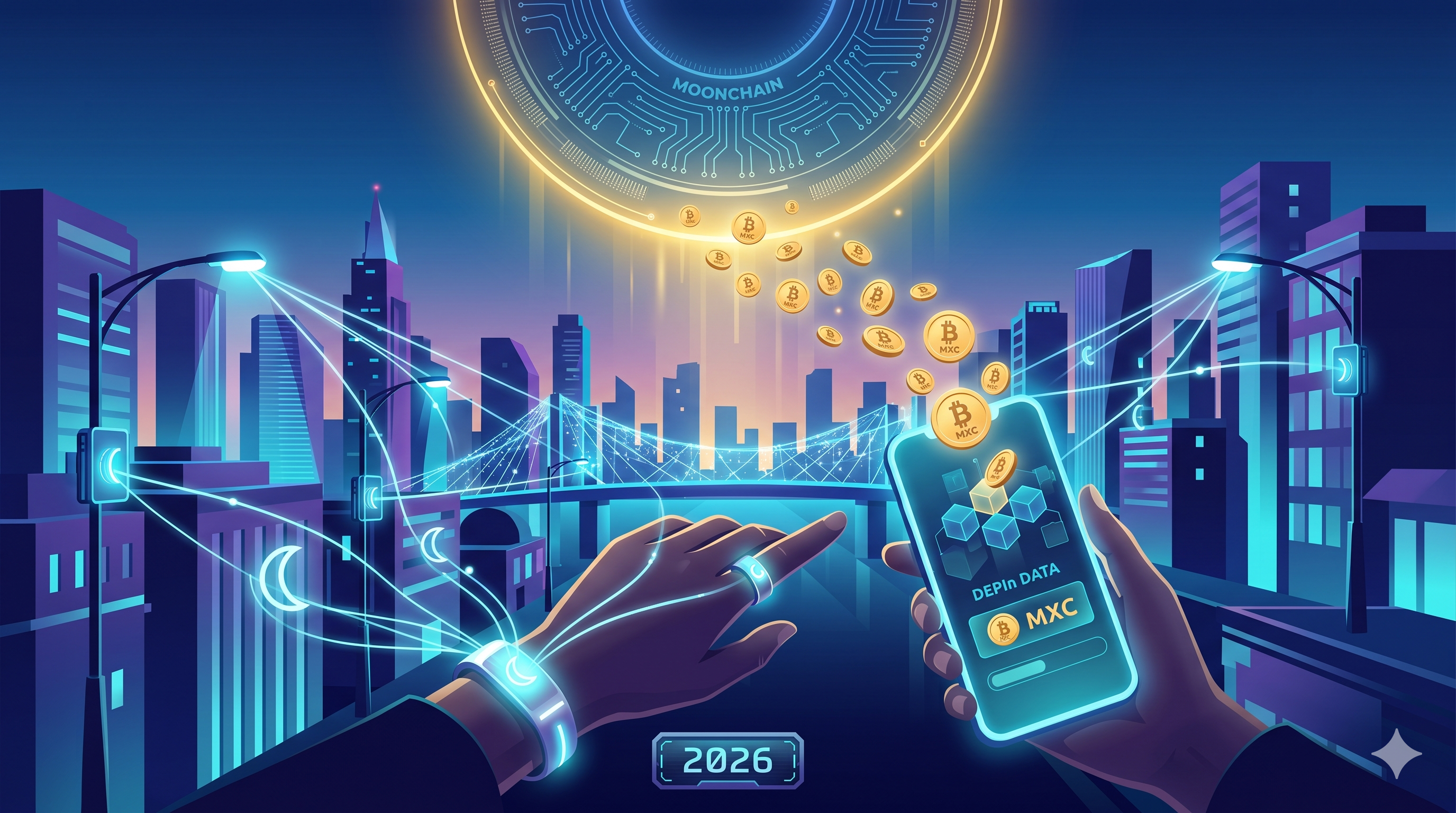
What if your smartwatch earned cryptocurrency while powering a global, decentralized data network? This vision is now reality with Moonchain (MXC), a pioneer in the DePIN (Decentralized Physical Infrastructure) and IoT space that has evolved from a simple protocol into a high-performance Layer 3 blockchain. Operating as Ethereum’s first "Beam Chain Sublayer" and powered by the c.xyz team (supported by Bobcat), Moonchain merges AI and IoT to create a "WearFi" ecosystem where daily activity is transformed into digital value via Zero-Knowledge (ZK) scaling technology.
As the native utility token, MXC fuels this ambitious infrastructure, facilitating hardware-to-blockchain communication with near-zero fees and institutional-grade security. By pivoting from its foundations to a specialized L3 zkEVM, the project has solved the critical bottlenecks of data congestion and high gas costs for billions of connected devices. For investors and crypto explorers in 2026, MXC represents a strategic shift toward sustainable, hardware-backed utility that bridges the gap between physical human movement and the decentralized web.
Key Takeaways
-
MXC is the native utility token of Moonchain — a Layer 3 blockchain on Ethereum designed as the infrastructure backbone for AI, IoT, and DePIN applications.
-
Moonchain operates as Ethereum's first Beam Chain Sublayer, using zkEVM technology for low-cost, high-speed transactions.
-
The MXC Foundation has handed over operations to c.xyz, powered by Bobcat, marking a significant governance transition.
-
WearFi is Moonchain's flagship concept: wearable devices (watches, rings, fitness trackers) that double as blockchain mining nodes earning MXC rewards.
-
MXC trades at approximately $0.0005–$0.0007 in April 2026, well below its 2022 all-time high of $0.1346 — a reflection of both market conditions and niche positioning.
-
Key risks include a crowded IoT/DePIN competitive landscape, low trading liquidity, and execution uncertainty on roadmap deliverables.
What Is MXC Crypto?
The Token Behind Moonchain
MXC is a blockchain-based utility token that powers the Moonchain network — a platform specifically engineered for the intersection of decentralized physical infrastructure, the Internet of Things, and artificial intelligence.
MXC is a cryptocurrency that has carved out a fast-growing sector within the WearFi, AI, and blockchain industries by building a decentralized global data network. It leverages the power of a robust, technologically savvy community and the innovative MXC Protocol to create a globally reaching network for real-world wearable applications.
In practical terms, MXC serves three roles on the Moonchain network: it is the gas token powering all transactions, the incentive reward for device operators contributing data and bandwidth, and the governance mechanism for network participants.
From MXC Foundation to c.xyz
The project was founded in Berlin in 2017 and built one of the earliest blockchain-powered IoT data networks in the industry. The MXC Foundation has officially wrapped up its operations, passing the torch to the c.xyz team, which is powered by Bobcat — the hardware manufacturer behind thousands of MXC-compatible mining devices globally.
This governance transition is significant. Rather than winding down, it represents a maturation of the project from a foundation-led structure toward a community and hardware ecosystem-driven model, with Bobcat's operational expertise at the helm.
What Is Moonchain? Architecture and Technology
Ethereum's First Beam Chain Sublayer
Moonchain is not simply another Layer 2 network. MXC operates as Ethereum's first Beam Chain Sublayer — a technical setup tailored for what they call WearFi. Think of it as a custom-built highway on top of a major road system: Ethereum handles the foundational traffic, while MXC focuses on specific cargo like data from AI and the Internet of Things.
MXC zkEVM Moonchain is a mainnet, EVM-equivalent zero-knowledge rollup optimized for DePIN and AIoT, using MXC as the native gas token. Its primary use cases include machine-to-machine micropayments, verifiable IoT data markets, AI agent workflows, and standard EVM dApps — enabled by sub-cent average gas costs and seconds-level block times suitable for high-frequency device traffic.
This architecture makes Moonchain particularly suited for IoT applications, where thousands of devices may need to transact tiny amounts of data and value at very high frequency — a use case that would be prohibitively expensive on Ethereum mainnet.
How the MXC Protocol Works
The MXC Protocol facilitates the creation and connection of networks via a decentralized and robust protocol. It uses an interchain data market, encouraging participation through WearFi Mining. It allows for the provisioning of tangible IoT "Wearable" devices at minimal cost, creating a framework for data providers and receivers to produce GDPR-safe data monitored by AI.
The protocol's Low Power Wide Area Network (LPWAN) implementation is especially important for IoT coverage. Through the MXProtocol IoT platform as a dedicated DePIN chain, Moonchain enhances performance in terms of IoT data security and stability.
What Is WearFi? Moonchain's Flagship Innovation
Wearables That Mine Crypto
WearFi is Moonchain's most compelling and commercially distinct concept. The idea is straightforward: wearable devices — smartwatches, fitness rings, wristbands, health trackers — are connected to the Moonchain network and earn MXC tokens by contributing verified data to the ecosystem.
The core focus of MXC is on Web3 wearables, where devices such as watches, rings, and wristbands are connected to the blockchain. These wearables are not just gadgets; they act as mining devices, allowing users to earn cryptocurrency by simply wearing and using them. AI is used to track, analyze, and understand individual device usage, providing personalized data and feedback to users while ensuring the blockchain remains efficient and adaptive.
This positions WearFi as a DePIN use case with genuine consumer appeal: participating in the network requires nothing more than wearing a device you might already own.
F-NFTs and Real-World Asset Tokenization
Beyond wearables, Moonchain introduces Functional NFTs (F-NFTs) — a more sophisticated mechanism for representing IoT devices and their data streams as on-chain assets.
Advanced token features using cutting-edge protocols like MEP-600 enable Sensor Token Offerings (STOs) and NFT issuances for tangible assets. This creates a pathway for real-world IoT hardware — sensors, energy meters, health monitors — to be represented as tradeable, ownable digital assets on the blockchain.
Moonchain's Ecosystem: Partners and Use Cases
Moonchain's ambitions extend well beyond wearables. Its ecosystem covers transportation, energy, logistics, cloud storage, and consumer rewards. Below is a snapshot of active ecosystem partners.
td {white-space:nowrap;border:0.5pt solid #dee0e3;font-size:10pt;font-style:normal;font-weight:normal;vertical-align:middle;word-break:normal;word-wrap:normal;}
| Sector | Partners / Use Cases |
| Energy & EV Charging | CyberCharge, Chargepal, JDI |
| Transportation & Logistics | Drife, Airo Networks |
| Data & Cloud | Dekube Network, Kaisar Network, WatchX |
| Consumer & Rewards | Rewards Bunny, Drop Wireless |
| Finance & DeFi | UXUY, Bitget Global |
| AI & Analytics | Public AI |
In the transportation sector, third parties such as Drife and Airo Networks employ MXC for decentralized ride-sharing and logistics management. WatchX Network and CyberCharge focus on secure data transmission and energy management, respectively. Public AI and UXUY leverage the network for AI-driven data analysis and decentralized exchanges.
The CyberCharge Partnership
One of the most strategically significant recent developments is Moonchain's collaboration with CyberCharge. Together, they are developing an AI-powered energy matching protocol for Web3 plug deployment — AI algorithms optimizing energy distribution across a decentralized grid, ensuring supply meets demand without centralized middlemen.
This move firmly anchors MXC in the DePIN space and demonstrates that the protocol's utility extends well beyond wearables into industrial-scale decentralized infrastructure.
MXC Token: Market Data and Price Performance in 2026
Current Market Snapshot
The price of MXC today is $0.0005308, with a 24-hour trading volume of $3,179. MXC has a circulating supply of 3.2 billion tokens and a market cap of approximately $1.7 million.
The MXC all-time high in USD was $0.1346, recorded on January 19, 2022. The all-time low was recorded on January 14, 2026. The price of MXC is down approximately 67% over the last year.
The following table provides a clear picture of MXC's price history and near-term forecasts:
td {white-space:nowrap;border:0.5pt solid #dee0e3;font-size:10pt;font-style:normal;font-weight:normal;vertical-align:middle;word-break:normal;word-wrap:normal;}
| Period | Price / Range | Notes |
| All-Time High (Jan 2022) | $0.13 | Cycle peak |
| All-Time Low (Jan 2026) | ~$0.000037 | Post-bear capitulation |
| Current Price (Apr 2026) | ~$0.0005–$0.0007 | Recovery phase |
| 2025 Forecast (Bearish) | $0.00 | CoinPedia estimate |
| 2025 Forecast (Bullish) | $0.00 | CoinPedia estimate |
| 2030 Forecast (Bull case) | $0.012940–$0.019410 | Multiple analysts |
Exchange Availability and Liquidity
A warning sign for MXC investors: OKX delisted MXC/USDT due to low trading activity, cutting exposure to tens of millions of users. However, Binance and Bybit continue to support the token.
Low liquidity is a persistent concern for MXC holders. With daily trading volumes often well below $10,000, the token is susceptible to outsized price swings on minimal volume — a risk traders must factor into any position sizing.
Competitive Landscape: How Does MXC Stack Up?
MXC operates in the crowded IoT and DePIN sector. MXC's biggest hurdle isn't just internal or market-driven — it's the sheer congestion in the IoT and DePIN sectors. They are up against heavyweights like Helium, which has built a robust network for IoT devices with tangible adoption through decentralized wireless hotspots, and IOTA, which targets machine-to-machine transactions with a feeless tangle architecture. Both have stronger community mindshare and clearer real-world traction.
What differentiates Moonchain, however, is its specific Beam Chain Sublayer positioning on Ethereum and its consumer-facing WearFi narrative — both of which are unique within the DePIN niche. No other IoT blockchain has made wearable consumer devices its primary mining hardware and positioned itself simultaneously as a zkEVM rollup for Ethereum's roadmap.
Key Risks to Watch
Moonchain's technological ambition comes with real risks that any informed investor should understand before considering MXC exposure.
Liquidity risk is the most immediate concern. With market cap hovering below $2 million and daily volumes often in the thousands of dollars, even modest sell pressure can produce large percentage declines.
Competitive risk is structural. Further exchange delistings could choke liquidity entirely. Regulatory scrutiny is another looming threat — governments worldwide are eyeing decentralized infrastructure projects, fearing loss of control over critical systems like energy or telecom. If DePIN faces crackdowns, MXC's core vision could hit a wall.
Execution risk is perhaps the most existential. The transition to c.xyz is still new, and delivering on a roadmap that includes IHO free hardware mining, DeFi staking, zkEVM upgrades, and global partnerships requires sustained organizational and engineering capacity that has not yet been publicly demonstrated at scale.
MXC sits at a genuinely interesting technical crossroads in 2026: recovering from an all-time low, rebuilding under new leadership with c.xyz, and operating in one of crypto's hottest macro narratives — DePIN and AIoT infrastructure. For traders who follow small-cap DePIN tokens with real technical differentiation, MXC is exactly the kind of asset that rewards thorough research and disciplined position management.
KuCoin is one of the world's most comprehensive platforms for trading emerging DePIN and IoT ecosystem tokens alongside major assets. With its intuitive interface, tight spreads, advanced order types, and automated grid trading bots, KuCoin gives you the tools to manage volatile, low-liquidity altcoin positions with precision. Whether you're building a small speculative position in MXC or diversifying across the broader DePIN sector — from Helium to IOTX — KuCoin's deep catalog of altcoin markets puts you at the center of the action. New users can get started today and explore KuCoin's full range of DePIN and emerging blockchain tokens.
Further Reading:
Conclusion
MXC and Moonchain represent one of crypto's most technically specific bets: that the world's billions of IoT devices will eventually settle data, identity, and value on a decentralized blockchain layer — and that Moonchain's Ethereum-native, zkEVM-powered infrastructure will be the platform they use to do it.
The project has undergone significant structural evolution. The MXC Foundation has officially wrapped up operations, passing the torch to the c.xyz team, powered by Bobcat — with Moonchain now positioned as Ethereum's first Beam Chain Sublayer for next-gen WearFi innovation. New partnerships with CyberCharge in AI-powered energy management signal that the team is actively expanding the DePIN use case beyond wearables.
However, the market realities in 2026 are sobering. MXC trades deep below its 2022 all-time high, daily volumes remain razor-thin, and competition from Helium and IOTA remains fierce. The roadmap is ambitious, but execution remains unproven at scale.
For investors willing to accept high risk for potentially asymmetric upside in the DePIN and WearFi sectors, MXC deserves genuine research. For everyone else, understanding what Moonchain is building provides valuable insight into where blockchain infrastructure is heading — regardless of which token captures it.
FAQs
Is MXC the same as Moonchain?
MXC is the native utility token of the Moonchain network. The project was originally called the MXC Protocol and rebranded to Moonchain in March 2024. The token ticker remains MXC, and it serves as the gas token, mining reward, and governance mechanism within the Moonchain ecosystem.
How is MXC mined?
Wearable devices such as watches, rings, and wristbands act as mining devices on the Moonchain network, allowing users to earn MXC by simply wearing and using them. This is the WearFi model — hardware mining via consumer IoT devices, without the energy-intensive hardware required by proof-of-work networks like Bitcoin.
What are Supernodes on Moonchain?
Members of the MXC community can stake and share in MXC Supernode profits. Supernode operators, stakers, and the MXC Foundation receive a small percentage of all network fees transacted through a Supernode. Supernodes are essentially the network's verification and revenue-sharing layer, rewarding participants who provide meaningful infrastructure support.
What is the difference between Moonchain and other DePIN tokens like Helium (HNT)?
Helium has built a robust network for IoT devices with tangible adoption through decentralized wireless hotspots, with thousands of active nodes globally. Moonchain differentiates through its Ethereum integration, zkEVM architecture, consumer WearFi focus, and its positioning as a Beam Chain Sublayer — giving it deeper interoperability with the broader Ethereum ecosystem than Helium's more independent network design.
Where can I buy MXC in 2026?
MXC/USDT was delisted from OKX due to low trading activity, but platforms like Binance and Bybit continue to support the token. MXC is also tradeable on Kraken as MXC/USD. Given its extremely low daily trading volume, buyers should use limit orders rather than market orders to avoid significant slippage.
Disclaimer: This article is for informational purposes only and does not constitute financial or investment advice. Cryptocurrency investments carry significant risk. Always conduct your own research before trading.